
Free Flight: Indoor
Bud Tenny Box 545 Richardson, TX 75080
Special Notes for CDs
AMA Technical Director Bob Underwood has released preliminary contest participation figures for the first nine months of 1990. Indoor participation appears down significantly from last year for three reasons:
- Attendance figures for the Johnson City USIC were not included due to an oversight.
- Some Contest Directors (CDs) have not been returning their contest reports, and some contest reports were improperly filled out (see next section).
- Approximately 20% of the year's activity occurs between October 1 and December 31 and won't be included until the year-end wrap-up.
New AMA contest forms
This year the contest forms used to report contest activity were revised to give greater accuracy in reporting participation by event. The summary of participation is generated from these revised reports.
The major forms change was in Form 11 — the Event Participation List. Basic instructions suggest a separate sheet be filled out for each event; space is provided for name, AMA number, place, address and (for FAI events only) time or score.
What you can do:
- Ask contestants to print their names and enter their AMA numbers once for each event entered on the report form for that event. Events with small entries can be recorded two or three per form.
- Collect the money and verify each entrant's AMA license by viewing it.
- Use the score column to enter each contestant's score, working directly from the flight cards. Work on the Form 11 to select the winners, make the awards, and go home.
An additional 20 minutes for all except large contests should suffice to complete the remaining information needed for Form 10 — the Contest Director's Report. Complete the paperwork on potential record flights before the contestant leaves the field; let him attach the required drawings and mail it. This way you can mail the results the next day — well ahead of the seven-day deadline.
A note for CDs who computerize their contest results: it is simple to generate your own forms as long as they contain the same information as Form 11. Bob Underwood has assured that these will be adequate and acceptable. What Bob really needs is correct and complete data, and we need to give him that. Indoor participation is a small portion of all contest activity, so we need our full credit!
Flying opportunities
The listings below are all contest dates presently on hand. CDs, please notify me about meets scheduled after March 1991. Refer to the January 1991 column for a list of site contact persons.
- California
- Los Angeles area: Monthly sessions at the 60-ft. Downtown L.A. Armory on Stadium Way. Contact Ken Johnson, 16728 Bermuda, Granada Hills, CA 91344; tel: 1-818-368-0448.
- Marin County: Mini-contests February 24 and March 24, 1991. St. Vincent School on Highway 101 between San Francisco and Novato. Take the St. Vincent–Marinwood exit. Contact Tom Brennan; tel: 1-707-938-2893.
- San Diego: Monthly sessions. Contact J. Howard Haupt, 3860 Ecochee Ave., San Diego, CA 92117.
- Connecticut
- Norwich: Flying sessions February 23, March 16, April 27, 1991. Contact Jerry Bockius, 48 Division St., Norwich, CT 06360; tel: 1-203-442-8003.
- Iowa
- Cedar Rapids: Regular unsanctioned sessions November through February, 34-ft. ceiling. Contact Paul McMillan, 1524 48th St. NE, Cedar Rapids, IA 52402; tel: 1-319-393-4677.
- Kansas
- Topeka: Unsanctioned indoor meets in the 22.5-ft. Stone Hangar site, February 10, March 10, April 7, 1991. AAA Cat. II.
- Topeka: Indoor State Championship, Whiting Field House, Topeka, KS, April 20, 1991. Contact Jack Koehler, 3425 SW Arrowhead Rd., Topeka, KS 66614-3485; tel: 1-913-272-8439.
- Wichita: Monthly session at Friends University (28-ft. site), 12–6 p.m., February 9, March 9, April 13, 1991. Contact Stan Chilton, 725 E. Lincoln, Wichita, KS 67211-3302; tel: 1-316-686-9634.
- Kentucky
- Louisville: Due to site renovations, access is currently intermittent. Contact Burr Stanton, 9210 Darley Dr., Louisville, KY 40241; tel: 1-502-425-1915 (periodically for information).
- Minnesota
- Burnsville: Contests in the Burnsville High gym on February 17 and April 7, 1991. Contact John O'Leary, 11425 Kell Circle, Bloomington, MN 55437; tel: 1-612-888-0638, or Dell Marchant, 1710 24th Ave. N., Plymouth, MN 55447; tel: 1-612-473-5971.
- Oklahoma
- Oklahoma City: Sessions at the National Guard Armory; dates in February and March to be announced. Contact Jim Belson, 4933 NW 29th, Oklahoma City, OK 73129; tel: 1-405-946-1093.
- Tulsa: Tulsa Glue Dobbers Indoor Fun Fly at Tulsa Armory, February 2 and March 2, 1991. Contact Roy O'Mara, 9120 E. 7th St., Tulsa, OK 74112; tel: 1-918-815-1424.
- Oregon
- Albany: Indoor contests at the South Albany High School gym on February 10 and March 3, 1991. Contact Bob Slakes, 5066 NW Picadilly Cir., Albany, OR 97321; tel: 1-503-928-8101.
- Washington
- Seattle area: Indoor contests at the Naval Reserve Armory on February 9, March 9 and April 27, 1991. Contact Ed Lamb, 15911 SE 42nd Place, Bellevue, WA 98006; tel: 1-206-747-7806.
Trimming plastic films
Heat has proven to be the best way to trim the plastic films used on Pennyplanes, Intermediate Stick and Easy B models. For building at home, Bud uses a 15-watt soldering iron powered by a variable autotransformer set to about 70 volts. A compact, portable tool is handy for field repairs.
Plenny Bates has experimented with discarded medical cauterizers to trim film; a typical cautery uses two ten-cell batteries for power. Three volts brings the nichrome cutting tip to red heat, which is far too hot for cutting film. Plenny developed a temperature control modification for these units and will share the information. Send a business-sized SASE and $1 to: Plenny Bates, 2505 White Eagle Trail SE, Cedar Rapids, IA 52403; tel: 1-319-363-2969.
Plenny also has a tenuous source for new cautery units and a small supply of modified units. He sells a modified cutter for $15; if you get the data sheet and decide not to modify your own, buy his unit for an additional $14.
Sticky lube and motor problems
A funny thing happened on the way to the ceiling. Despite clearly adequate clearance for unwinding Pennyplane motors, Bud had more stuck-wind problems at Kibbie and Amherst last summer. One flight landed with about 60 turns all in a glob, suspended by totally unwound rubber on the other side. It suddenly became obvious that the knots were glued together by the rubber tube; he has used the same mixture of green soap and glycerine for years with no apparent problem until he began flying Pennyplanes.
Why now? The motors currently used are made from the new tan rubber, which has a smooth surface. When a 0.096-oz., 25-in. loop of rubber is wound to more than 1.1 in., pressure between the two strands can exceed 100 psi. If anything can gum up the motor, that kind of pressure will.
Remedy tried: Bud washed the motor, borrowed some rubber lube from Stan Chilton, and double-lubed the larger knots with Armoral protectant during the final stages of winding while massaging them. One flight landed with about 10 turns out of 2,350. The tension was 13:21 after deadstick to the ground; the motor came off as the model settled. Subsequent flights on the same motor were slightly longer. It appears motor-unwinding problems over the last 18 months may have been caused, at least partly, by sticky lube.
What is Armoral?
The patent disclosure describes Armoral as an aqueous solution of silicone with glycerine and diethylene glycol. It is sold as a preservative for rubber and plastics. No lubricating properties are claimed by the manufacturer, but the instructions caution against use on floors due to slipperiness. Scale modelers have been using Armoral as a lube because there is less splatter inside the models. In the past Bud used Armoral as the only lube and it seemed to perform satisfactorily; it just didn't feel right.
Do I have sticky lube?
You can test various lubes by performing controlled winding tests such as those developed by Stan Chilton:
- Record turns vs. torque from successive windups on the same motors with different lube mixes.
- The best lube will show lower torque at any given number of turns during winding. Torque at any given number of turns will be higher during unwinding.
- Avoid high stress on test motors and rest the motors between tests. Any good rubber will repeat curves very closely with 24 hours' rest between winds, so a systematic approach yields good results.
Nonshrinking glue
One prerequisite for building light, straight, rolled motor sticks and tapered booms is nonshrinking glue. It is usually necessary to "roll" your own glue by adding some kind of plasticizer to a commercial glue. To know how much the glue you use will shrink, Stan Chilton suggests putting some on a strip of model tissue.
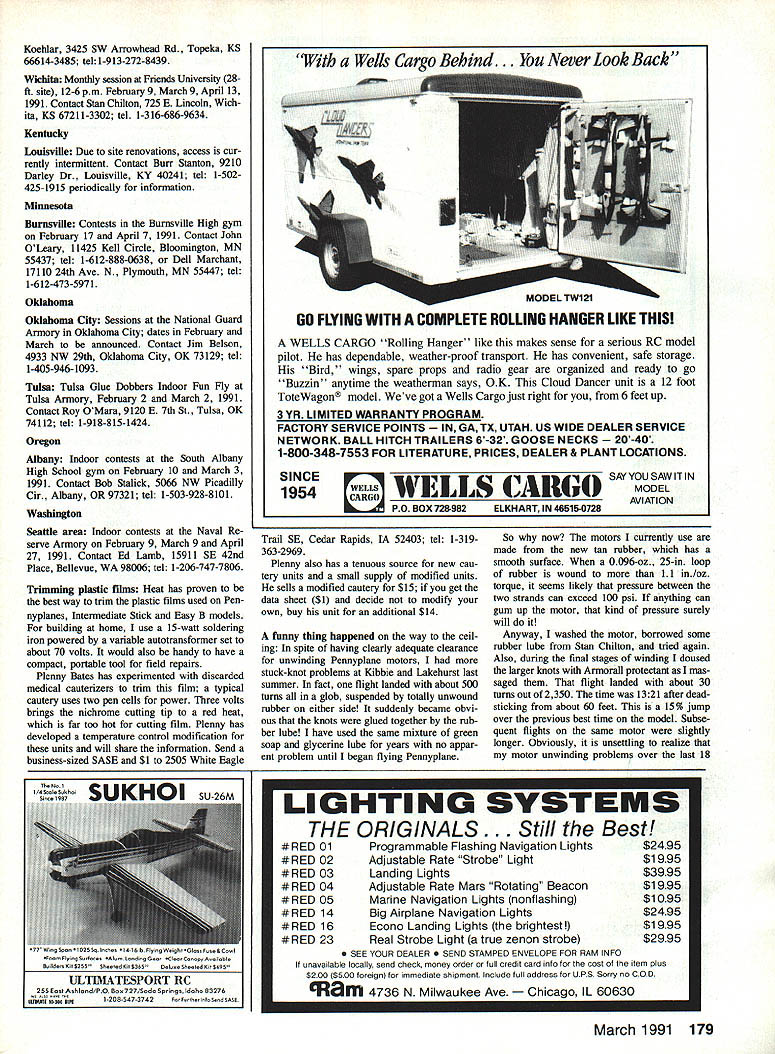
Test mechanics: Tape one end of the tissue strip to Saran Wrap. As soon as the glue is brushed on, lift the free end of the strip off the plastic until the glue is completely dry. Observe curling or twisting.
A test report
Two brands of nitrocellulose (household) cement available locally are DAP and DUCO. DUCO is almost water-clear and DAP has a slightly yellow tint. Test strips of model tissue about 3/8 in. x 1 1/8 in., with the grain running lengthwise, were used. Thinned glue was applied to one side only with a brush and allowed to dry. Both types caused the strips to curl and twist within minutes; DAP was slightly worse.
Preliminary testing showed a few drops of dibutyl phthalate (DBP) lessened the shrinkage. A test formula for DUCO was: 47.5% straight DUCO, 47.5% acetone and 5% amyl acetate. (If this mixture blushes in high humidity, add small amounts of amyl acetate until the blushing stops.) Adding 40 drops of DBP per 20 milliliters of thinned DUCO yielded test strips that didn't curl even after 24 hours. Preliminary tests indicated a similar amount of DAP would require about 45 drops of DBP for similar results.
Transcribed from original scans by AI. Minor OCR errors may remain.

