
Free Flight: Indoor
Bud Tenny Box 545 Richardson, TX 75080
The FAI Easy B event set, a new Indoor class (F1L — Indoor Easy B model), has been announced. This event has provisional status with the FAI, which essentially means that it will not be formally added to the FAI Sporting Code until the next printing (1994). The model specifications for the new event correspond exactly to AMA Easy B except that this class has a minimum 1.2-gram weight limit. Flight rules specify scoring on the best two of six flights.
The Indoor Contest Board has voted to allow both events to be flown at AMA contests beginning January 1, 1992, subject to announcement prior to the contest date. At present, no decision has been made whether or not to add F1L to the list of events that have AMA record status.
Change in contest forms. CDs please note: AMA contest record report forms now being furnished require the signature and AMA numbers of each of two (2) timers as part of the required flight documentation. The requirements are further clarified by a change in wording of item 2, "Acceptance of Records" (page 8, 1990–91 Competition Regulations handbook). The current wording is, "... average of times recorded by two officials other than the Contest Director." The wording for the 1992 rule book is, "... average of times recorded by two timers holding valid AMA licenses. The record applicant and the CD may not serve as timers."
Lakehurst news. Thanks to a lot of hard work by Gary and Kit Underwood, a very aggressive schedule of flight opportunities has been set up for Lakehurst Hangar No. 1 (see the Flying Opportunities section). Note carefully the somewhat more comprehensive rules of conduct for this season. Gary and Kit have always been gracious and caring hosts of these events. Now Kit has also obtained a CD license and is taking an active part in contest administration.
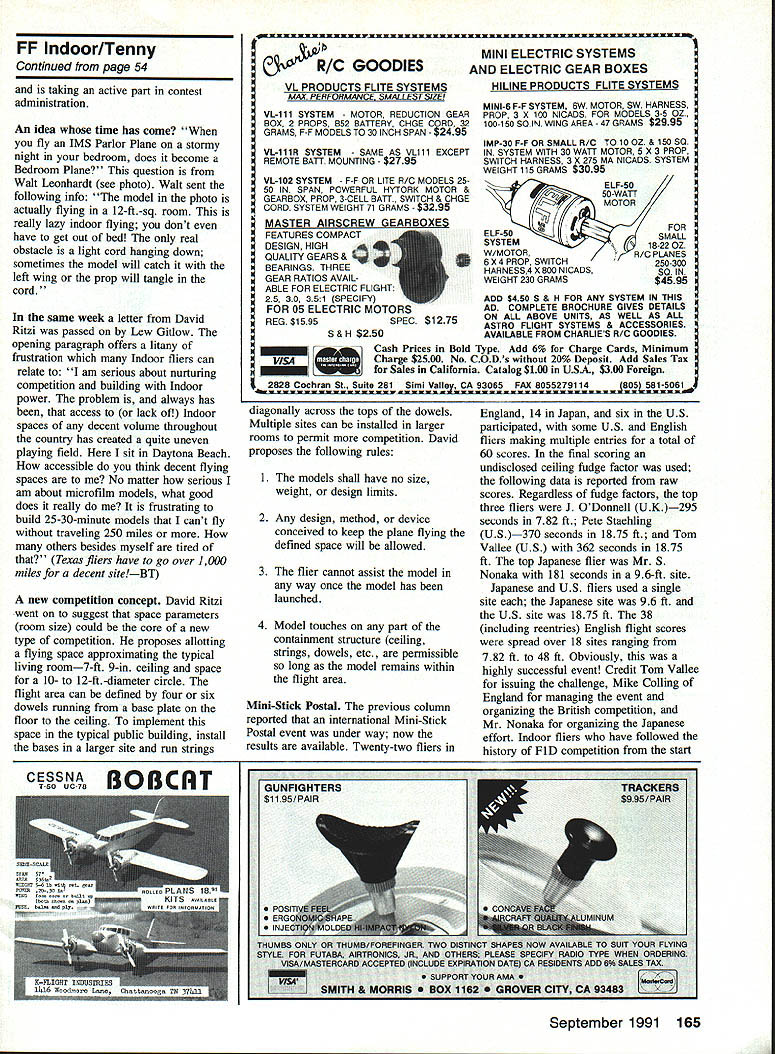
An idea whose time has come? "When you fly an IMS Parlor Plane on a stormy night in your bedroom, does it become a Bedroom Plane?" This question is from Walt Leonhardt (see photo). Walt sent the following info: "The model in the photo is actually flying in a 12-ft.-sq. room. This is really lazy indoor flying, you don't even have to get out of bed! When the only real obstacle is a light cord hanging down, sometimes the model will catch it with the left wing or the prop will tangle in the cord."
In the same week a letter from David Ritzi was passed on by Lew Gitlow. The opening paragraph offers a litany of frustration which many Indoor fliers can relate to: "I am serious about nurturing competition and building with Indoor power. The problem is, and always has been, that access to (or lack of!) Indoor spaces of any decent volume throughout the country has created a quite uneven playing field. Here I sit in Daytona Beach. How accessible do you think decent flying spaces are to me? No matter how serious I am about microfilm models, what good does it really do me? It is frustrating to build 25–30-minute models that I can't fly without traveling 250 miles or more. How many others besides myself are tired of that?" (Texas fliers have to go over 1,000 miles for a decent site. — BT)
A new competition concept. David Ritzi went on to suggest that space parameters (room size) could be the core of a new type of competition. He proposes allotting a flying space approximating the typical living room — 7 ft. 9 in. ceiling and space for a 10- to 12-ft.-diameter circle. The flight area can be defined by four or six dowels running from a base plate on the floor to the ceiling. To implement this space in the typical public building, install the bases in a larger site and run strings diagonally across the tops of the dowels. Multiple sites can be installed in larger areas to permit more competition. David proposes the following rules:
- The models shall have no size, weight, or design limits.
- Any design, method, or device conceived to keep the plane flying the defined space will be allowed.
- The flier cannot assist the model in any way once the model has been launched.
- Model touches on any part of the containment structure (ceiling, strings, dowels, etc.) are permissible so long as the model remains within the flight area.
Mini-Stick Postal. The previous column reported that an international Mini-Stick Postal event was under way; now the results are available. Twenty-two fliers in England, 14 in Japan and six in the U.S. participated, with some U.S. and English fliers making multiple entries for a total of 60 scores. In the final scoring an undisclosed ceiling fudge factor was used; the following data is reported from raw scores. Regardless of fudge factors, the top three fliers were J. O'Donnell (U.K.) — 295 seconds in 7.82 ft.; Pete Staehrling (U.S.) — 370 seconds in 18.75 ft.; and Tom Vallee (U.S.) — 362 seconds in 18.75 ft. The top Japanese flier was Mr. S. Nonaka with 181 seconds in a 9.6-ft. site. Japanese and U.S. fliers used a single site each; the Japanese site was 9.6 ft. and the U.S. site was 18.75 ft. The 38 (including reentries) English flight scores were spread over 18 sites ranging from 7.82 ft. to 48 ft. Obviously, this was a highly successful event! Credit Tom Vallee for issuing the challenge, Mike Colling of England for managing the event and organizing the British competition, and Mr. Nonaka for organizing the Japanese effort. Indoor fliers who have followed the history of F1D competition from the start will remember that Mr. Nonaka initiated Japanese World Championship competition by representing Japan at the 1972 WC at Cardington. In addition, he is credited with having organized Indoor activity in Japan.
Flying opportunities
The listings below are all the new information available. CDs please fill in for dates after July 1991 and later. Be safe: check contest status by phone before leaving home!
- Idaho — Kibbie Dome (Moscow)
Andy Tagliafico has set up a 3-day contest in Kibbie Dome, August 8–11, 1991. Call or write Andy at 650-B Taybin Rd. NW, Salem, Oregon 97304; tel. 503/371-0492 for more details.
- Illinois — Chicago area
Year-round weekly sessions in a 25-ft. gym at the College of DuPage in Glen Ellyn, Illinois. Currently held on Wednesday evenings. Don Lindley, 420 Tupelo, Naperville, Illinois 60540; tel. 708/355-9674.
- Maryland — Goddard NAS
Record trials and flying sessions scheduled in the auditorium of Building 8 at Goddard NAS on Saturdays, 11 a.m. until 10:30 p.m.: Jul. 27, Aug. 10, Aug. 24, Sept. 14, Sept. 28, Oct. 12, Oct. 26, and Nov. 9, 1991. All sessions beginning with Aug. 24 will be sanctioned as AMA and FAI record trials. NASA security requires that attendees be U.S. citizens and AMA members with license available for inspection at the gate AND be on a list compiled by Tom Vallee. You must notify Tom of your intention of attending in advance of each meet. Changes in NASA launch schedule and other possible events can preempt the auditorium without much warning; be sure to verify the dates with Tom before leaving home! Tom Vallee, 444 Henryton So., Laurel, Maryland 20707; tel. 301/498-0790.
- New Jersey — Lakehurst
New dates for Lakehurst No. 1: Jul. 21, Aug. 3–4, Aug. 18, Aug. 31, Sept. 1–2, Sept. 15, Sept. 29, Oct. 6, Oct. 20, 1991. Attendance at these sessions requires strict adherence to these rules:
- You must furnish your name, driver's license number, make and model of vehicle, license plate number and state of registration to Gary Underwood not later than the Wednesday before the meet you plan to attend.
- Obey all military regulations, especially speed limits, no smoking in certain areas, and restricted parking, all of which are clearly posted.
- Certain base personnel give access to lavatories and other facilities. Please follow instructions for assistance through the CD.
- Absolutely you must leave your flying area at least as clean as you find it; check with the CD about where you locate your equipment. No photos allowed except in the hangar.
Note: Out-of-town participants who fly in and then rent a car must make special arrangements regarding auto identification. Contact Gary Underwood, 9 Trelawny Terrace, Mercerville, New Jersey 08619; tel. 609/586-3202 for more information.
More on tan rubber lore
In a recent conversation, Hank Cole noted that some samples of tan rubber require only about two hours to recover to the approximate length obtained after break-in; others required approximately 24 hours to recover. Fortunately, my own records are detailed enough that I could identify this characteristic on certain of my motors.
Further testing and observation have indicated that motors which recover slowly give good results only on the first wind-up in a 24-hour period. That is, for "blast" winding, you can use these motors only once each day. I don't have even a good guess about the relative energy output between the two types of rubber at present.
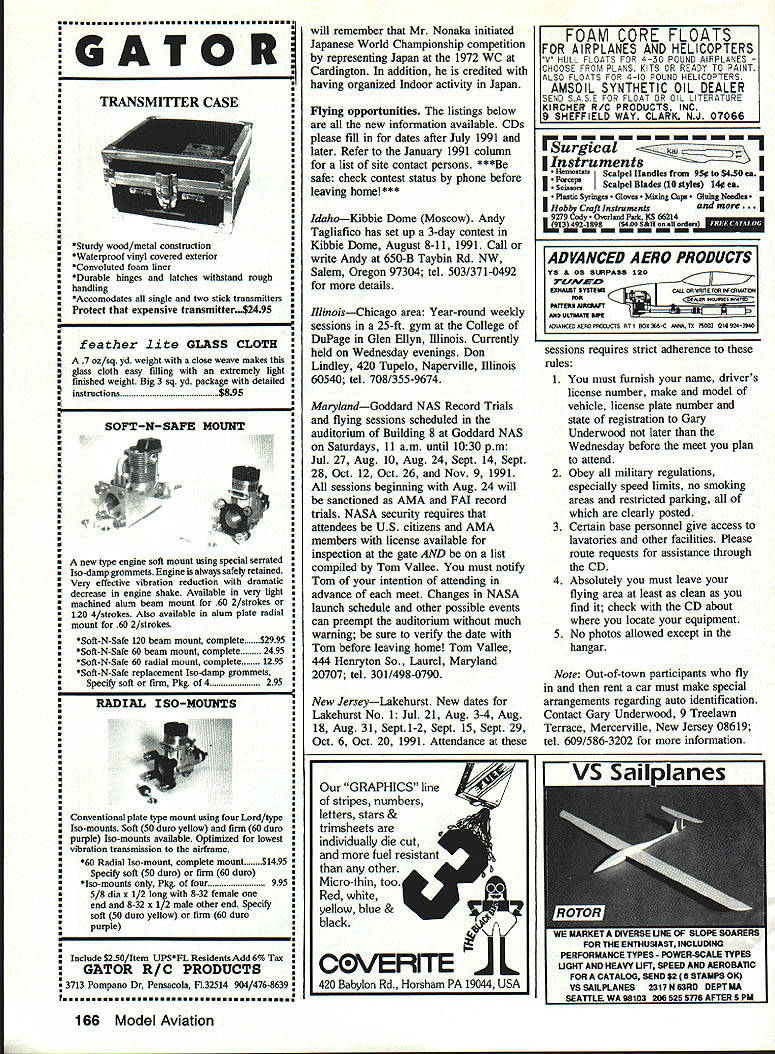
Prop loading? A previous column mentioned that trimming a model so that it flies with the nose high during the cruise helps load the prop; the column implied that this is beneficial. Figure 1 shows how this happens. If the thrust is represented by vector AA, this single vector can be resolved into vectors AT and AL. Even though vector AL is relatively small, it represents lift generated by the prop. How much lift? Assume the amount of nose-up attitude is five degrees. The amount of lift generated is 5/90, or about 5.5% of the total thrust. (If vector AA were vertical, all the thrust would be lift.) Of course the amount of nose-high trim must also be carefully considered. Too much, and the critical torque (torque required to keep the prop pulling) goes high enough that the model lands with more turns left in the motor than it would have with better trim.
Handy contest toolbox
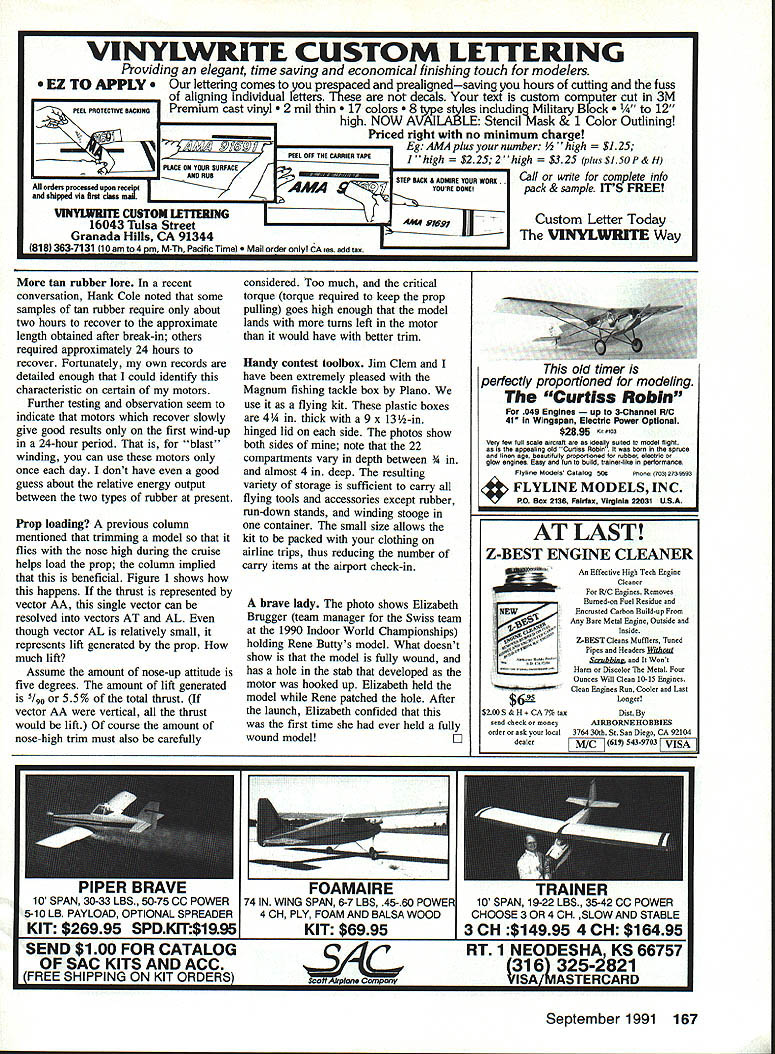
Jim Clem and I have been extremely pleased with the Magnum fishing tackle box by Plano. We use it as a flying kit. These plastic boxes are 4 1/4 in. thick with a 9 x 13-1/2-in. hinged lid on each side. The photos show both sides of mine; note that the 22 compartments vary in depth between 1/8 in. and almost 4 in. deep. The resulting variety of storage is sufficient to carry all flying tools and accessories except rubber, run-down stands, and winding storage in one container. The small size allows the kit to be packed with your clothing on airline trips, thus reducing the number of carry items at the airport check-in.
A brave lady
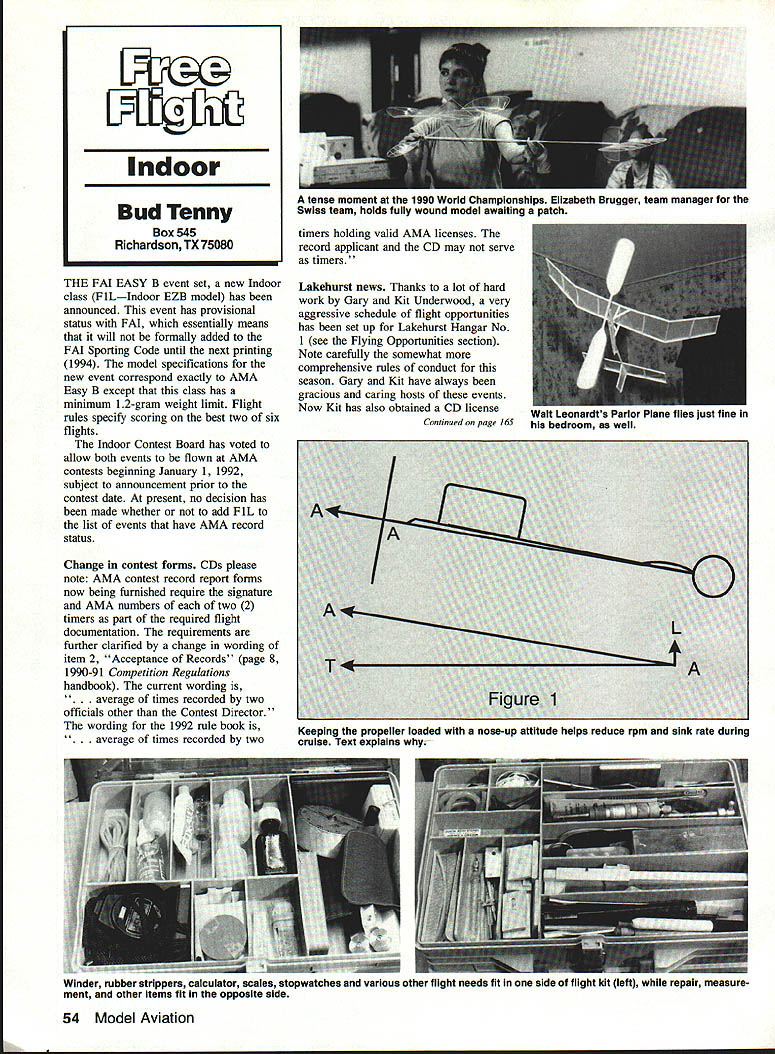
The photo shows Elizabeth Brugger (team manager for the Swiss team at the 1990 Indoor World Championships) holding Rene Butty's model. What doesn't show is that the model is fully wound, and has a hole in the stab that developed as the motor was hooked up. Elizabeth held the model while Rene patched the hole. After the launch, Elizabeth confided that this was the first time she had ever held a fully wound model!
Transcribed from original scans by AI. Minor OCR errors may remain.

