
Free Flight: Indoor
Bud Tenny Box 545 Richardson, TX 75080
Mini-Stick Lives and Breeds!
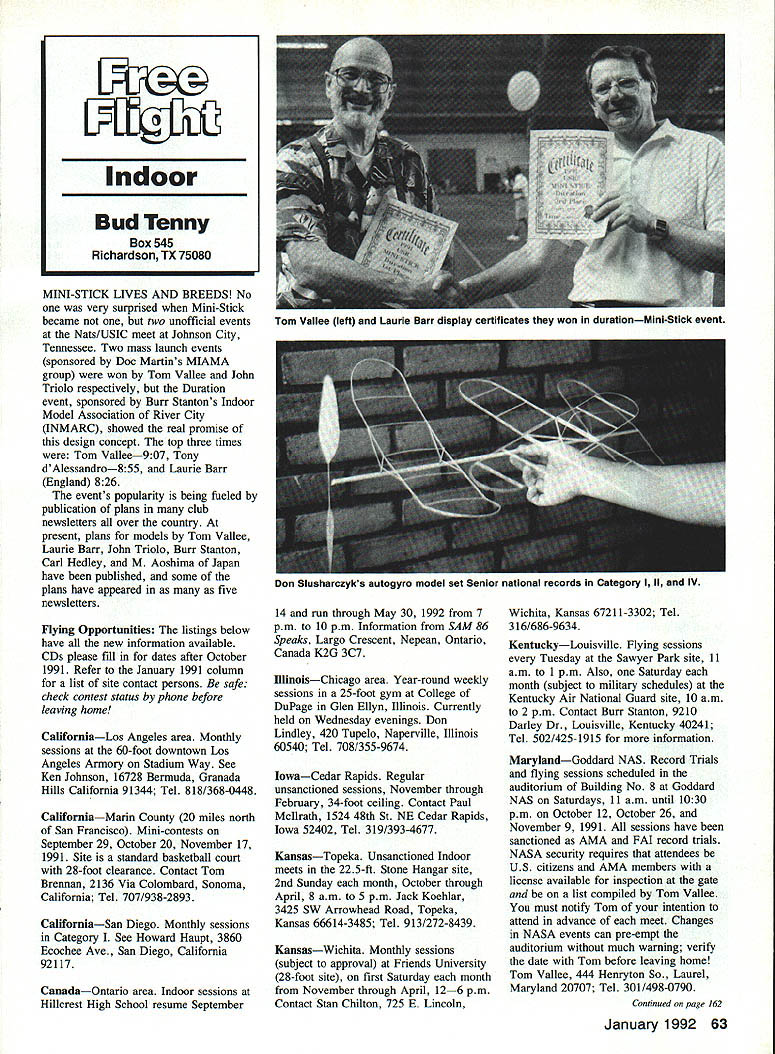
No one was very surprised when Mini-Stick became not one, but two unofficial events at the Nats/USIC meet at Johnson City, Tennessee. Two mass launch events (sponsored by Doc Martin's MIAMA group) were won by Tom Vallee and John Triolo respectively, but the Duration event, sponsored by Burr Stanton's Indoor Model Association of River City (INMARC), showed the real promise of this design concept. The top three times were: Tom Vallee — 9:07; Tony d'Alessandro — 8:55; and Laurie Barr (England) — 8:26.
The event's popularity is being fueled by publication of plans in many club newsletters all over the country. At present, plans for models by Tom Vallee, Laurie Barr, John Triolo, Burr Stanton, Carl Hedley, and M. Aoshima of Japan have been published, and some of the plans have appeared in as many as five newsletters.
Flying Opportunities
The listings below have all the new information available. Clubs please fill in dates after October 1991. Refer to the January 1991 column for a list of site contacts. Be safe: check contest status by phone before leaving home!
- California — Los Angeles area. Monthly sessions at the 60-foot downtown Los Angeles Armory on Stadium Way.
Contact: Ken Johnson, 16728 Bermuda, Granada Hills, California 91344; Tel. 818/368-0448.
- California — Marin County (20 miles north of San Francisco). Mini-contests on September 29, October 20, November 17, 1991. Site is a standard basketball court with 28-foot clearance.
Contact: Tom Brennan, 2136 Via Colombard, Sonoma, California; Tel. 707/938-2893.
- California — San Diego. Monthly sessions in Category I.
Contact: Howard Haupt, 3860 Ecochee Ave., San Diego, California 92117.
- Canada — Ontario area. Indoor sessions at Hillcrest High School resume September 14 and run through May 30, 1992 from 7 p.m. to 10 p.m.
Information from SAM 86 Speaks, Largo Crescent, Nepean, Ontario, Canada K2G 3C7.
- Illinois — Chicago area. Year-round weekly sessions in a 25-foot gym at College of DuPage in Glen Ellyn, Illinois. Currently held on Wednesday evenings.
Contact: Don Lindley, 420 Tupelo, Naperville, Illinois 60540; Tel. 708/355-9674.
- Iowa — Cedar Rapids. Regular unsanctioned sessions, November through February, 34-foot ceiling.
Contact: Paul McIlrath, 1524 48th St. NE, Cedar Rapids, Iowa 52402; Tel. 319/393-4677.
- Kansas — Topeka. Unsanctioned indoor meets in the 225-ft Stone Hangar site, 2nd Sunday each month, October through April, 8 a.m. to 5 p.m.
Contact: Jack Koehler, 3425 SW Arrowhead Road, Topeka, Kansas 66614-3485; Tel. 913/272-8439.
- Kansas — Wichita. Monthly sessions (subject to approval) at Friends University (28-foot site); first Saturday each month November through April, 12–6 p.m.
Contact: Stan Chilton, 725 E. Lincoln, Wichita, Kansas 67211-3302; Tel. 316/686-9634.
- Kentucky — Louisville. Flying sessions every Tuesday at the Sawyer Park site, 11 a.m. to 1 p.m. Also, on Saturday each month (subject to military schedules) at the Kentucky Air National Guard site, 10 a.m. to 2 p.m.
Contact: Burr Stanton, 9210 Darley Dr., Louisville, Kentucky 40241; Tel. 502/425-1915.
- Maryland — Goddard NAS. Record Trials and flying sessions scheduled in the auditorium of Building No. 8 at Goddard NAS on Saturdays, 11 a.m. until 10:30 p.m., on October 12, October 26, and November 9, 1991. All sessions have been sanctioned as AMA and FAI record trials. NASA security requires that attendees be U.S. citizens and AMA members with a license available for inspection at the gate, and be on a list compiled by Tom Vallee. You must notify Tom of your intention to attend in advance of each meet. Changes in NAS events can pre-empt the auditorium with much warning; verify date with Tom before leaving home.
Contact: Tom Vallee, 444 Henryton So., Laurel, Maryland 20707; Tel. 301/498-0790.
- New Jersey — Lakehurst. New dates for Lakehurst No. 1: September 29, October 6, October 20, 1991. Attendance at these sessions requires strict adherence to rules:
- You must furnish your name, driver's license number, make and model of vehicle, license plate number, and state of registration to Gary Underwood not later than the Wednesday before the meet you plan to attend.
- Obey all military regulations, especially speed limits, no smoking areas, and restricted parking; all are clearly posted.
- Certain base personnel give access to lavatories and other facilities. Please route requests for assistance through the CD.
- Absolutely you must leave your flying area at least as clean as you find it; check with the CD about where you locate your equipment.
- No photos allowed except in the hangar.
Note: Out-of-town participants who fly in and rent a car must make special arrangements regarding auto identification. Contact: Gary Underwood, 9 Treelawn Terrace, Mercerville, New Jersey 08619; Tel. 609/586-3022.
- New York — Columbia University. Sessions on September 22, October 27, and December 15, 1991. Due to continuing concern about campus security, it has become necessary to charge $10 per entrant to pay a security officer. In addition, you must furnish your social security number and AMA number to Gary Underwood at least two weeks in advance of any scheduled event. Absolutely no one will be admitted unless they are on the approved list.
Contact: Dan Marek, 210 West 101st St., No. 10F, New York, New York 10025; Tel. 212/222-1546. Gary Underwood contact: 9 Treelawn Terrace, Mercerville, New Jersey 08619; Tel. 609/586-4441.
- Oklahoma — Tulsa. Tulsa Glue Dobbers indoor contests at Tulsa National Guard Armory, November 16 and December 21, 1991.
Contact: Roy O'Mara, 9120 E. 7th St., Tulsa, Oklahoma 74112; Tel. 918/815-1424.
- Texas — Ft. Worth–Dallas area. Sessions expected to start in November.
Contact: Jesse Shepherd, 2713 Summit View, Bedford, Texas 76021; Tel. 817/282-3770.
- Washington State — Seattle area. Category II indoor meet at Naval Reserve Armory, October 26 and November 26, 1991; 9 a.m. to 4 p.m.
Contact: Ed Lamb, 15911 SE 42nd Pl., Bellevue, Washington 98006; Tel. 206/747-7806.
FF Indoor/Tenny (Continued)
A new covering adhesive
Del Ogren, the Chicago area whiz kid, suggests that StudioTac by Letraset is excellent for attaching plastic films. This material should be available from any professional art supplies vendor; it is a very thin film of reusable adhesive covered on both sides by paper. In normal use, one side of the paper is stripped off so the film can be burnished onto a piece of artwork. Then the second piece of backing is removed, and the artwork is burnished in place on a paste-up. It can be removed and shifted if necessary and is more convenient than the hot wax that used to be used.
For covering a model, cut the StudioTac into very narrow strips, and gently burnish them onto the wing or tail outlines. Remove the second piece of backing, and place the plastic on the surface. After you lay the plastic covering in place it can be shifted as necessary to minimize wrinkles. Note: one side of the adhesive has heavier paper; this is the first side to remove. I expect to try this material soon and will make weight-gain checks against the spray adhesives. Certainly, this material is much safer to use than spray adhesives!
Electronic Counters
In the past few years model builders have been using electronic counters to display the number of turns put into their motors. Stan Chilton was one of the first fliers to use a counter. His unit has evolved quite a bit over the years. Recently the advent of very long Federation ROGs has encouraged the use of counters to record the sometimes 7000-plus turns used.
Other Counters Some winders come with built-in counters. Bob Wilder sells an indoor winder that has a built-in counter that displays 500 turns. This reduces the job of counting to remembering how many revolutions the counter indicator has made, multiplying by 500, and adding the counts displayed in the last revolution. That usually is not too much of a chore—until you get distracted while putting in 6000-plus turns! Also, if you keep careful records it is very helpful to have an electronic counter that remembers the turns count until you find time to record it.
Counter Types Some enterprising fliers have purchased calculators and added switching to convert them into counters. Chilton's unit is built from discrete integrated circuits, but suitable dedicated counter modules have become available. The discrete approach is the most expensive and requires considerable expertise to design and build. As I have time, I am testing a counter module and will report results in a future column.
What's Required? The minimum requirement is to count turns and "remember" the number until you can record it. A more complete solution is to detect the winder shaft reversal as you unwind and subtract turns backed off. Finally, if you keep detailed records it is desirable for the counter to subtract the turns left as you unwind after a flight. The final number displayed is the turns used during the flight.
Chilton's counter is more complicated because he wants the count displayed next to his torque meter. Originally, his counter had the sensor on the winder and a cable that reached to his table. The latest unit uses an infrared beam to transmit the counts to the display unit. Don Slusarczyk has a counter and an electronic torque meter! So, you get what you can pay for.
Calculator Choice The choice of calculator for this task must be made carefully; fortunately, low-cost units often are the best choice. The first requirement is that the response time of the keyboard is fast enough. It must have a totaling function, and the physical size must be within a reasonable range. That is, the circuit board must be large enough to work on, but the unit must not be so large that it is unwieldy when mounted on the winder.
I have a calculator sold as a key-chain ornament; its small size would be ideal for mounting on a winder. However, it would require a tiny soldering iron and considerable skill to make the required connections.
Test Before Buying! You probably won't know if the calculator is fast enough to count the output shaft until you modify it and try it out. Test for totaling by entering a number and pressing the plus key. Now, repeatedly press the equals key. On the third key press, the display should begin to count up by the number increment entered.
What about backing off turns? The only option I've discovered is to store the finished count in memory, clear the display, enter the count increment, and repeatedly press the memory (M+) key. You will then be able to read the turns used during the flight. More on the count protocol in a later column.
The Connections If the counter will respond fast enough, you can count output shaft turns; otherwise you need to count handle revolutions (winder turns). You need to sense the shaft rotation; this is done with some kind of switch. The switching element can be a cam-driven microswitch, a magnetic reed relay (such as a window or door sensor sold for alarm systems) with the magnet turned by the counter shaft, or LED interrupter sensors. The magnetic and LED sensors do not affect the feel of the winder.
Whichever switch element you use, it must connect across the contacts of the calculator equals key. If you decide to use down-counting too, the simplest way may be to use a separate switch to put the sensor across the M- key contacts. I expect to have more explicit details next time.
Keep your rubber clean!
Jim Clem and I have both had problems with getting dirt on (in particular) tan rubber. His solution is to have two small bottles, one filled with water and some detergent, the second with clear water. Any motor suspected of being dirty is shaken thoroughly in the first, then rinsed in the second bottle; then fresh lube is applied. This is much quicker and more thorough than any other method of cleaning motors I've seen.
Indoor Prop Solutions
Lester Garber has produced a very comprehensive booklet on designing and building indoor props, and manufactured a matching kit for building a prop pitch gauge. If you want smooth-running props or want to understand more about indoor props, the gauge kit is $12.95 + $2 postage and the booklet is $3.95 + $1 postage. Order either from G & L Aero, 2324 East 5th St., Duluth, MN 55812; Tel. 218/728-6841.
Autogyro Record
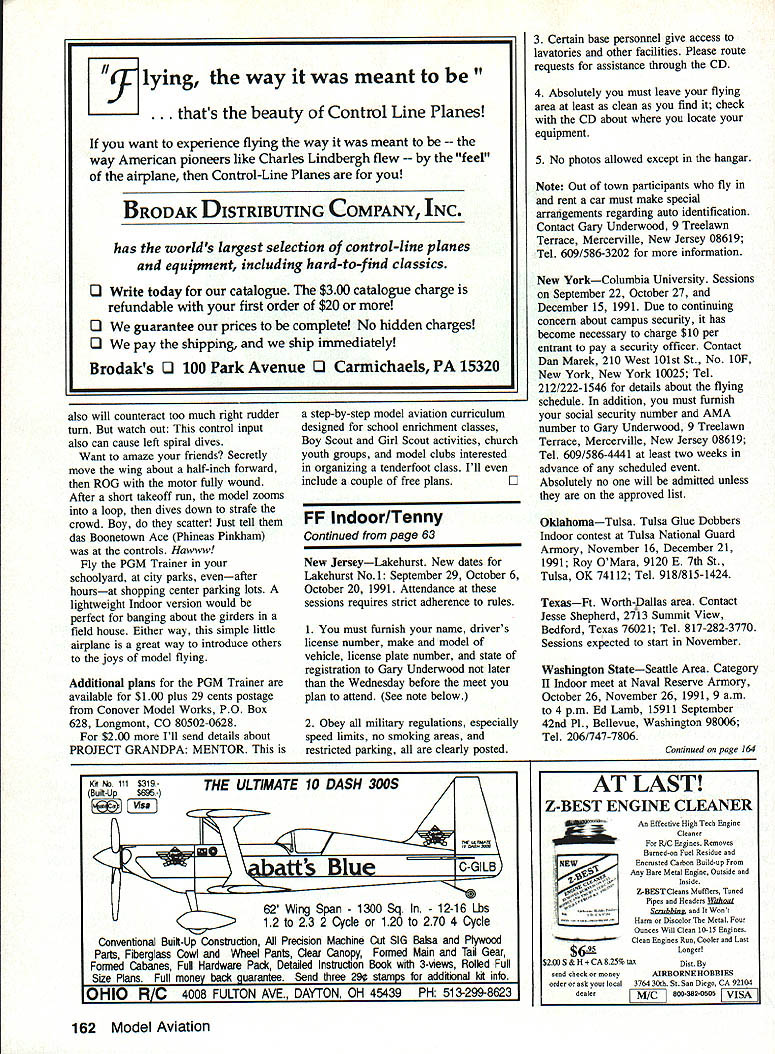
Don Slusarczyk built the autogyro shown in the photo, then set a new Senior Category IV record with a 12:11 flight at the Akron airdock on the 1990 Labor Day weekend. He also has set Senior Category I and II records with the same model.
Transcribed from original scans by AI. Minor OCR errors may remain.

