
Free Flight: Indoor
Bud Tenny
Now Is The Time:
Get out all your indoor models and check them over for warps and needed repairs! The indoor season is in full swing, with a number of clubs having regular practice sessions and contests set up. After your models are ready, make up new motors, and test fly your models if you have access to a site. Set up some sessions of your own — get into the swing of the season!
Visitors Welcome: For the various cities listed below, there is a list of indoor session/contest dates and a contact for more information:
- Connecticut — Glastonbury: Jan. 6, Jan. 16, Feb. 9, Feb. 13, Mar. 13, Apr. 12, Apr. 17, May 1, 1977. Contact George Armstead, 89 Harvest Lane, Glastonbury CT 06033.
- Florida — Miami: Jan. 2, Feb. 6, Mar. 6, Apr. 3, May 8, 1977. Contact Dr. John Martin, 3227 Darwin St., Miami FL 33133.
- Illinois — Chicago: monthly sessions in Chicago area; contact Otto Curth, 2107 Center, Northbrook IL 60062.
- New York — New York City: Record trial sessions (no gliders) held at Columbia University; contact Ron Williams, 1364 Lexington Ave., New York NY 10028.
- Oklahoma — Midwest City: Jan. 16, Feb. 20, Mar. 20, 1977. Contact Matt Gewain, 2215 Air Depot Blvd., Midwest City OK 73110.
Torque Makes The World Go 'Round:
And props too! More and more, indoor fliers are using torque meters for rubber testing and while winding motors for flight. The "why" of this is simple — the energy output of an indoor model's rubber motor is translated directly into torque, or twisting force, to drive the propeller. A good understanding of the torque output of a rubber motor can be very helpful in understanding why indoor models fly better with precisely the right motor for the model, ceiling height and conditions.
The Torque Curve:
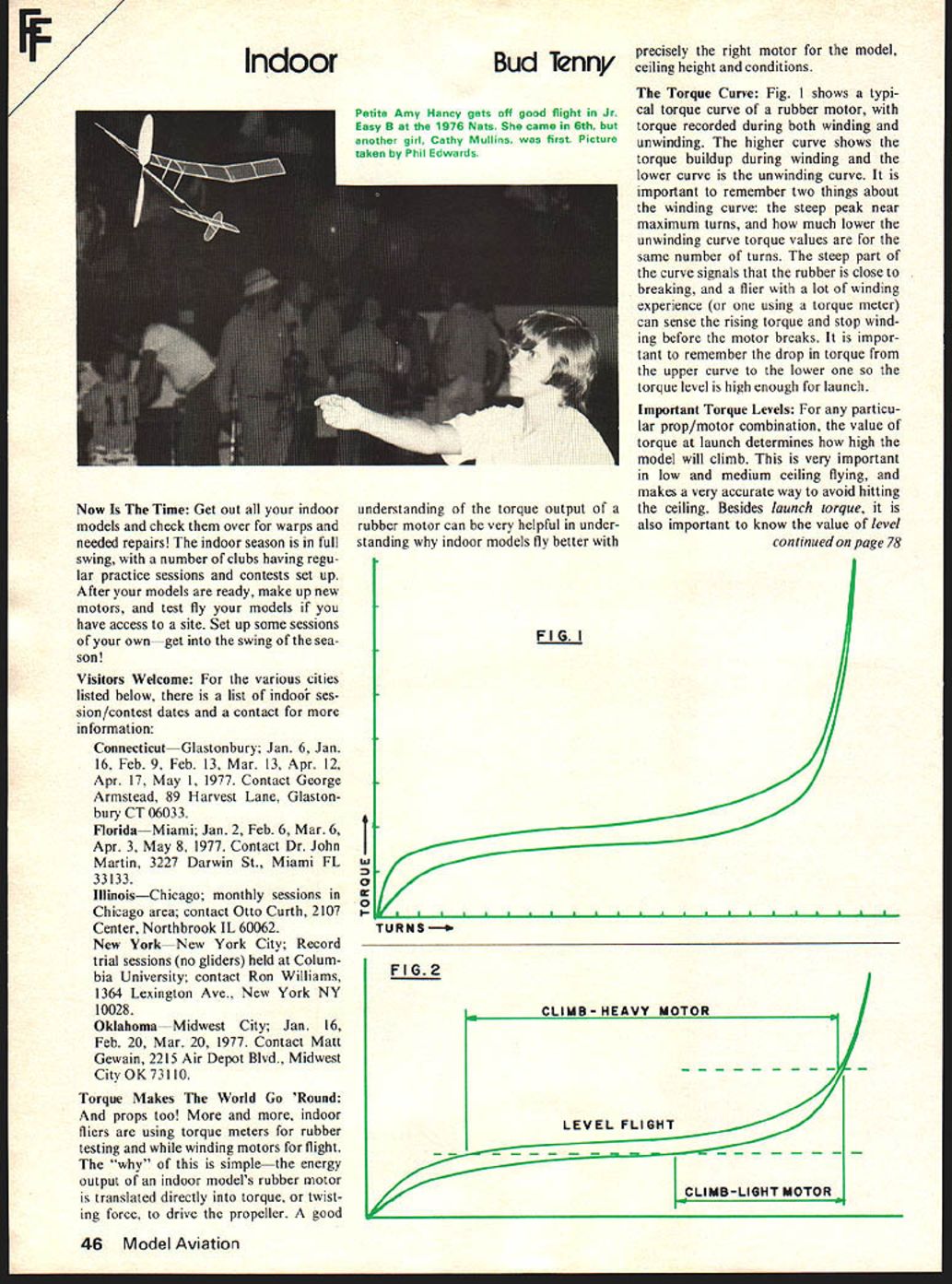
Fig. 1 shows a typical torque curve of a rubber motor, with torque recorded during both winding and unwinding. The higher curve shows the torque buildup during winding and the lower curve is the unwinding curve. It is important to remember two things about the winding curve: the steep peak near maximum turns, and how much lower the unwinding curve torque values are for the same number of turns. The steep part of the curve signals that the rubber is close to breaking, and a flier with a lot of winding experience (or one using a torque meter) can sense the rising torque and stop winding before the motor breaks. It is important to remember the drop in torque from the upper curve to the lower one so the torque level is high enough for launch.
Important Torque Levels:
For any particular prop/motor combination, the value of torque at launch determines how high the model will climb. This is very important in low and medium ceiling flying, and makes a very accurate way to avoid hitting the ceiling. Besides launch torque, it is also important to know the value of level flight torque.
Free Flight: Indoor
Level-flight torque is the torque required to fly the model level, while changeover torque is the minimum torque which will make the propeller continue to pull the model. If the model is still airborne when the motor unwinds to changeover torque, the model immediately starts to come down faster. What happens is that the prop continues to turn, but the model is now pushing the prop instead of being pulled by the prop.
What Does All That Mean? Fig. 2 shows the unwinding curves for a thick, heavy motor (upper curve) and for a thinner motor. Launch torque and level-flight torque are marked with two horizontal lines, to show the effect of two very different motors on the flight of the model. For two flights on the same model, each motor will be released with the same launch torque, and the level flight torque is assumed to be the same for both flights. With the heavy motor, note how much longer it takes (turns or flight time) for the motor to unwind to level-flight torque. This means that the model will climb that much longer with the thicker motor, but look what happens from then on! The total unwinding time of the heavy motor is over half gone, so that the model will probably run out of turns before touchdown.
On the other curve, the climb time is shorter than the time left to unwinding, and level-flight torque occurs at the start of the linear part of the curve. This choice of motor will result in a longer flight, since the model will come down slowly all during the time between level-flight torque and changeover torque.
Winding Technique Is Important:
The unwinding curves shown in Fig. 1 and Fig. 2 are typical of what happens on the flying field, but the winding curve in Fig. 1 is more idealized in shape than how it happens in real life. Actually, the Fig. 1 winding curve is traced from a machine-wound test, unstretched and wound nearly to the break point. An experienced flier winds with some variations on this scheme; the motor is stretched out to between four and six times its normal length, and turns are added fairly slowly. The torque meter reading is watched carefully—not for absolute values but for trend. When the torque begins to rise rapidly with addition of only a few turns, the amount of stretch is reduced. The reduced tension allows some motor knots to double up, and the indicated torque drops some.
At this point, many fliers allow the motor to rest a little, while they massage the knots and work out local "lumps" in the wound motor. Winding then continues, followed by further reduction in the stretch and more massage. When the motor is fully wound, torque level should be high and steady.
Launch Torque:
Now that the motor is fully wound, the torque is probably higher than the desired launch torque. Since it is usually necessary to let out a few turns to allow the motor to slip off the winder, hook the motor to the prop and re-check the torque. If the torque meter has an unwinding feature, it is easy to let off enough more turns to reach the desired launch torque. Otherwise, it is necessary to hook the motor on the model and let the prop run until the torque "feels" right.
Wind It Less?
If there is such a problem in getting from fully wound to the desired launch torque, why not wind the motor only enough to get the right torque? I'm glad you asked! Winding the motor "all the way" has certain benefits. First, with the winding technique mentioned above, the motor is consistently wound each time, so it is more likely to react as in previous flights. Second, by winding all the way and then unwinding to the desired torque, the motor will have up to 15% more turns than if it was simply wound to launch torque and then launched. Many fliers have problems making consistent flights, and proper winding technique can overcome many of these problems. And, since the torque rather than the number of turns (in any given motor) determines how high the model climbs, it is safer to use torque instead of turns.
Bud Tenny, Box 545, Richardson TX 75080.
Transcribed from original scans by AI. Minor OCR errors may remain.

