

Free Flight: Indoor
Bud Tenny Box 545 Richardson, TX 75080
Three Big Contests!
Last year we indoor fliers had only one major contest—the USIC combined with the National Championships at Johnson City. This year there will be three:
- U.S. Indoor Championships, June 4–7, 1992, at the Mini‑Dome of East Tennessee State University in Johnson City, Tennessee. Send a SASE to Chuck Slusarczyk, 4200 Royalton Rd., Brecksville, OH 44141; Tel.: 216/526-8613, and he will send housing and event information. He still needs volunteers to help run the meet, so tell him how you can help!
- National Aeromodeling Championships (Indoor), June 21–23, 1992. The indoor site is the base hangar at Westover AFB, Chicopee, Massachusetts—the same site as in 1983 and 1985. Request entry forms from AMA HQ.
- 1992 Kibbie Dome Annual, July 23–26, 1992. See the section on flying opportunities for more information.
Is your club lucky? If you have a newsletter, you are ahead of clubs that don't! This is a tribute to the editors of all the club newsletters I get—they work long hours and don't get nearly enough article contributions to make their jobs easier. They also don't get many models built! I salute all those club newsletter editors, no matter how small or large an issue they put out. When the next issue of your newsletter arrives, think about how you can help the editor with future issues.
Consistent performances
For three years I have been tracking the Catapult Glider event results from USIC. My contention is that we old-timers with years of HLG experience should be able to use a rubber band to replace the arm, and log a highly consistent series of times. My approach has been to drop each contestant's two shortest flight times and average the rest. I then express the consistency as (average time / best time) × 100%.
In previous years, only Chuck Markos had good consistency; this year, seven of the top 10 scores in Catapult Glider showed 94% or better consistency. Don DeLoach was the highest scoring Senior (the event combined all ages) with a two-flight total only 20 seconds less than Markos's 1,584 seconds and an amazing 98% consistency.
What good is consistency—especially since Markos was off his pace a bit this year and won with only 95%? Well, Wayne Triven, with 86% consistency, placed second—only four seconds behind Chuck. Here's the difference: Chuck's second-best time was only 1.2 seconds less than his top time. With a 3% time margin over Wayne and much higher consistency, Chuck knows he has the best model and is getting essentially the best possible time from it. Wayne's top time was only 1.2 seconds less than Chuck's best time; his model may well be as good as Chuck's, but Wayne didn't demonstrate that; he doesn't know how good his model is. Even so, he came very close to winning!
How about HLG? For those who still have an arm, it is interesting to note the consistency of the Open HLG fliers. Bernie Boehm is a machine—his consistency was 98%, and his two best times were identical. Also of interest is that three of the top five Open HLG fliers had 95% or better consistency.
Flying opportunities
The listings below contain all available new information. CDs please fill in dates after May 1992. Send a SASE to P.O. Box 830545, Richardson, TX 75083 for a list of site contact persons. Be safe: check contest status by phone before leaving home.
- California — Los Angeles area: Possible sessions at the 60‑ft downtown L.A. Armory on Stadium Way. Contact Otto Kuhn; Tel.: 213/872-0882.
- California — Marin County (20 miles north of San Francisco): Year‑round minicontests, 8 a.m.–2 p.m., fourth Sunday each month. The site is a standard basketball court with 28‑ft clear. Contact Tom Brennan, 21326 Via Colombard, Sonoma, CA 95476; Tel.: 707/938-2893.
- California — San Diego: Fun Fly and Scale sessions second Friday each month; monthly sessions on fourth Friday, all in Colima Del Sol Community Center (Cat. I), 5316 Orange Ave., San Diego. Howard Haupt, 3860 Echecoe Ave., San Diego, CA 92117; Tel.: 619/272-5656.
- Canada — Ontario area: Indoor sessions at Hillcrest High School run through May 30, 1992, 7 p.m.–10 p.m. Dates, 1992: Apr. 4, 11, 25; May 2, 9, 16, 23, 30. (Info from SAM 86 Speaks, a newsletter published by Dan O'Grady, 50 Largo Crescent, Nepean, Ontario, Canada K2G 3C7.)
- Connecticut — Glastonbury: Flying session at Glastonbury High School Gym, 8 a.m. to 12:30 p.m., Apr. 5, 1992 (contest). George Armstead, 89 Harvest Lane, Glastonbury.
- Connecticut — Norwich: Contest at Teachers Memorial Junior High, 9 a.m. to 1 p.m., Apr. 11, Apr. 27, 1992. Jerry Boccius, 48 Division St., Norwich, CT 06360; Tel.: 203/442-8003.
- Florida — Miami: Proxy Pistachio Internats, Apr. 12, 1992. Miami Dade South College; Meet #6 on May 9–10, 1992, at MacDill AFB. Contact Dr. John Martin; Tel.: 305/858-6363.
- Idaho — Kibbie Dome: Andy Tagliafico has arranged for the 1992 Kibbie Dome Annual to be held on July 23–26, 1992. It will have the same free-form format as previous sessions. All AMA events plus F1D local and regional trials. Lots of prizes and fun! Andy Tagliafico, 650‑B Taybin Road NW, Salem, OR 97304; Tel.: 503/371-0492.
- Illinois — Chicago area: Year‑round weekly sessions in a 25‑ft gym at College of DuPage in Glen Ellyn, Illinois. Currently held on Wednesday evenings. Don Lindley, 420 Tupelo, Naperville, IL 60540; Tel.: 708/355-9574.
- Kansas — Topeka: Fourth Annual TOPMAC-KISMAC meet, April 18, 1992. Jack Koehler, 3425 SW Arrowhead Rd., Topeka, KS 66614‑3485; Tel.: 913/272-8439.
- Kansas — Wichita: Session at Friends University (28‑ft site), 12 p.m.–6 p.m., Apr. 4, 1992. 12 p.m.–6 p.m., lightweight events; 2 p.m.–6 p.m., HLG, Scale, etc. Contact Stan Chilton, 725 E. Lincoln, Wichita, KS 67211‑3302; Tel.: 316/686-9634.
- Kentucky — Louisville: Flying sessions every Tuesday at the Sawyer Park site, 11 a.m.–1 p.m., and one Saturday each month (subject to military schedules) at the Kentucky Air National Guard site, 10 a.m.–2 p.m. Contact Bur Stanton, 9210 Darley Dr., Louisville, KY 40241; Tel.: 502/425-1915.
- Maryland — Goddard NAS: Record trials and flying sessions are expected to begin again in April 1992. Contact Tom Vallee, 444 Herntyson St., Laurel, MD 20707; Tel.: 301/498-0790 early in 1992 for that information.
- Massachusetts — M.I.T.: Contact Ray Harlan, 15 Happy Hollow Rd., Wayland, MA 01778; Tel.: 508/358-4013 for info about sessions at M.I.T.
- Minnesota — Burnsville: Contest in the Burnsville High Gym, 600 East Highway 13, Burnsville, on April 5, 1992. Contact John O'Leary, 11425 Kell Circle, Bloomington, MN 55437; Tel.: 612/888-0638 or Dell Marchant, 17110 74th Ave. N., Plymouth, MN 55447; Tel.: 612/473-5971.
- New Jersey — Lakehurst: Contact Gary Underwood, 9 Treelawn Terrace, Mercerville, NJ 08619; Tel.: 609/586-3202 later in 1992 for information on the 1992 season.
- New York — Brooklyn: Indoor contest at the "Blue Nose" Hangar at Floyd Bennett Field, Brooklyn. Site has 150 × 450‑foot floor and 45 feet to rafters (field truss beam, easy retrieval). The date isn't final; planned for April, 1992. Contact Don Ross, 38 Churchill Rd., Cresskill, NJ 07626; Tel.: 201/568-5272.
- New York — Westchester: Flying at Chappaqua. Art Maiden; Tel.: 914/769-2284 or 914/769-2644.
- New York — Columbia University: Contests in the Rotunda on May 24, 1992. Contact Dan Marek, 210 West 101st St., #10F, New York, NY 10025; Tel.: 212/222-1546 for details about the flying schedule. Due to site security problems, a $10 fee is charged each entrant. Also, you must furnish your social security number and AMA number to Gary Underwood, 9 Treelawn Terrace, Mercerville, NJ 08619; Tel.: 609/586-4441 at least two weeks in advance of any scheduled event, unless you know you are on the list. Absolutely no one who is not on the approved list will be allowed in.
- Pennsylvania — Philadelphia: Flying at Bryn Athyn and Fairmont Park; Joe Krush, 409 Warner Rd., Wayne, PA 19087; Tel.: 215/688-3027.
Mini‑Stick Tips
Tom Vallee is probably the top Mini‑Stick flier right now; but then, he ought to be. He has been flying Mini‑Sticks longer than anyone else, but others are catching up. I asked Tom for some information on his USIC winner, so he sent the data shown below. A typical finished weight is 0.015 oz., with the individual parts weighing as follows:
- Wing, stab & rudder: 0.0075 oz.
- Prop: 0.003 oz.
- Motor stick: 0.003 oz.
- Tail boom: 0.0015 oz.
Total: 0.015 oz.
Tom's props range from six to seven inches in diameter with almost constant-chord blades about 9/16 in. wide. His motor weight varies with ceiling height; on the USIC-winning flight the motor weighed the same as the model. Now that you have all his secrets, it's time to build one! Everyone who has built one claims that Mini‑Sticks are a lot of fun.
Prop pitch measurement
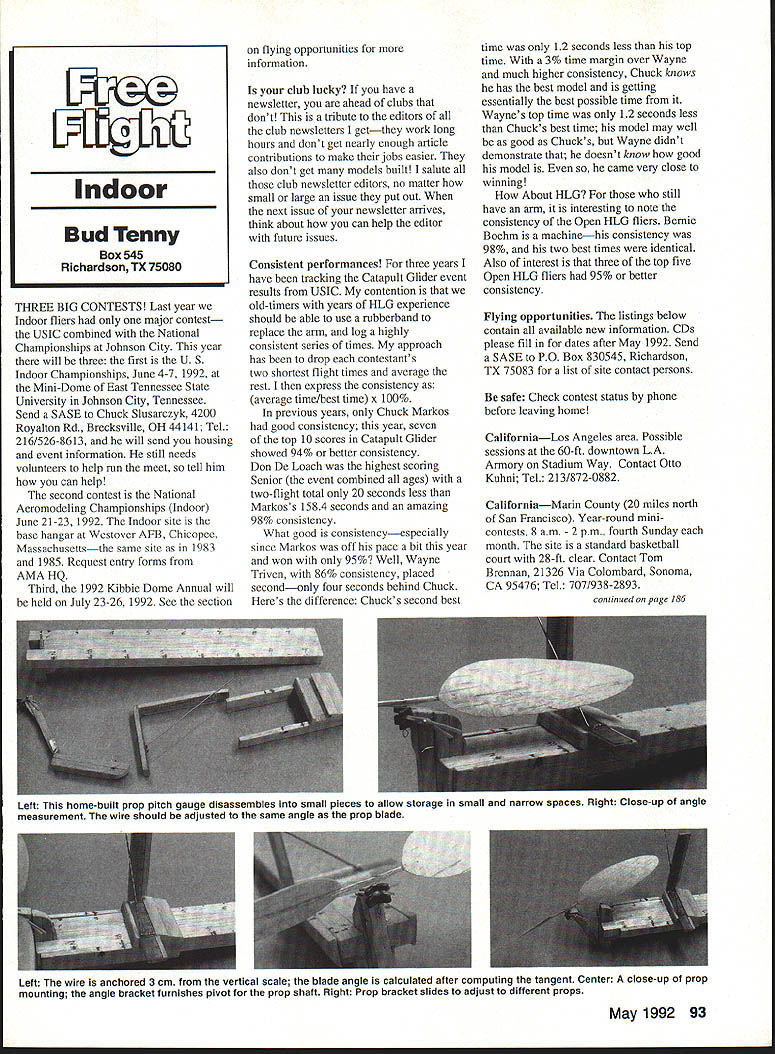
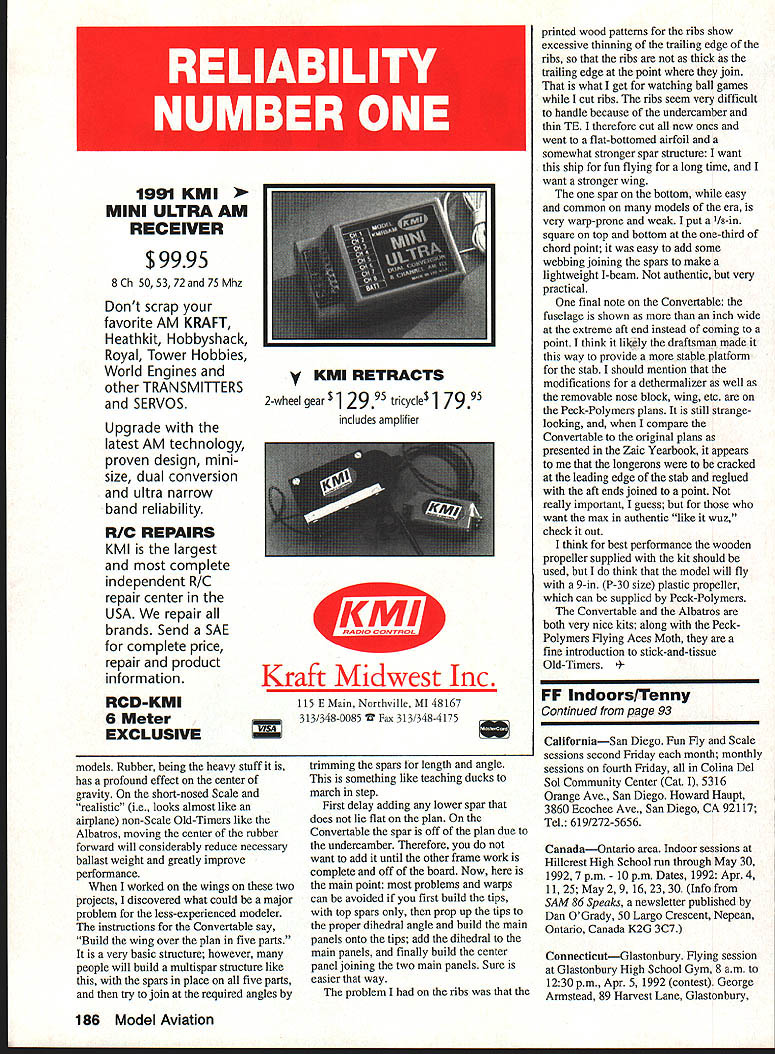
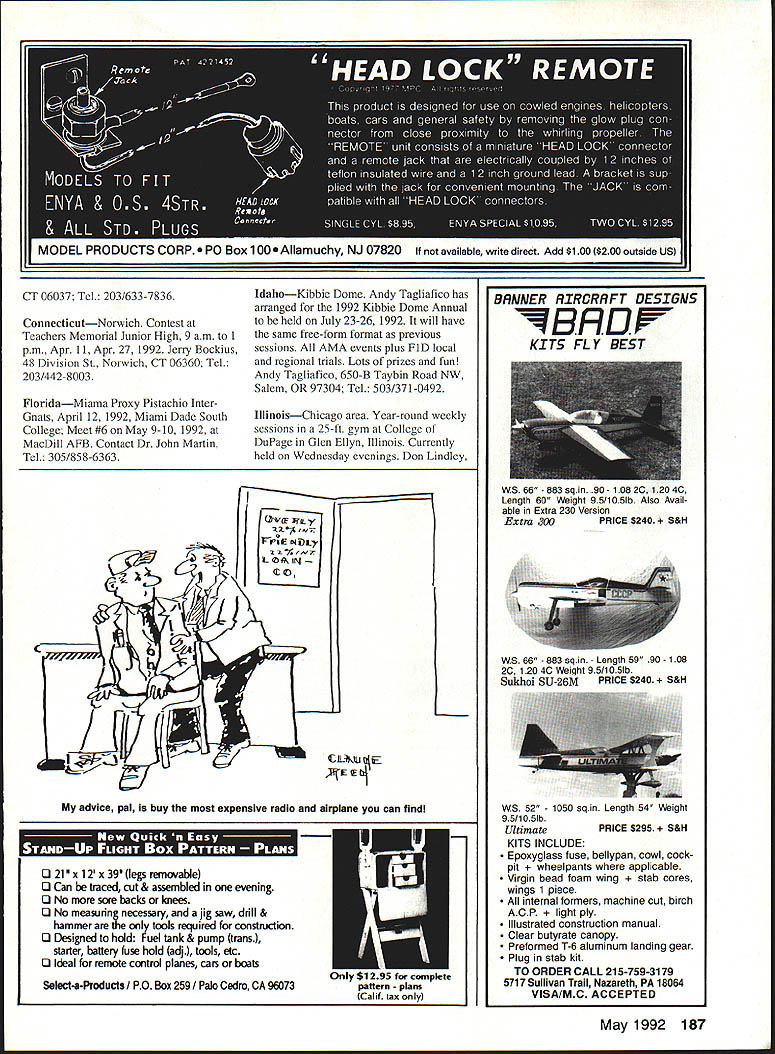
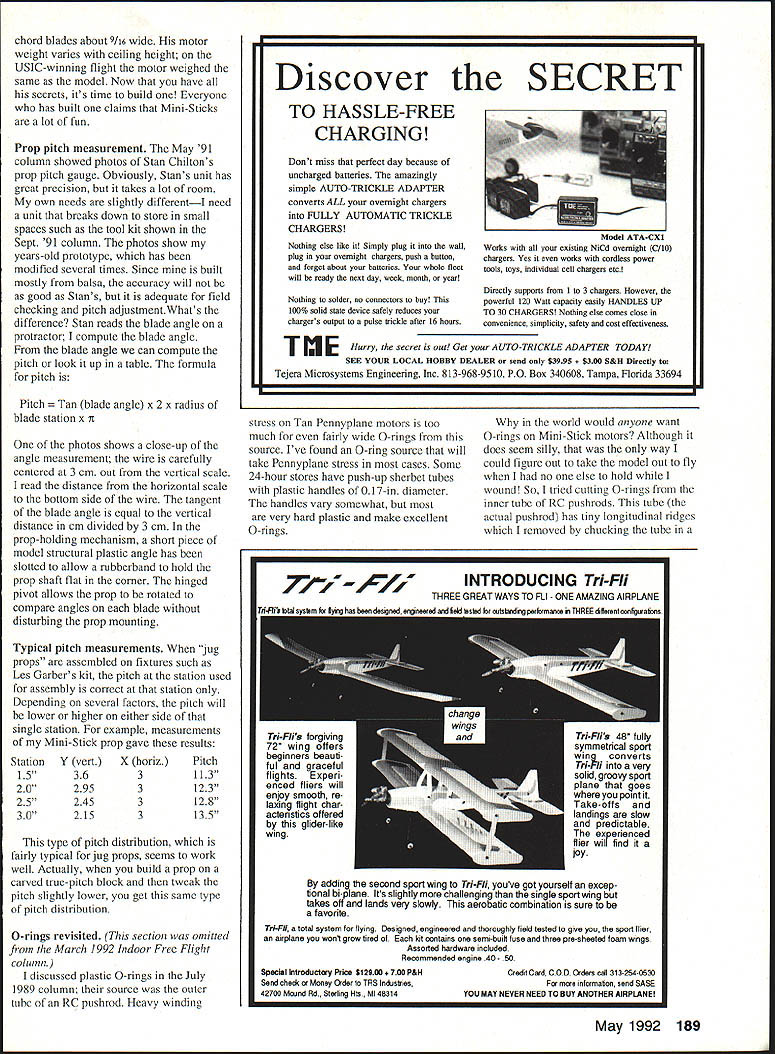
The May '91 column showed photos of Stan Chilton's prop pitch gauge. Obviously, Stan's unit has great precision, but it takes a lot of room. My own needs are slightly different—I need a unit that breaks down to store in small spaces such as the tool kit shown in the Sept. '91 column. The photos show my years‑old prototype, which has been modified several times. Since mine is built mostly from balsa, the accuracy will not be as good as Stan's, but it is adequate for field checking and pitch adjustment.
What's the difference? Stan reads the blade angle on a protractor; I compute the blade angle. From the blade angle we can compute the pitch or look it up in a table. The formula for pitch is:
Pitch = tan(blade angle) × 2 × radius of blade station × π
One of the photos shows a close-up of the angle measurement; the wire is carefully centered at 3 cm out from the vertical scale. I read the distance from the horizontal scale to the bottom side of the wire. The tangent of the blade angle is equal to the vertical distance in cm divided by 3 cm. In the prop-holding mechanism, a short piece of model structural plastic angle has been slotted to allow a rubber band to hold the prop shaft flat in the corner. The hinged pivot allows the prop to be rotated to compare angles on each blade without disturbing the prop mounting.
Typical pitch measurements
When "jug props" are assembled on fixtures such as Les Garber's kit, the pitch at the station used for assembly is correct at that station only. Depending on several factors, the pitch will be lower or higher on either side of that single station. For example, measurements of my Mini‑Stick prop gave these results:
- Station 1.5": Y (vert.) = 3.6 cm, X (horiz.) = —, Pitch = 11.3
- Station 2.0": Y (vert.) = 2.95 cm, X (horiz.) = —, Pitch = 12.3
- Station 2.5": Y (vert.) = 2.45 cm, X (horiz.) = —, Pitch = 12.8
- Station 3.0": Y (vert.) = 2.15 cm, X (horiz.) = —, Pitch = 13.5
This type of pitch distribution, which is fairly typical for jug props, seems to work well. Actually, when you build a prop on a carved true‑pitch block and then tweak the pitch slightly lower, you get this same type of pitch distribution.
O‑rings revisited
(This section was omitted in the March 1992 Indoor Free Flight column.)
I discussed plastic O‑rings in the July 1989 column; their source was the outer tube of an RC pushrod. Heavy winding stress on Pennyplane motors is too much for even fairly wide O‑rings from this source. I've found an O‑ring source that will take Pennyplane stress in most cases. Some 24‑hour stores have push‑on sheath tubes with plastic handles of 0.17‑in. diameter. The handles vary somewhat, but most are very hard plastic and make excellent O‑rings.
Why in the world would anyone want O‑rings on Mini‑Stick motors? Although it does seem silly, that was the only way I could figure out to take the model out to fly when I had no one else to hold while I wound! So, I tried cutting O‑rings from the inner tube of RC pushrods. This tube (the actual pushrod) has tiny longitudinal ridges which I removed by chucking the tube in a drill and abrading the ridges smooth. The resulting O‑rings work quite well and will withstand the winding stresses encountered in most Mini‑Stick motors.
The photo shown in the March issue contrasts the Mini‑Stick O‑rings with the Pennyplane O‑rings; the respective weights are 0.00013 oz. versus 0.00003 oz. Certainly the weight penalty is minimal compared with not being able to fly on a moment's notice!
Transcribed from original scans by AI. Minor OCR errors may remain.

