
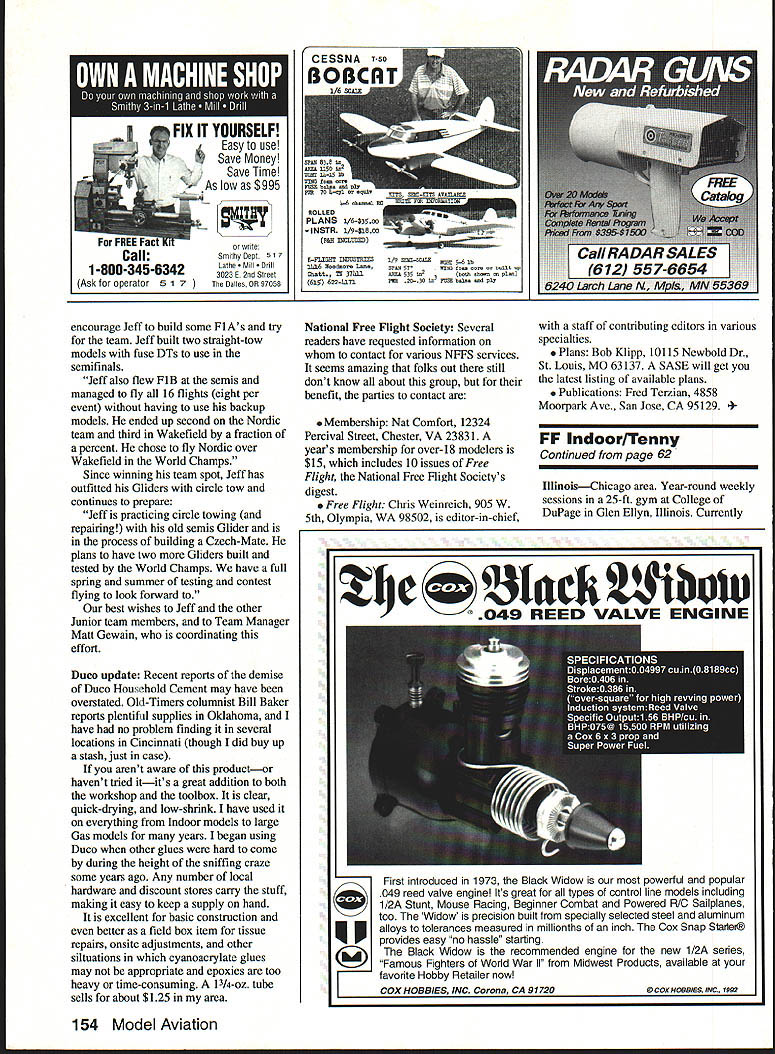
Free Flight: Indoor
Bud Tenny Box 545 Richardson, TX 75080
A light is gone. Louisville, Kentucky felt the loss first, but we all will miss Burr Stanton. Early this year Burr succumbed to a very aggressive cancer only a few weeks after diagnosis. Burr's association with Indoor began with the NIMAS-sponsored contests at West Baden and continued until his death. He was a very active and effective leader for the activity in Louisville, and he published a newsletter that enlightened more than just his local group. We will all miss his influence and enthusiasm.
Tools available
Dr. Vernon Hacker, Larry Loucka, and Ray Harlan are teaming up to make the following tools available:
- Micro cautery (trim plastic films or microfilm) — $5.00
- Three assorted eye scalpels — $3.00
- Handling & postage — $2.00
Total: $10.00
Proceeds from sales of these items will be donated to the AMA Indoor Fund. These items will be on sale at the USIC in June; otherwise order from Vern Hacker, 25599 Breckenridge Dr., Euclid, OH 44117; telephone: (216) 486-4990.
New plastic film source
Wayne Triven, 7408 W. Hanna Ave., Tampa, FL 33615, is distributing a new Mylar film. It is reported to be 25 percent thinner and 23 percent lighter than most types of Mylar and to have a lower static-cling tendency. A piece 20 feet long and 12 inches wide costs $20 plus $2.50 postage and handling.
Indoor book
I recently responded to questions a flier wouldn't have needed to ask—if he had access to a copy of Ron Williams' book Indoor Model Building and Flying. I believe that many more of those books were printed in each of the two printings than there are Indoor fliers. Those owned by libraries can be located via a network called OCLC. Almost all public and college libraries have access to the Interlibrary Loan System, which accomplishes much the same thing.
Meanwhile, if you have a copy of this book you would be willing to lend under controlled conditions (your conditions), or a copy you no longer use, please consider lending or donating it so others can benefit.
Loan coordinator
While on the subject of the Williams book, would anyone be willing to coordinate a loan system for these books if owners are willing to lend them? Please contact me if you can help organize such a loan system.
National Free Flight Society contacts
Several readers have requested information on whom to contact for various NFFS services:
- Membership: Nat Comfort, 12324 Percival Street, Chester, VA 23831. A year's membership for over-18 modelers is $15, which includes 10 issues of Free Flight, the National Free Flight Society's digest.
- Free Flight (editor): Chris Weinreich, 905 W. 5th, Olympia, WA 98502.
- Plans: Bob Klipp, 10115 Newbold Dr., St. Louis, MO 63137 — for the latest listing of available plans.
- Publications: Fred Trezian, 4858 Moorpark Ave., San Jose, CA 95129.
Flying opportunities
The listings below contain all available new information. Clubs, please fill in dates after July 1992. Be safe: check contest status by phone before leaving home!
- California — Los Angeles area: Possible sessions at the 60-ft. downtown L.A. Armory on Stadium Way. Contact Otto Kuhni; Tel.: (213) 872-0882.
- California — Marin County (20 miles north of San Francisco): Year-round minicontests, 8 a.m.–2 p.m., fourth Sunday each month. Site is a standard basketball court with 28-ft. clearance. Current schedule: June 28, July 26, Aug. 23, Sept. 27, Oct. 25, 1992. Contact Tom Brennan, 21326 Via Colombard, Sonoma, CA 95476; Tel.: (707) 938-2893.
- California — San Diego: Fun Fly and Scale sessions second Friday each month; monthly sessions on fourth Friday, all in Colina Del Sol Community Center (Cat. 1), 5316 Orange Ave., San Diego. Contact Howard Haupt, 3860 Ecochee Ave., San Diego, CA 92117; Tel.: (619) 272-5656.
- Canada — Ontario area: Indoor sessions at Hillcrest High School May 30, 1992, 7 p.m.–10 p.m. Info: SAM 86 Speaks newsletter published by Dan O'Grady, 50 Largo Crescent, Nepean, Ontario, Canada K2G 3C7.
- Idaho — Moscow (Kibbie Dome): Northwest Indoor Champs at Kibbie Dome, July 23–26, 1992. Andy Tagliafico, 650-B Taybin Rd. NW, Salem, OR 97304; Tel.: (503) 371-0492.
- Illinois — Chicago area: Year-round weekly sessions in a 25-ft. gym at College of DuPage in Glen Ellyn, Illinois. Currently held on Wednesday evenings. Contact Don Lindley, 420 Tupelo, Naperville, IL 60540; Tel.: (708) 355-9674.
- Kentucky — Louisville: Mason Plank of Louisville is filling in after the sad and untimely death of Burr Stanton. Flying sessions continue every Tuesday at the Sawyer Park site, 11 a.m.–1 p.m. Also one Saturday each month (subject to military schedules) at the Kentucky Air National Guard site, 10 a.m.–2 p.m. Contact Mason Plank, 3207 Oriole Dr., Louisville, KY 40213; Tel.: (502) 634-8191.
- Maryland — Goddard NAS: Record trials and flying sessions scheduled in the auditorium of Building 8 at Goddard NAS on Saturdays, 11 a.m. until 10:30 p.m.; July 25, Aug. 8, Aug. 22, Sept. 19, Oct. 3, Oct. 17, Oct. 31, and Nov. 14, 1992. Sanctioned national and FAI record trials on July 25, Aug. 8, Aug. 22, Sept. 19, Oct. 3, Oct. 31, and Nov. 14. NASA security requires that all attendees be U.S. citizens and AMA members; AMA licenses must be available for inspection at the gate. Attendees must also be on a list compiled by Tom Vallee. You must notify Tom of your intention to attend in advance of each meet. Changes in NASA launch schedules and other events can preempt the auditorium; verify the date with Tom before leaving home: Tom Vallee, 444 Henryton St., Laurel, MD 20707; Tel.: (301) 498-0790.
- Massachusetts — Chicopee: Indoor events in the 1992 National Aeromodelling Championships will be held in a hangar at Westover Air Force Base near Chicopee. Events will be flown from 8 a.m. to 7 p.m., June 21–23, 1992. Contact AMA HQ for entry blanks.
- New Jersey — Lackhurst: Contact Gary Underwood, 9 Treelawn Terrace, Mercerville, NJ 08619; Tel.: (609) 586-4441 later in 1992 for information on the 1992 season.
- New York — Westchester (Chappaqua): Contact Art Maiden at (914) 769-2284 or (914) 769-2644.
- New York — Columbia University: Negotiations with the university have broken down, so no contests will be held in the Rotunda until further notice.
- Tennessee — Johnson City (USIC): AMA Class AAAA Indoor contest, June 4–7, 1992. Send business-size SASE for contest info and entry forms to Chuck Slusarczuk, 4200 Royalton Rd., Brecksville, OH 44141.
Junior team news (Jeff)
Encourage Jeff to build some F1A's and try for the team. Jeff built two straight-tow models with fuse DTs to use in the semifinals. He also flew F1B at the semis and managed to fly all 16 flights (eight per event) without having to use his backup models. He ended up second on the Nordic team and third in Wakefield by a fraction of a percent. He chose to fly Nordic over Wakefield in the World Champs.
Since winning his team spot, Jeff has outfitted his Gliders with circle tow and continues to prepare. He is practicing circle towing (and repairing!) with his old semis. He is in the process of building a Czech-Mate and plans to have two more Gliders built and tested by the World Champs. We have a full spring and summer of testing and contest flying to look forward to. Our best wishes to Jeff and the other Junior team members, and to Team Manager Matt Gewain, who is coordinating this effort.
Duco update
Recent reports of the demise of Duco Household Cement may have been overstated. Old-Timers columnist Bill Baker reports plentiful supplies in Oklahoma, and I have had no problem finding it in several locations in Cincinnati (though I did buy up a stash, just in case).
Duco Cement is produced by Devcon Corporation of Wood Dale, Illinois and is sold at Ace Hardware stores, K-Mart stores, Wal-Mart stores, and some hobby shops. If you aren't aware of this product—or haven't tried it—it's a great addition to both the workshop and the toolbox. It is clear, quick-drying, and low-shrink. I have used it on everything from Indoor models to large gas models for many years.
It is excellent for basic construction and even better as a field-box item for tissue repairs, on-site adjustments, and other situations in which cyanoacrylate glues may not be appropriate and epoxies are too heavy or time-consuming. A 1-3/4-oz. tube sells for about $1.25 in my area.
FAI provisional status explained
Ian Kaynes, a member of the Free Flight Subcommittee of FAI, has responded to comments about the provisional status of FAI EZB (F1L). He explains: the term "provisional" denotes classes that are not eligible for World Championships; the official rules (eligible for World Championships) are the ones for which World Championship papers are run and are the only ones that appear in the Sporting Code. Provisional rules are published in a CIAM document that has had limited distribution (though Ian has proposed wider availability). The next Sporting Code will be printed next year (to come into force January 1993), and there is no possibility of EZB being included in that edition. The earliest possibility of upgrade would be the next Sporting Code after that—possibly 1997.
Plastic bag feedback
Bob Rogers read the information about plastic storage bags in the January 1991 column and noted my ambivalence about using two-sided tape to assemble larger bags from oven baking bag material. He recommends an acid-free tape called ATG tape, which is used by custom picture-framing shops. ATG tape is available in widths from 1/4 in. to 3/4 in., and it costs between $3 and $6 per roll. The tape is typically wound on bobbins used in applicators, but it can also be applied by hand.
Notes on Mini-Stick
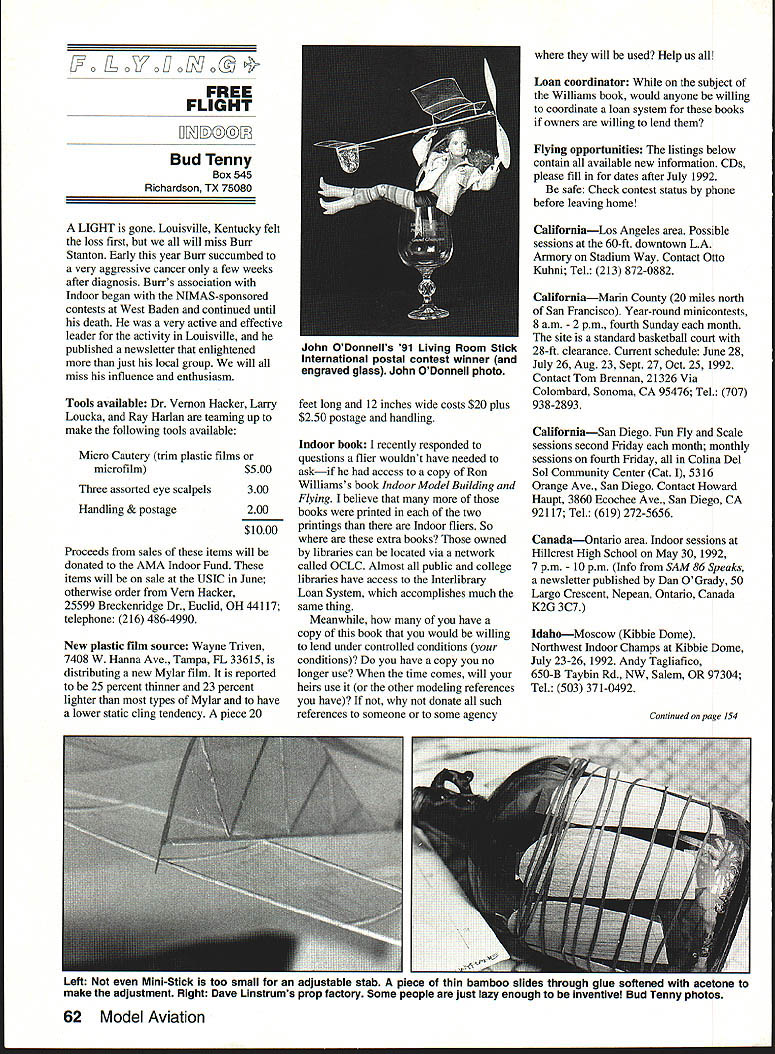
In a recent AeroModeller article, John O'Donnell (winner of the 1991 International Postal Meet) said: "Please don't call the class Mini-Stick, a nondescript appellation that could apply elsewhere. The specification started as 'Living Room Stick,' and the term is unambiguous. Let's leave it that way!" Mini-Stick postal flying for 1992 will have ended by the time you read this. Organizer John O'Donnell has received queries about the event from many countries, so this meet may have many entries.
More on lube
While doing low-power tests with my Limited Pennylane, Jesse Shepherd asked me to try his experimental lube. Two drops of the test lube were rubbed into the motor while I stabilized the knots after winding for the second and each successive flight. Compare the climb results of four flights on a 13.5-in. loop of .075-in. tan rubber weighing .044 oz.:
- Launch at 1,230 turns, 0.58 in.-oz. — touch in 21 seconds. (Benchmark value)
- Launch at 1,250 turns, 0.49 in.-oz. — touch in 25 seconds. (Special lube added)
- Launch at 1,250 turns, 0.44 in.-oz. — touch in 30 seconds.
- Launch at 1,215 turns, 0.37 in.-oz. — touch in 55 seconds.
The lube for the first flight was Stan Chilton's, which had solved my rubber-unwinding problems (see "A Funny Thing Happened" in the March 1991 column). No additional lube was needed for the second flight, so the experimental lube apparently decreased the unwinding friction drastically on flights two, three, and four. We need to know more about rubber lube!
More rubber lore
Ron Ganser related an experience in which he over-wound a motor being used on a second flight, only to get the model too high. He had expected the rubber to sag due to recent use, but it didn't. I have no recent experience on Pirelli, but I can comment on tan rubber. If you use tan, here's how to tell if the rubber has recovered: check the length before and after each flight. A broken-in 18-in. motor should recover to about one-half inch of stretch in half an hour. If the stretch is much greater, don't use that motor hard more than once a day.
Based on conversations with Hank Cole, I'm sure the slow-recovery samples are just under-cured tan. Since the sample probably will occur with each hank of rubber, I hope to figure out a remedy. Some extra re-cocking on your first few flights will help you get the most from each supply of tan.
For some time I have been cutting every hank of rubber into eight or ten pieces and keeping track of physical measurements. I record every wind-on for each motor, stretch recovery time, etc. The hank of tan I'm using now was split into eight pieces ("A" through "H"). "D" is the hardest piece (fastest to recover), and "E" is very slow to recover. You need to know.
Photo tips
The custom photo lab used by Model Aviation recommends the following films for photos submitted for possible publication:
- Black-and-white: Kodak T-Max 400.
- Color print: Kodak Ektar 125.
If the film is to be processed at one-hour shops, Ilford XP-2 black-and-white film is recommended; this film is more expensive, but it uses the same chemistry as color print films. I have used T-Max for three years with excellent results. For lower-light conditions, my own shop recommends Kodak Tri-X (ASA 400) be "pushed" (controlled underexposure). I have had excellent results pushing this film to ASA 1600; it has enabled me to take photos that I could not otherwise have made. There is an extra processing charge, and you must be sure to use a competent processing shop.
Winding revisited
In the May 1991 column I described "blast" winding. In rereading that material, I realize I failed to emphasize the final phase—knot stabilization. After winding to the highest torque that I dare, I manipulate (massage) each knot, working in Armor All (or a special lube as described above). This reduces the size of each knot and stabilizes the torque, while allowing time for winding hysteresis to dissipate. In effect, I create a wound, rested motor that will have a very repeatable torque curve.
After this activity I examine the resting torque; for Cat. IV ceiling I may add more turns and repeat if I think I can avoid breaking the motor. For lower ceilings or when working to a desired launch torque, I slowly reduce torque during stabilization. If you are serious about getting the last bit of energy from a motor, do not rush the launch!
Transcribed from original scans by AI. Minor OCR errors may remain.

