
Free Flight: Indoor
Bud Tenny Box 545 Richardson, TX 75080
Living Room Stick postal results (1992 version)
The 1992 version of the world's most popular postal meet ended after 117 contestants from 11 countries had posted flights in sites with ceiling heights ranging from 62 feet to 797 feet. Each flight score was modified by a carefully developed fudge factor to compensate for ceiling-height differences. Here are highlights and the top finishers after dropping multiple entries by individual fliers.
One of Tom Vallee's trials yielded 302 seconds under 7.97 feet with an adjusted score of 637.8 (sixth place in the ranking but not counted). J. LeBlanc of the U.S.A. posted 423 (second-place raw score under a 62-foot ceiling) for an adjusted score of 501.2 seconds (18th place).
Fliers from Argentina, Australia, Canada, Czechoslovakia, Finland, France, Italy, Japan, Spain, England, and the U.S.A. entered this postal. Thanks to Mike Colling of England for organizing this fine meet.
Top listed finishers (as printed):
- Gary Hunter — USA — 2320 4306 939
- Tom Vallee — USA — 1860 3906 692
- John O'Donnell — UK — 1037 3366 685
- Bud Tenny — USA — 2400 4066 488
- Bob Randolph — USA — 2300 3886 276
- Dan Belieff — USA — 1860 3395 972
- Bob Gibbs — USA — 2300 3615 840
- Bernard Hunt — UK — 2483 3595 681
- Reg Parham — UK — 2900 3625 473
- R. Warman — USA — 3000 3655 463
(Notes: the printed results include multiple numeric columns; the above reproduces names, countries and the numeric strings as presented.)
FAI international postal meet set
Tom Vallee reports that the postal meet between U.S. and Japanese teams will be flown between August 1 and November 1, 1992. Three Japanese teams have been chosen, and three U.S. teams have been organized so far. Bob Randolph is captain of the West Coast team, Chuck Slusarczyk heads the Midwest team, and Tom Vallee leads the East Coast team. Stay tuned, sports fans.
What is an Indoor flier?
Jerry Bockius, Indoor honcho for activity in Norwich, Connecticut, polled Indoor fliers in that area. The results are interesting. All respondents were AMA members:
- 33% fly RC in season.
- 33% fly Free Flight.
- 33% fly both Free Flight and RC.
Some members also fly full-scale aircraft or ultralight aircraft; one has a helicopter rating. No one flies Indoor to the exclusion of other events. The outdoor Free Flight events flown include Rubber, Power, HLG, and Old-Timer. For perspective: most of the fliers polled belong to FAC Squadron #20.
New Atlanta site
Watch for renewed activity in the Atlanta area. From David Mills' The Thumb Print (newsletter of the Thermal Thumbers of Metro Atlanta club), the group has located an Indoor site. An initial session was set for June 20; the site is the rec hall/community center of the New Hope Baptist Church on New Hope Road north of Fayetteville, between Peachtree City and Jonesboro. This is an idea for other clubs — some churches have excellent recreation facilities that are available at lower cost than commercial gyms.
Flying opportunities
The listings below include all the current information available. CDs, please fill in dates after July 1992. Be safe: check contest status before leaving home!
- California — Los Angeles area. Possible sessions at the 60-ft downtown L.A. Armory on Stadium Way. Contact Otto Kuhni; Tel.: (213) 872-0882.
- California — Marin County (20 miles north of San Francisco). Year-round minicontests, 8 a.m.–2 p.m., fourth Sunday each month. The site is a standard basketball court with 28-ft clearance. Current schedule: July 26, Aug. 23, Sept. 27, Oct. 25, 1992. Contact Tom Brennan, 21326 Via Colombard, Sonoma, CA 95476; Tel.: (707) 938-2893.
- Idaho — Moscow (Kibbie Dome). Northwest Indoor Champs at Kibbie Dome, July 23–26, 1992. Contact Andy Tagliafico, 650-B Taylin Rd., NW, Salem, OR 97304; Tel.: (503) 371-0492.
- Illinois — Chicago area. Year-round weekly sessions in a 25-ft gym at College of DuPage in Glen Ellyn, Illinois. Currently held on Wednesday evenings. Don Lindley, 420 Tupelo, Naperville, IL 60540; Tel.: (708) 355-9674.
- Kentucky — Louisville. Flying sessions continue every Tuesday at the Sawyer Park site, 11 a.m.–1 p.m. Also one Saturday each month (subject to military schedules) at the Kentucky Air National Guard site, 10 a.m.–2 p.m. Contact Mason Plank, 3207 Oriole Dr., Louisville, KY 40213; Tel.: (502) 634-8191.
- Maryland — Goddard NAS. Goddard NAS record trials and flying sessions are scheduled in the auditorium of Building 8 at Goddard NAS on Saturdays, 11 a.m. until 10:30 p.m.; July 25, Aug. 8, Aug. 22, Sept. 19, Oct. 3, Oct. 17, Oct. 31, Nov. 14, 1992. Sanctioned national and FAI record trials on July 25, Aug. 8, Aug. 22, Sept. 19, Oct. 3, Oct. 31, and Nov. 14. NASA security requires that all attendees be U.S. citizens and AMA members. AMA licenses must be available for inspection at the gate. Attendees must also be on a list compiled by Tom Vallee. You must notify Tom of your intention to attend in advance of each meet. Changes in NASA launch schedules and other events can prompt the auditorium to be closed without much warning. Be sure to verify the date with Tom before leaving home! Tom Vallee, 444 Herrington St., Laurel, MD 20707; Tel.: (301) 498-0790.
- New Jersey — Lakehurst. New dates for Lakehurst #1: July 25–26, Aug. 1–2, Aug. 9, Aug. 15–16, Aug. 22, Aug. 29–30, Sept. 5–6, Sept. 12, Sept. 27, Oct. 4, Oct. 11, Oct. 18, 1992. Attendance at these sessions requires strict adherence to these rules:
- Furnish your name, driver's license number, make and model of vehicle, license plate number, and state of registration to Gary Underwood not later than the Wednesday before the meet you plan to attend. Out-of-town participants who fly in and rent a car must make special arrangements regarding auto identification. Contact Gary Underwood, 9 Treelawn Terrace, Mercerville, NJ 08619; Tel.: (609) 586-3202.
- Obey all military regulations — especially speed limits, no-smoking areas, and restricted parking — all of which are strictly enforced.
- Certain base personnel give access to lavatories and other facilities. Please route requests for assistance through the CD.
- Leave your flying area at least as clean as you find it; check with the CD about where you locate your equipment.
- No photos allowed except in the hangar.
- New York — Westchester (Chappaqua). Contact Art Maiden at (914) 769-2284 or (914) 769-2644.
PP ceiling hook
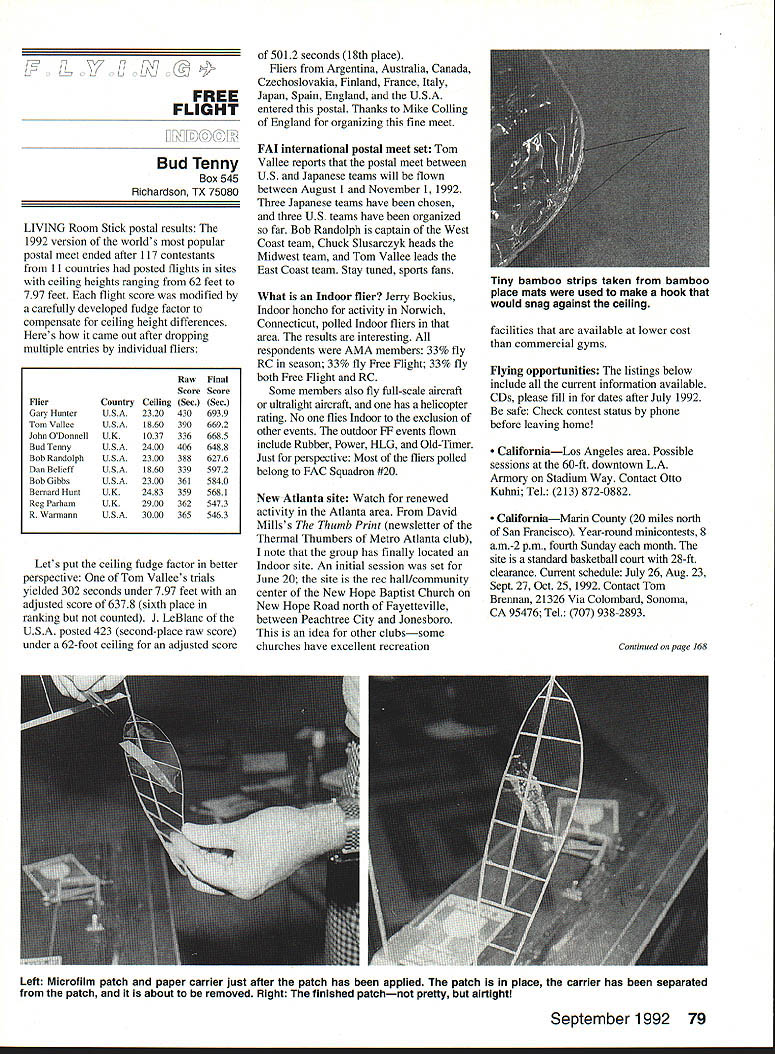
While making low-power tests on my Limited Pennyplane, I thought I had managed really optimum trim (make that minimum landing torque). Unfortunately, this trim let the model fly very flat and slightly faster than normal, so it wouldn't scrub the ceiling when I tried to make the model snag the inboard tip so that it would turn instead of running straight along the ceiling. One of the models in my shop shows a ceiling hook that helped, but not enough. It is made from extremely small bamboo strips anchored by inserting them into the tip outline and gluing them down.
In order to slow the model, I trimmed it slightly more nose-up, hoping that ceiling contacts would cause ministalls. With standard Cat. I trim, the model should drop away from the ceiling into the normal turn. Normally, the level-flight torque and the landing torque are higher with this trim. I had time for only one flight, which landed with slightly lower torque and lower RPM. This result leads me to believe that the original trim wasn't optimum. So even more nose-up trim is needed to achieve the ministalls; ceiling-touch performance was better on this flight than before and can improve even more.
Bamboo — where from?
The bamboo used for the ceiling hook has a very small diameter and low weight. Bill Vandehaas found bamboo place mats at Pier 1 Imports, a national chain.
Mini-Stick comments
A reminder on CG locations: the Mini-Stick has a very narrow wing — 2.5 inches. My own model balances 1/4 inch farther forward than the center of the motor. When I changed from a motor weighing 0.015 oz to one weighing 0.021 oz, the CG shifted by 1/8 inch. While that sounds like a very small shift, 1/8 inch is five percent of the chord — a shift of five percent in the static margin of balance. That much shift can make a model change from safe trim to critical (appears tail-heavy) or from optimum trim to extra-safe (appears nose-heavy). I can almost convince myself that it would be beneficial to add just enough tail weight (or get a drastically lighter prop) so the CG would fall exactly halfway between the front and rear hooks.
Microfilm patch techniques
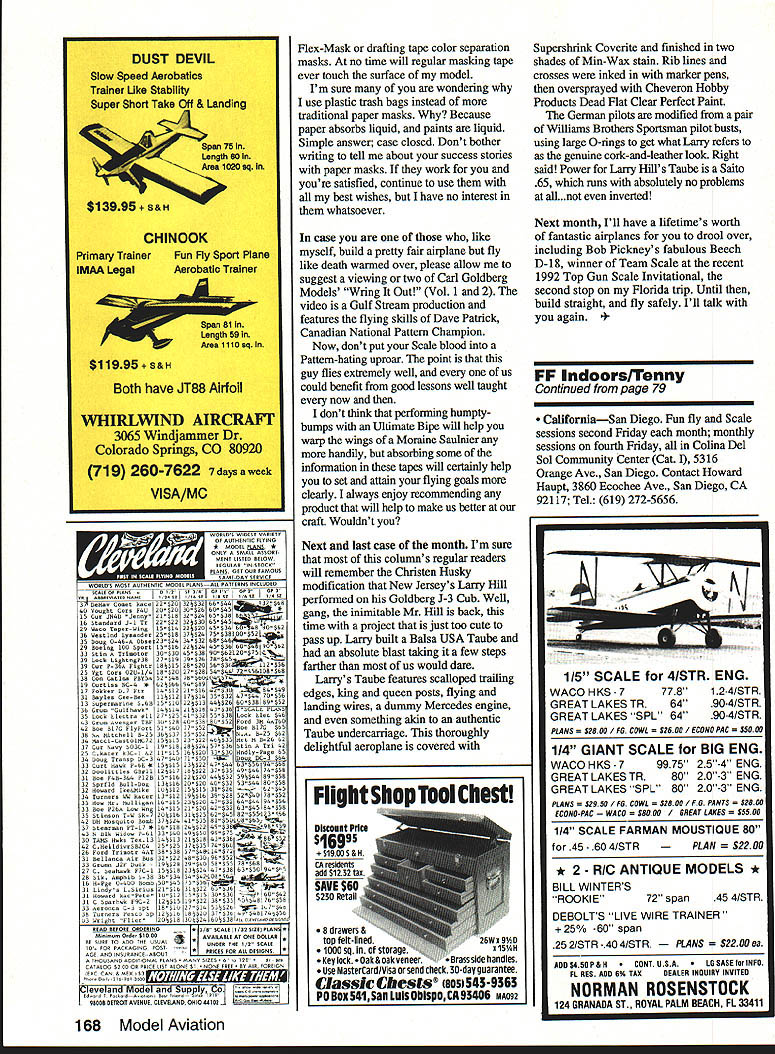
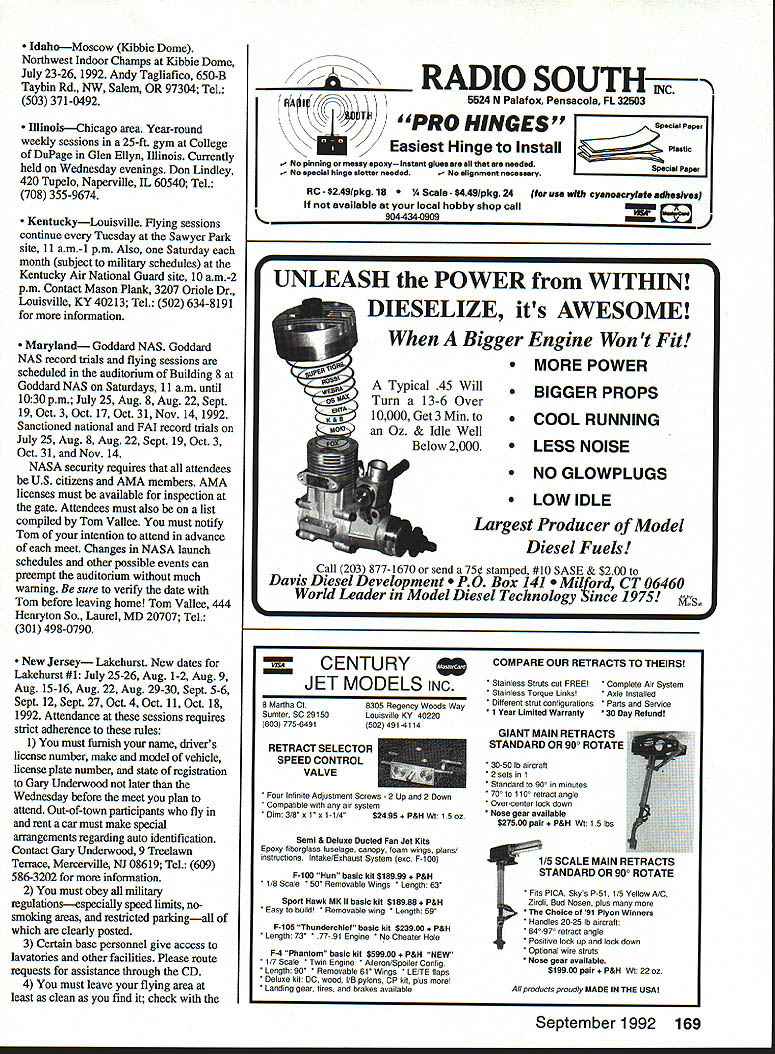
Microfilm patching is a necessary art for serious fliers who don't have an unlimited supply of models. The basics of patching are simple: cut a film patch and put it on. With proper preparation, it really is almost that simple!
There are six steps to proper patching:
- When pouring film, pour some extra for patch film. Prepare several pieces of patch film and store them so the film isn't pressed against the carrier. Typically, loosely stacked pieces of film/carrier protected by a closed box will suffice.
- Long before the contest, practice patching with the film you are currently using. You must know ahead of time if the film is so "dry" (non-sticky) that it won't stick to itself. You must know if the patch will separate properly from the carrier or if the film on the model is too weak to withstand the extra stress of patching.
- Inspect the structure to be sure there is no damage. If you patch a damaged structure, the damage may worsen, allowing the structure to distort. You may wind up with an unflyable model that must be discarded or that can be repaired only in your shop.
- Plan the whole patching operation before you start, particularly for large holes. On braced surfaces, be sure you have room to maneuver the patch past the bracing, or remove enough bracing to give access.
- Apply the patch, remove the carrier, and replace the bracing if necessary.
- For all but very minor holes, inspect the surface for proper alignment and for holes that you may have overlooked or added during the patching operation. Stress the whole model by gently wanging it up and down; other damage or improperly tensioned bracing may become apparent. The goal is to restore the model to its original trim, even if it isn't quite as pretty.
Preparing patch film:
My personal preference is to use non-wrinkled bond or other paper that has had office-type rubber cement applied in a very narrow band around the perimeter. (I use 8.5 x 11-in. pieces if the storage hoop is wide enough; otherwise, I use the widest paper that will fit inside the hoop width.) After allowing the rubber cement to dry, insert the hoop with the paper under the carrier and drop in the patch. Store the patch supply in a closed, flat box for safekeeping. Such film has a typical lifetime of two or three years, but you should check the supply for viability at the beginning of each season.
Applying the patch:
Using sharp scissors, cut a piece of patch film at least 3/8 in. larger than the hole in all directions. Use a spray atomizer to lightly mist the film side of the patch with water. Invert the surface to be patched, lift up the patch until it contacts the surface, and make sure the entire patch is touching. Use a very soft brush to apply a bead of water around the edge of the patch. The paper carrier will expand and wrinkle along at least two sides. With the patched surface still inverted, hook a wrinkle in the carrier with a sharp object, and gently pry loose one side of the paper. Usually, the paper will fall completely free; otherwise, gently pull it loose. Typically, the remaining water will evaporate quickly, and the model is ready to fly.
Transcribed from original scans by AI. Minor OCR errors may remain.

