
Free Flight: Indoor
Bud Tenny, P.O. Box 545, Richardson, TX 75080
Pete Andrews remembered: The first flier to post a 30-minute indoor flight is dead; Pete Andrews passed away after a six-month illness. Pete influenced people and indoor model design for several decades, winning many Nats events and other awards. Finally, he almost retired from modeling because there seemed to be no challenges left.
Frank Cummings, another modeling pioneer and longtime friend, convinced Pete to tackle FAI Indoor. Then, in 1972 Pete became Indoor World Champion after posting flights of 36:12 and 34:57, 1:34 ahead of Czech flier Karol Rybecky.
My favorite memory of Pete is of a processing session at the '72 World Championships. Bystanders were startled when his model was 5% overweight and 3% short in span; Pete just grinned and said, "It doesn't matter!"
Many others will also remember Pete, who helped anyone who needed it. He was always free with advice that worked—no matter who asked or what the question. This was Pete's legacy to us all—an example of wisdom and helpfulness.
Flying opportunities
The listings below represent only additions and changes to information presented last month. Please refer to the December '92 MA for a list of site contact persons. CDs—please fill in dates beginning with mid-March and later. As always, please check with the contact person to verify the contest schedule before leaving home!
- Canada — Ontario area. Dan O'Grady, 50 Largo Crescent, Nepean, Ontario, Canada K2G 3C7. Indoor flying at McArthur High School in Ottawa. Friday nights, 7 p.m. to 10 p.m.: Jan. 8, Jan. 15, Jan. 22, Jan. 29, Feb. 5, Feb. 12, Feb. 19, Feb. 26, Mar. 5, Mar. 12, 1993.
- Connecticut — Glastonbury. George Armstead, 89 Harvest Lane, Glastonbury, CT 06037; Tel.: (203) 633-7836. Sessions on Jan. 10, Feb. 7, Mar. 7, Apr. 4, 1993 at Glastonbury High School gym, beginning at 8 a.m.
- Florida — Miami. Dr. John Martin, 2180 Tigertail Ave., Miami, FL 33133; Tel.: (305) 858-6363. MIAMI contests: Miami Dade South #4 Feb. 1993; #5 Mar. 7, 1993. Florida State contests: #3 Jan. 2-3, 1993 (Delta hangar); #4 Feb. 13-14, 1993 at the Coast Guard hangar in Clearwater; #5 Apr. 3-4, 1993 at McDill AFB. Always verify the schedule by calling the hot line number above!
- Missouri — St. Louis. Larry Coslick, 4202 Valley Crest Hills, St. Louis, MO 63128; Tel.: (314) 892-3803 (after 7:30 p.m.). St. Louis fliers have arranged a series of sessions at Jefferson College, 25 miles south of St. Louis.
- New York — Brooklyn. Contact Don Ross, 38 Churchill Rd., Cresskill, NJ 07626; Tel.: (201) 568-5272. Activity planned for Floyd Bennett Field; tentative dates are the first weekends in April and May, 1993.
- Oklahoma — Oklahoma City. Jim Belson, 4933 NW 29th, Oklahoma City, OK 73129; Tel.: (405) 946-1093. Fun-fly sessions in the National Guard Armory, Jan. 17, Feb. 21, 1993; annual contest March 21, 1993.
- Oklahoma — Tulsa. George Calvert, Rt. 4, Box 188A, Wagoner, OK 74467; Tel.: (918) 627-7200. Jan. 11, 1993 (probable), plus Feb. and March dates; all at Tulsa National Guard Armory.
- Oregon — Albany. Bob Stalick, 5066 NW Picadilly Circle, Albany, OR 97321; Tel.: (503) 928-8101. Four one-day meets and two two-day meets, November 1992 through February 1993 at South Albany High School; 41-ft. hall and 26-ft. hall.
New indoor postal contest
This column has previously discussed activities by the Denver Area Indoor Model Airplane Association (DAIMAA) at the University of Colorado. The activity began with access to the CU Balch Fieldhouse in exchange for managing indoor model design courses for aerospace engineering freshmen. In seven years, over 1,000 students have taken these courses.
Beginning in 1992, the American Institute of Aeronautics and Astronautics (AIAA) made a three-year commitment to continue the program. In 1992, the flying activity was restricted to CU aerospace engineering graduates and undergraduates while the program was fine-tuned. In 1993, a postal meet will include students at universities in Kansas, Iowa, and Missouri, with wider coverage in 1994. NFFS will be participating also, so maybe other clubs can institute similar programs elsewhere.
New source of tan rubber?
Golf balls made by Titleist contain a central core that appears to be a liquid-filled rubber ball. Wound on this core is a length of (apparently) tan rubber that will relax to about 0.019 x 0.060. I'm writing this after Jim Clem and I spent two hours unwinding rubber strip from two such golf balls, so I'll relate that much of the story. More information will have to come after tests of the rubber.
A strong caution! Very few golf balls are wound with rubber; others contain liquid under very high pressure. If you cut into that type of golf ball, you could be seriously injured!
The outer cover of the balls we unwound had been cautiously scored using a bandsaw; in addition to ensuring that you have the right (safe!) type of ball, a deep cut will spoil a lot of rubber. When you start unwinding, be prepared for the rubber to come off in spurts. It may be advisable to have someone pull the rubber away so it doesn't pile up on the floor — it seems to tangle instantly. As the rubber strip separates, it has many twists that must be removed. During this process it will tangle again and again unless you are more clever than I was!
Some observations: The two golf balls appeared to be identical, but twice as much rubber was salvaged from one of them, for no obvious reason. As the rubber came off, it was very crinkled and ragged in appearance. Once it had a chance to relax, the dimensions changed and the rubber smoothed out.
Test Prop/Rubber Combinations
Time (min.) rpm Turns remaining 0 0 2,500 1 70 2,430 2 64.4 2,366 3 59.8 2,306 4 56.2 2,250 5 53.4 2,196 6 51.6 2,145 8 50.3 2,044 10 49.8 1,944 12 49.2 1,848 14 48.5 1,749 16 48.3 1,651 20 48.2 1,459 24 48.1 1,266 28 48.1 1,074 32 48.05 881 36 48 689
How good is it? Only time will tell. It is certain that the rubber has been re-tensioned and stressed; it will require time to relax. The thinner strip will pose problems in stripping also. Most rotary strippers have a guide to hold the rubber flat as it goes into the blades; such thin rubber isn't stabilized at all by current guides.
Testing prop/rubber combinations
Several years ago Bob Champine suggested using the turns-remaining method to analyze prop performance. Here is how to apply the test:
- Count the rpm beginning as soon as possible after launch, while recording the rpm and time it was measured. Continue during the flight with measurements at least every three minutes for high-ceiling flights and more often for low-ceiling flights.
- Beginning with the launch turns, compute the turns used for each rpm interval, and subtract from the turns left. For example, assume that the rpm is 70 at the end of the first minute and the launch turns were 2,500. The second point on the turns-remaining curve is 2,500 − 70, or 2,430. The remaining points are shown in the accompanying table.
After taking similar curves for different props, it should be easier to decide on prop-rubber combinations and changes in prop design.
Laminated structures
All indoor models I have recently built have used curved, laminated wing and stab tips and laminated rudders. In general, I have been pleased with the results, but not necessarily with the methods I used to build them. Those laminated parts were made by preshaping soaked balsa, drying the pieces, then gluing them together with thinned Duco cement.
When I built my first Mini-Stick recently, the wing tips, rudder, and the entire stab outline were all laminated. This time I tried an entirely new approach: the strips were softened with water, then wrapped on the form while still wet. The difference is that when I added the second strip, I used highly dilute white glue between the strips. This approach gives three advantages:
- One nondelicate operation.
- No apparent weight disadvantage.
- Excellent stiffness.
So far, the third advantage is still only an impression. I plan to build some test strips to measure weight vs. stiffness; my only current benchmark is the Mini-Stick stab. The stab is a 6.5 x 1.6875-in. ellipse, weighing .0018 oz. covered; it is almost unbelievably stiff.
Lamination — step-by-step. The balsa I used for the Mini-Stick outlines was .030-wide strips cut from four-pound C-grain 0.016-in. sheet. The forms were thin cardboard waterproofed with thin glue and sanded smooth. I used Slo‑Mo's Quik Glue for the lamination. The glue was thinned to eight or nine drops of glue in one tablespoon of water. Before wrapping the strips, I waxed the forms to prevent the finished outlines from sticking. Do not use wax as a parting agent with nitrite glue—the glue may not dry properly or may be degraded badly! The lamination process:
- Stretch plastic cling wrap tightly across the work area to create a smooth surface.
- Apply the parting agent (wax or whatever) to the form, and pin it to the work surface.
- Anchor one end of the first strip to the form, and wet it thoroughly with water and a brush. The water's surface tension will hold the strip on the plastic where you put it and will actually ease the problem of wrapping the strip on the form.
- As soon as the first strip is wrapped, anchor the second and repeat the wrapping, using the dilute glue instead of water.
- Let the strips dry thoroughly. The dilute glue makes a snug bond with the plastic, so use a pointed segment of a sharp double-edged razor blade to slide between the form and the film. If the release agent works properly, it will be easy to get the outline off the form.
The prop blades were also laminated; on the second prop I kept careful weight records. Four blades, each just over two square inches in area, were cut from 0.009 four-pound balsa. The total weight of the blades before lamination was 0.0038 oz.; after lamination they weighed .00385 oz. Based on a few flights, this prop is still overly stiff, and new ones could be much lighter if the wood can be found.
Final comments: My use of Slo‑Mo's glue is not necessarily a recommendation. Tony Sutter gave me a bottle with the comment that it dries clear—which is almost true. All I know is that it works very well, and the very dilute solution seemed to resist settling out better than other dilute white glues. If you would like to try this glue, call (800) 553-8940 (California) or (800) 423-4135 (rest of U.S.) to find the nearest dealer.
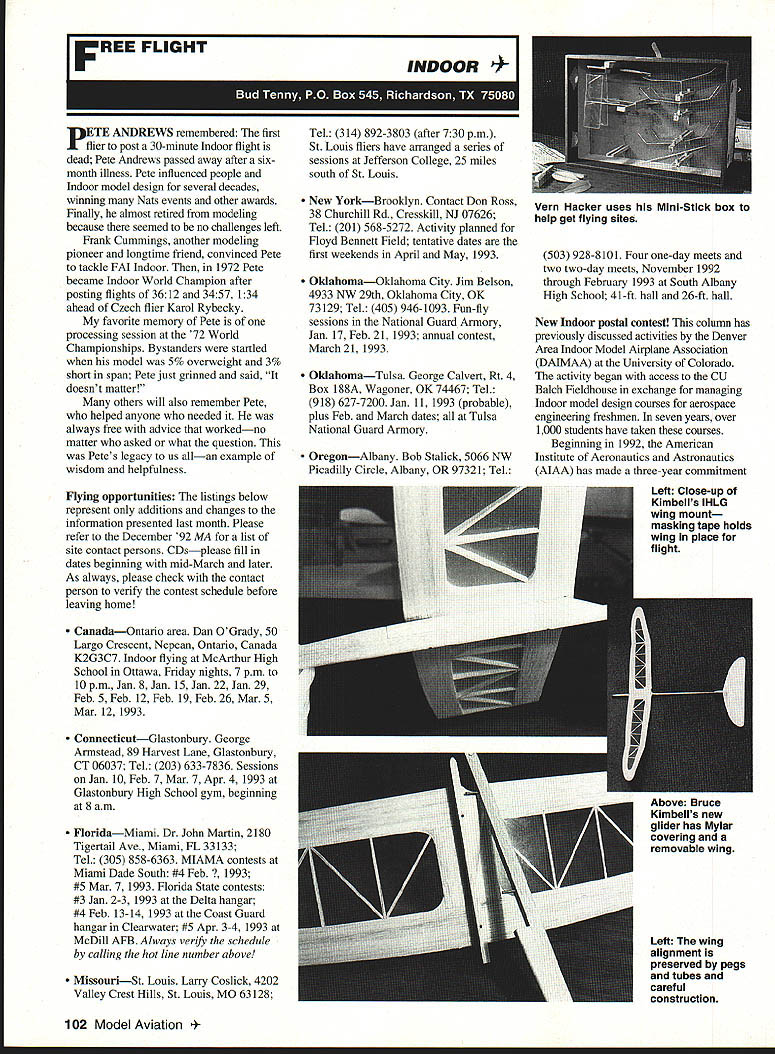
One of this month's photos shows Vern Hacker's Mini-Stick box, for which he has found an interesting use. In addition to storing his models in the box, Vern takes it to a prospective indoor site. When the site owner wants to know just what Vern means about flying model airplanes in his site, Vern has an immediate answer!
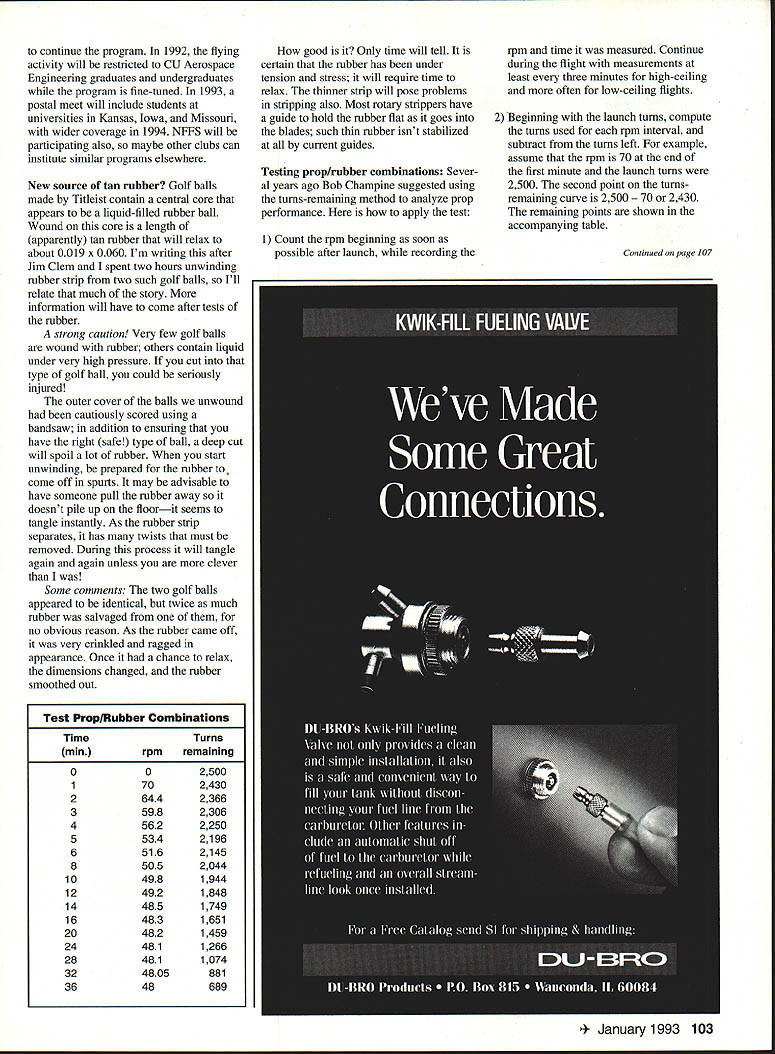
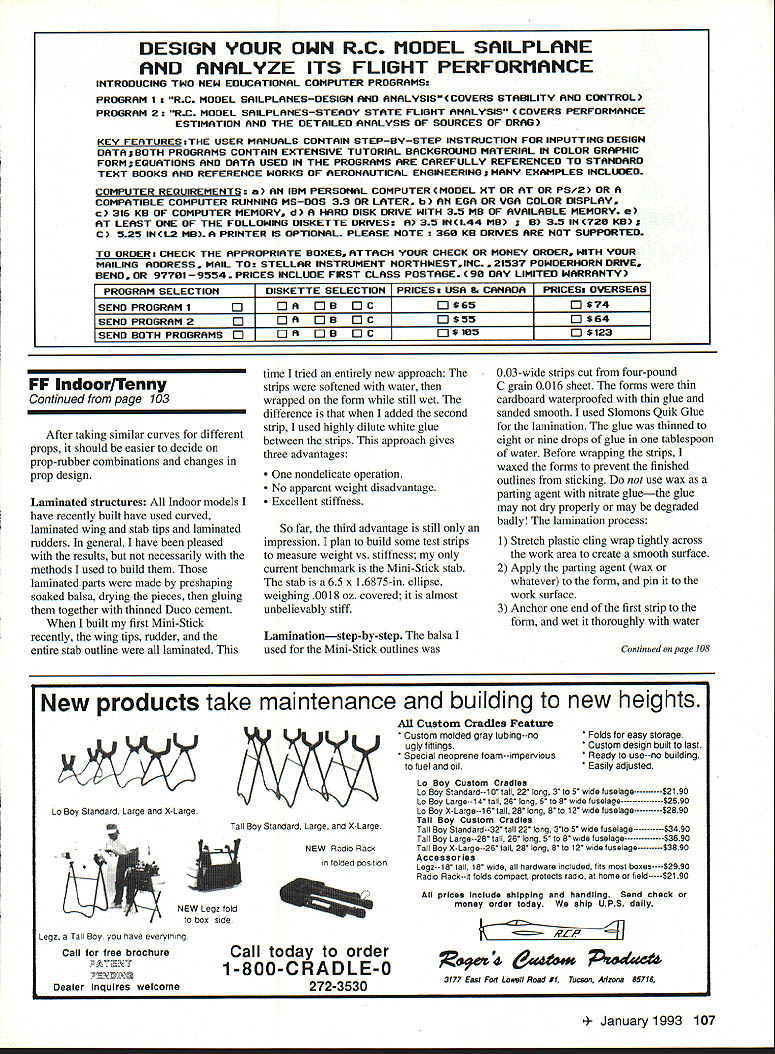
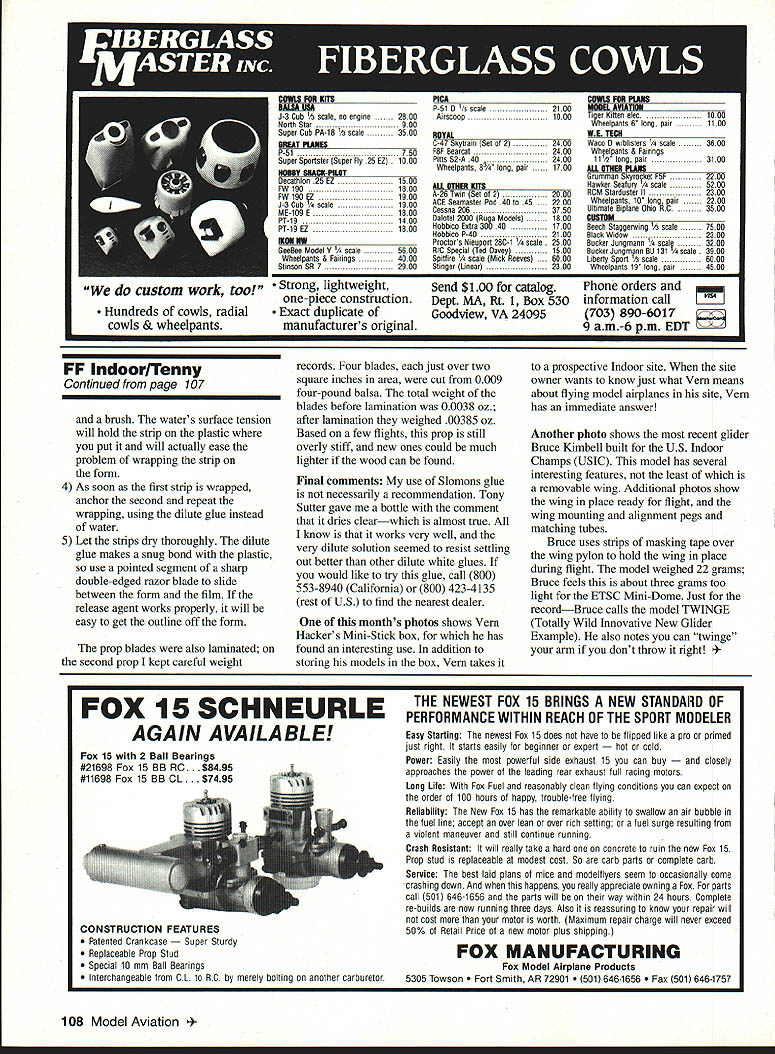
Another photo shows the most recent glider Bruce Kimbell built for the U.S. Indoor Champs. This model has several interesting features, not the least of which is a removable wing. Additional photos show the wing in place ready for flight, and the wing mounting and alignment pegs and matching tubes.
Bruce uses strips of masking tape over the wing pylon to hold the wing in place during flight. The model weighed 22 grams; Bruce feels this is about three grams too light for the ETSC Mini-Dome. Just for the record—Bruce calls the model TWINGE (Totally Wild Innovative New Glider Example). He also notes you can "twinge" your arm if you don't throw it right!
Transcribed from original scans by AI. Minor OCR errors may remain.

