
Free Flight: Indoor
Bud Tenney, P.O. Box 545, Richardson, TX 75080
Rubber Model Program Pack
Fred Rash is distributing the Rubber Model Program Pack, a set of BASIC programs that compute the following:
- Mean aerodynamic chord, projected area, horizontal tail volume, and longitudinal margin of stability.
- Propeller design: helical pitch, Larrabee outdoor rubber-model props, and indoor props.
- Maximum turns, maximum torque, winder turns, and torque turns for any motor when weight and unstretched length are known.
- A special routine for catapult-glider fliers — energy release from the launching rubber.
If you have an earlier copy, it covers items 1–3. The programs run directly on IBM PC–type computers and can be adapted to other BASIC dialects. Price: $25 for the program and documentation. Send to Fred Rash, 4614 Mitchell Rd., Kingsport, TN 37664. Tel.: 615-288-6568.
Flying opportunities
Listings below contain additions and changes to the information presented in the last column. Refer to the December 1992 MA for the full list of site contact persons. Always check the contact person to verify contest schedules before leaving home.
- Canada — Ontario area
Dan O’Grady, 50 Largo Crescent, Nepean, Ontario, Canada K2G 3C7. Indoor flying at McArthur High School, Ottawa — 23 ft 6 in ceiling. Friday nights, 7:00 p.m.–10:00 p.m. — February 26; March 5; March 12, 1993.
- Connecticut — Glastonbury
George Armstead, 89 Harvest Lane, Glastonbury, CT 06037. Tel.: 203-633-7836. Sessions March 7 and April 4, 1993. Glastonbury High School gym, beginning at 8:00 a.m.
- Florida — Miami
Dr. John Martin, 2180 Tigertail Ave., Miami, FL 33133. Tel.: 305-858-6363. MIAMA contests at the Tile Warehouse: #5 — March 7; #6 — May 30, 1993. Florida State contests: #5 — April 3–4; #6 — May 15–16, 1993. McDill AFB World Inter-Gnats Pistachio Proxy Meet, Youth Fair, Miami — April 24–25, 1993. Always verify schedule by calling the hotline number above.
- Kansas — Topeka
Jack Koehler, 3425 SW Arrowhead Rd., Topeka, KS 66614-3485. Tel.: 913-272-8439. Sessions in the Stone Hangar, 3600 Sardou, Topeka (weather permitting; planes moved out if good weather). Sessions February 28 and March 14, 1993. Fifth Kansas State Model Aircraft Championships (Class AAA), Whiting Field House, Topeka — 9:00 a.m.–5:00 p.m., April 17, 1993.
- Kansas — Wichita
Stan Chilton, 725 E. Lincoln, Wichita, KS 67211-3302. Tel.: 316-686-9634. Sessions in Friends University gym (28-ft ceiling) at Meridian and University — March 13 and April 3. Contest Director: Mike Tallman; Tel.: 316-524-4004.
- New York — Brooklyn
Contact Don Ross, 38 Churchill Rd., Cresskill, NJ 07626. Tel.: 201-568-5272. Activity planned for Floyd Bennett Field; tentative dates — first weekends in April and May, 1993.
- Oklahoma — Oklahoma City
Jim Belson, 4933 NW 29th, Oklahoma City, OK 73127. Tel.: 405-946-1093. Annual contest at the National Guard Armory, 200 NE 23rd, Oklahoma City.
- Oklahoma — Tulsa
George Calvert, Rt. 4, Box 188A, Wagoner, OK 74467. Tel.: 918-627-7200. Annual indoor contest March 13, 1993, at Tulsa National Guard Armory.
- Virginia — Newport News
Abram Van Dover, 112 Tillerson Dr., Newport News, VA 23602. Indoor sessions at the NASA Activity Building, 1:00 p.m.–6:00 p.m. — March 12, April 18, and May 2, 1993. Events include HLG, A, Easy B, Pennyplane, Peanut Scale, No-Cal, Bostonian, and MiniStick.
- Washington State — Seattle area
Ed Lamb, 15911 SE 424th Pl., Bellevue, WA 98006. Tel.: 206-747-7806. Or Steve Stubbs, 2119 NE 81st St., Seattle, WA 98115. Tel.: 206-522-7047. Monthly sessions October through April at Naval Reserve Training Center at Lake Union, usually on Saturdays.
- Wisconsin — Racine
Tony Italiano, 1655 Revere Dr., Brookfield, WI 53005. Tel.: 414-782-6256. The Bong Eagles have scheduled an indoor contest in Racine, Wisconsin — March 14, 1993, at the Racine Memorial Hall.
MiniStick Trim
Some previous comments hinted that the new MiniStick class is sensitive to power. To date, two models seem to show reduced power sensitivity — mine and Joe Krush’s winning model. While some models have shown an inability to use large amounts of rubber, Joe’s winning flight used a 14-in. loop of .026-in. tan and 2,650 turns without turning didos. Joe’s model has two special characteristics: a very high-pitch prop and twin rudders. The rudders are turned up vertically at the end of a 7-in. stab, and the model also has steeply upturned wingtips, giving additional vertical area.
My model has a huge rudder (visible in the December ’92 photo). I didn’t plan it that way; I free-handed a curve and built the rudder on the boom. By the time I saw how big it was, time was gone and I left it. After talking to Joe, I began to wonder if large rudder area is important on these models. We’re breaking new ground — why else do such tiny, relatively heavy models break 10 minutes in the first serious year of competition?
Anyone else using large rudders on MiniStick models or handling high power successfully? Let’s hear from you!
Improved winder hook?
Paul McIlrath offers an improvement for winder hooks. Many use O-rings on motors to preserve torque and turns at known levels; a side benefit is easy motor removal from the winder hook. Paul suggests a slotted winder hook to make it easy to transfer the motor to the prop hook.
Electronic turns/torque
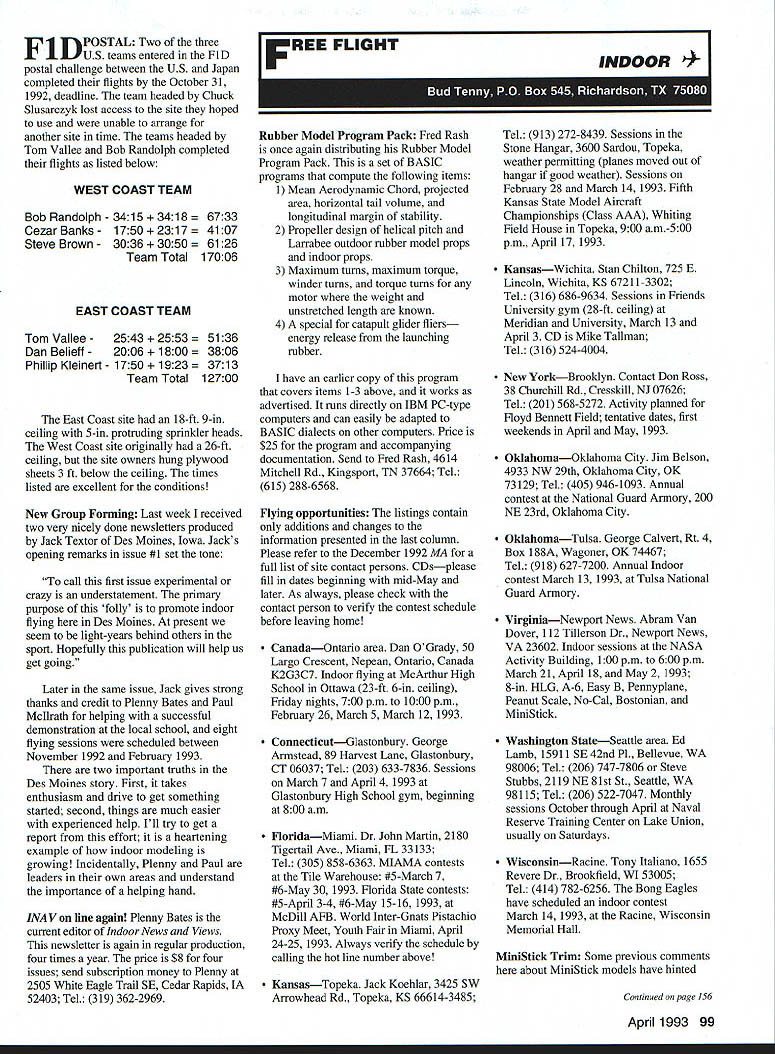
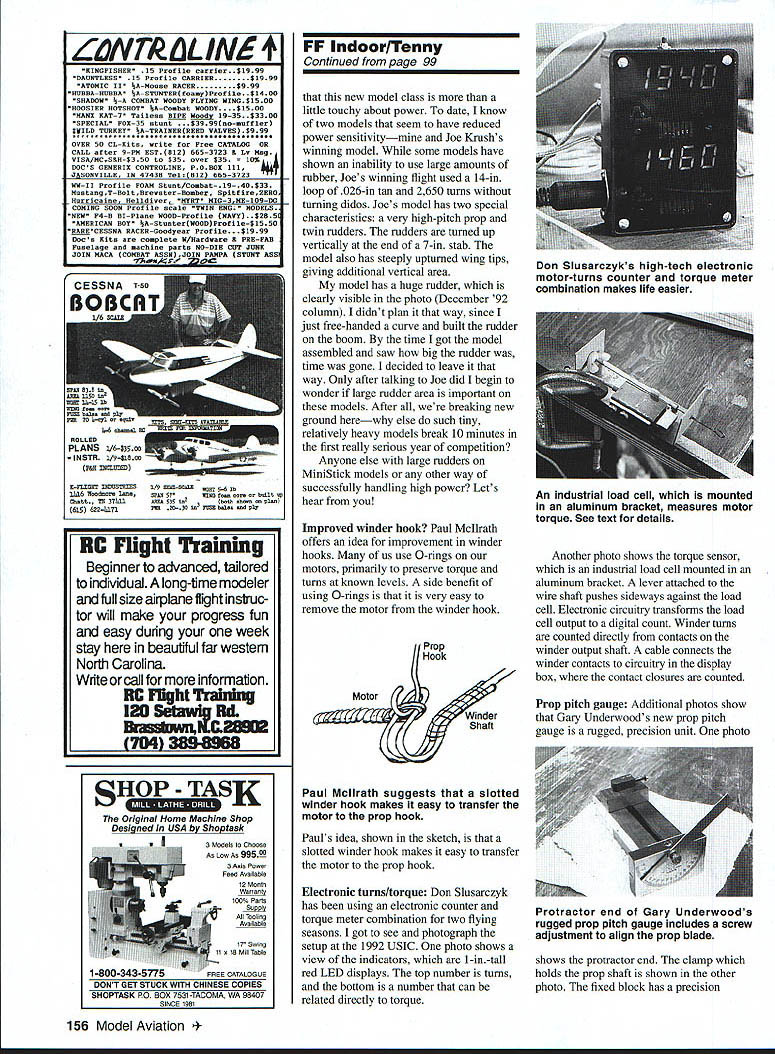
Don Slusarczyk has used an electronic counter and torque meter combination for two flying seasons. At the 1992 USIC I photographed his setup: the indicators are 1-in. tall red LED displays — the top number is turns, the bottom a number related directly to torque. The torque sensor is an industrial load cell mounted in an aluminum bracket. A lever attached to the wire shaft pushes sideways against the load cell; electronics convert the load cell output to a digital count. Winder turns are counted from contacts on the winder output shaft, with a cable to the display box where the closures are counted.
Prop pitch gauge
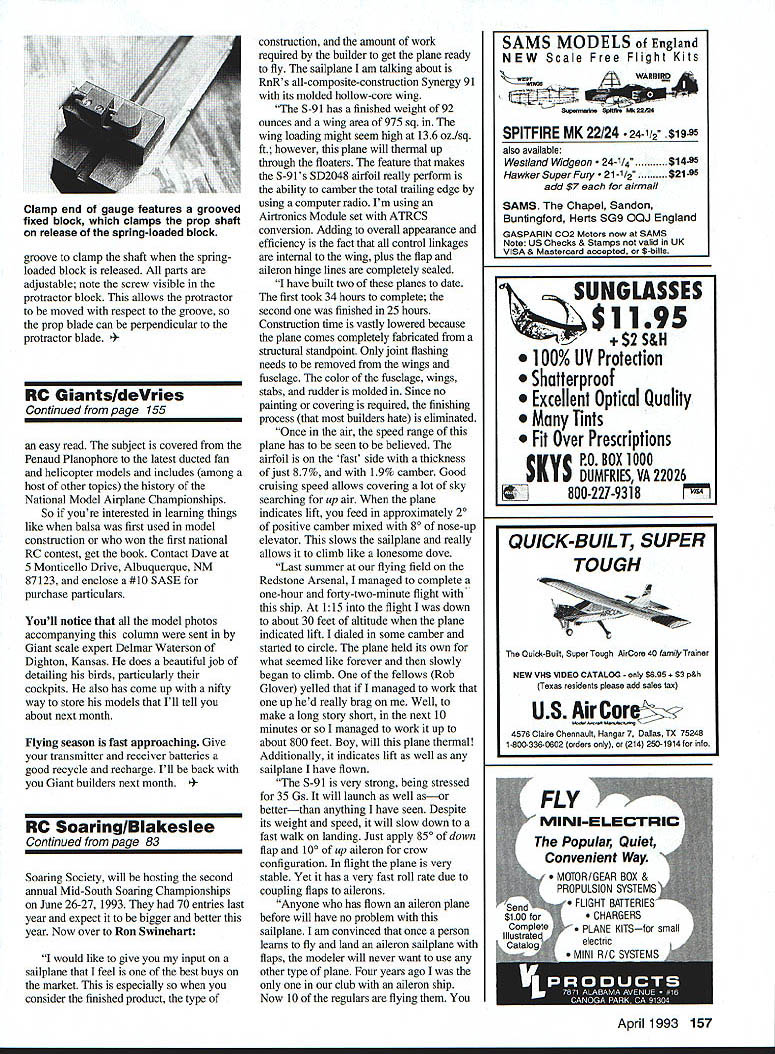
Gary Underwood’s new prop pitch gauge is a rugged, precision unit. Photos show the protractor end and the clamp that holds the prop shaft. The fixed block includes a precision adjustment to align the prop blade.
Postal (F1D postal challenge)
Two three-F1D teams entered the F1D postal challenge between the U.S. and Japan. Completed flights were due by October 31, 1992. The team headed by Chuck Slusarczyk lost access to the planned site and could not arrange another in time. The teams headed by Tom Vallee and Bob Randolph completed flights and are listed below.
WEST COAST TEAM
- Bob Randolph — 3415
- Cezar Banks — 1750 2317 4107
- Steve Brown — 3036
- Team Total — 17006
EAST COAST TEAM
- Tom Vallee — 2543
- Dan Beliefi — 2006
- Philip Kleinert — 1750
- Team Total — 12700
East Coast site: 18 ft 9 in ceiling; 5 in protruding sprinkler heads. West Coast site: originally 26-ft ceiling; site owners hung plywood sheets 3 ft below the ceiling. Times listed: excellent conditions.
New group forming
I received two nicely done newsletters by Jack Textor, Des Moines, Iowa. Jack’s opening remarks in issue #1 — “call this first issue experimental” — capture the tone. The primary purpose is to promote indoor flying in Des Moines, where activity seems behind other areas. Hopefully publication will help get things going.
Jack thanks Plenny Bates and Paul McIlrath for help with a successful school demonstration. Eight flying sessions are scheduled between November 1992 and February 1993. Two truths to the Des Moines story: enthusiasm and drive are required to start something; and things are much easier with experienced help. I’ll try to get a report — this effort is a heartening example of indoor modeling growth. Plenny and Paul are leaders in their own areas and understand the value of a helping hand.
INAV line
Plenny Bates is the current editor of Indoor News & Views (INAV) newsletter and has resumed regular production four times a year. Price: $8 for four issues. Send subscription money to Plenny Bates, 2505 White Eagle Trail SE, Cedar Rapids, IA 52403. Tel.: 319-362-2969.
Transcribed from original scans by AI. Minor OCR errors may remain.

