
Free Flight: Indoor
Quick change — 1993 Indoor Nats
After the FAA failed to grant timely clearance to use airport runways for outdoor events at Lubbock, Texas, the unified Nats concept was abandoned for 1993. The Indoor Nats will be held with the USIC, June 3–6, 1993. Tom Iacobellis will be the Contest Director (CD). Send Tom a SASE to receive entry blanks and other information:
Tom Iacobellis 198 Manhattan Ave. Hawthorne, NY 10532 Tel: (914) 592-5176 (day) or (914) 747-9038 (night)
U.S. Indoor Championships
The U.S. Indoor Champs will be held June 3–6, 1993, at the MiniDome, East Tennessee State University, Johnson City, Tennessee. Send a business-sized SASE to Tom Iacobellis (address above) for entry blanks and event information.
Advance note: a class for 35 cm microfilm-stick models has been added. These models are fun, easy to build, and easy to transport.
Tom will need volunteers to help run events and process data at the flight desk. Most entrants can spare time to work one event (as Event Director or processing) and to help record times and issue flight cards.
Kibbie Dome — Moscow, Idaho (July meet)
Andy Tagliafico has secured the Kibbie Dome in Moscow, Idaho, for July 15–18, 1993. A barbecue dinner is planned July 16 at 7:00 p.m. to help attendees get better acquainted. Note: the building has been freshly renovated. Andy will have 10-mil plastic to cover the track in front of the work tables, but contestants are advised to bring ground cloths to protect the plastic.
Free flight video available
The National Free Flight Society (NFFS) has announced a 42-minute documentary titled The Joy of Flying Free. It presents free flight sport and competition flying—indoor and outdoor—from gliders to gas-powered models. The tape is intended to inform civic groups, students, children, and the general public about free flight activity.
Price: $25 plus $3 postage and handling. Order from: NFFS 1655 Revere Dr. Brookfield, WI 53045
FLD international postal meet results
Tom Vallee reports the following posted times from the recent international FLD postal meet:
- Bob Randolph — 3315
- Satoshi Kinoshita — 3039
- Steve Brown — 3036
- Shigeyoshi Nonaka — 2621
- Toshiaki Okada — 2637
- Kazumasa Kihara — 2614
- Tom Vallee — 2543
- Ryosuke Harada — 1651
- Kenichi Ohota — 2321
- Hideyo Enomoto — 2230
- Cezar Banks — 1750
- Dan Belieff — 2006
- Phillip Kleinert — 1750
- Ryuuji Matuzawa — 1653
- Isao Hamada — 1534
Team standings:
- USA West — 17006
- Japan Kawasaki — 16007
- Japan Tokyo — 14321
- USA East — 12700
- Japan Nagoya — 11700
Chinese indoor flying
Ed Whitten has been corresponding with an indoor flier in Beijing. Most Chinese indoor fliers are beginners, and Shanghai holds a yearly citywide contest. The correspondent hoped China could send a team to the 1994 World Championship.
Finding indoor flying sites
Where do we fly? Active sites are usually found either by diligent search or by accident.
Example: Cliff Culpepper (1401 Ferncliff Rd., Charlotte, NC 28211; Tel: (704) 366-7350) discovered an active indoor site used weekly year-round in a church gymnasium after passing by on a rainy afternoon. He discussed use with the pastor and now has keys. The gym is 45 ft × 65 ft with a 26-ft domed ceiling and recessed fixtures. Cliff welcomes additional fliers; two regulars travel 100 miles to fly.
Morals:
- Keep searching and don’t pass up reasonable opportunities.
- Always leave the premises cleaner than you found them. Even small trash (broken motors, scrap tissue) should be cleaned up to maintain good relations with site owners.
Flying opportunities
Always call the contact person before each meet—schedules sometimes change.
- California — Marin County. Contact: Tom Brennan, 21326 Via Colombard, Sonoma, CA 95476; Tel: (707) 938-2893.
Temporary wing mounts (John Pakiz)
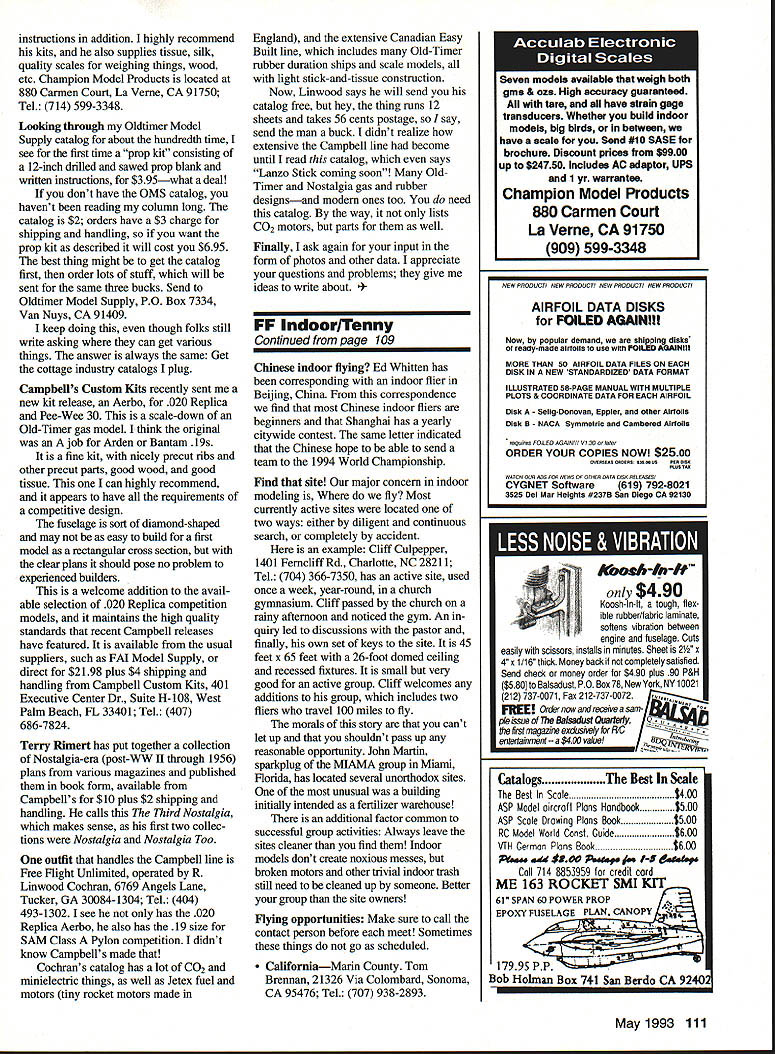
John Pakiz (Omaha, NE), a sparkplug of indoor activity, suggests a simple temporary wing-mounting solution for determining wing-post placement: create U-shaped channels sized for a friction fit on the wing posts (Figure referenced by original author).
John’s instructions:
- Balance the EZB fuselage with prop and rubber attached, but without the wing.
- Mark the balance point.
- Mount the front wing post two inches ahead of the balance point and the rear post one inch behind.
- Slide the wing fore or aft in the slots as needed; when the correct location is found, make the permanent wing mounting system.
- Attach anchors with a liquid-based adhesive for easy removal if desired.
Catapult glider classes (proposed for 1994)
Two classes have been proposed:
- Standard class: 12-inch span and 3-inch maximum chord (as used at USIC and other contests).
- Unlimited class: 100 square-inch maximum area.
The proposal should broaden opportunities for those who prefer catapult models to high-ceiling indoor hand-launched gliders.
A trim problem (PIO-like oscillation)
Bob Randolph asks about small models (Peanut Scale and MiniStick) that, at low power and after level cruise, begin a series of horizontal oscillations resembling pilot-induced oscillation (PIO). Possible cause and remedy:
- One hypothesis: at a critical airspeed the lift ratio between wing and stabilizer shifts enough for the nose to drop; the dive increases speed and flips the ratio back, producing oscillation.
- Possible cure: change the camber of the wing or stabilizer.
- The author invites additional ideas from readers.
Bracing techniques (Stan Chilton)
Bracing reprise:
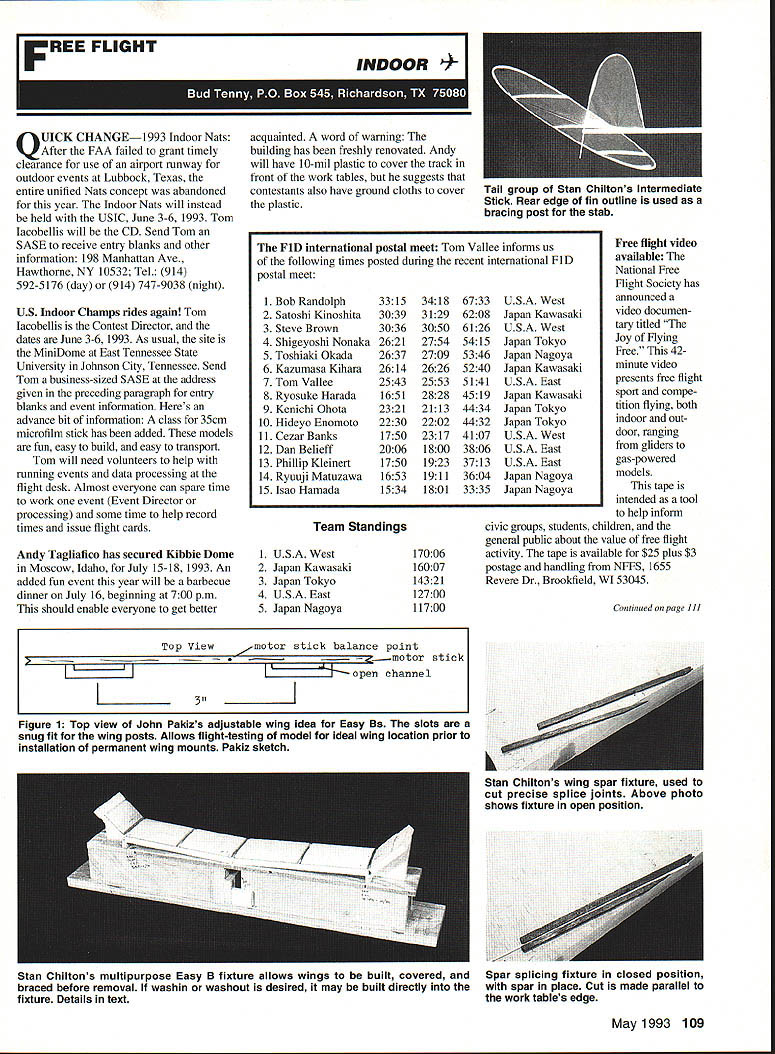
- Stan Chilton uses a tail-bracing scheme on one of his Intermediate Stick models where the fin is glued at the front and held at the rear by a tissue tube. The rear edge of the fin outline passes through the tissue tube; the stabilizer is braced normally using the fin outline as a bracing post. The stab is anchored at the front and supported by bracing wires.
Bracing fixture:
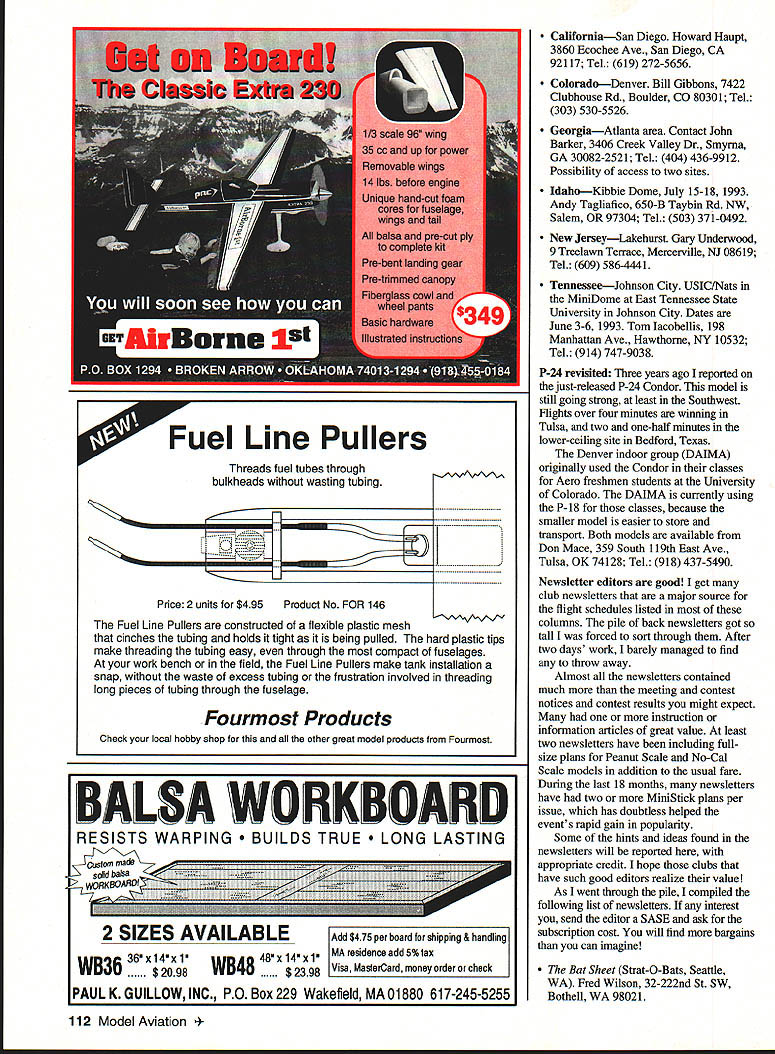
- Stan’s multipurpose Easy B fixture is used for building, covering, and bracing. Wing framework is built first directly on the fixture, then covered, and finally braced. Although not visible in the referenced photo, preplanned wash-in or washout can be built into the fixture. By combining wing offset and variable airfoil thickness, Stan has worked on minimizing or eliminating wash-in/washout.
MiniStick notes (Peter Kearney, Ontario)
Peter Kearney describes his MiniStick development:
- Initial flights had the characteristic “spiral of death.” After trimming, he managed about a 6:30 flight before giving up.
- At Lakehurst he added an Ultrafilm “pylon” similar to one that improved Chilton’s model; that alone didn’t solve the problem.
- Stan Chilton suggested mounting the rudder on the bottom of the boom and moving the wing aft. With partial turns and half torque, the model achieved nearly eight minutes after climbing ~150 ft.
- Stan then supplied a 15-inch motor of tan rubber, wound to 2,200 turns. The model climbed slowly to about 140 ft and dead-sticked at 9:27. A subsequent try with 1,000 more turns broke the motor and then the model; it was getting dark, so further testing was cut short.
Precise joints (Stan Chilton)
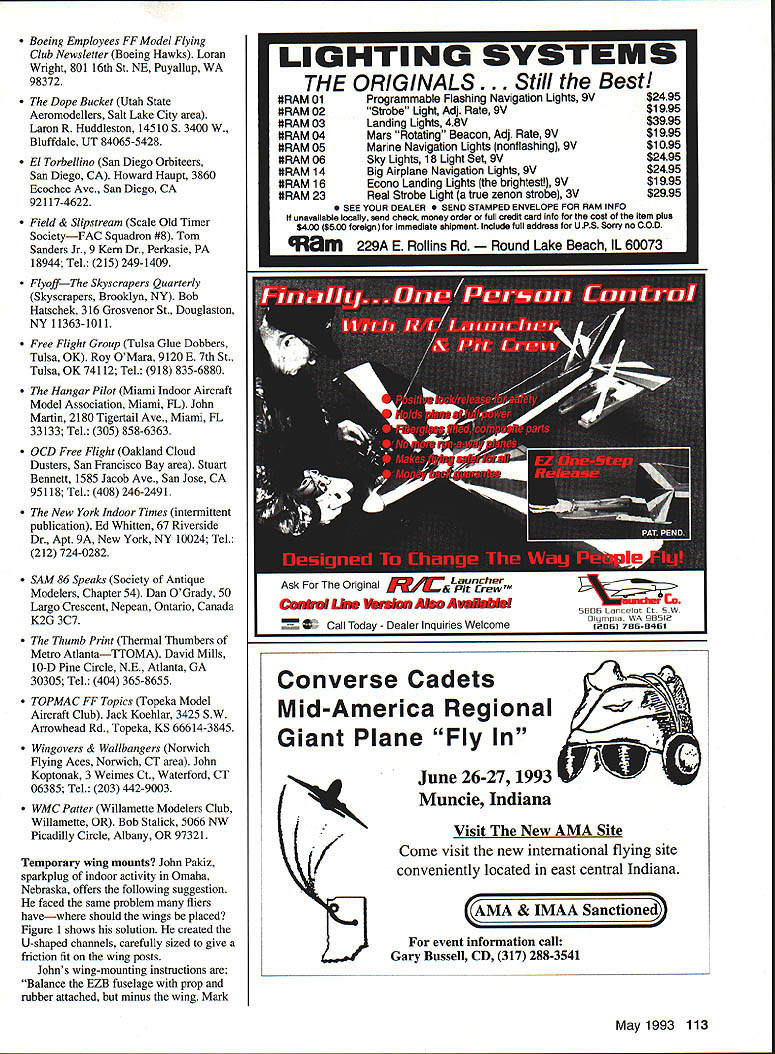
Stan uses a special fixture to cut precise splices for wing spars. One photo shows the fixture open; another shows the spar in place. After positioning, the cut is made parallel to the edge of the work table to ensure accurate joints.
Transcribed from original scans by AI. Minor OCR errors may remain.

