
FREE FLIGHT INDOOR
Bud Tenny, P.O. Box 545, Richardson, TX 75080
LARRY COSLICK
At last year's USIC, Larry Coslick seemed to appear out of nowhere to post some really good times. It is no accident—Larry works really hard to develop his skills. We will hear about several of his techniques as space permits; meanwhile, he offers the following concept as food for thought:
How about a "no touch" Easy B contest?
It would be interesting! It might be flown in rounds, starting with five-, eight-, 10-, 11-, and 12-minute goals. Allow two attempts for each target time, and, if your model touches the ceiling it is disqualified. Also, two events could be held: one for models lighter than 0.7 grams and the other for heavier models. Any takers?
Flying opportunities
- Ohio — Cleveland area. Weekly sessions year-round in Category I sites. One site is in Willoughby at the Andrews School, which has a 20-foot flat ceiling with a 60 x 80-foot floor area. The other site, at Meridian Euclid Hospital in Euclid, has a 19.5-foot ceiling and a 45 x 70-foot floor area. Contact Vern Hacker, 25599 Breckenridge Dr., Euclid, OH 44117-1807; Tel.: (216) 486-4990.
- California — Burbank. The Blacksheep Exhibition Squadron (VMF-214) has monthly sessions on second Fridays; flying in Category I site at Luther Burbank Middle School; 7–10 p.m. Tony Naccarato, 2121 N. Hollywood Way, Burbank, CA 91507; Tel.: (818) 842-5062.
- Maryland — Goddard Space Flight Center. Record trials and flying sessions scheduled in the auditorium of Building 8 at Goddard on Saturdays, 11 a.m. until 10:30 p.m.; June 26, July 17, September 11 and 25, October 9 and 23, and November 6, 1993. Sanctioned national and FAI record trials on September 11 and 25, October 9 and 23, and November 6.
NASA security requires attendees to be U.S. citizens and AMA members, with license available for inspection at the gate, and to be on a list compiled by Tom Vallee. You must notify Tom of your intent to attend in advance of each meet. Changes in NASA launch schedules and other possible events can preempt use of the auditorium without much warning; be sure to verify the date with Tom before leaving home. Tom Vallee, 444 Henryton South, Laurel, MD 20707; Tel.: (301) 498-0790.
- New Jersey — Lakehurst. New dates for Lakehurst #1 began the May 1–2 weekend. Other dates are August 7–8, 14–15, 21–22, and 28–29; September 4–6, 11–12, 18–19, 25–26; Oct. 2–3, 9–10, 17, 24. Contact Gary Underwood to make the necessary arrangements for access to Lakehurst NAS.
Attendance at Lakehurst meets requires strict adherence to these rules:
- You must furnish your name, driver's license number, make and model of vehicle, license plate number and state registration to Gary Underwood no later than the Wednesday before the meet you plan to attend.
- Obey all military regulations—especially speed limits, no-smoking areas, and restricted parking—all of which are clearly posted.
- Certain base personnel give access to lavatories and other facilities. Please route requests for assistance through the Contest Director (CD).
- You absolutely must leave the flying area at least as clean as you find it; check with the CD about where to locate your equipment.
- No photos allowed, except in the hangar.
Out-of-town participants who fly in and rent cars must make special arrangements regarding auto identification. Contact Gary Underwood, 9 Treelawn Terrace, Mercerville, NJ 08619; Tel.: (609) 586-3202 for more information.
Built-up booms
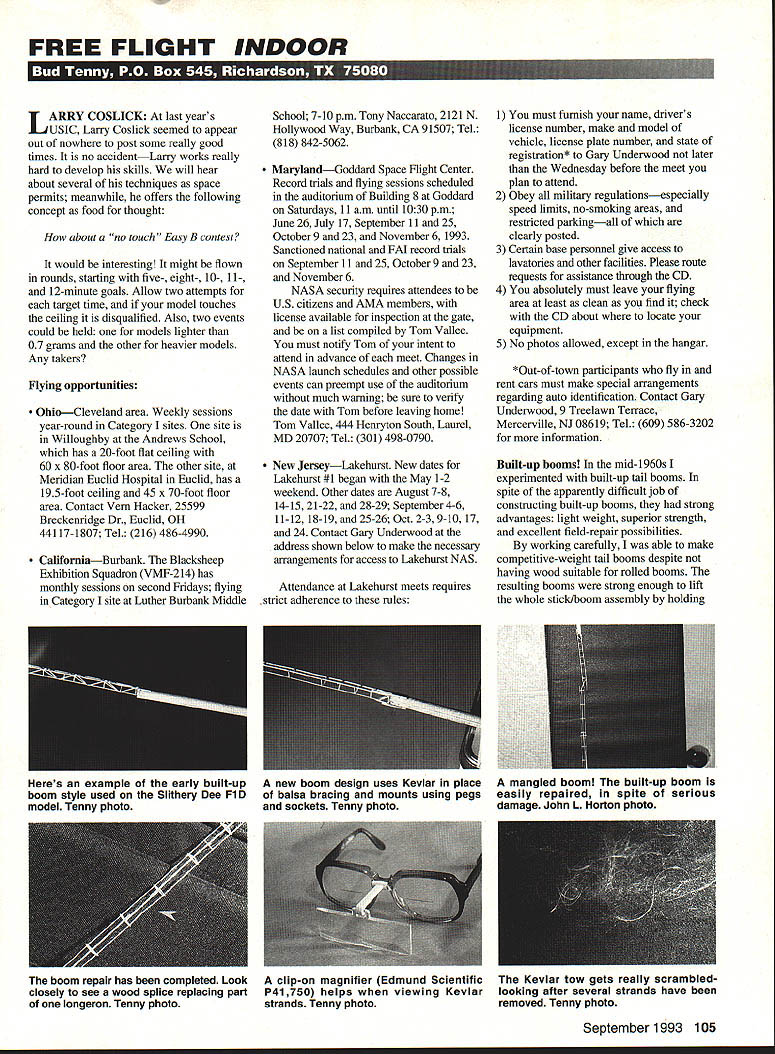
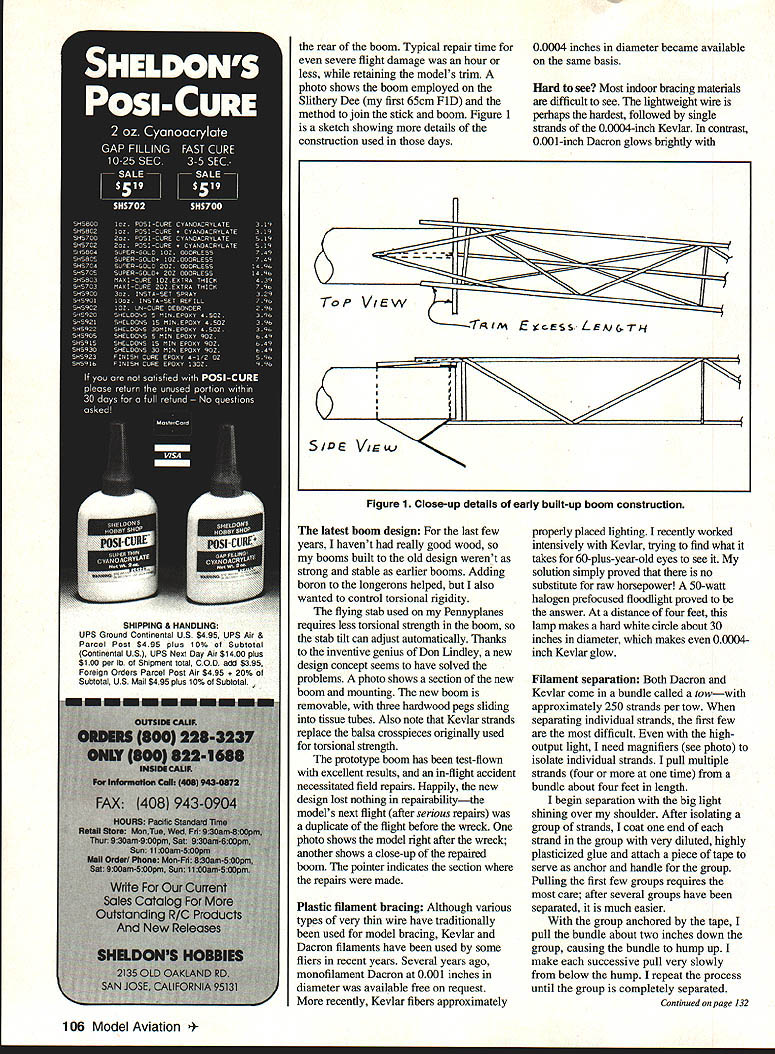
In the mid-1960s I experimented with built-up tail booms. In spite of the apparently difficult job of constructing built-up booms, they had strong advantages: light weight, superior strength, and excellent field-repair possibilities. By working carefully, I was able to make competitive-weight tail booms despite not having wood suitable for rolled booms. The resulting booms were strong enough to lift the whole stick/boom assembly.
The latest boom design
For the last few years, I haven't had really good wood, so my booms built to the old design weren't as strong and stable as earlier booms. Adding boron to the longerons helped, but I also wanted to control torsional rigidity.
The flying stab used on my Pennyplanes requires less torsional strength in the boom, so the stab tilt can adjust automatically. Thanks to the inventive genius of Don Lindley, a new design concept seems to have solved the problems. A photo shows a section of the new boom and mounting. The new boom is removable, with three hardwood pegs sliding into tissue tubes. Also note that Kevlar strands replace the balsa crosspieces originally used for torsional strength.
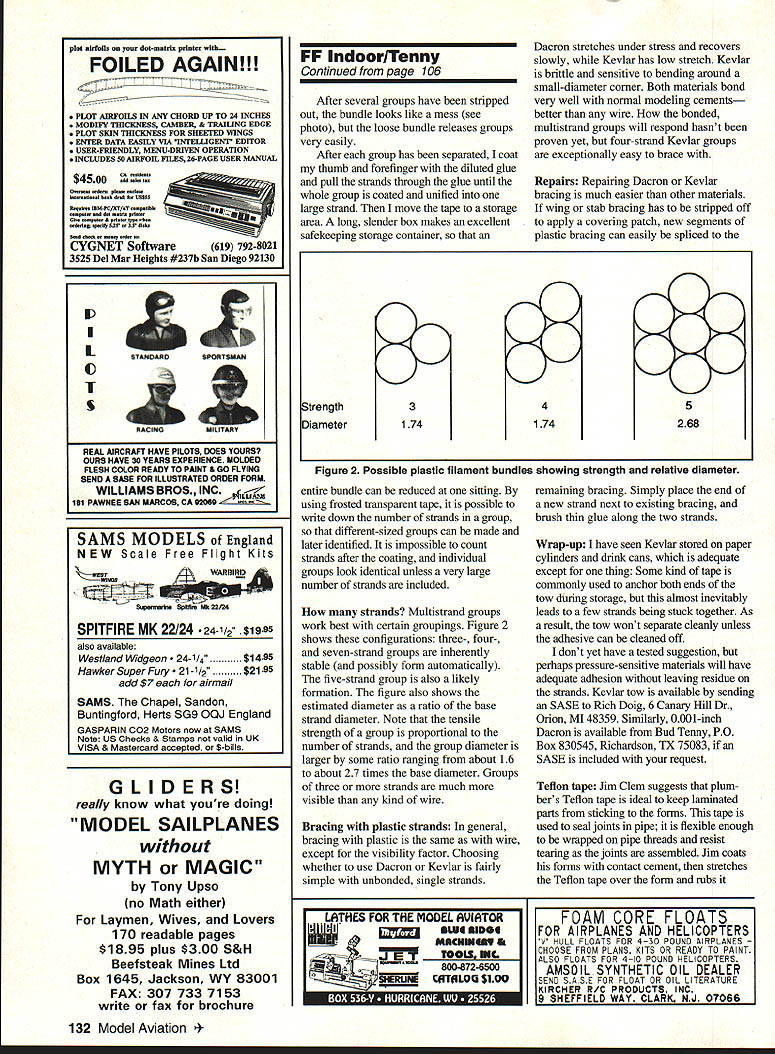
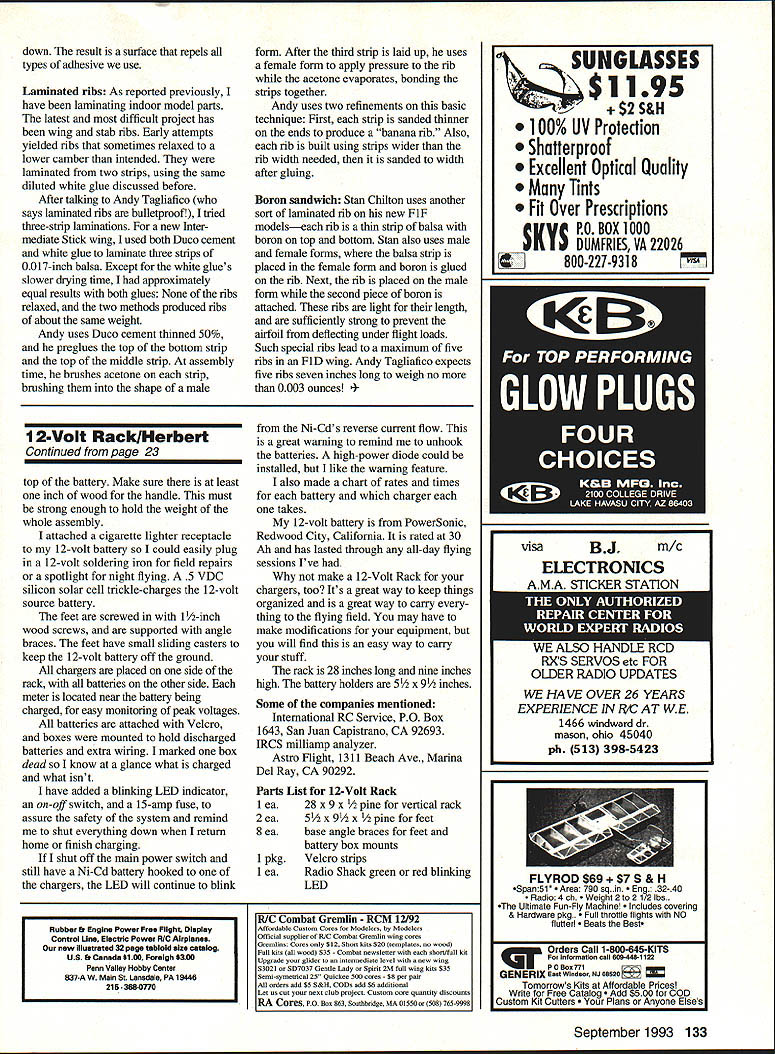
The prototype boom has been test-flown with excellent results, and in an in-flight accident necessitated field repairs. Happily, the new design lost nothing in repairability—the model's next flight (after serious repairs) was a duplicate of the flight before the wreck. One photo shows the model right after the wreck; another shows a close-up of the repaired boom. The pointer indicates the section where the repairs were made.
Plastic filament bracing
Although various types of very thin wire have traditionally been used for model bracing, Kevlar and Dacron filaments have been used by some fliers in recent years. Several years ago, monofilament Dacron at 0.001 inch in diameter was available free on request. More recently, Kevlar fibers approximately 0.0004 inch in diameter became available on the same basis.
Hard to see? Most indoor bracing materials are difficult to see. The lightweight wire is perhaps the hardest, followed by single strands of the 0.0004-inch Kevlar. In contrast, 0.001-inch Dacron glows brightly with properly placed lighting. I recently worked intensively with Kevlar, trying to find what it takes for 60-plus-year-old eyes to see it. My solution simply proved that there is no substitute for raw horsepower! A 50-watt halogen prefocused floodlight proved to be the answer. At a distance of four feet, this lamp makes a hard white circle about 30 inches in diameter, which makes even 0.0004-inch Kevlar glow.
Filament separation
Both Dacron and Kevlar come in a bundle called a tow—approximately 250 strands per tow. When separating individual strands, the first few are the most difficult. Even with the high-output light, I need magnifiers to isolate individual strands. I pull multiple strands (two or more at one time) from a bundle about four feet in length.
I begin separation with the big light shining over my shoulder. After isolating a group of strands, I coat one end of the group with very diluted, highly plasticized dope and attach a piece of 0.002-inch music wire to serve as an anchor and handle for the group. Pulling the first few groups requires the most care; after several groups have been separated, it is much easier.
With the group anchored by the tape, I pull the bundle about two inches down the group, causing the bundle to hump up. I make each successive pull very slowly from below the hump. I repeat the process until the group is completely separated.
After several groups have been stripped out, the bundle looks like a mess, but the loose bundle releases groups very easily.
After each group has been separated, I coat my thumb and forefinger with the diluted glue and pull the strands through the glue until the whole group is coated and unified into one large strand. Then I move the tape to a storage area. A long, slender box makes an excellent safekeeping storage container, so that an entire bundle can be reduced at one sitting. By using frosted transparent tape, it is possible to write down the number of strands in a group, so that different-sized groups can be made and later identified. It is impossible to count strands after the coating, and individual groups look identical unless a very large number of strands are included.
How many strands? Multistrand groups work best with certain groupings. Three-, four-, and seven-strand groups are inherently stable (and possibly form automatically). The five-strand group is also a likely formation. The estimated diameter is a ratio of the base strand diameter. Note that the tensile strength of a group is proportional to the number of strands, and the group diameter is larger by some ratio ranging from about 1.6 to about 2.7 times the base diameter. Groups of three or more strands are much more visible than any kind of wire.
Bracing with plastic strands
In general, bracing with plastic is the same as with wire, except for the visibility factor. Choosing whether to use Dacron or Kevlar is fairly simple with unbonded, single strands.
Dacron stretches under stress and recovers slowly, while Kevlar has low stretch. Kevlar is brittle and sensitive to bending around a small-diameter corner. Both materials bond very well with normal modeling cements—better than any wire. How the bonded, multistrand groups will respond hasn't been proven yet, but four-strand Kevlar groups are exceptionally easy to brace with.
Repairs
Repairing Dacron or Kevlar bracing is much easier than other materials. If wing or stab bracing has to be stripped off to apply a covering patch, new segments of plastic bracing can easily be spliced to the remaining bracing. Simply place the end of a new strand next to existing bracing, and brush thin glue along the two strands.
Wrap-up
I have seen Kevlar stored on paper cylinders and drink cans, which is adequate except for one thing: some kinds of tape are commonly used to anchor both ends of the bundle during storage, and this almost inevitably leads to a few strands being stuck together. As a result, the tow won't separate cleanly unless it is cleaned before use.
I don't yet have a tested suggestion, but perhaps pressure-sensitive materials will have adequate adhesion without leaving residues on the strands. Kevlar tow is available by sending an SASE to Rich Doig, 6 Canary Hill Dr., Orion, MI 48359. Similarly, 0.001-inch Dacron is available from Bud Tenny, P.O. Box 545, Richardson, TX 75080, if an SASE is included with your request.
Teflon tape
Jim Clem suggests that plumbers' Teflon tape is ideal to keep lamination parts from sticking to the forms. This tape is used to seal joints in pipe; it is flexible enough to be wrapped on pipe threads and resists tearing as the joints are assembled. Jim coats the forms with contact cement, then stretches the Teflon tape over the form and rubs it in place with a cloth. After the forms are used, the tape can be removed and reused.
Laminated ribs
As reported previously, I have been laminating indoor model parts. The latest and most difficult project has been wing and stab ribs. Early attempts yielded ribs that sometimes relaxed to a lower camber than intended. They were laminated from two strips, using the same diluted white glue discussed before.
After talking to Andy Tagliafico (who says laminated ribs are bulletproof), I tried three-strip laminations. For a new intermediate Stick wing, I used both Duco cement and white glue to laminate three strips of 0.017-inch balsa. Except for the white glue's slower drying time, I had approximately equal results with both glues: none of the ribs relaxed, and the two methods produced ribs of about the same weight.
Andy uses Duco cement thinned 50%, and he preglues the top of the bottom strip and the top of the middle strip. At assembly time, he brushes acetone on each strip, brushing them into the shape of a male form. After the third strip is laid up, he uses a female form to apply pressure to the rib while the acetone evaporates, bonding the strips together.
Andy uses two refinements on this basic technique: first, each strip is sanded thinner on the ends to produce a "banana rib." Also, each rib is built using strips wider than the rib width needed, then it is sanded to width after gluing.
Boron sandwich
Stan Chilton uses another sort of laminated rib on his new F1D models—each rib is a thin strip of balsa with boron on top and bottom. Stan also uses male and female forms, where the balsa strip is placed in the male form and boron is glued on the rib. Next, the rib is placed on the male form while the second piece of boron is attached. These ribs are light for their length, and are sufficiently strong to prevent the airfoil from deflecting under flight loads. Such special ribs lead to a maximum of five ribs in an F1D wing. Andy Tagliafico expects five ribs seven inches long to weigh no more than 0.003 ounces.
Transcribed from original scans by AI. Minor OCR errors may remain.

