



FREE FLIGHT: INDOOR
Bud Tenney, P.O. Box 830545, Richardson, TX 75083
A tragic accident
In early May, Don and Jane Lindley were involved in an automobile accident. Jane suffered severe bruises and two broken fingers, but Don was much more seriously injured. Two weeks later, friends were hopeful as Don seemed to be recovering.
On May 27, Don succumbed to a suspected pulmonary embolism. His passing leaves a large hole in the lives of his friends. Don’s many years of hard work on behalf of modeling and the Academy of Model Aeronautics are a lasting legacy. On the modeling side, Don’s advice and counsel solved problems and advanced the state of the art for many of us. We miss him.
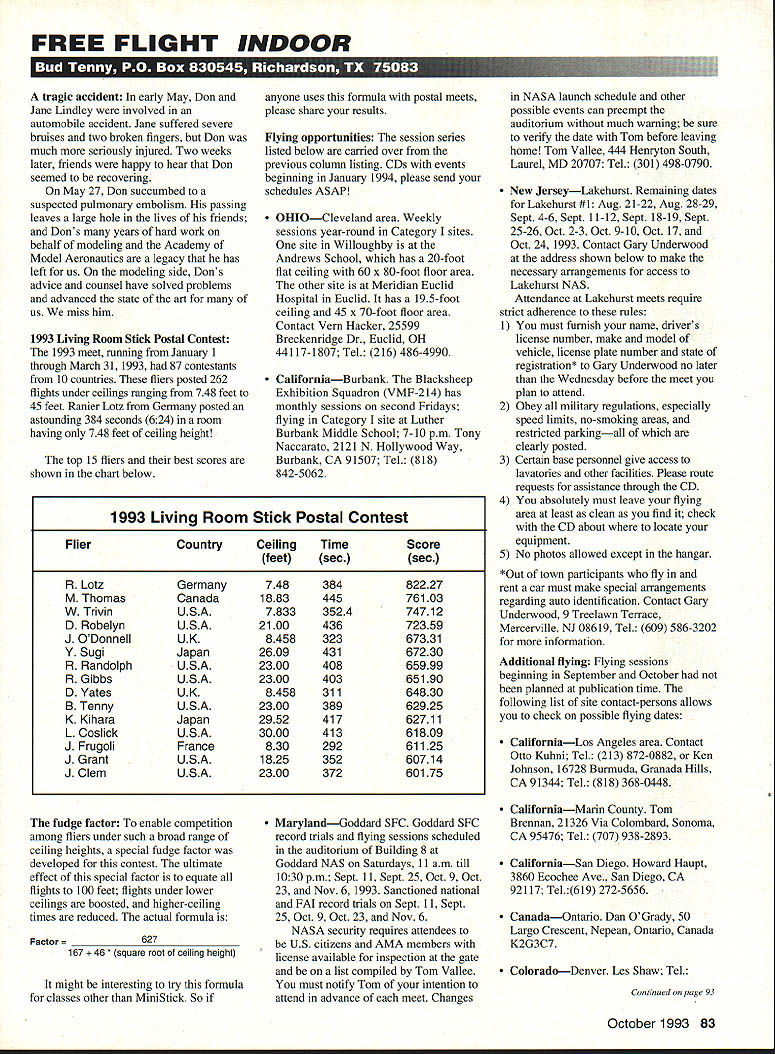
1993 Living Room Stick Postal Contest
The 1993 meet, running from January 1 through March 31, 1993, had 87 contestants from 10 countries. These fliers posted 262 flights under ceilings ranging from 7.48 feet to 45 feet. Rainer Lotz from Germany posted an astounding 384 seconds (6:24) in a room having only 7.48 feet of ceiling height!
Top 15 fliers and their best scores:
- R. Lotz, Germany — Ceiling: 7.48 ft — Time: 384 sec — Score: 822.27
- M. Thomas, Canada — Ceiling: 18.83 ft — Time: 445 sec — Score: 761.03
- W. Trivin, U.S.A. — Ceiling: 7.83 ft — Time: 352.4 sec — Score: 747.12
- D. Robelyn, U.S.A. — Ceiling: 21.00 ft — Time: 436 sec — Score: 723.59
- J. O'Donnell, U.K. — Ceiling: 8.45 ft — Time: 323 sec — Score: 673.31
- Y. Sugi, Japan — Ceiling: 26.09 ft — Time: 431 sec — Score: 672.30
- R. Randolph, U.S.A. — Ceiling: 23.00 ft — Time: 408 sec — Score: 659.99
- R. Gibbs, U.S.A. — Ceiling: 23.00 ft — Time: 403 sec — Score: 651.90
- D. Yates, U.K. — Ceiling: 8.45 ft — Time: 311 sec — Score: 648.30
- B. Tenney, U.S.A. — Ceiling: 23.00 ft — Time: 389 sec — Score: 629.25
- K. Kihara, Japan — Ceiling: 29.52 ft — Time: 417 sec — Score: 627.11
- L. Coslick, U.S.A. — Ceiling: 30.00 ft — Time: 413 sec — Score: 618.09
- J. Frugoli, France — Ceiling: 8.30 ft — Time: 292 sec — Score: 611.25
- J. Grant, U.S.A. — Ceiling: 18.25 ft — Time: 352 sec — Score: 607.14
- J. Clem, U.S.A. — Ceiling: 23.00 ft — Time: 372 sec — Score: 601.75
The fudge factor: To enable competition among fliers under such a broad range of ceiling heights, a special fudge factor was developed for this contest. The effect is to equate all flights to 100 feet: flights under lower ceilings are boosted, and higher-ceiling times are reduced. The formula is:
Factor = 627 / (167 + 46 × sqrt(ceiling height))
It might be interesting to try this formula for classes other than MiniStick. If anyone uses this formula with postal meets, please share your results.
Flying opportunities
The session series listed below are carried over from the previous column listing. CDs with events beginning in January 1994, please send your schedules ASAP!
- OHIO — Cleveland area. Weekly sessions year-round in Category I sites. Andrews School (Willoughby): 20‑ft flat ceiling, 60 × 80 ft floor area. Meridian Euclid Hospital (Euclid): 19.5‑ft ceiling, 45 × 70 ft floor area. Contact Vern Hacker, 25599 Breckenridge Dr., Euclid, OH 44117-1807; Tel.: (216) 486-4990.
- California — Burbank. Black Sheep Exhibition Squadron (VMF-214) monthly sessions on second Fridays; Category I site at Luther Burbank Middle School, 7–10 p.m. Contact Tony Naccarato, 2121 N. Hollywood Way, Burbank, CA 91507; Tel.: (818) 842-5062.
- Maryland — Goddard SFC. Goddard SFC record trials and flying sessions in the auditorium of Building 8 at Goddard NAS on Saturdays, 11 a.m. to 10:30 p.m.: Sept. 11, Sept. 25, Oct. 9, Oct. 23, and Nov. 6, 1993. Sanctioned national FAT record trials same dates. NASA security requires attendees to be U.S. citizens and AMA members with license available for inspection at the gate and be on a list compiled by Tom Vallee. You must notify Tom of your intention to attend in advance of each meet. Changes in NASA launch schedule and other events can preempt the auditorium without much warning; verify the date with Tom before leaving home. Contact Tom Vallee, 444 Henryton South, Laurel, MD 20707; Tel.: (301) 498-0790.
- New Jersey — Lakehurst. Remaining Lakehurst #1 dates: Aug. 21–22, Aug. 28–29, Sept. 4–6, Sept. 11–12, Sept. 18–19, Sept. 25–26, Oct. 2–3, Oct. 9–10, Oct. 17, Oct. 24, 1993. Contact Gary Underwood to arrange access to Lakehurst NAS. Attendance at Lakehurst meets requires strict adherence to these rules:
- You must furnish your name, driver's license number, make and model of vehicle, license plate number and state of registration to Gary Underwood no later than the Wednesday before the meet you plan to attend.
- Obey all military regulations, especially speed limits, no-smoking areas, and restricted parking—all of which are clearly posted.
- Certain base personnel give access to lavatories and other facilities. Please route requests for assistance through the CD.
- You absolutely must leave the flying area at least as clean as you found it; check with the CD about where to locate your equipment.
- No photos allowed except in the hangar.
Out-of-town participants who fly in and rent a car must make special arrangements regarding auto identification. Contact Gary Underwood, 9 Treelawn Terrace, Mercerville, NJ 08619; Tel.: (609) 586-3202 for more information.
Additional flying: Flying sessions beginning in September and October had not been planned at publication time. The following site contact persons allow you to check on possible flying dates:
- California — Los Angeles area. Contact Otto Kuhni; Tel.: (213) 872-0882, or Ken Johnson, 16728 Bermuda, Granada Hills, CA 91344; Tel.: (818) 368-0448.
- California — Marin County. Tom Brennan, 21326 Via Colombard, Sonoma, CA 95476; Tel.: (707) 938-2893.
- California — San Diego. Howard Haupt, 3860 Ecochee Ave., San Diego, CA 92117; Tel.: (619) 272-5656.
- Canada — Ontario. Dan O'Grady, 50 Largo Crescent, Nepean, Ontario, Canada K2G 3C7.
- Colorado — Denver. Les Shaw; Tel.: (contact).
- Connecticut — Glastonbury. George Armstead, 89 Harvest Lane, Glastonbury, CT 06037; Tel.: (203) 633-7836.
- Connecticut — Norwich. Jerry Beckius, 48 Division St., Norwich, CT 06360; Tel.: (203) 887-5879.
- Connecticut — Wilton. Roger Kleinert, 17 Gardiner St., Darien, CT 06820; Tel.: (203) 655-1585.
- Florida — Miami. Dr. John Martin, 2180 Tigertail Ave., Miami, FL 33133; Tel.: (305) 858-6363.
- Georgia — Atlanta area. John Barker, 3406 Creek Valley Dr. 875E, Smyrna, GA 30082; Tel.: (404) 436-9912.
- Idaho — Kibbie Dome. Andy Tagliafico, 650‑B Taylors Rd. N.W., Salem, OR 97304; Tel.: (503) 371-0492.
- Iowa — Cedar Rapids. Paul McIlrath, 1524 48th St. NE, Cedar Rapids, IA 52402; Tel.: (319) 393-4677.
- Kansas — Topeka. Jack Koehler, 3425 SW Arrowhead Rd., Topeka, KS 66614-3485; Tel.: (913) 272-8349.
- Kansas — Wichita. Stan Chilton, 725 E. Lincoln, Wichita, KS 67211-3302; Tel.: (316) 686-9634.
- Kentucky — Louisville. Mason Plank, 3207 Oriole Dr., Louisville, KY 40213; Tel.: (502) 634-8191.
- Maryland — Goddard SFC. Tom Vallee, 444 Henryton South, Laurel, MD 20707; Tel.: (301) 498-0790.
- Massachusetts — Cambridge (M.I.T.). Ray Harlan, 15 Happy Hollow Rd., Wayland, MA 01778; Tel.: (617) 358-4013.
- Minnesota — Burnsville. John O'Leary, 11425 Kell Circle, Bloomington, MN 55437; Tel.: (612) 888-0638. Alternate: Dell Marchant, 17110 24th Ave. N., Plymouth, MN 55447; Tel.: (612) 473-5971.
- Nebraska — Beatrice. John Pakiz, 4523 Poppleton Ave., Omaha, NE 68106; Tel.: (402) 551-2964.
- New York — Brooklyn. Contact Don Ross, 38 Churchill Rd., Cresskill, NJ 07626; Tel.: (201) 568-5272.
- New Jersey — Northern area. Don Ross, 38 Churchill Rd., Cresskill, NJ 07626; Tel.: (201) 568-5272.
- New Jersey — Lakehurst. Gary Underwood, 9 Treelawn Terrace, Mercerville, NJ 08619; Tel.: (609) 586-4441.
- New Jersey — Union area. Fergus Collins, 48 East Hazlewood Ave., Rahway, NJ 07067.
- New York — Westchester (Chappaqua). Art Maiden, 115 Rolling Hills Rd., Thornwood, NY 10594; Tel.: (914) 769-2644.
- New York — Queens. Bob Bender, 159 Raff Ave., Mineola, NY 11501; Tel.: (516) 248-5118.
- New York — NYC. Dan Marek, 210 West 101st St., #10F, New York, NY 10025; Tel.: (212) 222-1546.
- New York — Locust Valley. Fred Dippel, 2 David Court, Glen Cove, Long Island, NY 11542; Tel.: (516) 671-2858.
- New York — Levittown (Cantiague). Richard Fiore, 531 Seacoast Ave., Farmingdale, Long Island, NY 11735; Tel.: (516) 249-4358.
- Oklahoma — Oklahoma City. Jim Belson, 4933 NW 29th, Oklahoma City, OK 73129; Tel.: (405) 946-1093.
- Oklahoma — Tulsa. Roy O'Mara, 9120 E. 7th St., Tulsa, OK 74112; Tel.: (918) 815-1424.
- Oregon — Albany. Bob Stalick, 5066 NW Picadilly Circle, Albany, OR 97321; Tel.: (503) 928-8101.
- Pennsylvania — Eastern. Walt Eggert Jr., 26 Moredon Rd., Huntington Valley, PA 19006; Tel.: (215) 947-4387.
- Pennsylvania — Philadelphia. Joe Krush, 409 Warner Rd., Wayne, PA 19087; Tel.: (215) 688-3927.
- Texas — Ft. Worth/Dallas area. Jesse Shepherd, 2713 Summit View, Bedford, TX 76021; Tel.: (817) 282-3770.
- Virginia — Newport News. Abram Van Dover, 112 Tillerson Drive, Newport News, VA 23602.
- Washington state — Seattle area. Ed Lamb, 15911 SE 42nd Place, Bellevue, WA 98006; Tel.: (206) 747-7806.
- Wisconsin — Racine. Tony Italiano, 1655 Revere Dr., Brookfield, WI 53005; Tel.: (414) 782-6256.
More on built-up booms
The tiny triangles are prefabricated parts for a built-up tail boom (see photos). Tenney photo.
The size of the triangles is standardized by building them on a fixture. Tenney photo.
Prefabricated parts are assembled and Kevlar is applied before the boom is removed from the rod. Tenney photo.
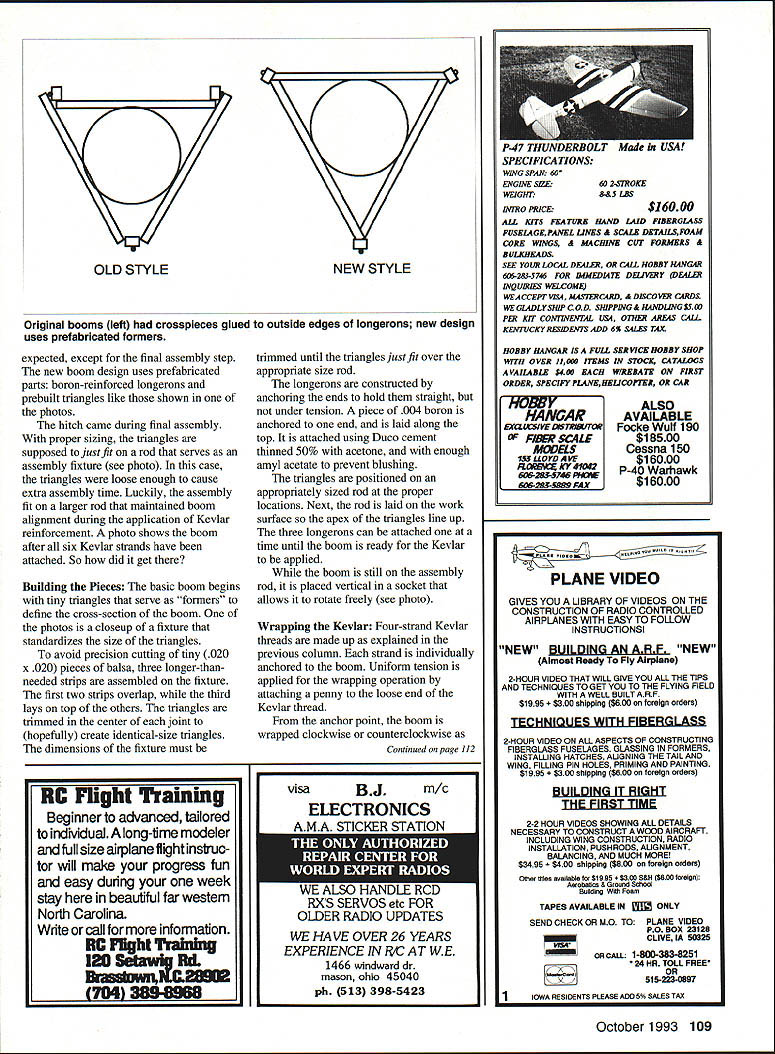
My second Kevlar/boron boom went almost the way I expected, except for the final assembly step. The new boom design uses prefabricated parts: boron-reinforced longerons and prebuilt triangular formers.
The hitch came during final assembly. With proper sizing, the triangles are supposed to just fit on a rod that serves as an assembly fixture. In this case, the triangles were loose enough to cause extra assembly time. Unluckily, the assembly fit on a larger rod that maintained boom alignment during the application of Kevlar reinforcement. A photo shows the boom after all six Kevlar strands have been attached.
Building the pieces
The basic boom begins with tiny triangles that serve as formers to define the cross-section. One photo is a closeup of a fixture that standardizes the size of the triangles.
To avoid precision cutting of tiny (.020 × .020 in) pieces of balsa, three longer-than-needed strips are assembled on the fixture. The first two strips overlap, while the third lays on top of the others. The triangles are trimmed in the center of each joint to (hopefully) create identical-sized triangles. The dimensions of the fixture must be trimmed until the triangles just fit over the appropriate-size rod.
The longerons are constructed by anchoring the ends to hold them straight, but not under tension. A piece of .004 boron is anchored to one end and laid along the top. It is attached using Duco cement thinned 50% with acetone, with enough amyl acetate to prevent blushing.
The triangles are positioned on an appropriately sized rod at the proper locations. Next, the rod is laid on the work surface so the apexes of the triangles line up. The three longerons can be attached one at a time until the boom is ready for the Kevlar to be applied.
While the boom is still on the assembly rod, it is placed vertical in a socket that allows it to rotate freely.
Wrapping the Kevlar
Four-strand Kevlar threads are made up as explained in the previous column. Each strand is individually anchored to the boom. Uniform tension is applied for the wrapping operation by attaching a penny to the loose end of the Kevlar thread.
From the anchor point, the boom is wrapped clockwise or counterclockwise as needed to produce X-bracing in every bay. The Kevlar is anchored with thinned Duco cement at each place it crosses a longeron. The boom is rotated 120° after each attachment.
The preset tension holds the thread in place while the boom is rotated to the next side. After all six threads are in place, a drop of glue is added at each place where the threads cross; this completes the basic construction. For permanent attachment, the boom is essentially finished.
The new boom is slightly stronger than the first in longitudinal deflection and much stronger in torsion. Both strength increases are due to the new arrangement of longerons and crosspieces. The original boom was built with the longerons suspended in midair and the balsa crosspieces glued to them. The crosspieces used in boom one were replaced by the triangles, with the longerons at the triangle apices instead of between the crosspieces. This places the longerons farther apart, increasing longitudinal strength and increasing the distance between the Kevlar strands so they have greater leverage to resist torsion.
Be prepared!
I used to be a Boy Scout, but I guess I forgot what I learned. When I started to build my new Intermediate Stick, I couldn't find some of my tools, my wood box was a disorganized mess, and my rubber wasn't organized. Consequently, I had to examine each candidate piece of wood to locate the ones I needed. It takes a lot of care to properly organize indoor wood; several factors are important, especially wood density (weight per cubic foot), grain direction and uniformity, and strength.
Wood grading
Each sheet of wood should be weight-graded and tested for wind breaks and soft spots. Weight grading is easy and tedious: carefully measure each sheet as accurately as possible, then weigh it. Compute the average sheet density using this formula:
Density = (weight in ounces × 108) / volume in cubic inches
Example: a sheet of balsa 1 × .050 × 18 in = 0.9 cubic inches. For wood weighing 0.05 oz, density = (0.05 × 10⁸) / 0.9 = 6 lb/ft³.
After computing the density, mark it on the sheet. See if the wood's balance point is in the center of the sheet; if so, the wood is reasonably uniform lengthwise. Hold it up to a strong light and see if it looks uniform edge to edge. Check that the grain is straight and parallel to the edges.
Finally, cut a uniform strip parallel to the grain and test it for strength by bending it in a curve. Stress breaks in the sheet will cause the strip to snap with little force. Soft spots in the wood cause a smaller radius in the curve. Mark the sheet to identify any defects you find.
Bad rubber?
We often perceive that a motor or piece of rubber is bad—either too "tired" or too hard to take as many turns as we feel it should. In particular, TAN rubber is often misunderstood.
Rubber that is too soft (needs aging) can be identified by how quickly it recovers after being used. Unless a TAN motor returns to within 1/8 inch of the length before the first windup of the day, it should be used only once each day.
On the other hand, TAN that has aged too much usually gets hard or stiff enough to reduce the turns it will hold safely. It appears that such rubber may be well suited for low-ceiling flying.
I recently found two motors of identical length and weight; one was known to have aged too much to hold high-ceiling turns. On successive flights, the "hard" rubber landed with fewer turns than the softer rubber. In theory, the hard rubber can be stripped to a smaller cross-section so it will hold as many turns as the softer rubber.
Indoor thrust bearings
(From the Bat Sheet) Are you an indoor duration flier? Do you shave with a Gillette Sensor razor? Save the used cartridges and remove the aluminum end straps.
Use a jeweler's screwdriver and be very careful of the sharp blades. The straps are soft aluminum and can easily be flattened and reshaped. The flattened strip is about .625 × .0625 × .015 in—adequate to make thrust bearings for most of the smaller classes.
Transcribed from original scans by AI. Minor OCR errors may remain.

