
Free Flight Nationals: Indoor/Outdoor
Jim Haught
Indoor — Westover AFB hangar
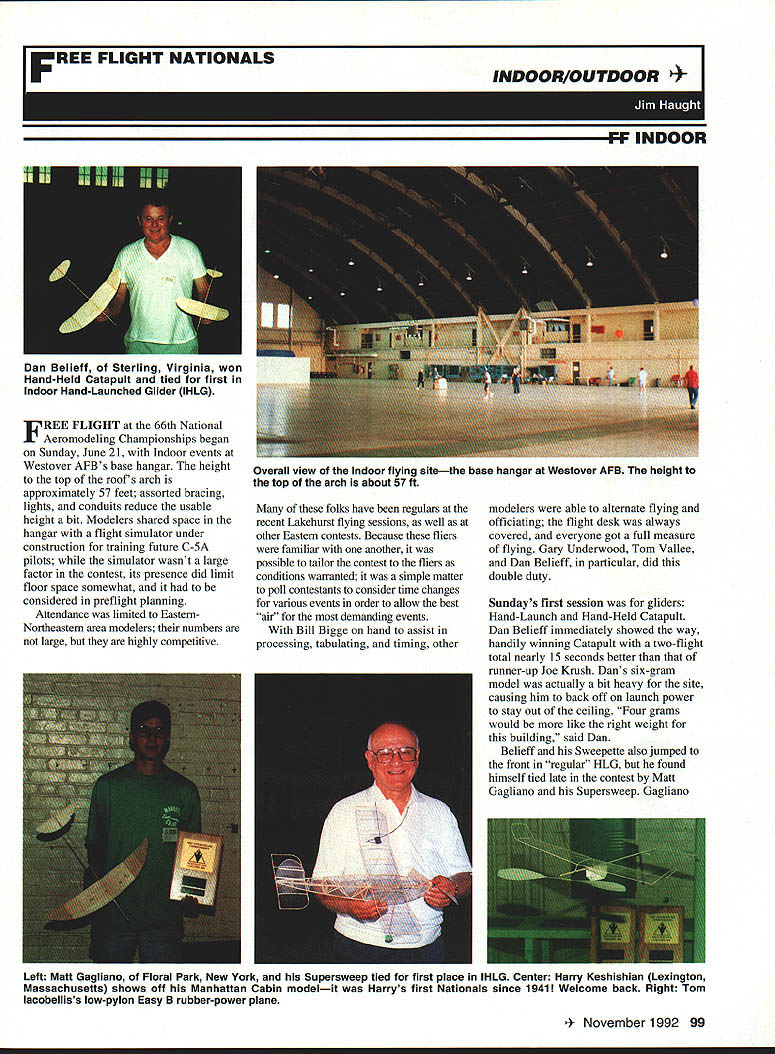
The 66th National Aeromodeling Championships began Sunday, June 21, with Indoor events in a large Westover AFB hangar. The arch height is about 57 ft; bracing, lights, and conduits reduced usable height. Modelers shared the hangar with a C-5A flight simulator under construction, which limited floor space and affected preflight planning.
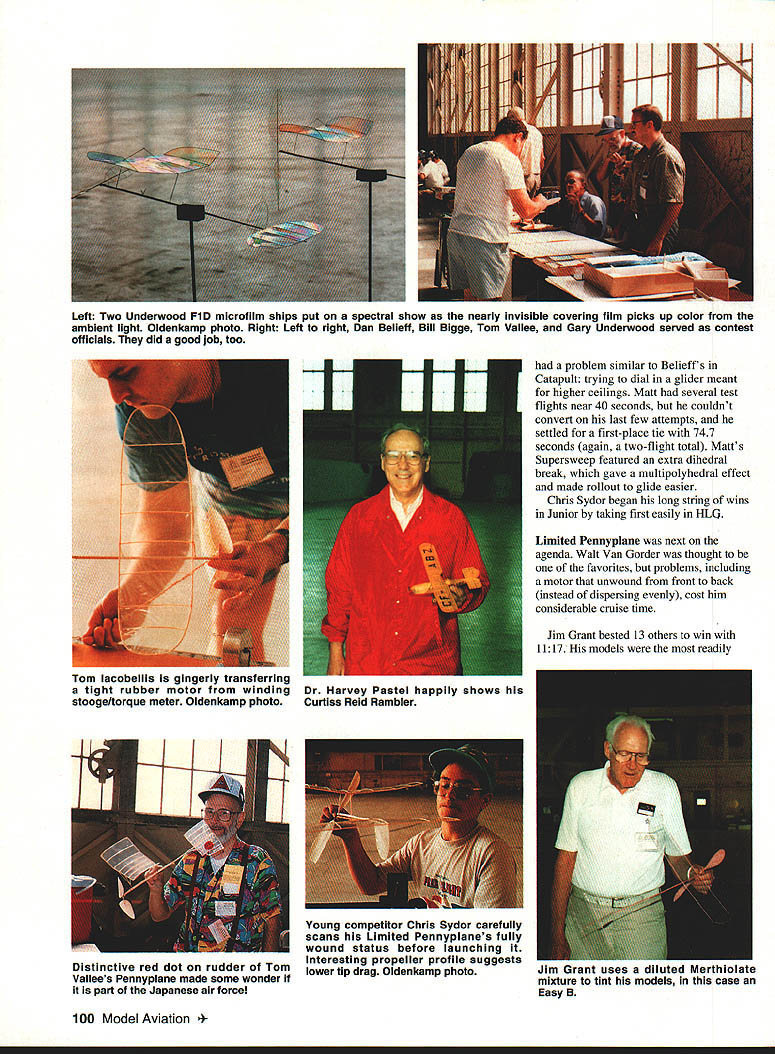
Attendance was largely Eastern–Northeastern fliers, a relatively small but highly competitive group. With Bill Bigge handling processing, tabulation, and timing, many competitors alternated flying and officiating so the flight desk was always covered. Gary Underwood, Tom Vallee, and Dan Belieff notably did double duty.
Hand-Launch and Hand-Held Catapult (Day 1)
- Dan Belieff won Catapult handily with a two-flight total nearly 15 seconds better than runner-up Joe Krush. Belieff’s six-gram model proved a bit heavy for the site; he advised four grams for this building.
- Belieff’s Sweepette led regular HLG until Matt Gagliano’s Supersweep — featuring an extra dihedral break for a multi‑polyhedral rollout — tied Belieff late in the contest. The two-flight total tie was 74.7 seconds.
- Chris Sydor began a string of Junior wins, taking HLG easily.
Limited Pennyplane, Manhattan, Open Pennyplane
- Jim Grant won Limited Pennyplane (best of 14 entrants). Grant tints his frameworks with diluted Merthiolate, a long-used technique.
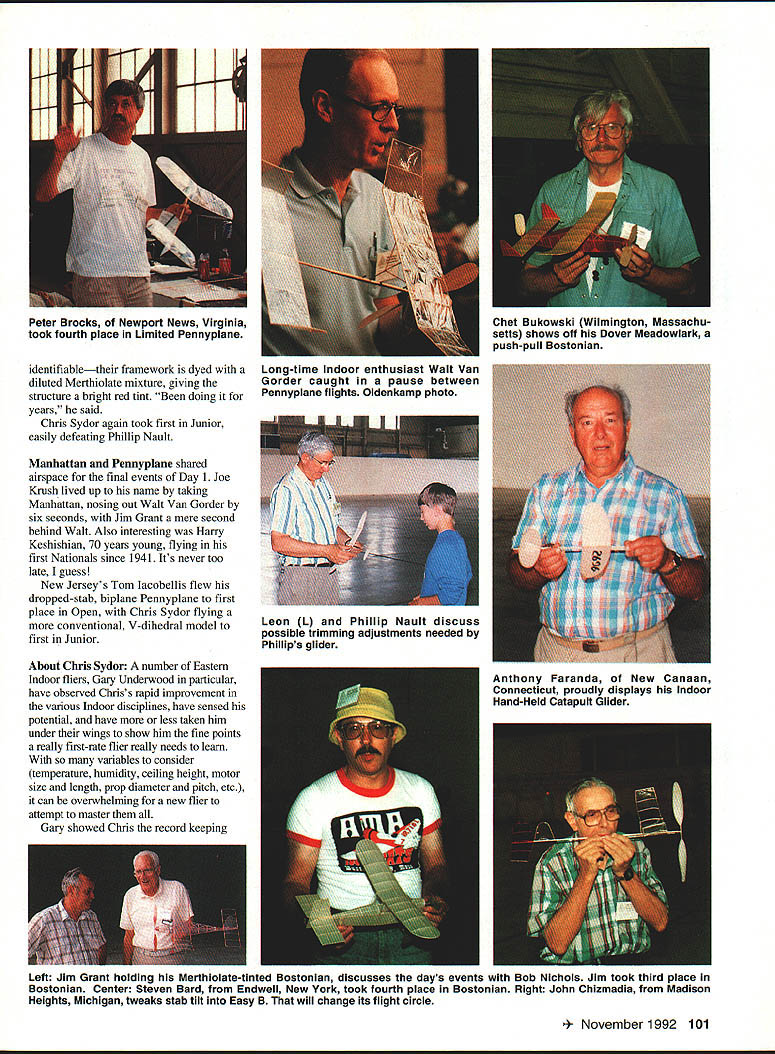
- Manhattan Pennyplane: Joe Krush won, nosing out Walt Van Gorder by six seconds; Jim Grant was one second behind Van Gorder.
- Open Pennyplane: Tom Jacobellis (NJ) flew a dropped-stab biplane to first in Open; Chris Sydor won Junior Pennyplane flying a conventional V-dihedral model.
- Notable entrant: Harry Keshishian, 70, flew his first Nationals since 1941.
Day 2 — Indoor Scale, Peanut Scale, Easy B, F1D
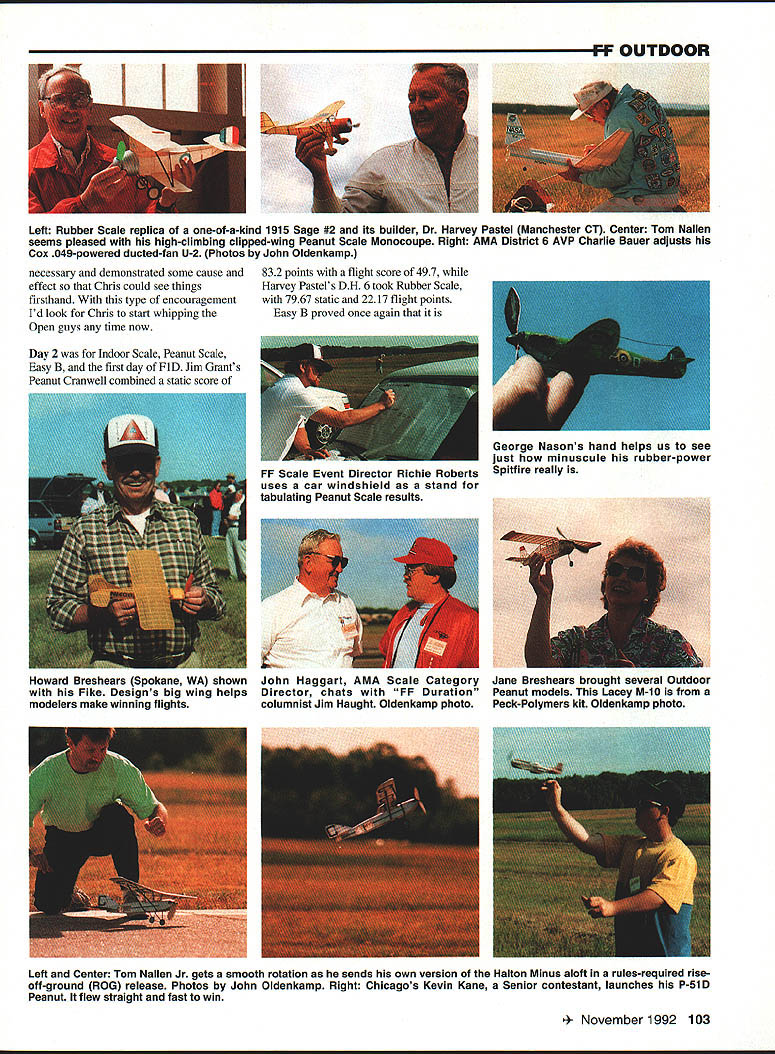
- Jim Grant’s Peanut Cranwell combined an 83.2-point static with a 49.7 flight score to win Peanut.
- Harvey Pastel’s D.H. 6 topped Rubber Scale with 79.67 static and 22.17 flight points.
- Easy B proved anything but easy. A poll favored Walt Van Gorder, but Dan Belieff won with a 6:30 flight amid tricky rafter-bang and hang-up risks.
- F1D flying encountered low-level turbulence caused by unsettled outdoor weather. Temperature/humidity checks showed swings (e.g., 80°F/40% earlier dropping to 74.5°F/38% later). Because many flights were futile in the rough air, contestants rescheduled F1D to the following morning.
F1D finals (morning)
- Dan Belieff posted two flights over 19:00 and a 22:07.
- Tom Vallee had 19:21.
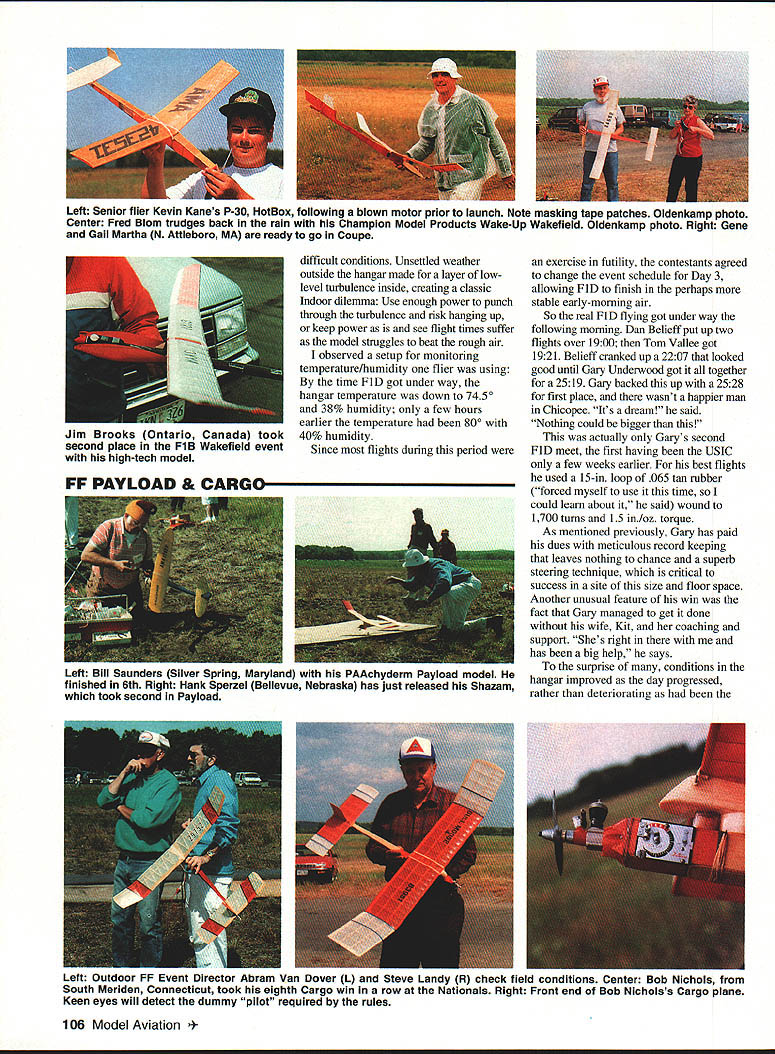
- Gary Underwood assembled top flights of 25:19 and 25:28 to take first place. For his best flights he used a 1.5‑in. loop of .065 tan rubber, wound to about 1,700 turns and about 1.5 in./oz. torque. Gary’s meticulous record keeping and steering technique were cited as key factors; he credited his wife Kit for her usual coaching support despite her absence this meet.
- As the morning progressed conditions improved further, allowing remaining Indoor Scale, Peanut Scale, Easy B, and HLG finals to be completed.
Outdoor — Westover airfield
Day 3 moved outdoor free-flight to the adjacent Westover airfield. A brisk wind and localized turbulence — caused in part by a small upwind grove of trees — made conditions challenging. Thermals proved small in diameter; often only one model in a group stayed in each thermal.
Selected outdoor event highlights and winners
Outdoor Scale, Peanut, Rubber Scale, Senior/Junior Peanut
- Tom Nallen Sr. flew an unusual 1932 Shortwing Monocoupe that proved a consistent flier.
- Tom Nallen Jr. led Peanut static scores with a Bleriot (89.91 points).
- Charles Bauer’s U‑2 topped Rubber Scale static.
- Kevin Kane blasted his P‑51D to first in Senior Peanut.
Catapult Glider, Payload, CO2
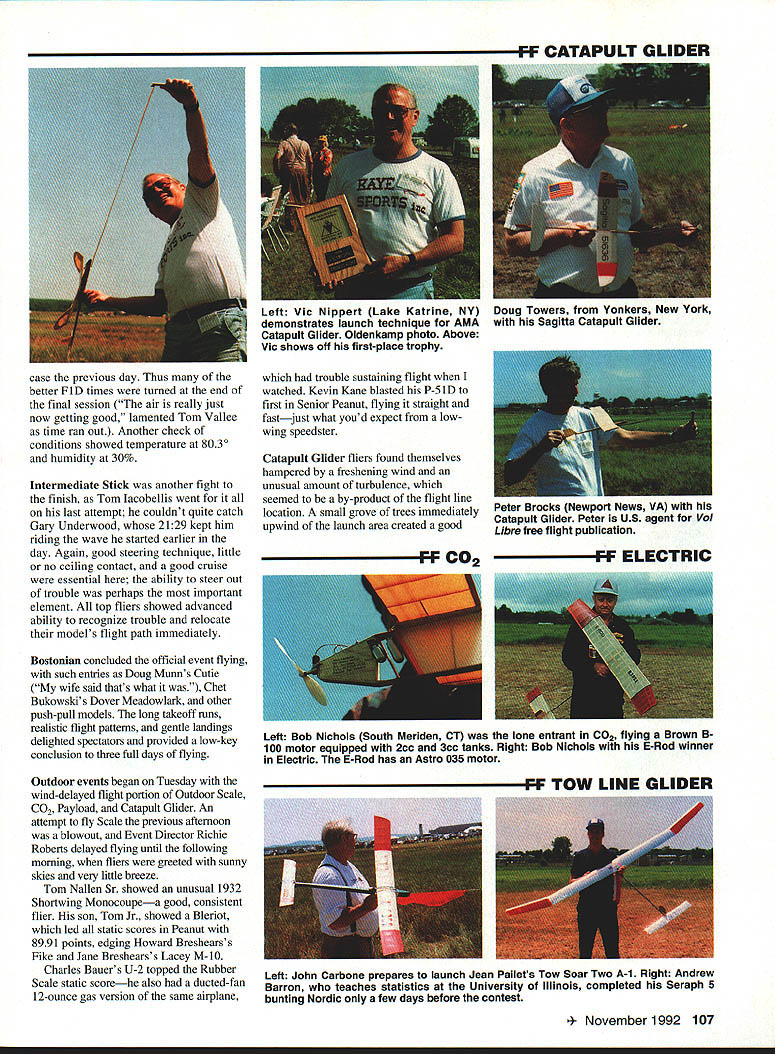
- Catapult Glider was hampered by rotor and turbulence from trees near the launch area; many models struggled to find clean air.
- Payload, flying from the same area, suffered aborted takeoffs and ground loops; Pete Ferrara edged Hank Sperzel’s Shazam by 27 seconds.
- Dick Stiles’ Blanchard-designed PAAmite made a dramatic ROG and climbed on power until running out of fuel; it disappeared downrange and was lost.
- Bob Nichols (Meriden, CT) was the lone CO2 entrant, flying a Brown B‑100 with 2cc and 3cc tanks.
Wednesday — A Gas, A Electric, Wakefield, Cargo, Hand-Launch Glider
- Rainy, unstable weather in the morning made Wakefield and HLG difficult; rain continued through the morning.
- Wakefield: William Buss topped the event with 1,160 seconds, edging Jim Brooks by 15 seconds. Anders Haakanson (Sweden) visited and placed fifth.
- Hand-Launch: Larger, built-up wing models were common; Mark Shankle showed strong launching ability with a 24‑in. span Athena. Gerald Donahue took first and the Tubas Glue Dobbers perpetual trophy.
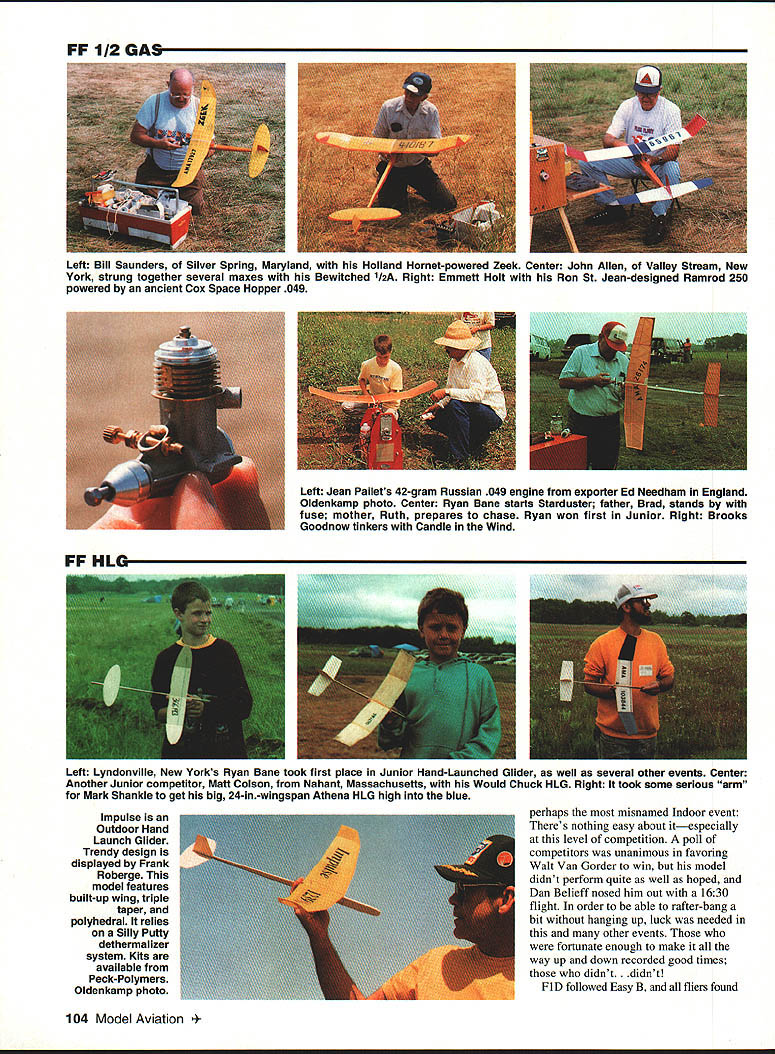
- A Gas: Brad Bane (Windwhip design) won A Gas with a 585 Windwhip. The Bane family (Brad, wife Ruth, and son Ryan) were prominent all week; Brad prefers not to watch his models closely as maxes progress.
- Ryan Bane took Junior A and Junior Hand-Launch; Grant Yokel was runner-up in both events.
- A Electric and Cargo: Bob Nichols won both — Cargo marked his eighth Nationals Cargo win in a row. His E‑Rod used an Astro .035 motor, glass boom, golf-tube forward fuselage; Class A all-up weight was 12½ oz. Best lift recorded was 680 g with a three-flight total of 1,736 g.
Thursday — B Gas, B Electric, F1J, Nordic, Mulvihill
- Ruth Bane had a good day, finishing fourth in B Gas behind Tom Joerger, Bob Sifleet, and Hank Sperzel.
- Tom Joerger’s original model weighed 28 oz and used an O.S. .21 with an 8x4 prop; he favors this setup over some ducted-fan O.S. engines.
- Mulvihill used an incremental flyoff; Jim Brooks (Canada) won with 601 seconds among 25 entrants.
- Bob Nichols repeated as B Electric winner.
- Nordic: Andrew Barron (Univ. of Illinois) brought a newly finished Seraph 5. A hard launch peeled Mylar from a tip panel, creating a dive‑brake effect and a near-disaster; he reverted to a proven model afterward.
P‑30, F1C, F1H
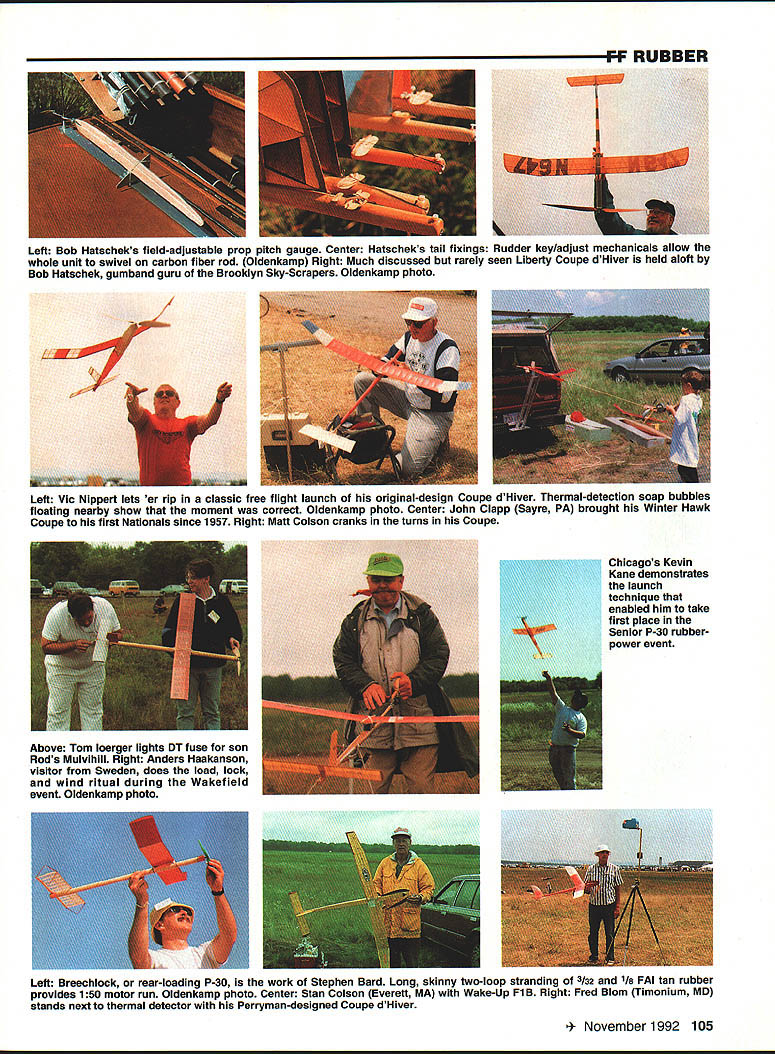
- P‑30 drew 42 entries (second only to 1/2A Gas). Arthur Ellis ran off a string of morning maxes in a Mylar-covered, pop‑up-wing original to win with 1,140 seconds. Ryan Bane (Junior) and Kevin Kane (Senior) took the junior and senior P‑30 titles.
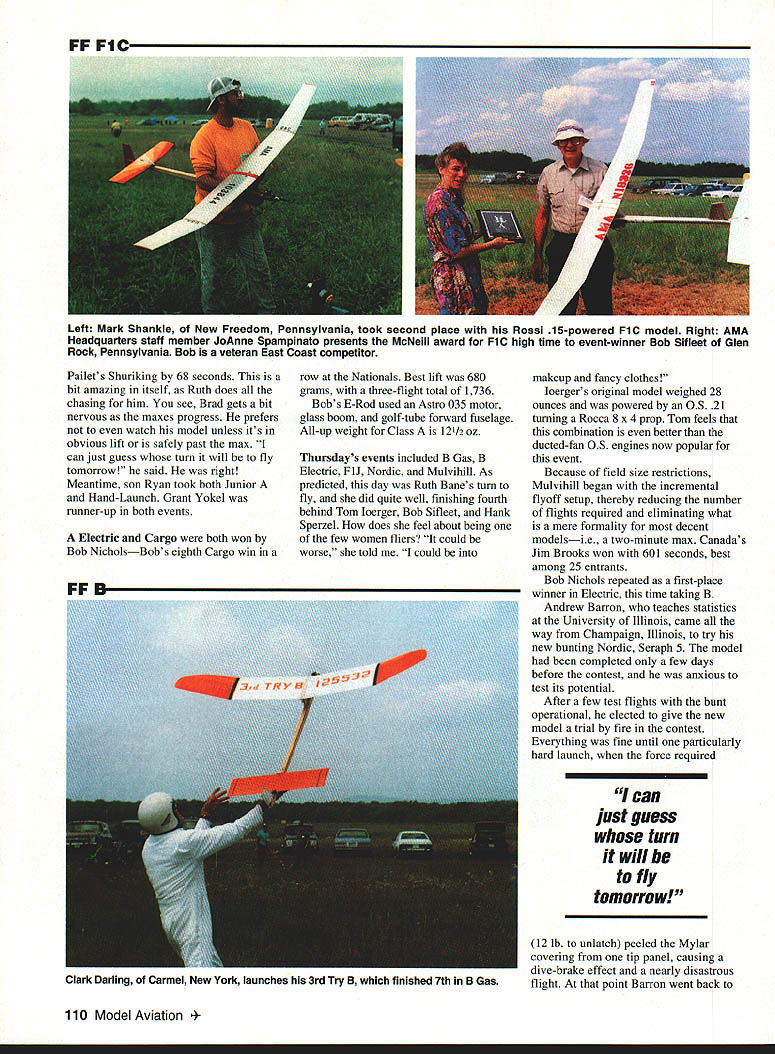
- F1C had only two fliers — Bob Sifleet and Mark Shankle. A wind shift made conditions unsafe; by gentleman’s agreement the event was halted and Sifleet declared the winner. He also received the McNeill Award for F1C high time and a Nelson .15 engine.
- F1H saw straightforward Classic A‑1 style models; light breezes and heavy models made for interesting flying.
Final day — D Gas, 1/2A Gas, F1G (Coupe)
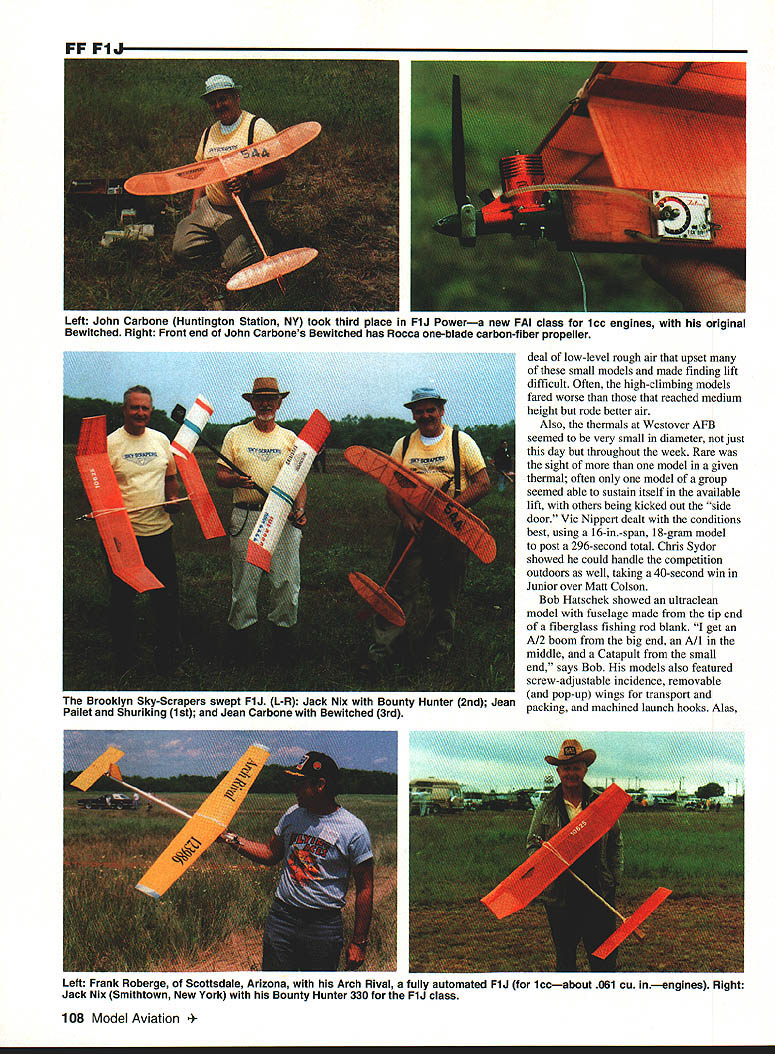
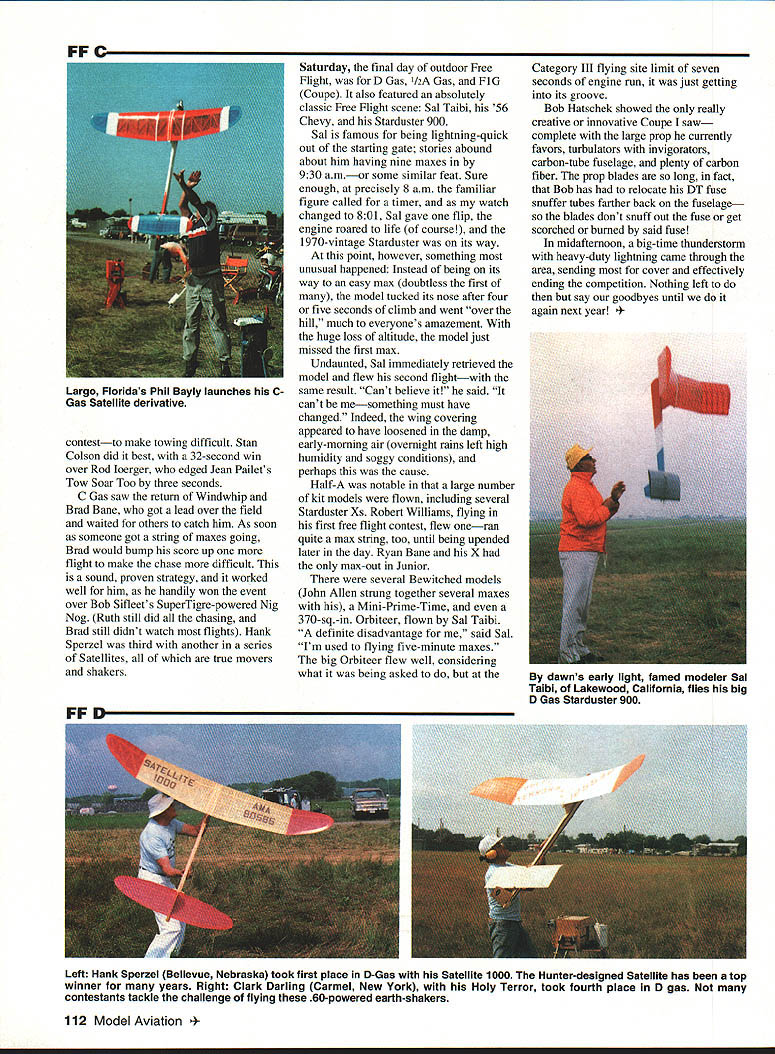
- Sal Taibi provided a classic Free Flight scene with his ’56 Chevy and Starduster 900. Early morning humidity loosened wing covering on his Starduster, causing two nose-tuck flights; otherwise the model and several kit models (Starduster Xs, Orbiter, etc.) put on notable performances.
- 1/2A Gas featured many kit models; Ryan Bane’s X was the only Junior max-out.
- Bob Hatscheck showed a creative Coupe with a large prop, turbulators with invigorators, carbon-tube fuselage, and long prop blades that required relocating DT fuse snuffer tubes.
- Midafternoon a severe thunderstorm with heavy lightning ended the competition for the day and effectively concluded the Nationals.
General observations
- Localized low-level rough air and small thermals at Westover often favored models that climbed to medium height and rode better air over those that climbed high then fell out of lift.
- Top competitors demonstrated advanced steering technique and the ability to recognize and relocate models out of trouble.
- Camaraderie remained strong throughout three full days of flying despite challenging and changeable conditions.
Transcribed from original scans by AI. Minor OCR errors may remain.

