
Free Flight is nothing more than losing your plane every flight...
Jim Bocckinfuso
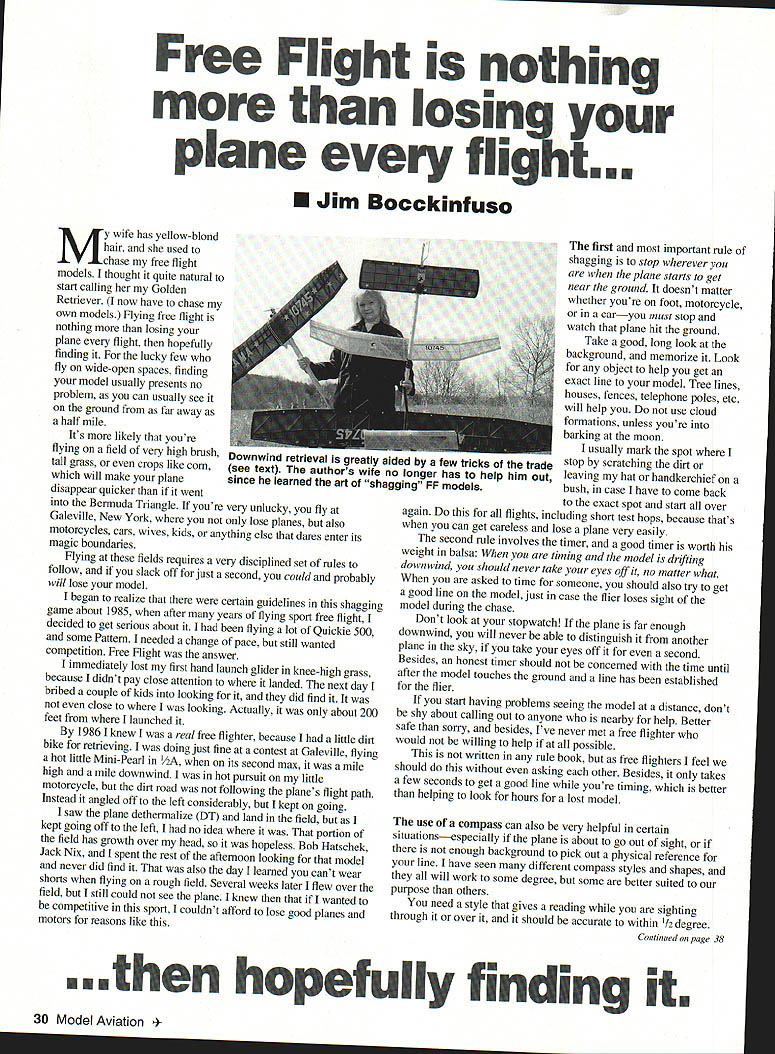
My wife has yellow-blond hair, and she used to chase my free-flight models. I thought it quite natural to start calling her my Golden Retriever. (I now have to chase my own models.) Flying free flight is nothing more than losing your plane every flight, then hopefully finding it.
For the lucky few who fly on wide-open spaces, finding your model usually presents no problem, as you can often see it on the ground from as far away as a half mile. It's more likely that you're flying on a field of very high brush, tall grass, or even crops like corn, which will make your plane disappear quicker than if it went into the Bermuda Triangle. If you're very unlucky, you fly at Galeville, New York, where you not only lose planes, but also motorcycles, cars, wives, kids, or anything else that dares enter its magic boundaries.
Flying at these fields requires a very disciplined set of rules to follow, and if you slack off for just a second, you could—and probably will—lose your model.
I began to realize that there were certain guidelines in this shagging game about 1985, when after many years of flying sport free flight, I decided to get serious about it. I had been flying a lot of Quickie 500 and some Pattern. I needed a change of pace, but still wanted competition. Free flight sounded like the answer.
I immediately lost my first hand-launch glider in knee-high grass because I didn't pay close attention to where it landed. The next day I bribed a couple of kids into looking for it, and they did find it. It was not even close to where I was looking. Actually, it was only about 200 feet from where I launched it.
By 1986 I knew I was a real free fighter, because I had a little dirt bike for retrieving. I was doing just fine at a contest at Galeville, flying a hot little Mini-Pearl in 1/2A, when on its second max it went a mile high and a mile downwind. I was in hot pursuit on my little motorcycle, but the dirt road was not following the plane's flight path. Instead it angled off to the left considerably, but I kept on going.
I saw the plane dethermalize (DT) and land in the field, but as I kept going off to the left, I had no idea where it was. That portion of the field had grown taller than my head, so it was hopeless. Bob Hatschek, Jack Nix, and I spent the rest of the afternoon looking for that model and never did find it. That was also the day I learned you can't wear shorts when flying on a rough field. Several weeks later I flew over the field, but I still could not see the plane. I knew then that if I wanted to be competitive in this sport, I couldn't afford to lose good planes and motors for reasons like this.
Rules for Shagging
- Stop and watch
The first and most important rule of shagging is to stop wherever you are when the plane starts to get near the ground. It doesn't matter whether you're on foot, motorcycle, or in a car—you must stop and watch that plane hit the ground.
Take a good, long look at the background, and memorize it. Look for any object to help you get an exact line to your model. Tree lines, fences, telephone poles, etc., will help you. Do not use cloud formations, unless you're into barking at the moon.
I usually mark the spot where I stop by scratching the dirt or leaving my hat or handkerchief on the spot, in case I have to come back to the exact spot and start all over again. Do this for all flights, including short test hops, because that's when you can get careless and lose a plane very easily.
- The timer's job
The second rule involves the timer, and a good timer is worth his weight in balsa: when you are timing and the model is drifting downwind, you should never take your eyes off it, no matter what. When you are asked to time for someone, you should also try to get a good line on the model, just in case the flier loses sight of the model during the chase.
Don't look at your stopwatch! If the plane is far enough downwind, you will never be able to distinguish it from another plane in the sky if you take your eyes off it for even a second. Besides, an honest timer should not be concerned with the time until after the model touches the ground and a line has been established for the flier.
If you start having problems seeing the model at a distance, don't be shy about calling out to anyone who is nearby for help. Better safe than sorry, and besides, I've never met a free fighter who would not be willing to help if at all possible. This is not written in any rule book, but as free fliers we should do this without even asking each other. It only takes a few seconds to get a good line while you're timing, which is better than helping to look for hours for a lost model.
Tools and Gear
- Compass
The use of a compass can be very helpful in certain situations—especially if the plane is about to go out of sight, or if there is not enough background to pick out a physical reference for your line. You need a style that gives a reading when you are sighting through it or over it, and it should be accurate to within 1/2 degree. Holding your trusty Boy Scout compass in your hand and looking down at it is not going to help very much.
I use a compass called a Suunto, which is made in Finland and sold in Hoffritz stores. You keep both eyes open, but only look through the compass with one eye. This superimposes the compass reading on your natural vision. It takes a bit of getting used to, but it's worth it.
- Binoculars
Binoculars come in almost as many varieties as model airplanes, and ever since their use has been allowed for timing, no free flier should be without a pair. In a 15 mph wind, with good eyes, a model will be just about out of sight in two minutes, and gone in three. With binoculars, you will be able to see all the way out until it lands, ensuring that you get a good line on it.
The important thing to remember here is that once you feel that the model is far enough away to use the binoculars, use them until the model lands. It is very difficult to pick up a speck in the sky with binoculars and do so quickly before the plane lands. Once the model lands, get a line on it from the binoculars, because your perspective will be different without them. I use a set of 7 x 35 and have also used 8 x 50. It's not so much the power that's needed as the ease of use. Stay away from the small, compact models that I see a lot of people use; to me, they are difficult to use quickly and never seem as clear as the standard-type sets.
- Walkie-talkies
Walkie-talkies are another good item. They are excellent in keeping a person on his line when the terrain is rough. Here in the eastern U.S., we seldom go to contests anymore without them. We also use them to coordinate a search for a lost model when several people are looking for it at the same time.
My suggestion is that they be at least a one-watt set, which will easily transmit for a mile. Stay away from the toy stuff using a 9-volt battery. These only put out 100 milliwatts and are just not powerful enough for our use. Radio Shack has a fine line of walkie-talkies, and I use their one-watt, three-channel set, which sells for about $30. These come with one crystal installed (channel 14); buy the others and install them yourself. Find out what other channels are being used in your area and get those crystals. Because just about every set of walkie-talkies comes with channel 14 already installed, that's the channel we usually end up using.
- Electronic locating devices
Last, but not least, are the modern electronic methods to locate your model, ranging from simple audible sounding devices to more sophisticated (and more expensive) radio transmitters that go for a ride with the model. I use the latter type and rarely fly without it unless I'm on an excellent field. The unit I use weighs 10.2 grams, costs about $100 for the transmitter and receiver, and has saved several of my planes.
There were times when I had no line or never even saw my model go down, yet I found it with no problem—usually in less than 10 minutes. There are even better units than the one I use, but I feel that I can still find a needle in a haystack with mine, as long as it's not completely out of range.
Maybe one day I'll get my Golden Retriever to shag some models again, but what would I do with all my fancy equipment, like my radio transmitter?
Transcribed from original scans by AI. Minor OCR errors may remain.

