
Free Flight: Old-Timer
Clarence Haught
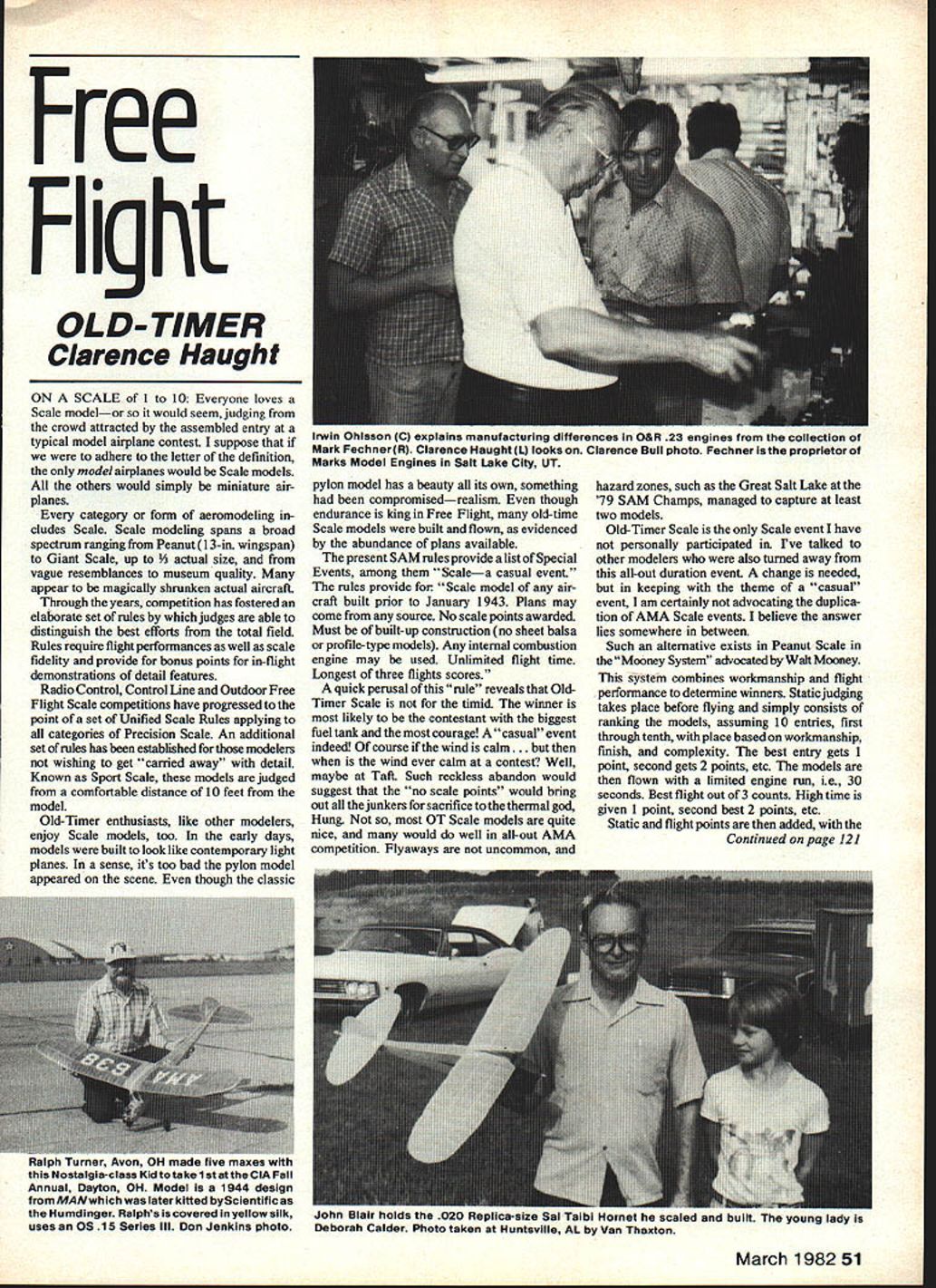
On a scale of 1 to 10: everyone loves a Scale model—or so it would seem, judging from the crowd attracted by the assembled entries at a typical model airplane contest. If we were to adhere strictly to the definition, the only model airplanes would be Scale models; all the others would simply be miniature airplanes.
Every category or form of aeromodeling includes Scale. Scale modeling spans a broad spectrum ranging from Peanut (13‑in. wingspan) to Giant Scale (up to 1/3 actual size), and from vague resemblances to museum quality. Many appear to be magically shrunken actual aircraft.
Through the years, competition has fostered an elaborate set of rules by which judges can distinguish the best efforts from the field. Rules require flight performance as well as scale fidelity and provide for bonus points for in‑flight demonstrations of detailed features.
Radio Control, Control Line and Outdoor Free Flight Scale competitions have progressed to the point of a set of Unified Scale Rules applying to all categories of Precision Scale. An additional set of rules has been established for those modelers not wishing to get "carried away" with detail. Known as Sport Scale, these models are judged from a comfortable distance of 10 feet from the model.
Old‑Timer enthusiasts, like other modelers, enjoy Scale models too. In the early days, models were built to look like contemporary light planes. In a sense, it's too bad the pylon model appeared on the scene. Even though the classic pylon model has a beauty all its own, something was compromised—realism. Even though endurance is king in Free Flight, many Old‑Timer Scale models were built and flown, as evidenced by the abundance of plans available.
The present SAM rules provide a list of Special Events, among them "Scale"—a casual event. The rules provide for:
"Scale model of any aircraft built prior to January 1943. Plans may come from any source. No scale points awarded. Must be of built‑up construction (no sheet balsa or profile‑type models). Any internal combustion engine may be used. Unlimited flight time. Longest of three flights scores."
A quick perusal of this rule reveals that Old‑Timer Scale is not for the timid. The winner is most likely to be the contestant with the biggest fuel tank and the most courage! A "casual" event indeed. Of course, if the wind is calm... but then when is the wind ever calm at a contest? Well, maybe at Taft. Such reckless abandon would suggest that the "no scale points" rule would bring out all the junkers for sacrifice to the thermal god. Huh. Not so — most Old‑Timer Scale models are quite nice, and many would do well in all‑out AMA competition. Flyaways are not uncommon, and hazard zones such as the Great Salt Lake at the '79 SAM Champs managed to capture at least two models.
Old‑Timer Scale is the only Scale event I have not personally participated in. I've talked to other modelers who were also turned away from this all‑out duration event. A change is needed, but in keeping with the theme of a "casual" event, I am certainly not advocating duplication of AMA Scale events. I believe the answer lies somewhere in between.
An alternative: The Mooney System (Peanut Scale)
Such an alternative exists in Peanut Scale in the "Mooney System" advocated by Walt Mooney. This system combines workmanship and flight performance to determine winners. It is quick, simple, and works well.
- Static judging takes place before flying.
- Rank the models (assuming 10 entries) from first through tenth based on workmanship, finish, complexity, etc.
- Assign points equal to the rank: 1 point for first, 2 points for second, etc.
- Flight judging.
- Limit engine run (for example, 30 seconds).
- Fly each model three times; the best flight counts.
- Rank flight performance: 1 point for highest time, 2 points for second best, etc.
- Scoring.
- Add static and flight points; the lowest total score places first.
- Ties are broken using the flight point score (better flight ranking wins).
Example:
- If the best static entry (1 point) places fifth in flight (5 points), the total is 6 points.
- If a model places third in static (3 points) and second in flight (2 points), the total is 5 points and it would place ahead of the previous example.
Let us know how you feel about it. Perhaps it's worth submitting as a rule change proposal?
Clarence Haught R1 5, Box 16 Coeur d'Alene, ID 83814
Transcribed from original scans by AI. Minor OCR errors may remain.

