
Free Flight
OLD-TIMER
Clarence Haught
SPREAD THE WORD. You hear it all the time: "Man, I'd like to have some of them radio-controlled models!" You answer: "Well, I only fly Free Flight." To which they reply, "You mean hang gliding? Isn't that kind of dangerous?"
The National Free Flight Society believes more kids and younger adults would be interested in Free Flight if they only knew it existed. So NFFS President Tony Italiano has delegated the responsibility of a publicity program to Jack Woodard, 7985 Sunridge Court, Fair Oaks, CA 95628; (916) 961-1829.
This is a big job, and Jack needs help. He will contact all the AMA Free Flight clubs, but the problem is finding all you folks out there who don't have the luxury of a good club to help promote Free Flight. Jack needs contact people from every major area of every state having any Free Flight activity.
The Old-Timer movement is just a small part of the whole picture, but we do have a special appeal in that our cabin ships have realism and a special beauty all their own. We are also fortunate to have events already in existence which are tailor-made for beginners. Our .020 Replica event comes to mind instantly, but how about the special-event, half-scale OT .049 glow engines? And how about all the full-scale models that would fly beautifully on inexpensive Baby Bee .049 engines?
Let's all get together behind Jack and the NFFS — and promote Free Flight. Take a spectator along the next time you go out to fly. Get a kid hooked on model airplanes.
Truth in advertising. "Flies 36 min. on a 15-sec motor run!" Similar statements introduced many advertisements in early issues of the modeling press. Thermals were unheard of by the average modeler, and lucky thermal flights were credited to the designer. I've often pondered the finishes, or lack thereof, applied to many of the old ships, but when one considers the life expectancy brought about by flyaways and crashes, it becomes clearer. Today, models enjoy long service due primarily to the wide-spread popularity of dethermalizer systems.
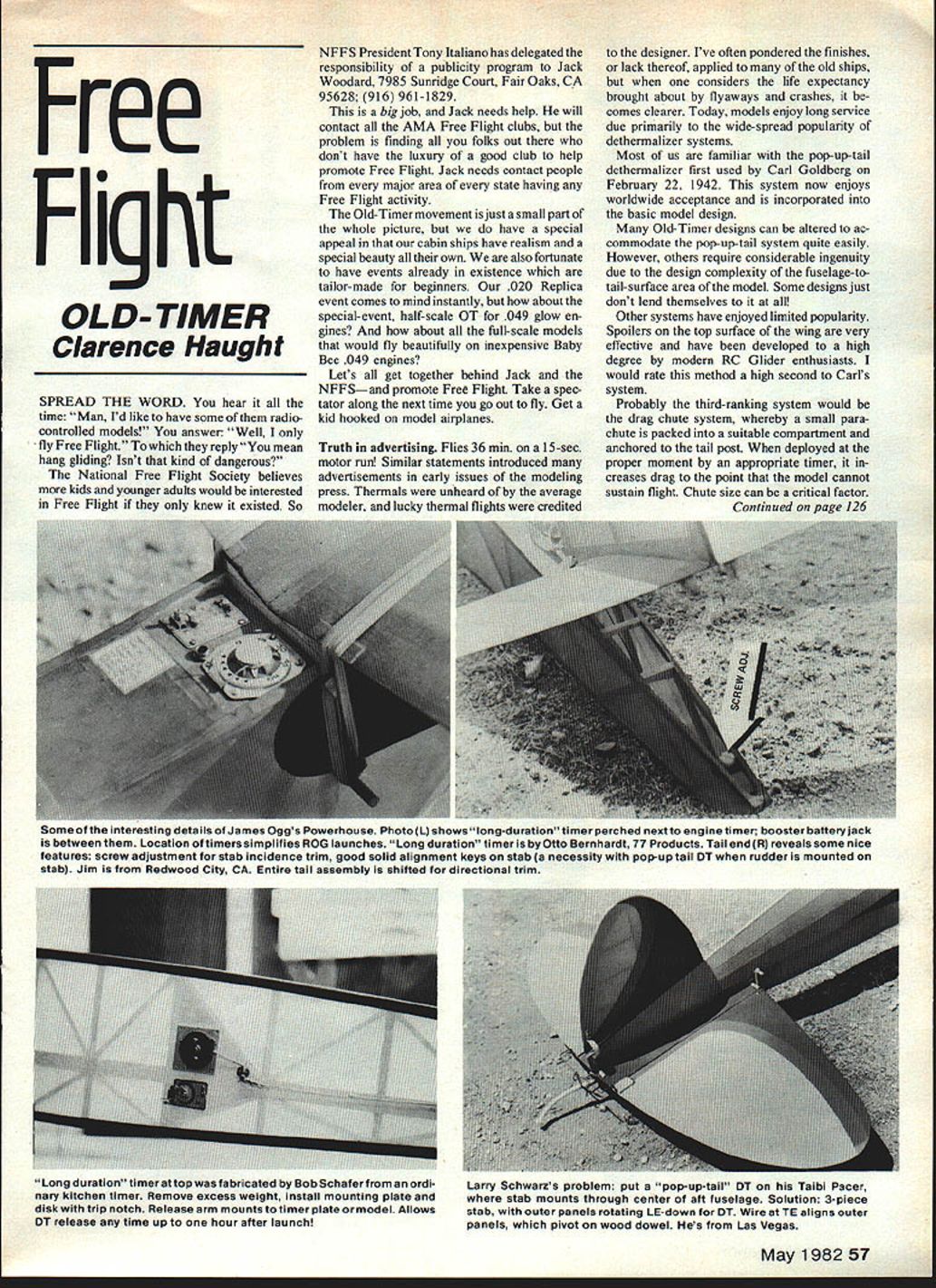
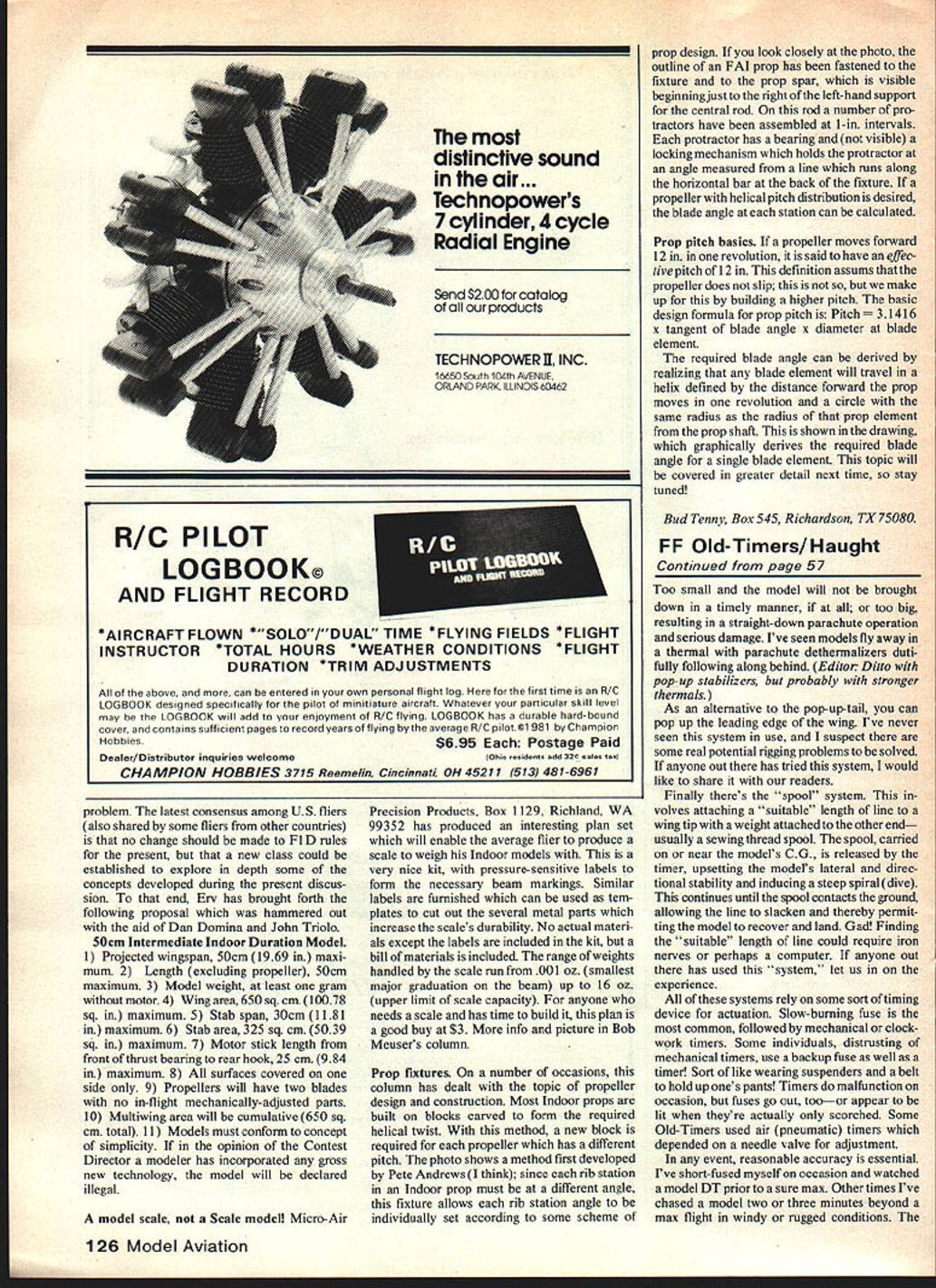
Most of us are familiar with the pop-up-tail dethermalizer first used by Carl Goldberg on February 22, 1942. This system now enjoys worldwide acceptance and is incorporated into the basic model design.
Many Old-Timer designs can be altered to accommodate the pop-up-tail system quite easily. However, others require considerable ingenuity due to the design complexity of the fuselage-to-tail-surface area of the model. Some designs just don't lend themselves to it at all!
Other systems have enjoyed limited popularity. Spoilers on the top surface of the wing are very effective and have been developed to a high degree by modern RC glider enthusiasts. I would rate this method a close second to Carl's system.
Probably the third-ranking system would be the drag-chute system, whereby a small parachute is packed into a suitable compartment and anchored to the tail post. When deployed at the proper moment by an appropriate timer, it increases drag to the point that the model cannot sustain flight. Chute size can be a critical factor.
The latest consensus among U.S. fliers (also shared by some fliers from other countries) is that no change should be made to F1D rules for the present, but that a new class could be established to explore in depth some of the concepts developed during the present discussion. To that end, Erv has brought forth the following proposal which was hammered out with the aid of Dan Domina and John Triolo.
50cm Intermediate Indoor Duration Model
- Projected wingspan, 50 cm (19.69 in.) maximum.
- Length (excluding propeller), 50 cm maximum.
- Model weight, at least one gram without motor.
- Wing area, 650 sq. cm. (100.78 sq. in.) maximum.
- Stab span, 30 cm (11.81 in.) maximum.
- Stab area, 325 sq. cm. (50.39 sq. in.) maximum.
- Motor stick length from front of thrust bearing to rear hook, 25 cm (9.84 in.) maximum.
- All surfaces covered on one side only.
- Propellers will have two blades with no in-flight mechanically adjusted parts.
- Multiwing area will be cumulative (650 sq. cm. total).
- Models must conform to concept of simplicity. If, in the opinion of the Contest Director, a model has incorporated any gross new technology, the model will be declared illegal.
Too small and the model will not be brought down in a timely manner, if at all; too big, and you get a straight-down parachute operation with serious damage. I've seen models fly away in a thermal with parachute dethermalizers dutifully following along behind. (Editor: Ditto with pop-up stabilizers, but probably with stronger thermals.)
As an alternative to the pop-up-tail, you can pop up the leading edge of the wing. I've never seen this system in use, and I suspect there are some real potential rigging problems to be solved. If anyone out there has tried this system, I would like to hear about it.
Finally there's the "spool" system. This involves attaching a suitable length of line to a wing tip with a weight attached to the other end—usually a sewing-thread spool. The spool, carried on or near the model's C.G., is released by timer, upsetting the model's lateral and directional stability and inducing a steep spiral (dive). This continues until the spool contacts the ground, allowing the line to slacken and thereby permitting the model to recover and land. Good! Finding the suitable length of line could require iron nerves or perhaps a computer. If anyone out there has used this system, let us in on the experience.
All of these systems rely on some sort of timing device for actuation. Slow-burning fuse is the most common, followed by mechanical or clockwork timers. Some individuals use a mechanical timer and a backup fuse as well—sort of like wearing suspenders and a belt to hold up one's pants! Timers do malfunction on occasion, but fuses go out, too—or appear to be out when they have actually only been scorched. Some Old-Timers use a pneumatic timer which depends on a needle valve for adjustment.
In any event, reasonable accuracy is essential. I have short-fused myself on occasion and watched a model DT prior to a sure max. Other times I've chased a model two or three minutes beyond a max flight in windy or rugged conditions. The best solution I can offer in this regard is to make it a practice to test-burn some fuse two or three times during the contest day. You'll be surprised how the burning rate will vary with existing conditions! Moisture, humidity, wind velocity, etc., all have measurable effects.
Some all-out Duration events—Texaco, Fuel Allotment, Antique, etc.—do not utilize dethermalizers. I have noticed, however, more and more long-time dethermalizer timers installed on models used in these events. It all boils down to how willing the flier is to sacrifice a model for a trophy. Sometimes flying site size is a factor, and competitors want to ensure staying on the field. A circling model can still get a long way downwind, given good air.
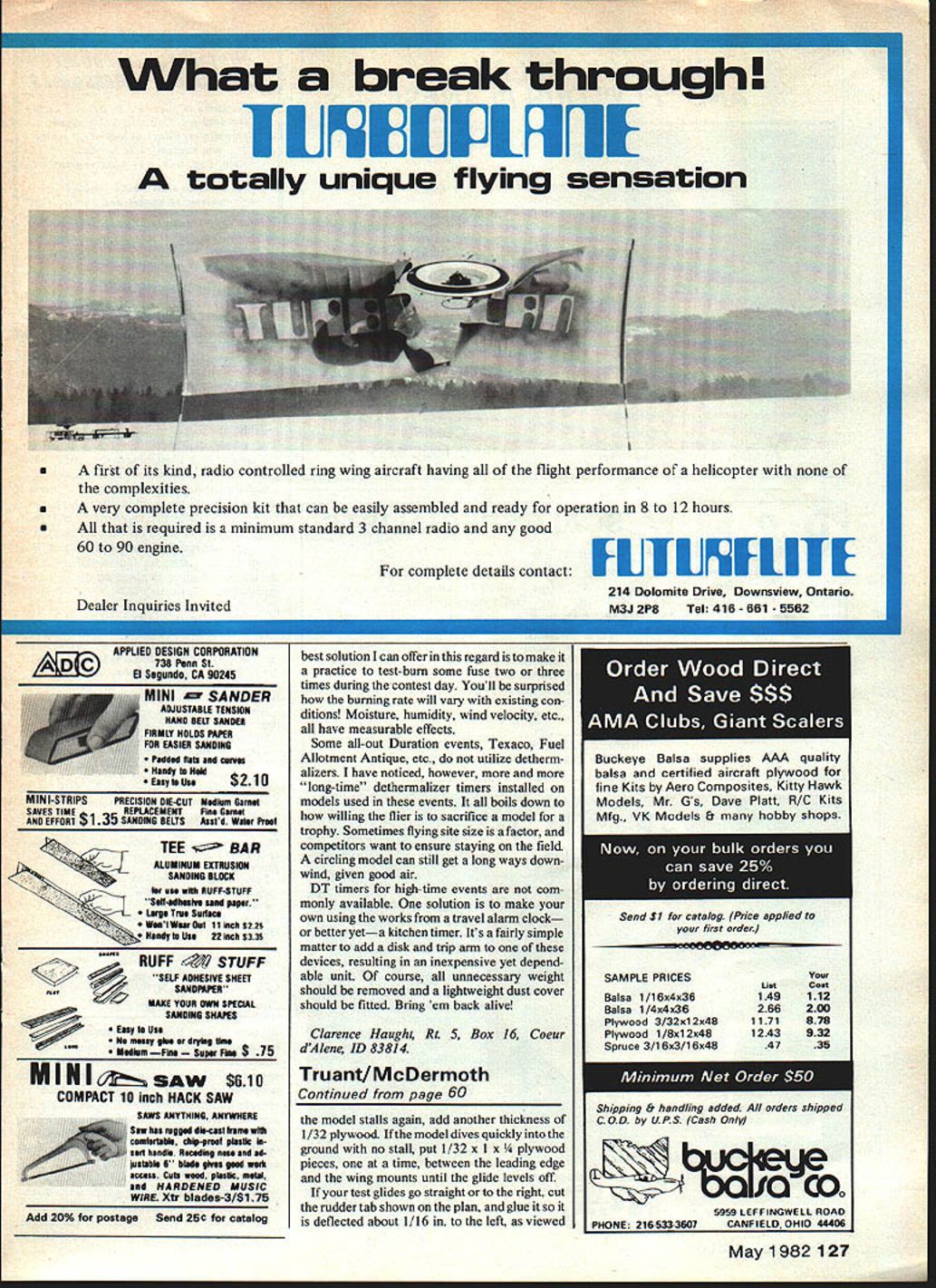
DT timers for high-time events are not commonly available. One solution is to make your own using the works from a travel alarm clock—or better yet—a kitchen timer. It's a fairly simple matter to add a disk and trip arm to one of these devices, resulting in an inexpensive yet dependable unit. Of course, all unnecessary weight should be removed and a lightweight dust cover should be fitted. I'm getting back alive!
Clarence Haught Rt. 5, Box 16, Coeur d'Alene, ID 83814.
Transcribed from original scans by AI. Minor OCR errors may remain.

