
Free Flight: Old-Timer
Clarence Haught
Why?
Some time ago, after a prolonged period of futile engine-cranking, spurred on by an occasional single firing, I sat back on my heels and asked myself: "Why am I doing this? Why Old-Timers? I have a shop full of models of virtually all other categories."
I vividly recall my first glow plug: an Arden ordered by mail, along with one pint of strong-smelling glow fuel which necessitated shipment by rail—a process requiring nearly a month. (The nearest hobby shop was 40 miles away, and I was lucky to get there twice a year.) After installing the plug and fueling up, I was nearly afraid to hook up the battery—fearing the engine would burst into life on its own. All that happened was that the fuel tank dissolved!
Many years (and glow engines) later, I returned to ignition engines with all their trials—albeit much easier now with a better understanding of engine operation and, of course, the one most important factor: good batteries.
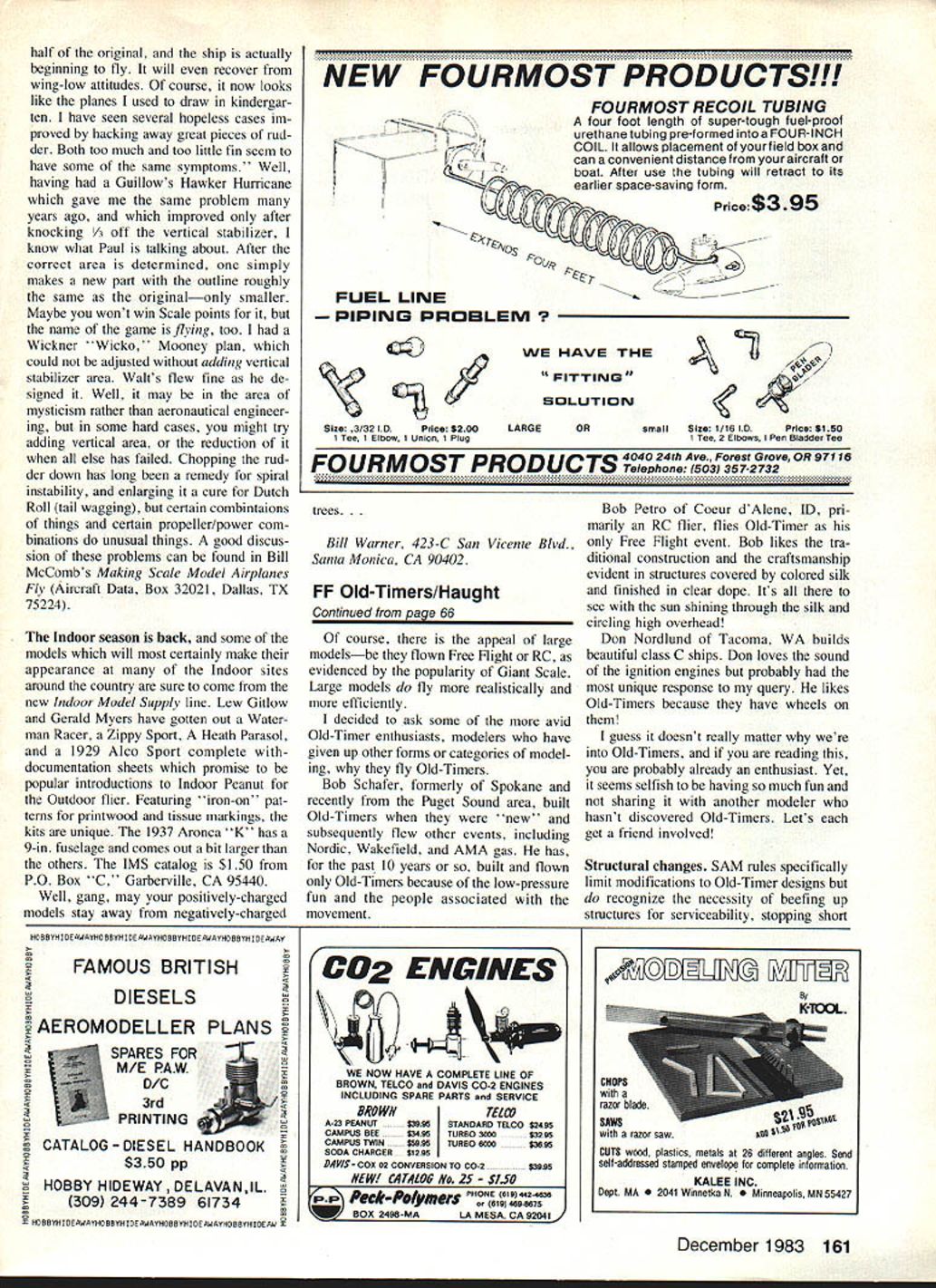
The appeal of Old-Timers is as varied as are Old-Timer enthusiasts. Realism of the typical cabin model probably heads the list. Another reason is the preservation of modeling as it was in its infancy—just as there are today many traditional woodworkers and furniture builders who would not think of using power tools (or even sandpaper) in turning out a magnificent replica of period cabinetry.
Of course, there is the appeal of large models—whether flown by free flight or RC, as evidenced by the popularity of Giant Scale. Large models do fly more realistically and more efficiently.
I decided to ask some of the more avid Old-Timer enthusiasts, modelers who have given up other forms or categories of modeling, why they fly Old-Timers.
- Bob Schafer, formerly of Spokane and recently from the Puget Sound area, built Old-Timers when they were "new" and subsequently flew other events, including Nordic, Wakefield, and AMA gas. For the past ten years or so he has built and flown only Old-Timers because of the low-pressure fun and the people associated with the movement.
- Bob Petro of Coeur d'Alene, ID, primarily an RC flier, flies Old-Timer as his only free flight event. Bob likes the traditional construction and the craftsmanship evident in structures covered by colored silk and finished in clear dope. It's all there to see with the sun shining through the silk and the model circling high overhead.
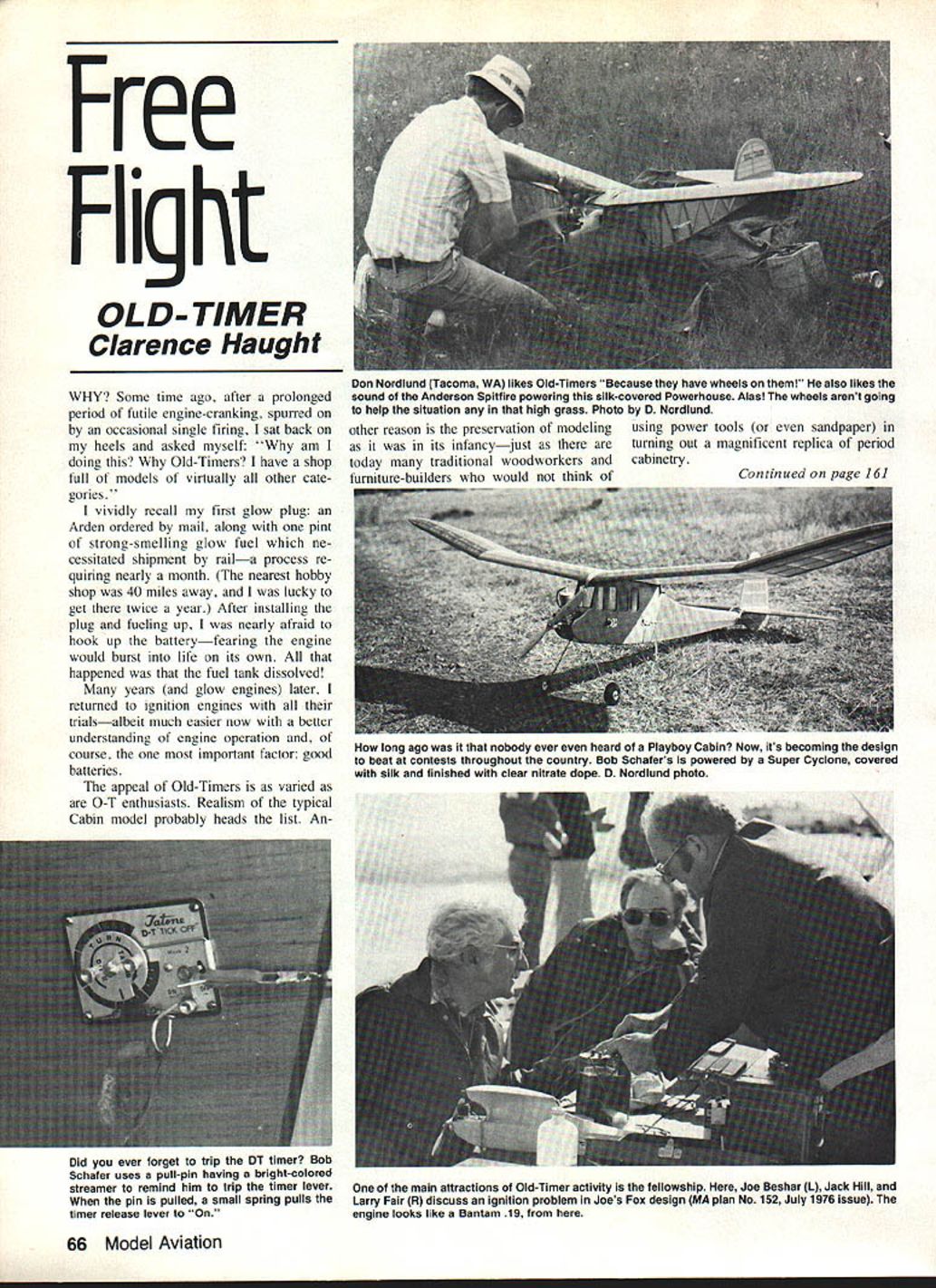
- Don Nordlund of Tacoma, WA builds beautiful class C ships. Don loves the sound of the ignition engines but probably had the most unique response to my query: he likes Old-Timers because they have wheels on them!
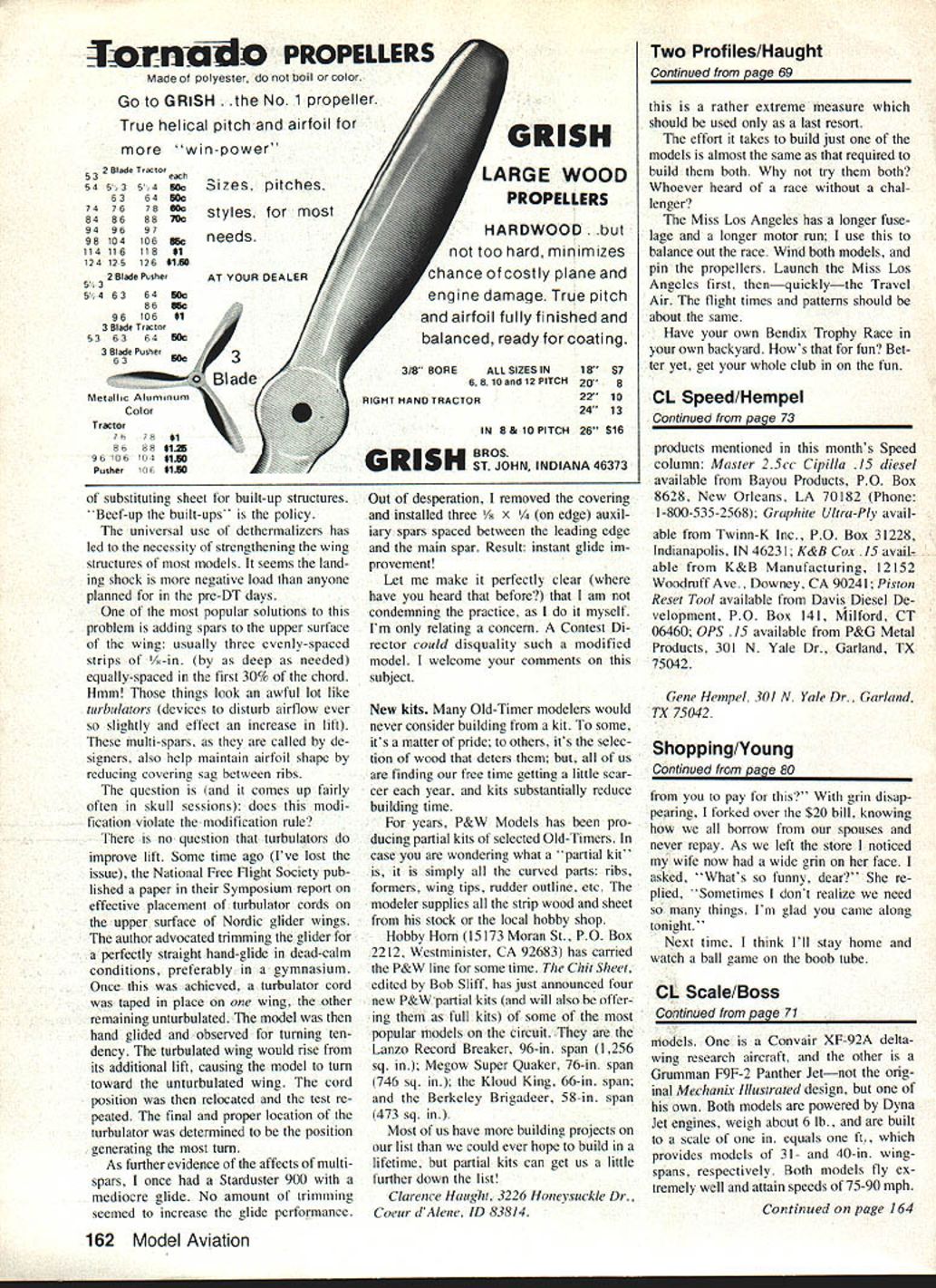
I guess it doesn't really matter why we're into Old-Timers, and if you are reading this, you are probably already an enthusiast. Yet, it seems selfish to be having so much fun and not sharing it with another modeler who hasn't discovered Old-Timers. Let's each get a friend involved!
Structural changes
SAM rules specifically limit modifications to Old-Timer designs but do recognize the necessity of beefing up structures for serviceability, stopping short of substituting sheet for built-up structures.
"Beef-up the built-ups" is the policy.
The universal use of dethermalizers has led to the necessity of strengthening the wing structures of most models. It seems the landing shock is more negative load than anyone planned for in the pre-DT days.
One of the most popular solutions to this problem is adding spars to the upper surface of the wing—usually three evenly spaced strips of 1/8 in. (by as deep as needed) placed in the first 30% of the chord. Those additions look an awful lot like turbulators (devices to disturb airflow ever so slightly and effect an increase in lift). These multi-spars, as they are called by designers, also help maintain airfoil shape by reducing covering sag between ribs.
The question is (and it comes up fairly often in skull sessions): does this modification violate the modification rule?
There is no question that turbulators do improve lift. Some time ago, the National Free Flight Society published a paper in their Symposium report on effective placement of turbulator cords on the upper surface of Nordic glider wings. The author advocated trimming the glider for a perfectly straight hand-glide in dead-calm conditions, preferably in a gymnasium. Once this was achieved, a turbulator cord was taped in place on one wing, the other remaining unturbulated. The model was then hand-glided and observed for turning tendency. The turbulated wing would rise from its additional lift, causing the model to turn toward the unturbulated wing. The cord position was then relocated and the test repeated. The final and proper location of the turbulator was determined to be the position generating the most turn.
As further evidence of the effects of multi-spars, I once had a Starduster 900 with a mediocre glide. No amount of trimming seemed to increase glide performance. Out of desperation, I removed the covering and installed three 1/8 x 1/8 (on edge) auxiliary spars spaced between the leading edge and the main spar. Result: instant glide improvement!
Let me make it perfectly clear: I am not condemning the practice—I do it myself. I'm only relating a concern. A Contest Director could disqualify such a modified model. I welcome your comments on this subject.
New kits
Many Old-Timer modelers would never consider building from a kit. To some, it's a matter of pride; to others, it's the selection of wood that deters them. But all of us are finding our free time getting a little scarcer each year, and kits substantially reduce building time.
For years, P&W Models has been producing partial kits of selected Old-Timers. In case you are wondering what a "partial kit" is: it is simply all the curved parts—ribs, formers, wing tips, rudder outline, etc. The modeler supplies all the strip wood and sheet from his stock or the local hobby shop.
Hobby Horn (15173 Moran St., P.O. Box 2212, Westminster, CA 92683) has carried the P&W line for some time. The Chit Sheet, edited by Bob Sliff, has just announced four new P&W partial kits (and will also be offering them as full kits) of some of the most popular models on the circuit. They are:
- Lanzo Record Breaker — 96 in. span (1,256 sq. in.)
- Megow Super Quaker — 76 in. span (746 sq. in.)
- Kloud King — 66 in. span
- Berkeley Brigadier — 58 in. span (473 sq. in.)
Most of us have more building projects on our list than we could ever hope to build in a lifetime, but partial kits can get us a little further down the list!
Clarence Haught 3226 Honeysuckle Dr. Coeur d'Alene, ID 83814
Transcribed from original scans by AI. Minor OCR errors may remain.

