
Free Flight
OLD-TIMER Clarence Haught
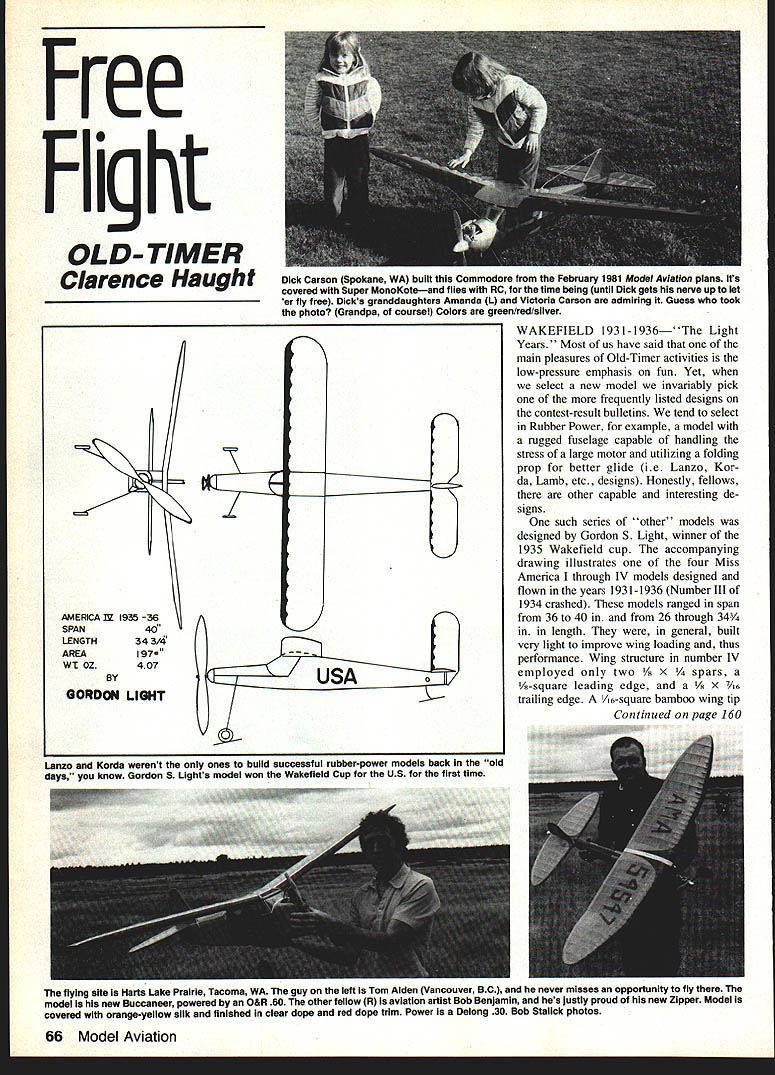
WAKEFIELD 1931–1936 — "The Light Years." Most of us have said that one of the main pleasures of Old-Timer activities is the low-pressure emphasis on fun. Yet, when we select a new model we invariably pick one of the more frequently listed designs on the contest-result bulletins. We tend to select in Rubber Power, for example, a model with a rugged fuselage capable of handling the stress of a large motor and utilizing a folding prop for better glide (i.e., Lanzo, Korda, Lamb, etc., designs). Honestly, fellows, there are other capable and interesting designs.
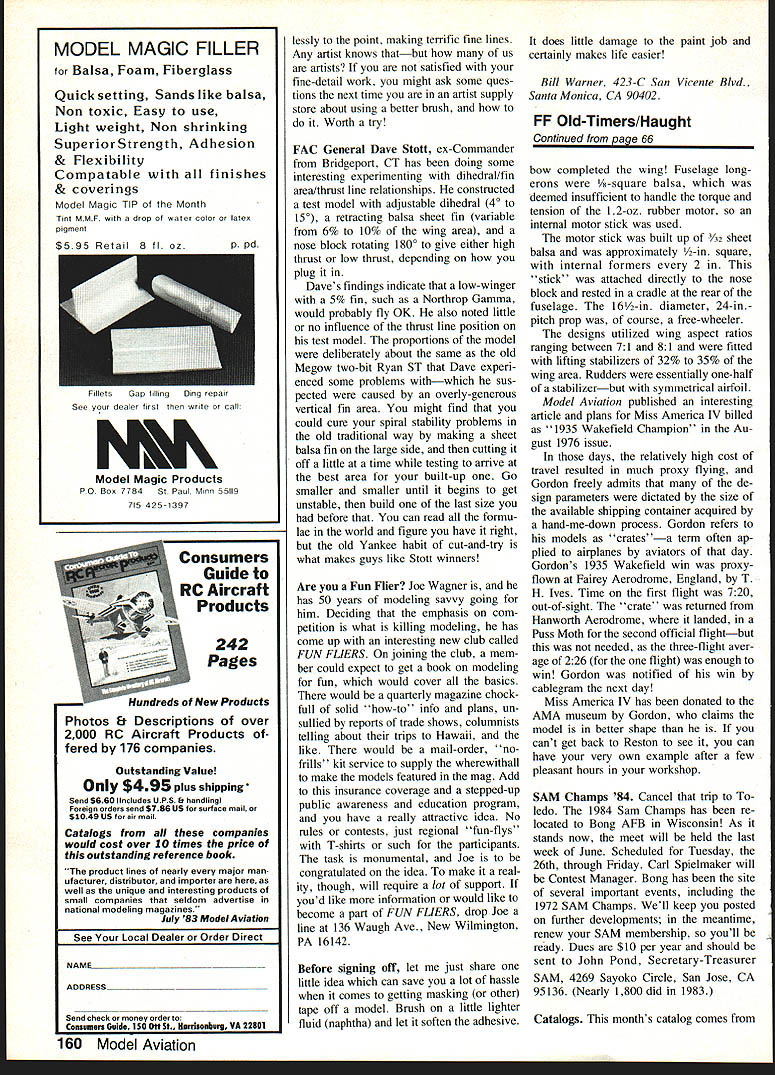
One such series of "other" models was designed by Gordon S. Light, winner of the 1935 Wakefield cup. The accompanying drawing illustrates one of the four Miss America I through IV models designed and flown in the years 1931–1936 (Number III of 1934 crashed). These models ranged in span from 36 to 40 in. and from 26 through 34 3/4 in. in length. They were, in general, built very light to improve wing loading and, thus, performance. Wing structure in Number IV employed only two 3/8 × 3/4 spars, a 1/8-square leading edge, and a 1/8 × 7/16 trailing edge. A 1/16-square bamboo wing tip completed the wing.
Fuselage longerons were 1/8-square balsa, which was deemed insufficient to handle the torque and tension of the 1–2 oz. rubber motor; therefore an internal motor stick was used. The motor stick was built up of 3/32-in. sheet balsa and was approximately 1/2-in. square, with internal formers every 2 in. This "stick" was attached directly to the nose block and rested in a cradle at the rear of the fuselage. The 1-1/2-in. diameter, 24-in. pitch prop was, of course, a free-wheeler.
The designs utilized wing aspect ratios ranging between 7:1 and 8:1 and were fitted with lifting stabilizers of 32% to 35% of the wing area. Rudders were essentially one-half of a stabilizer—but with a symmetrical airfoil.
Model Aviation published an interesting article and plans for Miss America IV, billed as "1935 Wakefield Champion," in the August 1976 issue.
In those days, the relatively high cost of travel resulted in much proxy flying, and Gordon freely admits that many of the design parameters were dictated by the size of the available shipping container acquired by a hand-me-down process. Gordon refers to his models as "crates"—a term often applied to airplanes by aviators of that day. Gordon's 1935 Wakefield win was flown at Fairey Aerodrome, England, by T. H. Ives. Time on the first flight was 7:20, out of sight. The "crate" was returned from Hanworth Aerodrome, where it landed, in a Puss Moth for the second official flight—but this was not needed, as the three-flight average of 2:26 (for the one flight) was enough to win! Gordon was notified of his win by cablegram the next day.
Miss America IV has been donated to the AMA Museum by Gordon, who claims the model is in better shape than he is. If you can't get back to Reston to see it, you can make your very own example after a few pleasant hours in your workshop. Let go and hope!
I recently received a copy of an article from the August 1936 issue of Model Craftsman entitled "Test Flying Your Gas Model Airplane," by Carl Schmaed. It's interesting to note that the first-flight anxieties haven't changed over the years. Let Go and Hope (L.G.&H.) is still very much in vogue! Back in 1936, many modelers realized that this reliance on luck did not contribute to aircraft longevity and began devising better test-flying techniques. Even then, it was recognized that hand-gliding was only a general indicator and that the true gliding speed was only attained in flight. However, many models did not survive the power portion of the flight and thus never demonstrated their glide capabilities.
Much testing was done ROG, rather than by hand-launching, and many systems revolved around assisting the model by running alongside and guiding the wing tip on takeoff. Letting the model take off has its advantages; for one, it doesn't have as far to fall if things don't go right initially. Further, any undesirable turning tendencies show right up. Of course, the model can zoom (an abrupt steep climb), but Frank Tush (Lyndhurst, NJ) came up with a novel solution to that problem. He simply added considerable downthrust in the form of washers under the engine mount lug. On successive flights, downthrust was reduced until a desirable climb was achieved.
Engine timers were not in common use in 1936, but the importance of a limited run during the test phase was readily recognized. Some fliers adapted clockwork timers to cut the power, but J. Condon added an external knife switch with a string attached. This allowed him to cut the power if things didn't look good. Some even tied strings to the tail skid! By running after the model with the string and allowing it to climb to about 10 to 20 feet and then gradually slowing down, the model loses speed and sinks down. The pressure on the tail prevents the nose from dropping, making the model pancake. This sounds logical, but it is doubtful that it has much use in adjusting models, because the model is not in true free flight long enough for one to see exactly how it performs.
The modern version of this could be: "Real men don't tie strings to their models." Interestingly, the author exhibited foresight in his discussion of limiting engine runs by staking. "Cheap toys offer a large assortment of gears, springs, etc., and a light and simple device (for limiting engine runs) can be fashioned from them." With all the Tomy-toy-based timers being used in free flight today, one can only wonder if he had a vision!
Transcribed from original scans by AI. Minor OCR errors may remain.

