
OLD-TIMER Clarence Haught
Rubber Power!
RUBBER POWER! The mainstay of Old-Timer activity is undoubtedly the Gas model. Earlier Old-Timer revival activity centered around the ignition engine. Of late, more and more entries and events are showing up in other disciplines: Towline, Hand-Launched Glider, and definitely Rubber.
It isn't the cost of gasoline or ignition-engine availability that has brought about this change of direction. It is the enjoyment of rubber flying itself!
A recent survey by the National Free Flight Society (you should be a member; write NFFS, 707 2nd St., Davis, CA 95616) indicates that Rubber Power in all categories is growing by leaps and bounds. Keeping in mind most free-flighters are multi-interest, we stuck to the column showing between 11% and 50% interest (activity). Hand-Launched Glider was highest, Free Flight Power second, FF Old-Timer third, Rubber Power tying with Scale for fourth place, and FAI events holding down 12th, 13th and 14th places. Fifth place went to Indoor, which is at least half rubber.
So why aren't you into Rubber Power? Chances are it's prop carving that's holding you back the most. They say prop carving builds character! Well, I've seen some at every Old-Timer event I've attended. But prop carving has been around a lot longer than gas models, and even the early gas props were hand-carved! Anyhow, there is lots of good information around that was discovered and proven by "the old guys."
Prop basics: diameter, pitch, and P-D ratio
Rubber-power props are usually large in diameter and slow-turning. Diameters usually range from one-third to one-half the model's wingspan. Such a large-diameter, slow-turning prop needs considerable pitch to be effective.
Pitch, although related to blade angle, is not an angle but the distance the propeller would advance in one revolution through a solid. Air, being a gas, allows considerable slippage, resulting in loss of efficiency. Pitch and diameter go together in loading the power plant (rubber). Getting the proper combination of pitch, diameter, and motor is the key to good power performance.
Proper pitch-to-diameter is expressed by ratio. Pitch-to-diameter (P-D) ratios of 1¼-to-1 to 1½-to-1 have proven, through experience, to be about right. Thus, a P-D ratio of 1¼-to-1 figures out as 30 in. pitch, 20 in. diameter.
Examples:
- P-D ratio 1¼-to-1: 30 in. pitch, 20 in. diameter.
- P-D ratio 1½-to-1: scale accordingly (pitch = 1.5 × diameter).
How to carve a prop
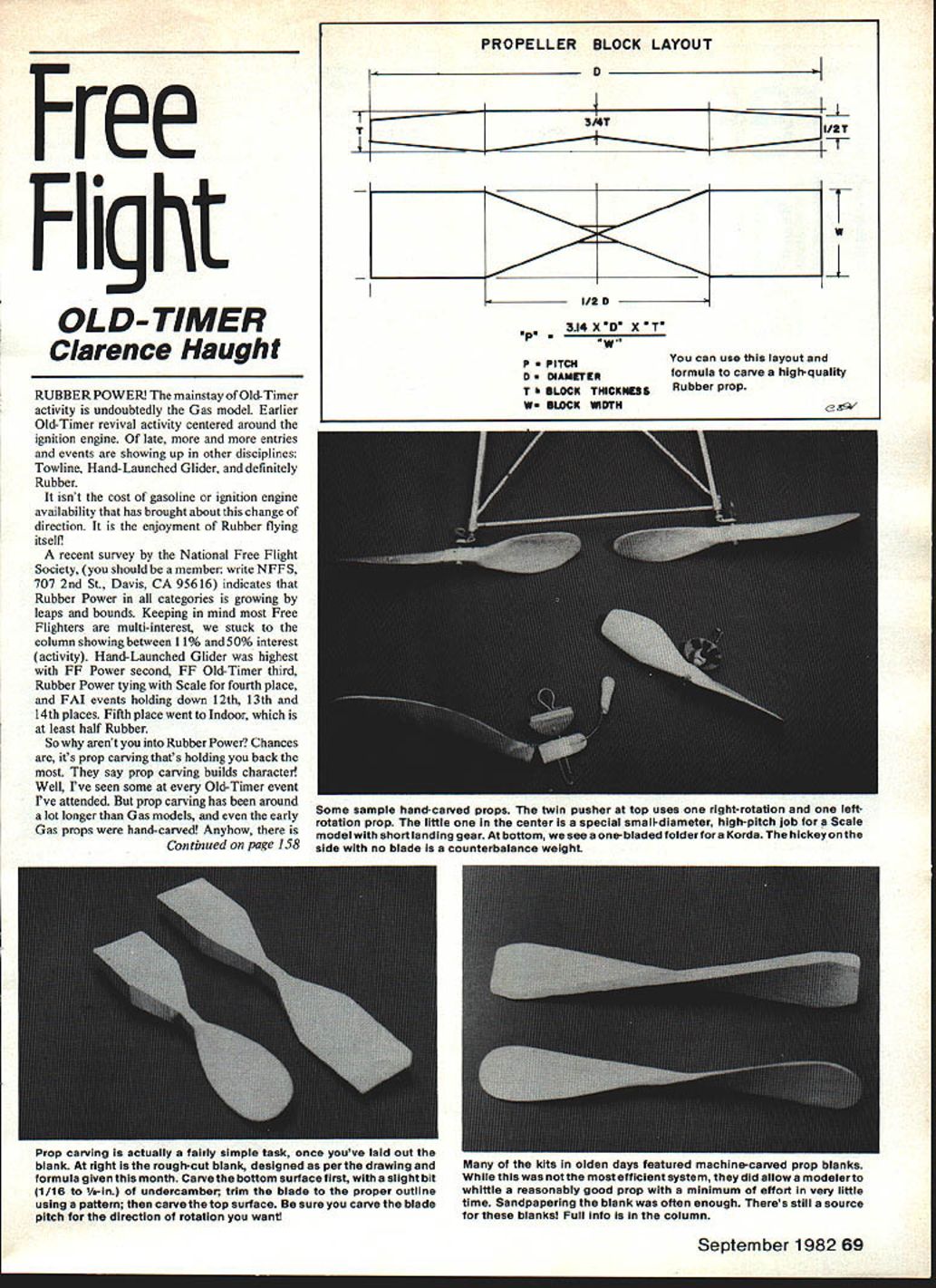
How do we carve a prop with a desired pitch? A simple formula devised back in the Thirties tells us how:
Pitch = (π × Diameter × Thickness) / Width
(Use π ≈ 3.14 in the old formula.) The formula may be solved for any unknown in case one or more factors are established, such as available wood stock or restricted diameter due to landing gear length, etc. A few quick mathematical exercises will get you the information you need.
After laying out the block, as shown on the accompanying drawing, cut away the waste and carve the bottom surface. This surface should have a slight undercamber—1/16 in. to 1/8 in. maximum. A long X-Acto carving blade and sandpaper will do the trick. Shape the blade outlines next, using a template to ensure matching blades.
Carve the top surface to an airfoil section. The thinner the blade section, the more efficient the prop will be—but thinness sacrifices strength.
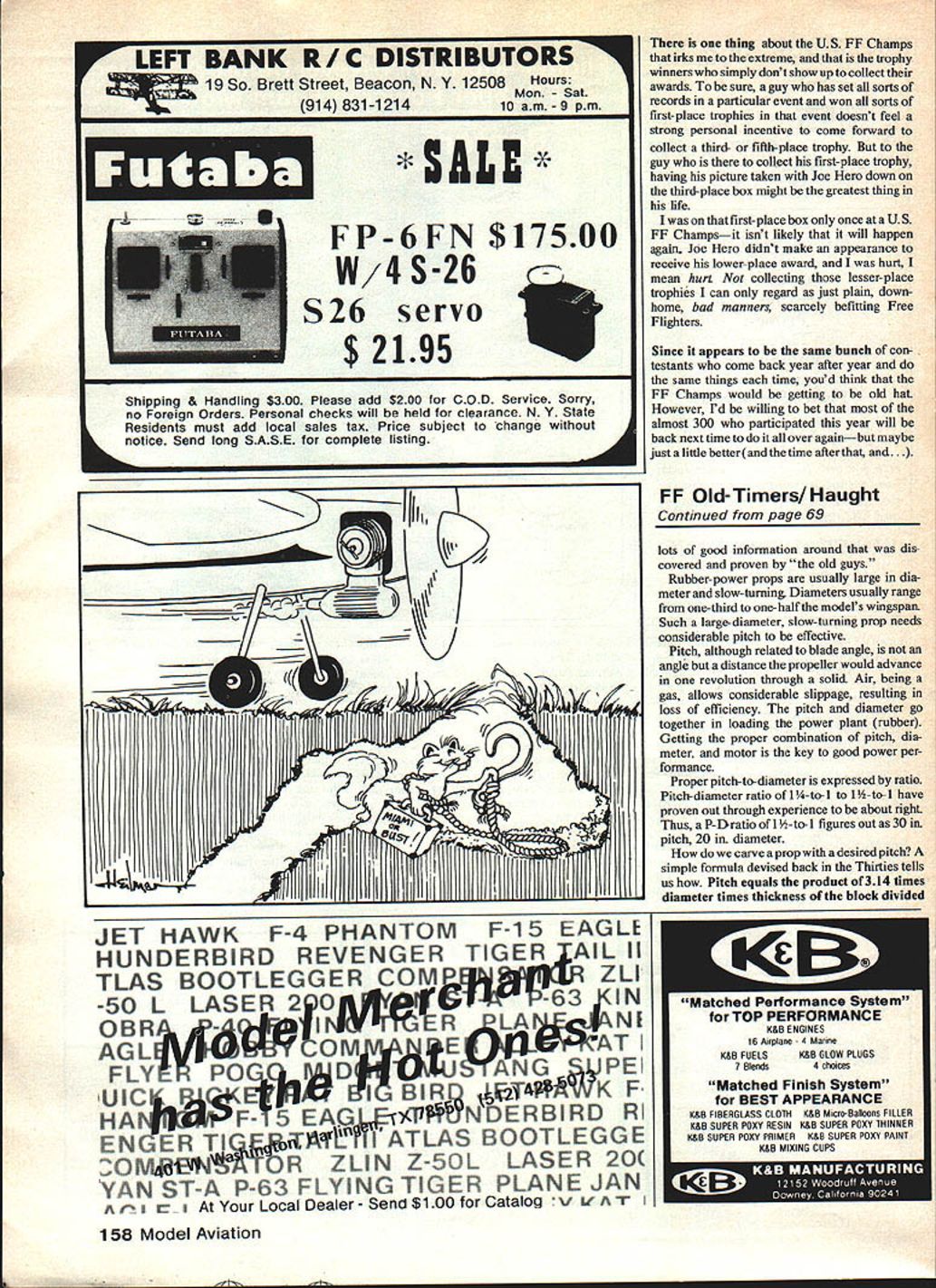
One last precaution: think about what you are doing before taking that first cut. It is quite easy to come up with a left-hand prop if you are not careful! Of course, you can always use it on your twin pusher. The rest is practice. Buy a block of balsa and start carving. It builds character... er, character.
Materials, strength, and finishing
Speaking of strength, many Old-Timers do not use folding props and, therefore, subject the prop to potential damage at each landing.
Proper selection of firm, straight-grain balsa with annular rings either vertical or horizontal—but not angled—helps, as does covering the delicate blades with silk and dope. Other woods work quite well: pine or spruce makes an excellent prop. The slight increase in weight often helps to bring the CG into limits, and it also provides flywheel action. Pine props can be made thinner while still retaining their strength.
Machine-carved props
Those of you who have been into OT Rubber for some time will recall the machine-carved props supplied with many of the popular kits. Those blanks allowed the builder to finish up an acceptable prop in a few minutes with nothing more than some sandpaper and perhaps a penknife.
Joe Dill, N 7215 Maher Court, Spokane, WA 99218, has uncovered a supply of original machine-carved prop blanks in diameters of 8, 9, and 10 in. Joe will make them available at $2.00 each, postpaid. These props will get you in the air in short order, and at the current price of balsa they are a pretty good deal.
Update on spool dethermalizers
Our discussion of spool dethermalizers brought some interesting comments from readers who actually employed the system. The "system," as you may recall, released a weight (spool) attached to a wingtip by a suitable length of line—causing a spiral descent until the weight hit the ground, allowing the line to slacken and the model to recover and land.
George Myers, our Radio Technique columnist, related the unhappy experience of watching his original sailplane floating out of sight with a spool hanging from a wing. George said it just tightened up the turn a bit. He feels only spirally unstable models can be brought down with the system. Of course, more weight might have done the trick, but in a contest you hesitate to carry more weight than the minimum required by the rules.
Robert Stuhr of Shelby, IA solved the lack-of-weight problem by using a C-cell battery instead of a spool. His installation, in a Thermal Thumber, used 75 ft. of button and carpet thread secured to a hole in the right wingtip just behind the spar, and it worked great. Robert recently unearthed the model, and the battery bore the legend "place in service before July 1939!"
Thanks for the input, folks. We columnists thrive on it!
Clarence E. Haught 3226 Honeysuckle Dr. Rt. 5 Box 16 Coeur d'Alene, ID 83814
Transcribed from original scans by AI. Minor OCR errors may remain.

