
Free Flight
OLD-TIMER
Clarence Haught
Whoops! In our last column (September 1982) we published drawings and a formula for carving a rubber-power propeller. A couple of our readers, Ken Simpson (Cedarburg, WI) and J.O. Niederhouser (Indianapolis, IN), caught an error and brought it to our attention. The formula should have read:
P = π/2 x D x T / W
Where:
- P = Pitch
- D = Diameter
- T = Thickness
- W = Width
The formula given last time is correct for the old, straight-X block where the X runs from corner to corner of the block. It is the formula used in the machine-cut blocks we featured, which are distributed by Joe Dill, N. 7215 Maher Court, Spokane, WA 99218. I was also corrected on undercutting the center of the prop before carving, as it affects blade angle. This is true, but very little is lost in the shank portion of the blade, and I feel it makes carving and shaping easier. At any rate, I believe you will find prop carving an enjoyable part of our hobby, and I urge you to try it.
Lightweights
Seems like, percentagewise, the C Gas ships have always outnumbered their smaller relatives, the A and B jobs. One reason could be the lack of good small engines, but part of the problem has to be the difficulty in producing a model at or near the minimum weight in order to get decent glide performance.
Choosing light wood, employing Japanese tissue for covering, and using a minimum of colored dope helps, but a major culprit is the sheer weight of the ignition system. Smaller and better batteries are available today, especially in the alkaline-cell type. Also, modelers have been identifying lighter condensers from the electronics industry. A 0.1 µF, 200–400 volt unit will do the trick.
One of the biggest culprits in adding weight is the ignition coil. There were a few small ones built way back when, but new stock, the Modelectric, is quite large for a small Class A ship.
Martin Gettig of Gettig Engineering and Manufacturing Company, Inc., 1 Streamside Place East, Spring Mills, PA 16875, wants to do something about this heavy ignition coil situation. Martin's firm had acquired some coil-winding equipment, and he set about producing a small, efficient coil. His coil weighs 1.16 ounces and will operate on two AAA-size batteries. This brings the weight of the ignition system to 2.22 ounces (less wiring and timer, which can vary considerably), but at least gives you some options.
When can you obtain this lightweight system? Well, you can't—at least not right away. Martin will go into production if there is sufficient interest in the products. The coils will go for $13.00, condensers for $1.50, and battery boxes (AAA) for $2.00. Write Martin at the above address and advise him of your needs.
Small ships
Speaking of small models and engines, I recently test-ran a Simplex Hornet .19. The engine started easily and responded well to needle valve and spark advance. The engine would run as slow as 4,000 rpm and as high as 10,000 rpm on a 9-4 wood prop. That 10,000 rpm is very good for a .19 sideport engine, which makes it very competitive on the contest circuit. The low-end rpm would be good for Scale or fuel-allotment events. As always with John Morrill's engines, workmanship and finish are superb. However, all the production run of the Hornet .19 as well as the Simplex .25 are sold. I asked John if he plans another batch, but he's not sure. If you are interested, contact Simplex Miniature Engines, 143 Richmond Avenue, El Segundo, CA 90245.
See Oh Two?
Some time ago we wrote about compressed-air engines. Bill Zand of the Cleveland Free Flight Society sent photos of his Brown (how appropriate) CO-2-powered Mini Ruler. The CFFS flies these models in a 50-second precision event. Can't imagine a more fun-filled and relaxing event! Power output of current CO-2 engines is adjustable, and with a little experimentation with props, the still-air flight time could be extended. Possible subjects are endless, as any OT design can be scaled down.
There are also many Scale plans available from the OT era. Bob Stallick of the Willamette Modelers in Albany, OR pioneered some activities along these lines by building a scaled-down Miss America to be flown in conjunction with the regular indoor season. It may not be an official SAM event, but with a little promotion it could go over big in local meets.
A lot of Bull
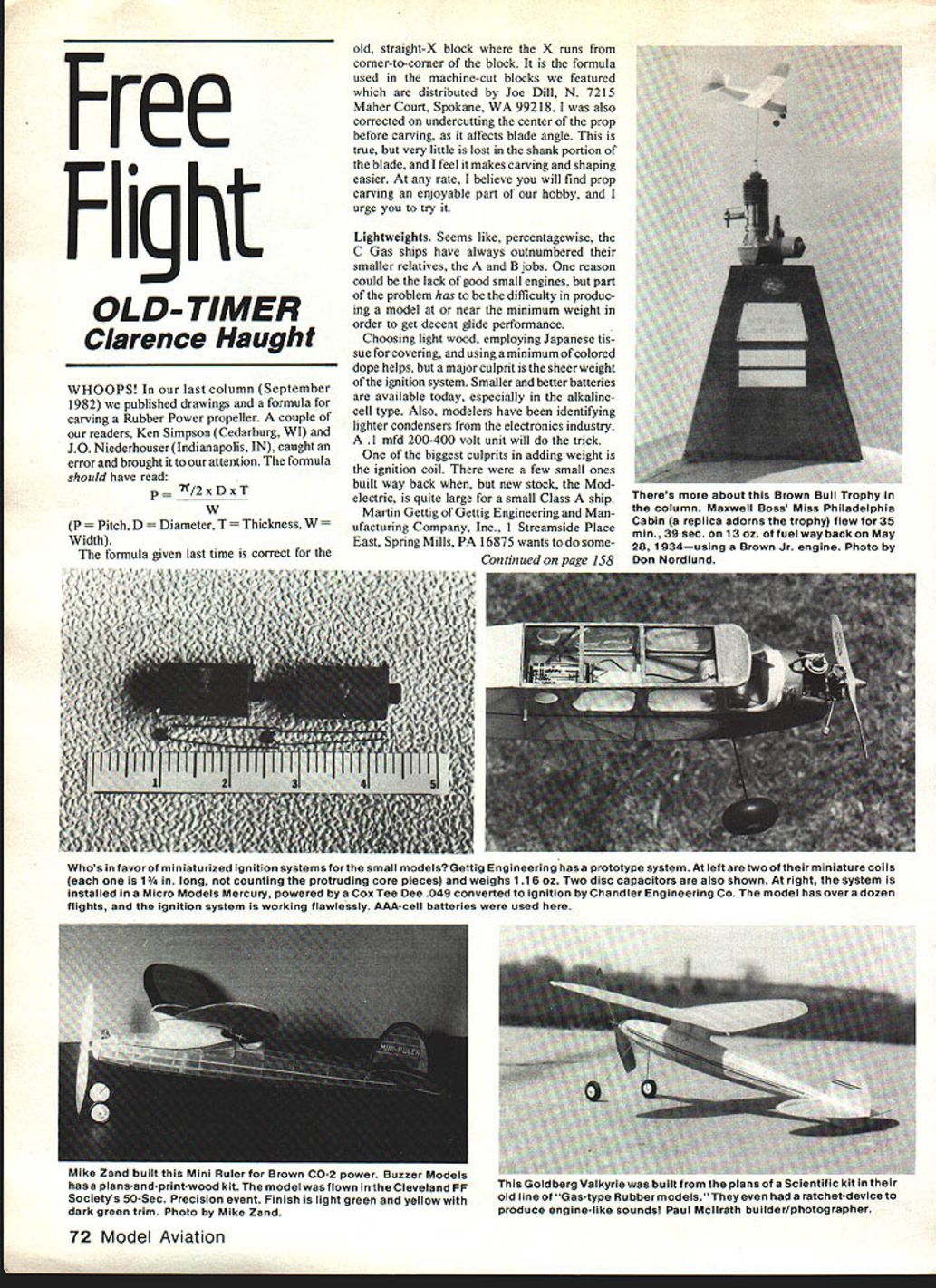
Clarence Bull of Eugene, OR is a fan of Brown Jr. engines. He is also an avid competitor in Control Line, Free Flight and especially in Old-Timer Free Flight. Clarence has come up with the "Brown Bull Trophy" pictured here. This perpetual trophy goes to the winner of the Brown-powered event. The concept is not new, as there have been many special trophies dedicated to particular engines: O&R .23s, Delong .30s, Slag engines, etc., but the big payoff is Fun! Anything that can put the smiles in and the frowns out just has to be good! We need a lot more events like these.
Most of these trophies are special homemade "works of art" and mean a great deal to the recipient. Let's encourage more of them, but at the same time let's not burden the CD with the extra responsibility. Most CDs welcome a little extra help on special activities.
New address
Clarence Haught 3226 Honeysuckle Dr. Coeur d'Alene, ID 83814
Transcribed from original scans by AI. Minor OCR errors may remain.

