
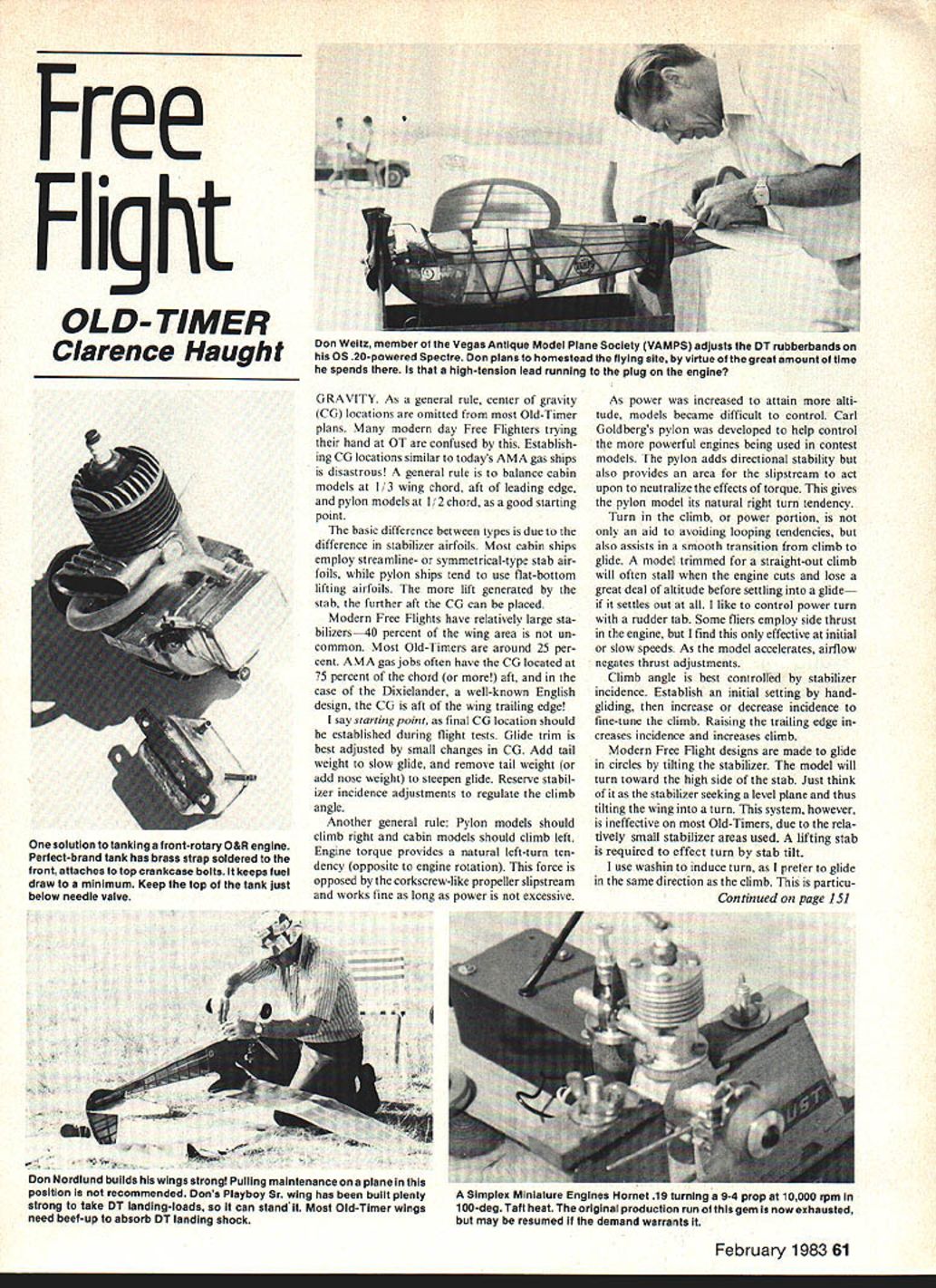
Free Flight: Old-Timer
Clarence Haught
Gravity
As a general rule, center of gravity (CG) locations are omitted from most Old-Timer plans. Many modern-day Free Flighters trying their hand at OT are confused by this. Establishing CG locations similar to today's AMA gas ships is disastrous! A general rule is to balance cabin models at 1/3 wing chord aft of the leading edge, and pylon models at 1/2 chord, as a good starting point.
The basic difference between types is due to the difference in stabilizer airfoils. Most cabin ships employ streamline- or symmetrical-type stab airfoils, while pylon ships tend to use flat-bottom lifting airfoils. The more lift generated by the stab, the further aft the CG can be placed.
Modern Free Flight designs have relatively large stabilizers—40 percent of the wing area is not uncommon. Most Old-Timers are around 25 percent. AMA gas jobs often have the CG located at 75 percent of the chord (or more!), and in the case of the Dixielander, a well-known English design, the CG is aft of the wing trailing edge! I say "starting point," as final CG location should be established during flight tests. Glide trim is best adjusted by small changes in CG. Add tail weight to slow glide, and remove tail weight (or add nose weight) to steepen glide. Reserve stabilizer incidence adjustments to regulate the climb angle.
Climb turn and directional stability
Another general rule: pylon models should climb right and cabin models should climb left. Engine torque provides a natural left-turn tendency (opposite to engine rotation). This force is opposed by the corkscrew-like propeller slipstream and works fine as long as power is not excessive.
As power was increased to attain more altitude, models became difficult to control. Carl Goldberg's pylon was developed to help control the more powerful engines being used in contest models. The pylon adds directional stability but also provides an area for the slipstream to act upon to neutralize the effects of torque. This gives the pylon model its natural right-turn tendency.
Turn in the climb, or power portion, is not only an aid to avoiding looping tendencies, but also assists in a smooth transition from climb to glide. A model trimmed for a straight-out climb will often stall when the engine cuts and lose a great deal of altitude before settling into a glide—if it settles out at all. I like to control power turn with a rudder tab. Some fliers employ side thrust in the engine, but I find this only effective at initial or slow speeds. As the model accelerates, airflow negates thrust adjustments.
Climb angle and stabilizer incidence
Climb angle is best controlled by stabilizer incidence. Establish an initial setting by hand-gliding, then increase or decrease incidence to fine-tune the climb. Raising the trailing edge increases incidence and increases climb.
Glide turn: stabilizer tilt vs washin
Modern Free Flight designs are made to glide in circles by tilting the stabilizer. The model will turn toward the high side of the stab. Just think of it as the stabilizer seeking a level plane and thus tilting the wing into a turn. This system, however, is ineffective on most Old-Timers, due to the relatively small stabilizer areas used. A lifting stab is required to effect turn by stab tilt.
I use washin to induce turn, as I prefer to glide in the same direction as the climb. This is particularly helpful if one launches into a thermal, as the model will usually stay in the thermal rather than turning out of it as in the case of having opposite glide turn in relation to climb turn.
In practice, the wing panel toward which the turn is desired is washed in (trailing edge down). During the higher-speed climb portion of the flight, the lift generated is greater than the drag created by the washin. This holds the inboard (turn) wing up and maintains climb. Remember the outboard (that is, on the outside of the turn) wing will be moving through the air faster than the inboard wing, creating more lift on the outboard wing and tending to roll the model toward the inboard wing. When the engine stops, airspeed decreases, and the washin now creates more drag than lift, thereby inducing turn but still generating enough lift to nearly equal the faster-moving outboard wing. This sounds complicated, but it works!
Summary: basic trimming rules for Old-Timers
- Establish basic center of gravity.
- Establish basic stabilizer incidence by hand-gliding.
- Regulate climb angle with stabilizer incidence.
- Regulate climb turn with rudder tab.
- Regulate glide speed with minor CG shifts.
- Regulate glide turn with washin.
Warps and field adjustments
Wing warps are easily added or removed by holding the surface over a pan of boiling water (if the surface is covered with silk, silkspan, or tissue) and twisting in the desired direction for a moment, then removing the surface and cooling it by rubbing it across your leg. This is fine for initial settings, but what do you do in the field? You can adjust warps fairly well by heating the surface in the exhaust of an automobile—just be sure to avoid breathing it!
An alternate to warping is to secure a length of shaped trailing-edge stock to the bottom of the wing trailing edge with the sharp edge forward. This method is not as efficient as washin, due to the resulting thick trailing edge. It adds drag, but not much lift. It is easy to add in the field.
New kit
When SAM gave its approval of the 70-percent Buzzard Bombshell for official SAM competition, Four K's Models lost no time producing a kit. The model has a 50.4-in. wingspan and is recommended for .19 to .29 engines. The kit features sanded wing ribs, formers, and fuselage sides, formed landing gear, and several choice flying surfaces. Sold by Sal Taibi of Superior Aircraft Balsa, at today's prices the kit's price of $39.95 is reasonable. Four K's Models, 4202 W. 172 St., Torrance, CA 90504 also produces the other Old-Timer kits: 72-in. Buzzard Bombshell, 36-in. Baby Bombshell, 73-in. Denny Junior Power Fliers, and the Korda Wakefield and Lamb Climber for rubber. Try your dealer first.
Clarence Haught, 3226 Honeysuckle Dr., Coeur d'Alene, ID 83814.
Transcribed from original scans by AI. Minor OCR errors may remain.

