
Free Flight
OLD-TIMER Clarence Haught
NFFS Free Flight Hall of Fame: One of the things that sets free flight apart from many other special interests is the presence of many of the modeling pioneers. For example, how many Civil War veterans do you know? A little-known fact in many fields requires extensive research. In model aviation, we can still ask someone "who was there." Quite a few of these early birds — er, birdmen — attend major model meets each year and are always willing to share their experiences with those interested.
This model set the pace for a long line of designs featuring single wheels, high-lift airfoils, and elliptical wing planforms. The Skyscraper was also the forerunner of many models designed by fellow Brooklyn Skyscrapers club members, including the Topper and Rocketeer.
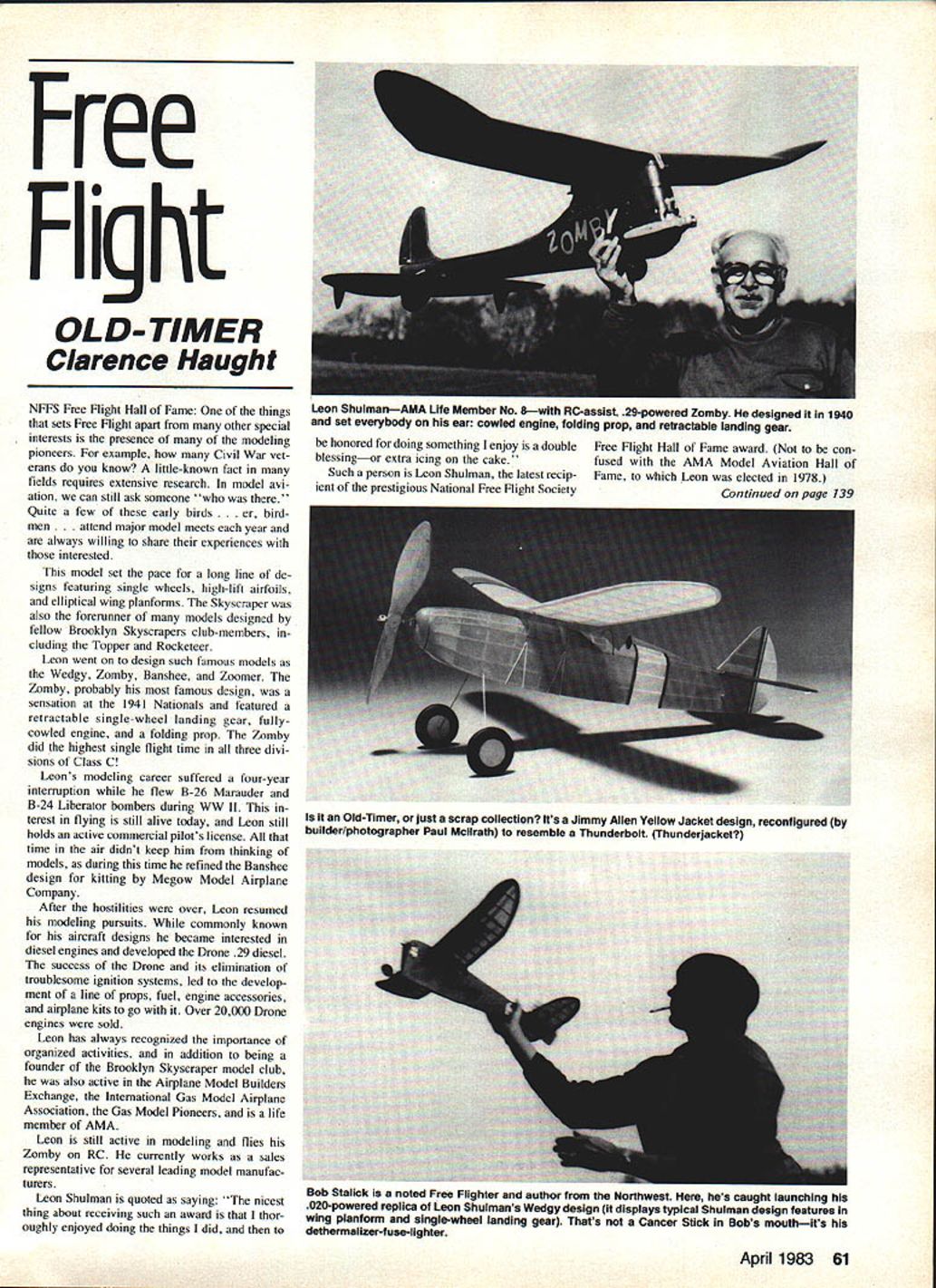
Leon went on to design such famous models as the Wedgy, Zomby, Banshee, and Zoomer. The Zomby, probably his most famous design, was a sensation at the 1941 Nationals and featured a retractable single-wheel landing gear, fully cowled engine, and a folding prop. The Zomby did the highest single flight time in all three divisions of Class C.
Leon's modeling career suffered a four-year interruption while he flew B-26 Marauder and B-24 Liberator bombers during WWII. This interest in flying is still alive today, and Leon still holds an active commercial pilot's license. All that time in the air didn't keep him from thinking of models; during this time he refined the Banshee design for kitting by Megow Model Airplane Company.
After the hostilities were over, Leon resumed his modeling pursuits. While commonly known for his aircraft designs, he became interested in diesel engines and developed the Drone .29 diesel. The success of the Drone and its elimination of troublesome ignition systems led to development of a line of props, fuel, engine accessories, and airplane kits to go with it. Over 20,000 Drone engines were sold.
Leon has always recognized the importance of organized activities. In addition to being a founder of the Brooklyn Skyscraper model club, he was active in the Airplane Model Builders Exchange, the International Gas Model Airplane Association, the Gas Model Pioneers, and is a life member of the AMA.
Leon is still active in modeling and flies his Zomby on RC. He currently works as a sales representative for several leading model manufacturers.
Leon Shulman is quoted as saying: "The nicest thing about receiving such an award is that I thoroughly enjoyed doing the things I did, and then to be honored for doing something I enjoy is a double blessing—or extra icing on the cake."
Such a person is Leon Shulman, the latest recipient of the prestigious National Free Flight Society Free Flight Hall of Fame award (not to be confused with the AMA Model Aviation Hall of Fame, to which Leon was elected in 1978).
Free Flight: Old-Timer
Like many of us, Leon started with the 10-cent model, but unlike most of us he was inspired by the Graf Zeppelin cruising over Brooklyn in the early 1920s.
Leon's first engine was an Elf, followed by a Baby Cyclone and then a Brown Junior. His first flight, in 1936, lasted only 30 seconds—but that's not bad when you consider Leon had tied a long string to the tail and had to run along behind! Tension on the string slowed the model and caused it to land. Remember, engine runs were limited by fuel allotment alone in those days, and dethermalizers were unheard of.
His next model was the TD Coupe built from magazine plans in 1937 (and modified, of course). Leon says he covered it with brown wrapping paper and painted it blue and orange with household enamel. I tried that household enamel over silkspan once, and it took days to dry!
Preferring to design his own models, Leon brought out the Skyscraper—the first one-wheeler to be published. Three-and-one-half-inch M&M wheels were very expensive, and the one-wheel saved weight and drag. (This model is featured on page 66 of Air Age Gas Models, available from Model Airplane News.)
Airborne
I recently received a sample copy of Airborne, the official journal of the Model Aeronautics Association of Australia. This is a superb publication serving all aspects of model aviation with good free flight coverage. Paul Logan writes a column called "Free Flight Topics," and Max Starick writes "For-Old-Timers' Sake." Lots of other interesting columns and articles make up the balance of the magazine.
The September–October 1982 issue I received had a nice Peanut Scale plan of the Puss Moth that would tempt any scale builder. Nine dollars (Australian) will get you six copies per year via surface mail ($15 by airmail). Airborne Magazine, 11 Cornwall Close, Tullamarine, Victoria, Australia 3043.
Stardusters forever
Robert Craig, Rt. 70 Box 2450, Las Vegas, NV 89124, has been doing some old-time engine rework and producing custom Old-Timer kits for some time now and advises me that he is producing kits and semikits of the entire Starduster line. They're not Old-Timers—but one of the easiest ways to get a kid hooked on free flight! They always seem to fit "right off the board." Although the design is around 30 years old, designer Sal Taibi can still be seen producing max after max at the U.S. Free Flight Championships and the Nationals with one size or another of this design.
Engines
I recently received Gene Hempel's list of engine rework/repair services. Known as P&G Metal Shop, 301 North Yale Drive, Garland, TX 75042, Gene specializes in chrome plating and fitting pistons—a good way to extend the life of your favorite engine. Gene is also stocking the new OPS .15 competition engine. This mill is intended to compete with the Rossi and OS .15 engines (not an Old-Timer!). He has them in stock and lots of parts are available. He also has performance parts for the Cox TD engines.
Nostalgia
More and more contests are including events for Nostalgia models (1943 to 1956 designs). One of the hottest areas outside of California is the Midwest. Central Indiana Aeromodelers' Bob Larsh is Rules Coordinator in the area. They have experienced some of the usual problems—like performance designs dominating contests and the use of high-power engines—experienced by other special-interest events in every category of model aviation. As a result, many rules-change proposals have surfaced, some being passed and others being rejected—but the point is that progress is being made and tested on the competition trail.
Recent voting on rules proposals imposed a two-year freeze on rules changes and clarified some gray areas in the area of allowable powerplants. Front-rotor Cox engines have been outlawed in the spirit of the era, and some small 1/2A ships may be scaled up to 250 sq. in. to match the era benchmark.
Those of us in Old-Timer flying need to be aware of this fast-growing event. It isn't a threat to Old-Timer; Nostalgia is a viable alternative for many fliers unable to obtain (or for one reason or another) a satisfactory ignition. It should also interest those who desire more performance than usually attained by Old-Timer models. Contact Bob Larsh at 45 South Whitcomb Ave., Indianapolis, IN 46241.
SAM Membership
Our special interest is trying to bring membership up to date. The latest rule book is out now and will be sent to new and renewed members. When writing, use the new address for the Society of Antique Modelers: 4269 Saybrook Circle, San Jose, CA 95136.
Clarence Haught 3226 Honeysuckle Dr. Coeur d'Alene, ID 83814
Transcribed from original scans by AI. Minor OCR errors may remain.

