
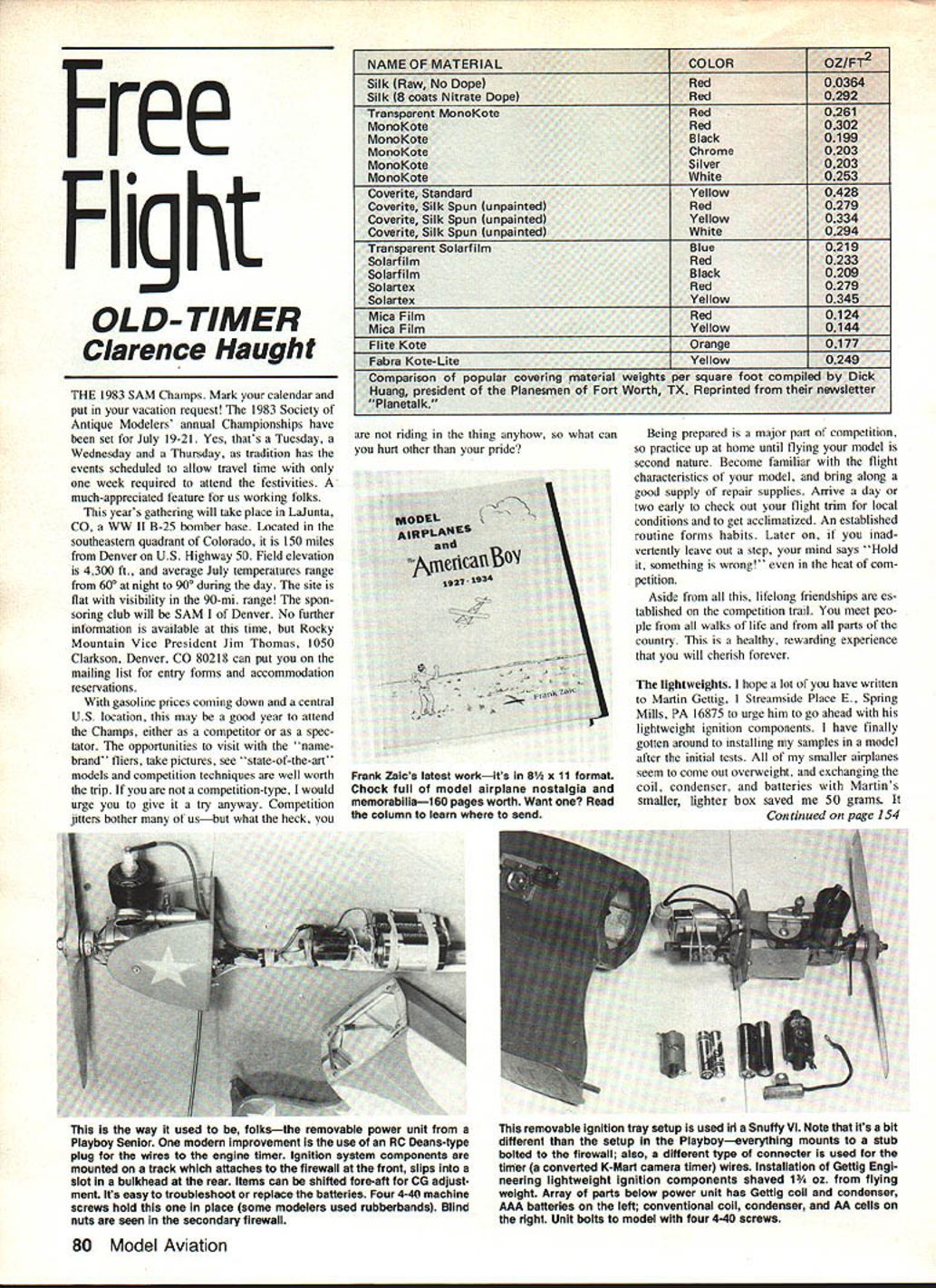
Free Flight: OLD-TIMER
Clarence Haught
The 1983 SAM Champs
Mark your calendar and put in your vacation request! The 1983 Society of Antique Modelers' annual Championships have been set for July 19–21. Yes, that's a Tuesday, a Wednesday and a Thursday, as tradition schedules the events to allow travel time with only one week required to attend the festivities — a much-appreciated feature for us working folks.
This year's gathering will take place in La Junta, CO, at a WWII B-25 bomber base. Located in the southeastern quadrant of Colorado, it is 150 miles from Denver on U.S. Highway 50. Field elevation is 4,300 ft., and average July temperatures range from about 60° at night to 90° during the day. The site is flat with visibility in the 90-mile range. The sponsoring club will be SAM 1 of Denver. No further information is available at this time, but Rocky Mountain Vice President Jim Thomas, 1050 Clarkson, Denver, CO 80218, can put you on the mailing list for entry forms and accommodation reservations.
With gasoline prices coming down and a central U.S. location, this may be a good year to attend the Champs, either as a competitor or as a spectator. The opportunities to visit with the "name-brand" fliers, take pictures, and see state-of-the-art models and competition techniques are well worth the trip. If you are not a competition type, I would urge you to give it a try anyway. Competition jitters bother many of us—but what the heck, you are not riding in the thing anyhow, so what can you hurt other than your pride?
Being prepared is a major part of competition, so practice at home until flying your model is second nature. Become familiar with the flight characteristics of your model, and bring along a good supply of repair supplies. Arrive a day or two early to check out your flight trim for local conditions and to get acclimatized. An established routine forms habits. Later on, if you inadvertently leave out a step, your mind says "Hold it, something is wrong!" even in the heat of competition.
Aside from all this, lifelong friendships are established on the competition trail. You meet people from all walks of life and from all parts of the country. This is a healthy, rewarding experience that you will cherish forever.
The lightweights
I hope a lot of you have written to Martin Gettig, 1 Streamside Place E., Spring Mills, PA 16875, to urge him to go ahead with his lightweight ignition components. I have finally gotten around to installing my samples in a model after the initial tests. All of my smaller airplanes seem to come out overweight, and exchanging the coil, condenser, and batteries with Martin's smaller, lighter box saved me 50 grams — doesn't sound like much, but that's about 1¾ oz. Enough of a savings to put my old Snuffy VI back to near minimum weight. Now, with a slightly stronger O&R .23, well, most models can use a little extra help in the form of less weight to drag around. Let's convince Martin to get on with production!
Removable power units
As you have noticed in this month's photos, the engine firewall and ignition system are removable on the Snuffy as well as on all my other Old-Timers. This used to be a standard practice with many modelers, and lots of plans show removable power units. In the "old days," the power unit was attached with rubber bands around wire hooks or dowels. This provided a shock-absorbing factor as well as easily accessible ignition components.
Nowadays, it seems we know a little more about trimming and flying and don't need the shock-absorbing feature so much. Many models seen today have the ignition system built in with a hatch over the battery box for access. The old rubber-band system is a little unsightly, but three or four 4-40 screws held in anchor nuts can take its place and keep the nose sanitary. If you worry about shock absorption, you could substitute nylon screws and let them shear under load.
Servicing the ignition system is only one advantage of removable power units. A second benefit is easy C.G. adjustment by shifting coil or batteries. The photo of my Playboy Senior shows a track-mounted ignition system. The track is 1/8-in. plywood which is hinged at the firewall and slips into a guide slot in the fuselage. Rubber bands secure the components, and little wood stops act as locators on the track to prevent shifting during normal operations.
Removable power units do require some sort of connector plug to the timer, unless it is mounted up forward. The RC Deans-type connectors work quite well. It is a good idea to tape them together to prevent accidental disconnection due to vibration.
Frank Zaic's latest
Those of you who follow this column will probably recall an interview with Frank Zaic. Although retired from his regular job for some time now, he continues to generate material for model airplane enthusiasts. His latest work, entitled Model Airplanes and the American Boy, contains a wealth of fascinating information. Essentially reprints of the model airplane articles from The American Boy magazine from 1927 to 1934, the book provides insight into the early days of modeling. The range of plans includes early solid-scale models, twin pushers, endurance models, and Flying Scale models. Enough information is included to build these models without the assistance of a full-size plan service.
The Airplane Model League of America was the association in those days, and the League kept you abreast of new developments, techniques, and ran profiles of famous modelers. Remember that in those pre-war days, modeling was often a first step to a career in aviation.
Also included are a number of interesting advertisements for everything from Cracker Jack to Ford Trimotors. These ads are indexed, as are all the other articles, enabling you to relocate them quickly. Articles are listed by year and month for convenience. A series of 1916 articles by William Stout is included as a final bonus. Available from Model Aeronautics Publications, Box 135, Northridge, CA 91328. (Also available from AMA Supply & Service Section for $8. RM&C.)
Clarence Haught 3226 Honeysuckle Dr. Coeur d'Alene, ID 83814
Transcribed from original scans by AI. Minor OCR errors may remain.

