
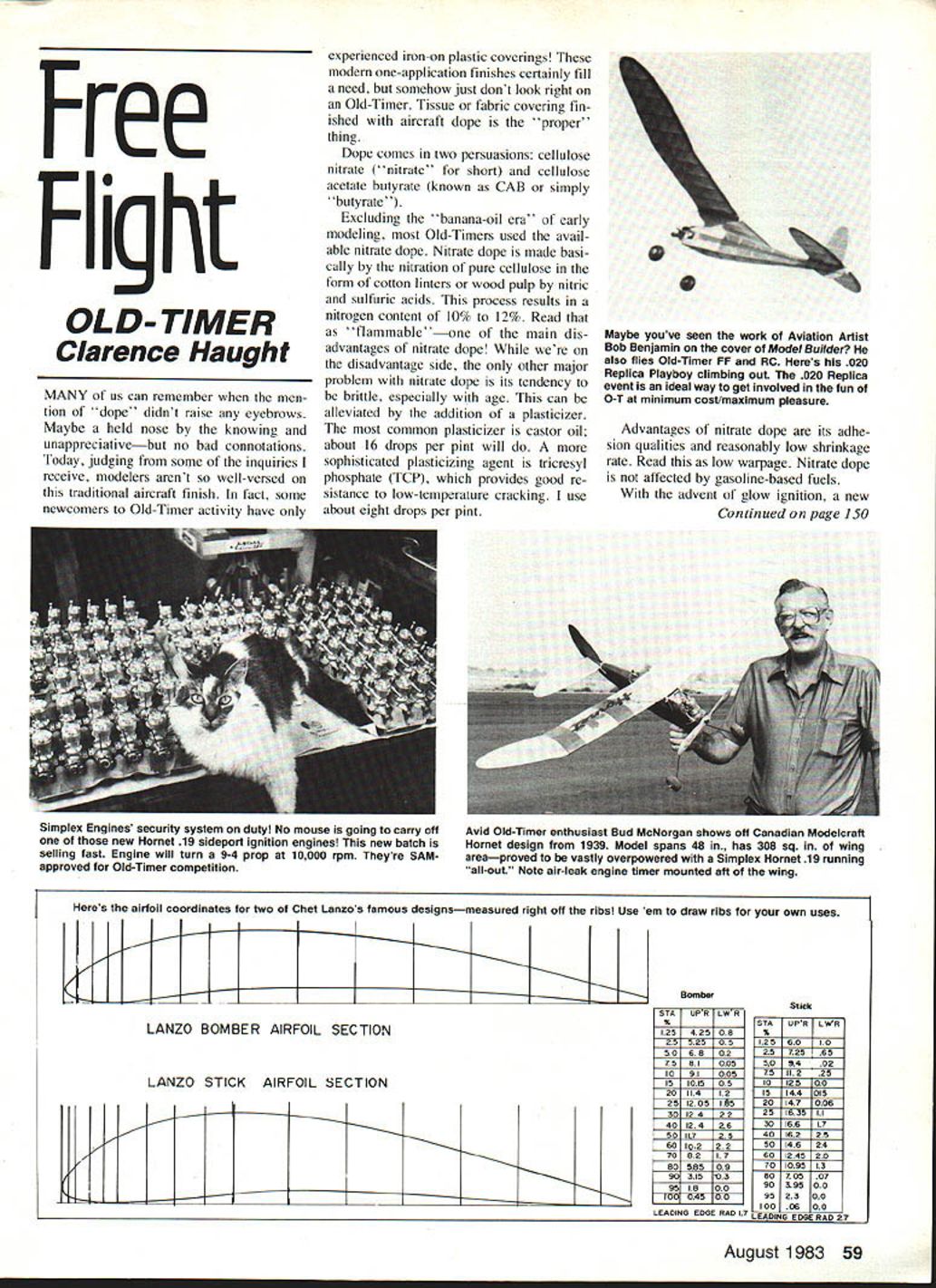
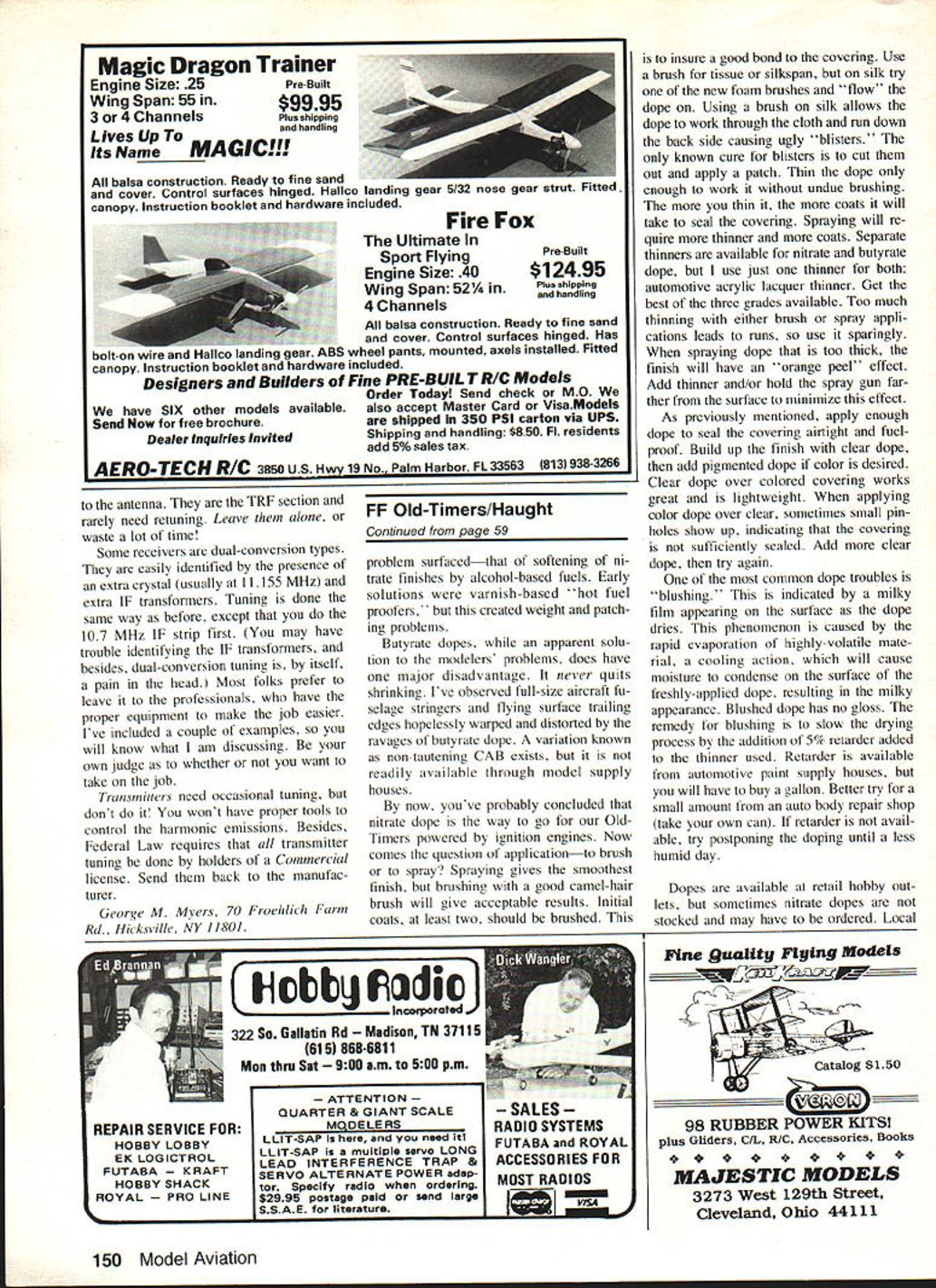
Free Flight: OLD-TIMER
Clarence Haught
Many of us can remember when the mention of "dope" didn't raise any eyebrows. Maybe a held nose by the knowing and unappreciative—but no bad connotations. Today, judging from some of the inquiries I receive, modelers aren't so well-versed on this traditional aircraft finish. In fact, some newcomers to Old-Timer activity have only experienced iron-on plastic coverings! These modern one-application finishes certainly fill a need, but somehow just don't look right on an Old-Timer. Tissue or fabric covering finished with aircraft dope is the "proper" thing.
Dope comes in two persuasions:
- Cellulose nitrate ("nitrate")
- Cellulose acetate butyrate (known as CAB or simply "butyrate")
Excluding the "banana-oil era" of early modeling, most Old-Timers used the available nitrate dope. Nitrate dope is made basically by the nitration of pure cellulose in the form of cotton linters or wood pulp by nitric and sulfuric acids. This process results in a nitrogen content of 10% to 12% — read that as "flammable" — one of the main disadvantages of nitrate dope!
While we're on the disadvantage side, the only other major problem with nitrate dope is its tendency to be brittle, especially with age. This can be alleviated by the addition of a plasticizer:
- Castor oil (about 16 drops per pint)
- Tricresyl phosphate (TCP) — a more sophisticated plasticizer that provides good resistance to low-temperature cracking (I use about eight drops per pint).
Advantages of nitrate dope are its adhesion qualities and reasonably low shrinkage rate — read this as low warpage. Nitrate dope is not affected by gasoline-based fuels.
With the advent of glow ignition, a new problem surfaced: softening nitrate finishes with alcohol-based fuels. Early solutions, varnish-based hot-fuel proofers, created weight and patching problems. Butyrate dopes, an apparent solution to modelers' problems, do have a major disadvantage — they never quit shrinking. I've observed full-size aircraft fuselage stringers and flying-surface trailing edges hopelessly warped and distorted by the ravages of butyrate dope. A variation known as non-tautening CAB exists and is readily available through model supply houses.
Now you've probably concluded nitrate dope is the way to go for Old-Timers powered with ignition engines. Now comes the question of application — brush or spray?
- Spraying gives the smoothest finish; brushing with a good camel-hair brush will give acceptable results.
- The initial coats, at least two, should be brushed to ensure a good bond to the covering.
- Use a brush for tissue or silkspan, but on silk try one of the new foam brushes and "flow" the dope on. Using a brush on silk allows the dope to work through the cloth and run down the back side causing ugly "blisters." The only known cure for blisters is to cut them out and apply a patch.
- Thin the dope only enough to work it without undue brushing. The more you thin it, the more coats it will take to seal the covering. Spraying will require more thinner and more coats.
- Separate thinners are available for nitrate and butyrate dope, but I use just one thinner for both: automotive acrylic lacquer thinner. Get the best of the three grades available.
- Too much thinning with either brush or spray applications leads to runs, so use it sparingly. When spraying dope that is too thick, the finish will have an "orange peel" effect. Add thinner and/or hold the spray gun farther from the surface to minimize this effect.
Apply enough dope to seal the covering airtight and fuel-proof. Build up the finish with clear dope, then add pigmented dope if color is desired. Clear dope over colored covering works great and is lightweight. When applying color dope over clear, sometimes small pinholes show up, indicating that the covering is not sufficiently sealed. Add more clear dope, then try again.
One of the most common dope troubles is "blushing." This is indicated by a milky film appearing on the surface as the dope dries. This phenomenon is caused by the rapid evaporation of highly volatile material, a cooling action, which causes moisture to condense on the surface of the freshly-applied dope, resulting in the milky appearance. Blushed dope has no gloss. The remedy for blushing is to slow the drying process by adding 5% retarder to the thinner used. Retarder is available from automotive paint supply houses, but you will have to buy a gallon. Better try for a small amount from an auto body repair shop (take your own can). If retarder is not available, try postponing the doping until a less humid day.
Dopes are available at retail hobby outlets, but sometimes nitrate dopes are not stocked and may have to be ordered.
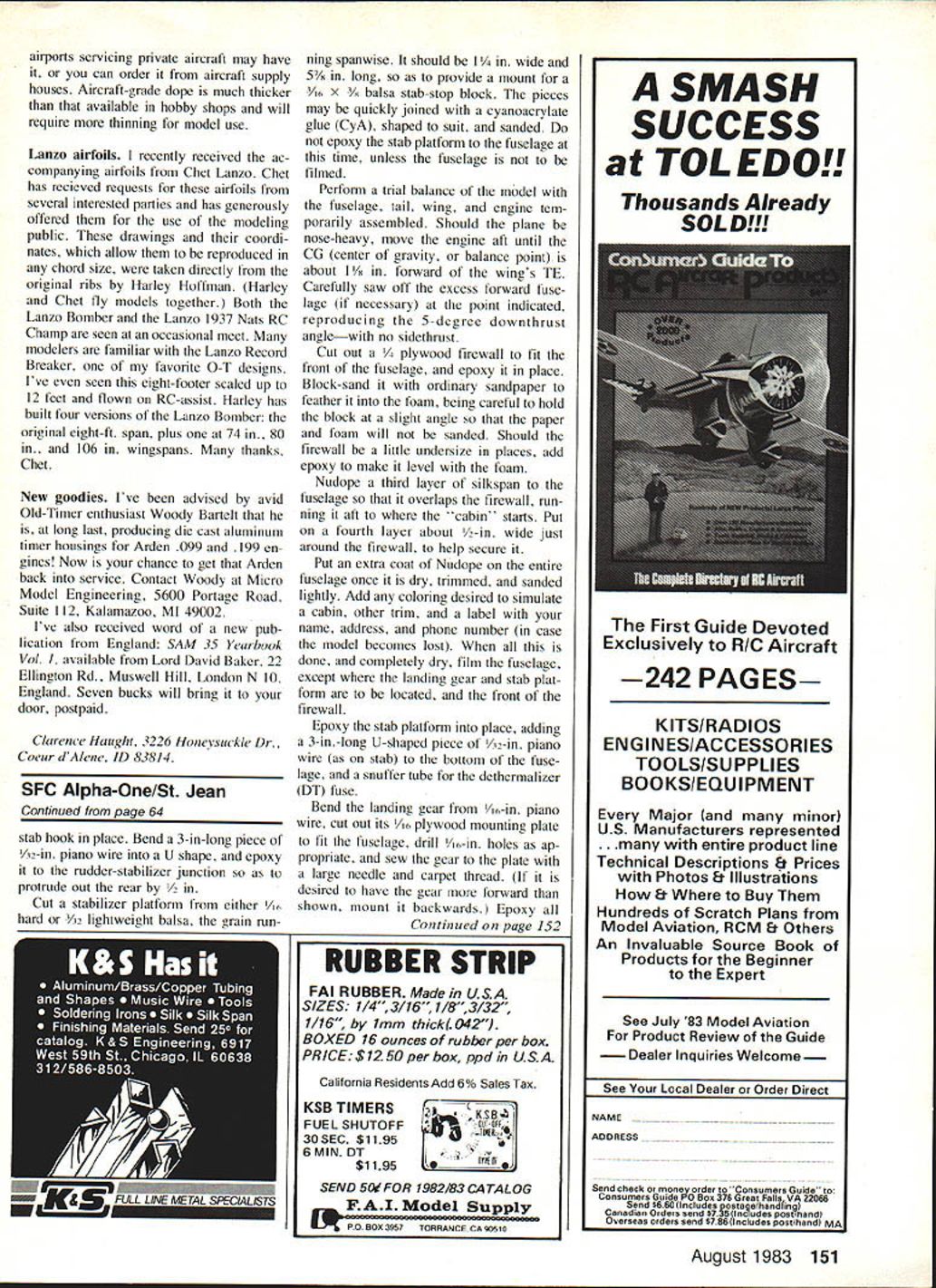
Lanzo airfoils
I recently received the accompanying airfoils from Chet Lanzo. Chet has received requests for these airfoils from several interested parties and has generously offered them for the use of the modeling public. These drawings and their coordinates, which allow them to be reproduced in any chord size, were taken directly from the original ribs by Harley Hoffman (Harley and Chet fly models together). Both the Lanzo Bomber and the Lanzo 1937 Nats RC Champ are seen at an occasional meet. Many modelers are familiar with the Lanzo Record Breaker, one of my favorite O-T designs. I've even seen this eight-footer scaled up to 12 feet and flown on RC-assist.
Harley has built four versions of the Lanzo Bomber: the original eight-foot span, plus ones at 74 in., 80 in., and 106 in. wingspans. Many thanks, Chet.
New goodies
I've been advised by avid Old-Timer enthusiast Woody Bartlett that he is, at long last, producing die cast aluminum timer housings for Arden .099 and .199 engines! Now is your chance to get that Arden back into service. Contact Woody at Micro Model Engineering, 5600 Portage Road, Suite 112, Kalamazoo, MI 49002.
I've also received word of a new publication from England: SAM 35 Yearbook Vol. 1, available from Lord David Baker, 22 Ellington Rd., Muswell Hill, London N10, England. Seven bucks will bring it to your door, postpaid.
Clarence Haught 3226 Honeysuckle Dr. Coeur d'Alene, ID 83814
Transcribed from original scans by AI. Minor OCR errors may remain.

