
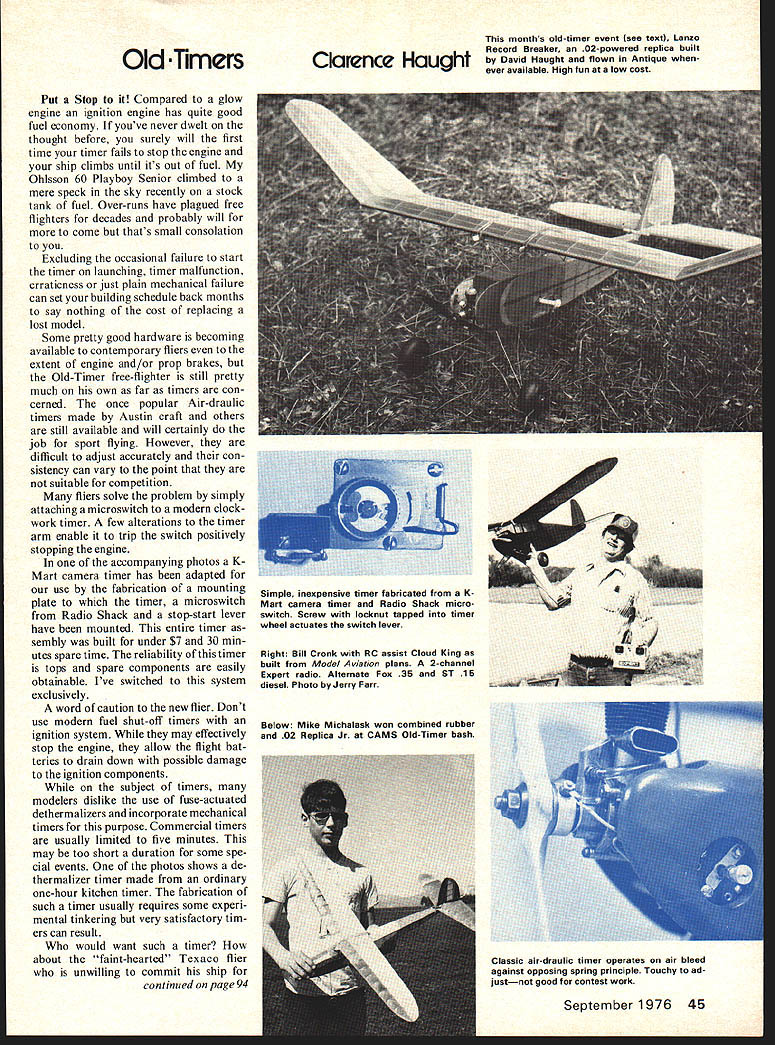
Old-Timers
Clarence Haught
Put a Stop to it! Compared to a glow engine an ignition engine has quite good fuel economy. If you've never dwelt on the thought before, you surely will the first time your timer fails to stop the engine and your ship climbs until it's out of fuel. My Ohlsson 60 Playboy Senior climbed to a mere speck in the sky recently on a stock tank of fuel. Over-runs have plagued free fighters for decades and probably will for more to come but that's small consolation to you.
Excluding the occasional failure to start the timer on launching, timer malfunction, erraticness or just plain mechanical failure can set your building schedule back months to say nothing of the cost of replacing a lost model.
Some pretty good hardware is becoming available to contemporary fliers even to the extent of engine and/or prop brakes, but the Old-Timer free-flighter is still pretty much on his own as far as timers are concerned. The once popular Air-hydraulic timers made by Austin Craft and others are still available and will certainly do the job for sport flying. However, they are difficult to adjust accurately and their consistency can vary to the point that they are not suitable for competition.
Many fliers solve the problem by simply attaching a microswitch to a modern clockwork timer. A few alterations to the timer arm enable it to trip the switch positively stopping the engine.
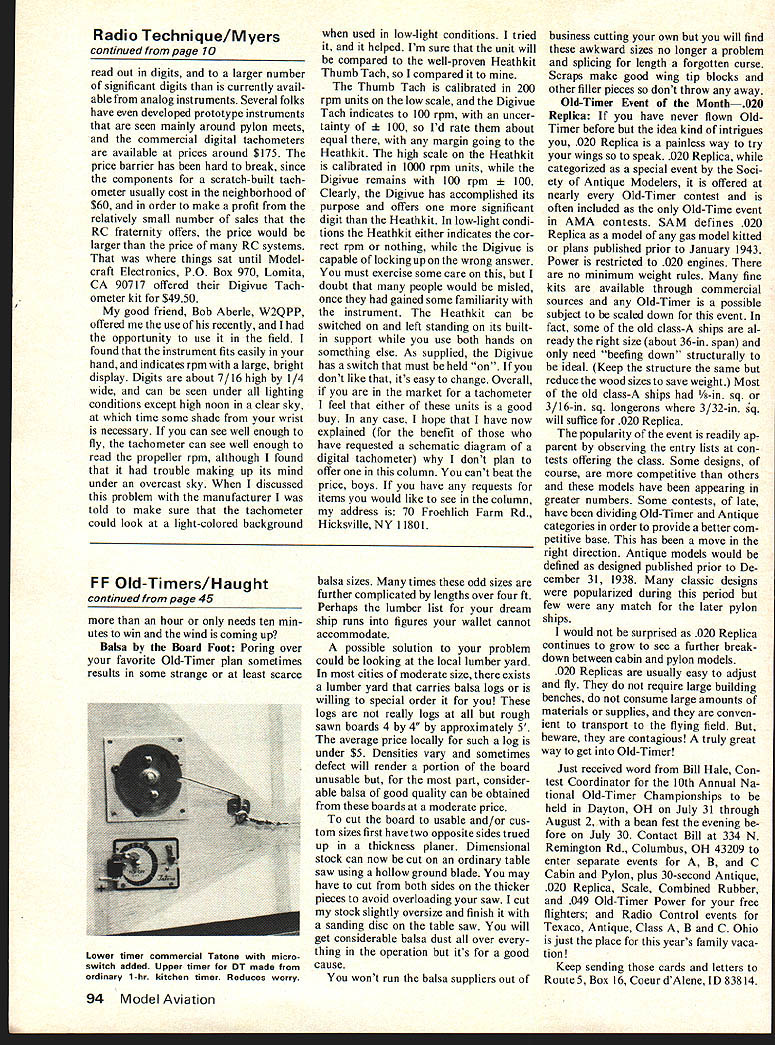
In one of the accompanying photos a K-Mart camera timer has been adapted for our use by the fabrication of a mounting plate to which the timer, a microswitch from Radio Shack and a stop-start lever have been mounted. This entire timer assembly was built for under $7 and 30 minutes spare time. The reliability of this timer is tops and spare components are easily obtainable. I've switched to this system exclusively.
A word of caution to the new flier. Don't use modern fuel shut-off timers with an ignition system. While they may effectively stop the engine, they allow the flight batteries to drain down with possible damage to the ignition components.
While on the subject of timers, many modelers dislike the use of fuse-actuated dethermalizers and incorporate mechanical timers for this purpose. Commercial timers are usually limited to five minutes. This may be too short a duration for some special events. One of the photos shows a dethermalizer timer made from an ordinary one-hour kitchen timer. The fabrication of such a timer usually requires some experimental tinkering but very satisfactory timers can result.
Who would want such a timer? How about the "faint-hearted" Texaco flier who is unwilling to commit his ship for
FF Old-Timers/Haught
more than an hour or only needs ten minutes to win and the wind is coming up?
Balsa by the Board Foot: Poring over your favorite Old-Timer plan sometimes results in some strange or at least scarce balsa sizes. Many times these odd sizes are further complicated by lengths over four ft. Perhaps the lumber list for your dream ship runs into figures your wallet cannot accommodate.
A possible solution to your problem could be looking at the local lumber yard. In most cities of moderate size, there exists a lumber yard that carries balsa logs or is willing to special order it for you! These logs are not really logs at all but rough-sawn boards 4 by 4 by approximately 5'. The average price locally for such a log is under $5. Densities vary and sometimes defect will render a portion of the board unusable but, for the most part, considerable balsa of good quality can be obtained from these boards at a moderate price.
To cut the board to usable and/or custom sizes first have two opposite sides trued up in a thickness planer. Dimensional stock can now be cut on an ordinary table saw using a hollow ground blade. You may have to cut from both sides on the thicker pieces to avoid overloading your saw. I cut my stock slightly oversize and finish it with a sanding disc on the table saw. You will get considerable balsa dust all over everything in the operation but it's for a good cause.
You won't run the balsa suppliers out of business cutting your own but you will find these awkward sizes no longer a problem and splicing for length a forgotten curse.
Scraps make good wing tip blocks and other filler pieces so don't throw any away.
Old-Timer Event of the Month—.020 Replica: If you have ever flown Old-Time before but the idea kind of intrigues you, .020 Replica is a painless way to try your wings so to speak. .020 Replica, while categorized as a special event by the Society of Antique Modelers, is offered at nearly every Old-Timer contest and is often included as the only Old-Time event in some contests. SAM defines .020 Replica as a model of any gas model kitted or plans or published prior to January 1943. Power is restricted to .020 engines. There are no minimum weight rules. Many fine kits are available through commercial sources and any Old-Timer is a possible subject to be scaled down for this event. In fact, some of the old class-A ships are already the right size (about 36-in. span) and only need "beefing down" structurally to be ideal. (Keep the structure the same but reduce the wood sizes to save weight.) Most of the old-class A ships had 1/8-in. sq. or 3/16-in. sq. longerons where 3/32-in. sq. will suffice for .020 Replica.
The popularity of the event is readily apparent by observing the entry lists at contests during the class. Some designs, of course, are more competitive than others and these models have been appearing in greater numbers. Some contests, of late, have been dividing Old-Timer and Antique categories in order to provide a better competitive base. This has been a move in the right direction. Antique models would be defined as designed published prior to December 31, 1938. Many classic designs were popularized during this period but fewer are seen much for the later pylon ships.
I would not be surprised as .020 Replica continues to grow to see a further breakdown between cabin and pylon models.
.020 Replicas are usually easy to adjust and fly. They do not require large building benches, do not consume large amounts of materials or supplies, and they are convenient to transport to the flying field. But, beware, they are contagious! A truly great way to get into Old-Timer!
Just received word from Bill Hale, Contest Coordinator for the 10th Annual National Old-Timer Championships to be held in Dayton, OH on July 31 through August 2, with a bean fest the evening before on July 30. Contact Bill at 334 N. Remington Rd., Columbus, OH 43209 to enter separate events for A, B, and C Cabin and Pylon, plus 30-second Antique, .020 Replica, Scale, Combined Rubber, and .049 Old-Timer Power for your free flighters; and Radio Control events of Texaco, Antique, Class A, B and C. Ohio is just the place for this year's family vacation.
Keep sending those cards and letters to Routes 5, Box 16, Coeur d'Alene, ID 83814.
Transcribed from original scans by AI. Minor OCR errors may remain.

