
Free Flight: Old-Timers
Clarence Haught
GOOD MORNING, Mr. Haught, this is Robert Larsh of the C.I.A. Good Lord, I thought, what have I done now? The call came at work so Old Timers were the farthest thing from my mind. It took a few seconds to realize that the C.I.A. stood for "Central Indiana Aeromodelers!"
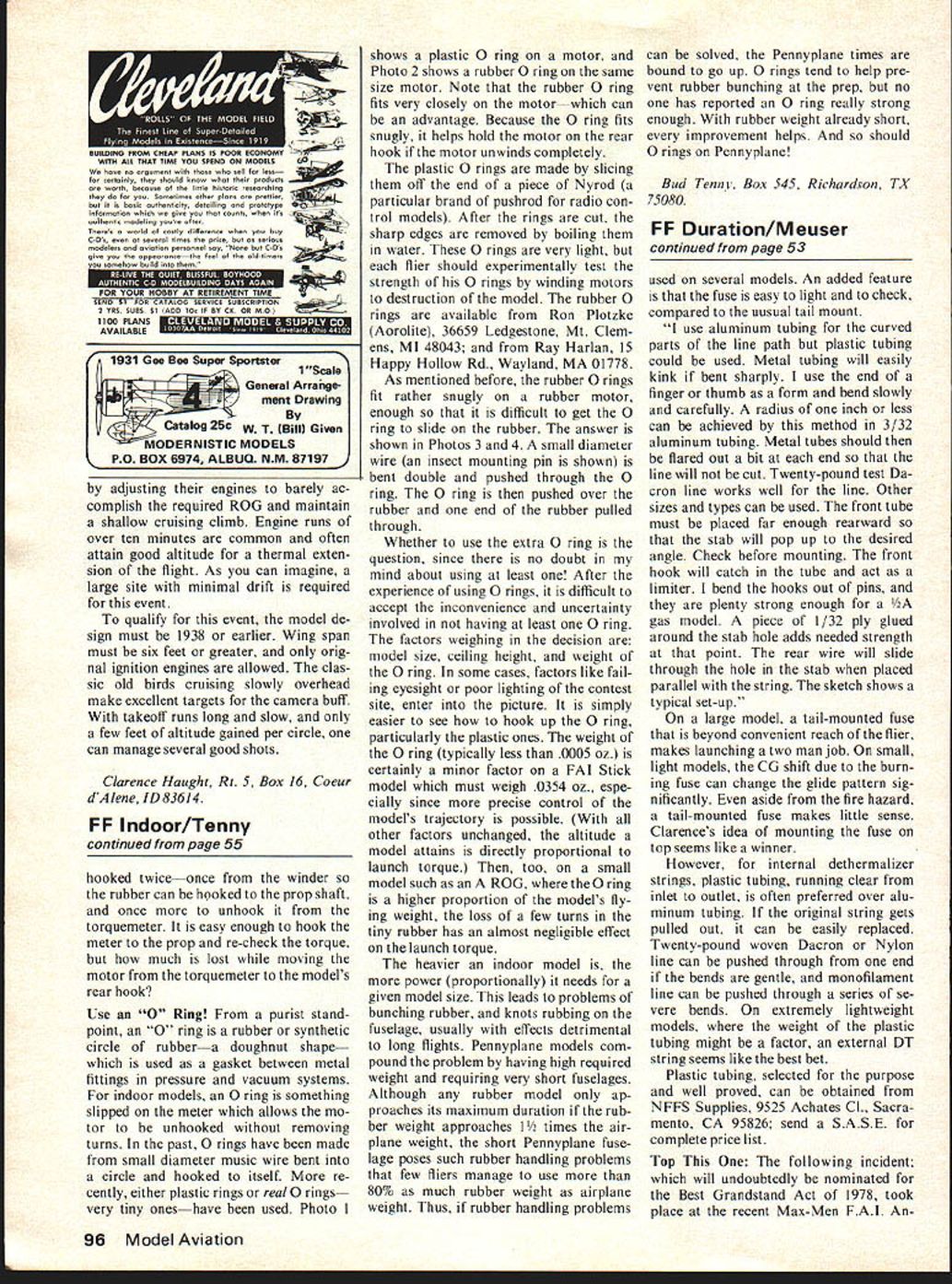
Bob was calling to tell me of the club's plans for their first annual Old Timer Contest. Normally, the announcement of a new meet would only excite a small segment of the readership of Model Aviation, but there are a couple of very interesting aspects to this June 25th event to be held at Wright Patterson Air Force Base. In addition to the usual events, the C.I.A. is including an O.T. Hand Launch Glider event. Entries in this event must be pre-1943 published or kit designs. In case you may be unaware of the fact, literally dozens of designs have been published in the old Zaic yearbooks still available from several sources, including AMA. Something fitting every fancy is available. In addition, the C.I.A. is making full-size plans available for a stamped, self-addressed envelope. Send your request to Robert Larsh, 45 South Whitcomb, Indianapolis, IN 46242, or to Contest Director Meredith Chamberlain, 5810 Madison Avenue, Anderson, IN 46013. number of seconds for the speed laps. Phil Cartier will keep the statistics on this event and I'd like to publish the results. It should make a most interesting comparison of model performance.
Under the "there's gotta be a better way" column, our local group has tried various ways of running combat events. Our latest system does away with the knock-out pyramid and gives each flier four matches. The point total from the four matches determines the winner in Slow, and number of wins determines a winner in Fast (flyoffs if necessary). At future contests, we'll try penalty points for down time (minus one point for every second on the ground during the match), and a two collision rule where contestants will be put out if involved in two mid-airs that end the match. The Slow Combat system works well and allows use of an FAI type one-minute match.
The winner of our first meet run this way accumulated six cuts and almost five minutes air time in his final match of the day, good even by comparison to pre-glow days in England. The goal is to have everyone fly 20 minutes of combat, and to instill a dread fear of hitting the other guy's plane.
1/2A Combat—another National event? Ben Sasnett is coordinating efforts to make 1/2A Combat an official National event. If you would like to share information on 1/2A techniques, or voice an opinion, write Ben at 1443 McKinley Ave., Escondido, CA 92027.
Charlie Johnson, 3716 Ingraham St., San Diego, CA 92109.
Another interesting sidelight of the C.I.A. contest is the use of graduated engine runs — 100% for original ignition engines, 75% for conversions, and 60% for glow engines. The 100% figure to be set by C.D. on site, depending on prevailing conditions. Looks as if many local clubs won't let the lack of an ignition engine keep them from enjoying Old Timer flight.
Up With Rubber Power: It seems that many think of Old Timer only in terms of gas jobs, forgetting that it all began with rubber. Many meets, including the '77 SAM Champs in Las Vegas, offer oldtimer rubber power, only to be disappointed in the lack of entries compared to other events. As mentioned before, there are many fine old designs around and one needn't build a Lanzo or a Korda Wake to be competitive. Many modern modelers have turned away from rubber-powered events, saying that without Pirelli there is nothing. Actually, the industry has responded and reasonably good rubber is available again. Some evaluators are willing to compare it to some of the more average batches of the extinct Pirelli. An advantage of O.T. rubber is that you don't necessarily have to have the best rubber because there are no restrictions to the amount used. Within reasonable weight ranges, you can simply add a few strands to make up for any lack of power. My only experience with the old standard brown rubber was its use to band wings on my gas ships, so I really can't say how good the old rubber was. I have had considerable experience with Pirelli. Some say it was better, others say it was poorer. Rubber is actually a welcome change of pace.
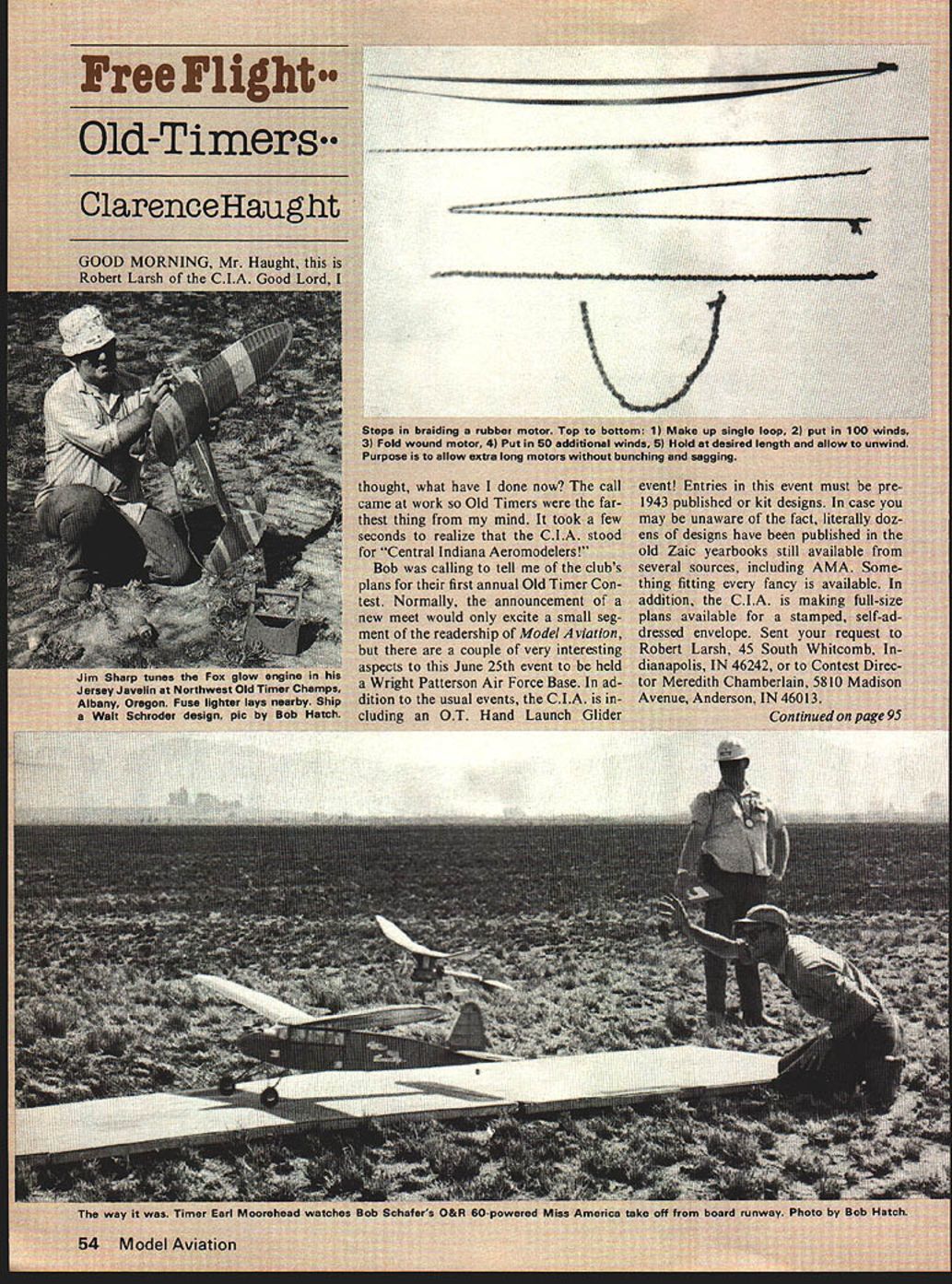
Some reference is made in the old publications regarding the use of braided motors. Modelers discovered at an early point that the shorter motors, those just long enough to reach from prop shaft to rear motor peg, provided an initial "burst" of power and a relatively short duration of run. Longer motors, 1 1/2 to 2 times the distance between hook and peg, would put out a longer, more even run. The problem was that, as the motor ran down, the extra length was prone to bunch up, either in the nose or tail, upsetting the C.G., and of course, the glide angle. Braiding the motor was used as a method of making a long motor fit properly between hook and peg without any slack.
Friend and flying buddy John Morrell, a Los Angeles movie photographer, showed me a very interesting method of "braiding" motors. First make a single, or double if necessary, loop of the desired rubber. Anchor the end and stretch out to 1 1/2 to 2 times its slack length. Put in 100 winds. Now, without relieving the stretch, grasp the motor in the center of its stretched length and fold the end at your winder back to the anchor point. Remove the winder and attach the end to the anchor point. Hook your winder at the folded point and crank in 50 more turns moving in towards the anchor point until the wound motor is the exact length between hook and peg of your model. Hook wound motor to your prop and nose block assembly. Allow motor to unwind driving the prop, hold nose block at proper distance. The motor will automatically self-braid itself to the proper length, and will remain in this braided condition, allowing installation in your model. This system will work on all size models from P-nut on up. A few experimental braids and you'll have the hang of it.
Event Of The Month: Fuel Allotment — Antique. This basic event is, as the name would imply, flown without a specified engine run, just as done in the interim period between no limit on engine runs and timed engine runs still practiced in some restriction events. Fuel for an official flight is issued by the contest director, after weighing the model and calculating the fuel ration according to the formula 1/2 oz. per pound of weight, up to a maximum of 8 oz. Most modelers make this into an economy run. by adjusting their engines to barely accomplish the required ROG and maintain a shallow cruising climb. Engine runs of over ten minutes are common and often attain good altitude for a thermal extension of the flight. As you can imagine, a large site with minimal drift is required for this event.
To qualify for this event, the model design must be 1938 or earlier. Wing span must be six feet or greater, and only original ignition engines are allowed. The classic old birds cruising slowly overhead make excellent targets for the camera buff. With takeoff runs long and slow, and only a few feet of altitude gained per circle, one can manage several good shots.
Clarence Haught, Rt. 5, Box 16, Coeur d'Alene, ID 83814.
Transcribed from original scans by AI. Minor OCR errors may remain.

