
FREE FLIGHT OLD-TIMERS
Bill Baker, 1902 Peter Pan, Norman OK 73072
I was flying Free Flight in the 1940s when the Mahieu-designed Zeek came out, which was an interesting combination of old and new. It had the five-panel wing of the Goldberg Sailplane. It also used the Goldberg technique of locating the almost-completed model's center of gravity (CG) before gluing on the pylon, so that a predetermined point on the wing chord was right on the CG.
The new thing was deliberate stabilizer (stab) tilt for glide trim. At the time, some people said they wouldn't use the stab tilt because having the wing and stab misaligned was unattractive and a sign of sloppy workmanship. Those who adopted the technique were soon flying circles around those who did not.
Prior to the use of stabilizer tilt for glide circle trim, the approach was different. On pylon models, which usually turned right under power, you "balanced" the power pattern with left rudder, hoping that the amount of left rudder needed to control the power pattern would give a good glide circle. For left-climbing cabin models, you used right rudder. It worked fairly well, but the amount of rudder needed for climb was often either way too little or way too much for the glide.
The effect of rudder is very dependent on airspeed—something like increasing in power with the square of the speed increase. A little rudder has a big effect on power, but much less effect on the slower glide. With the lifting-stab/aft-center-of-gravity setup that quickly evolved in Free Flight to control the large pitch-trim change that comes with large power/glide airspeed differences, the tilted stabilizer gives a very controllable glide turn that has little effect on power. That means it is possible to trim glide and climb independently.
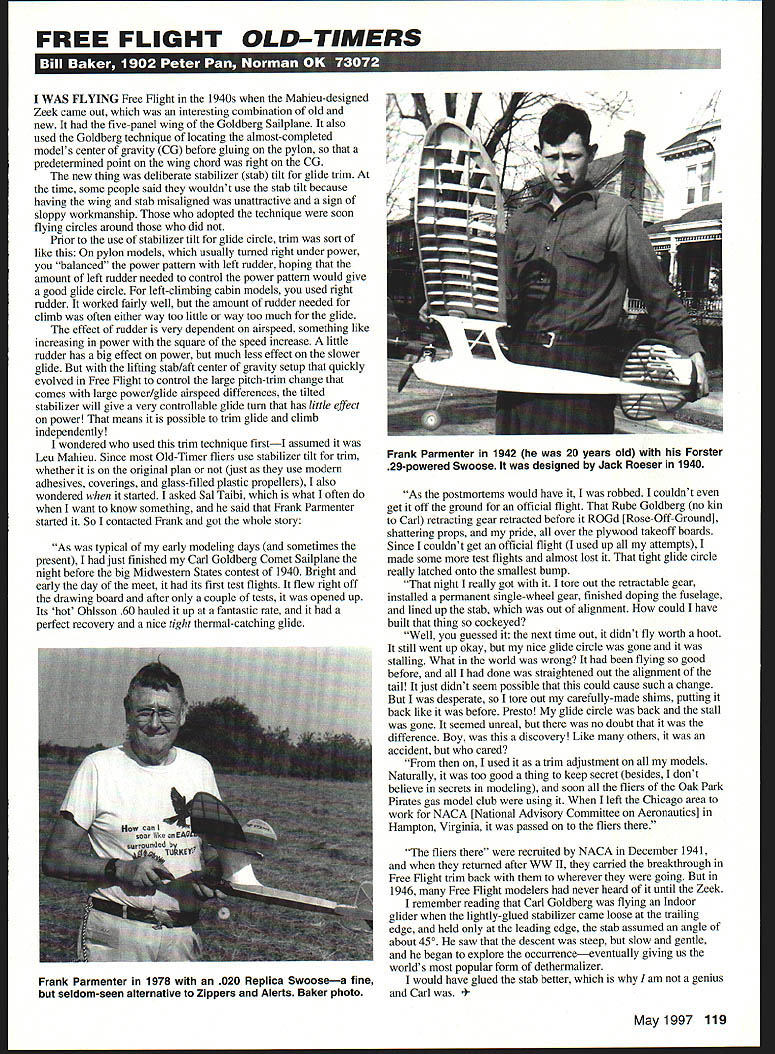
I wondered who used this trim technique first—I assumed it was Leu Mahieu. Since most Old-Timer fliers use stabilizer tilt for trim, whether it is on the original plan or not (just as they use modern adhesives, coverings, and glass-filled plastic propellers), I also wondered when it started. I asked Sal Taibi, which is what I often do when I want to know something, and he said that Frank Parmenter started it. So I contacted Frank and got the whole story.
Frank Parmenter — his recollection
"As was typical of my early modeling days (and sometimes the present), I had just finished my Carl Goldberg Comet Sailplane the night before the big Midwestern States contest of 1940. Bright and early the day of the meet, it had its first test flights. It flew right off the drawing board and after only a couple of tests, it was opened up. Its hot Ohlsson .60 hauled it up at a fantastic rate, and it had a perfect recovery and a nice tight thermal-catching glide.
"As the postmortems would have it, I was robbed. I couldn't even get it off the ground for an official flight. That Rube Goldberg (no kin to Carl) retracting gear retracted before it ROG'd (rose off the ground), shattering props, and my pride, all over the plywood takeoff boards! Since I couldn't get an official flight (I used up all my attempts), I made some more test flights and almost lost it. That high glide circle really latched onto the smallest bump.
"That night I really got with it. I tore out the retractable gear, installed a permanent single-wheel gear, finished doping the fuselage, and lined up the stab, which was out of alignment. How could I have built that thing so cockeyed?
"Well, you guessed it: the next time out, it didn't fly worth a hoot. It still went up okay, but my nice glide circle was gone and it was stalling. What in the world was it that had been flying so good before, and all I had done was straightened out the alignment of the tail! It just didn't seem possible that this could cause such a change. But I was desperate, so I tore out my carefully-made shims, putting it back like it was before. Presto! My glide circle was back and the stall was gone. It seemed unreal, but there was no doubt that it was the difference. Boy, was this a discovery! Like many others, it was an accident, but who cared?
"From then on, I used it as a trim adjustment on all my models. Naturally, it was too good a thing to keep secret (besides, I don't believe in secrets in modeling), and soon all the fliers of the Oak Park Pirates gas model club were using it. When I left the Chicago area to work for NACA (National Advisory Committee on Aeronautics) in Hampton, Virginia, it was passed on to the fliers there.
"The fliers there were recruited by NACA in December 1941, and when they returned after WWII, they carried the breakthrough in Free Flight trim back with them to wherever they were going. But in 1946, many Free Flight modelers had never heard of it until the Zeek.
"I remember reading that Carl Goldberg was flying an indoor glider when the lightly-glued stabilizer came loose at the trailing edge, and held only at the leading edge, the stab assumed an angle of about 45°. He saw that the descent was steep, but slow and gentle, and he began to explore the occurrence—eventually giving us the world's most popular form of dethermalizer.
"I would have glued the stab better, which is why I am not a genius and Carl was."
Transcribed from original scans by AI. Minor OCR errors may remain.

