
FREE FLIGHT OLD-TIMERS
Bill Baker, 1902 Peter Pan, Norman OK 73072
Rotating the cylinder/exhaust on small engines
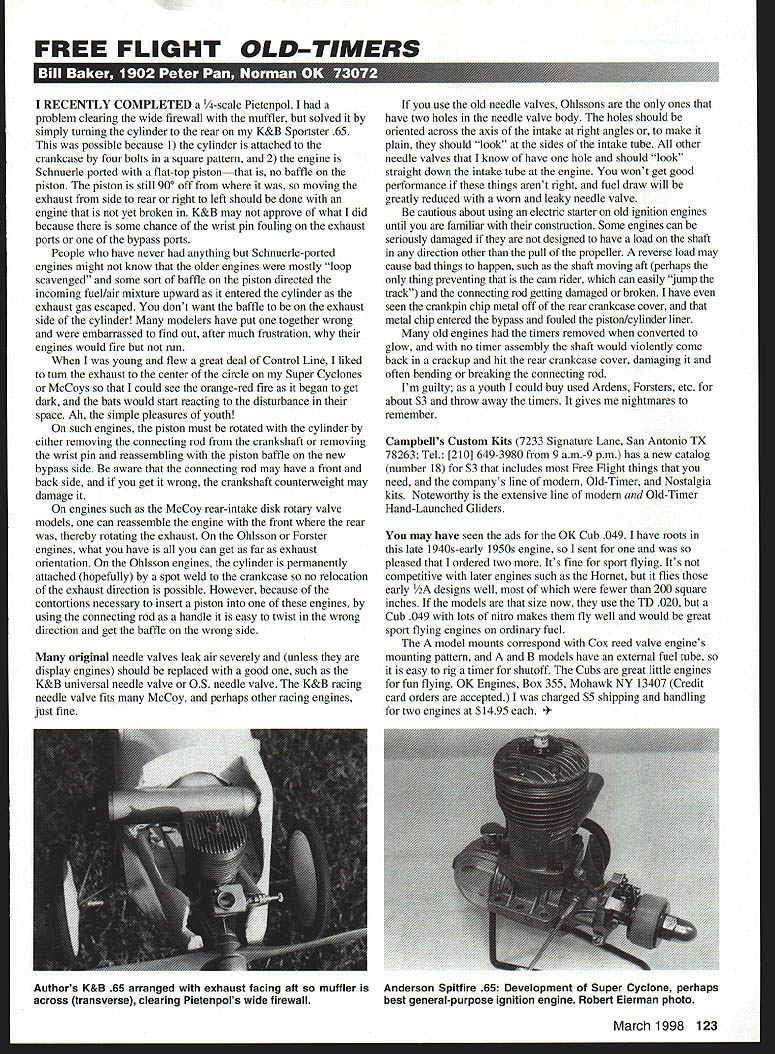
I recently completed a 1/4-scale Pietenpol. I had a problem clearing the wide firewall with the muffler, but solved it by turning the cylinder to the rear on my K&B Sportster .65. This was possible because (1) the cylinder is attached to the crankcase by four bolts in a square pattern, and (2) the engine is Schnuerle-ported with a flat-top piston (no piston baffle). The piston is still 90° off from where it was, so moving the exhaust from side to rear (or right to left) should be done with an engine that is not yet broken in. K&B may not approve of this modification because there is some chance of the wrist pin fouling on the exhaust ports or one of the bypass ports.
Loop-scavenged engines and piston baffles
People who have only used Schnuerle-ported engines might not know that many older engines were loop-scavenged and used a piston baffle to direct the incoming fuel/air mixture upward as the exhaust gas escaped. You do not want the baffle on the exhaust side of the cylinder. Many modelers have assembled one wrong and were frustrated to discover why their engines would fire but not run.
When I was young and flew a great deal of Control Line, I liked to turn the exhaust to the center of the circle on my Super Cyclones or McCoys so I could see the orange-red fire as it began to get dark and watch the bats react to the disturbance. Ah, the simple pleasures of youth!
How to rotate piston/cylinder and assembly cautions
On loop-scavenged engines, the piston must be rotated with the cylinder by either:
- Removing the connecting rod from the crankshaft, or
- Removing the wrist pin and reassembling with the piston baffle on the new bypass side.
Be aware that the connecting rod may have a distinct front and back. If reinstalled incorrectly, the crankshaft counterweight can damage the rod.
Exhaust orientation on different makes
- McCoy rear-intake disk rotary valve models: you can reassemble the engine with the front where the rear was, thereby rotating the exhaust.
- Ohlsson and Forster engines: exhaust orientation is generally fixed. On many Ohlsson engines the cylinder is spot-welded to the crankcase, so relocation of the exhaust is not possible. Because of the contortions required when inserting a piston, using the connecting rod as a handle can easily twist the piston the wrong way and place the baffle on the wrong side.
Needle valves
Many original needle valves leak air severely and (unless the engine is for display only) should be replaced with a good valve such as the K&B universal needle valve or an O.S. needle valve. The K&B racing needle valve fits many McCoy racing engines and perhaps other racing engines as well.
Note differences in needle valve construction:
- Ohlsson valves: have two holes in the needle valve body. The holes should be oriented across the axis of the intake, at right angles to it (i.e., they should "look" at the sides of the intake tube).
- Most other needle valves: have one hole and should "look" straight down the intake tube at the engine.
Incorrect orientation or a worn, leaky needle valve will reduce fuel draw and hurt performance.
Electric starter caution
Be cautious using an electric starter on old ignition engines until you understand their construction. Some engines can be seriously damaged if subjected to a load on the shaft in any direction other than the pull of the propeller. A reverse load may cause:
- The shaft to move aft (the cam rider may be the only thing preventing this; it can "jump the track"),
- The connecting rod to be bent or broken,
- Chips to be taken off the crankpin or rear crankcase cover, with the metal chip entering the bypass and fouling the piston/cylinder liner.
Timers and conversions
Many old engines had their ignition timers removed when converted to glow or to no-timer assemblies. Without the timer to absorb or control forces, the shaft can violently move back ("crack up") and hit the rear crankcase cover, often bending or breaking the connecting rod. I’m guilty of this—when I was young I could buy used Ardens, Forsters, etc., for about $3 and throw away the timers. It still gives me nightmares to remember.
Suppliers and kits
Campbell's Custom Kits 7233 Signature Lane, San Antonio, TX 78263 Tel: (210) 649-3980 (9 a.m.–9 p.m.) They have a new catalog (No. 18) for $3 that includes most Free Flight items you need and their lines of modern, Old-Timer, and Nostalgia kits. Noteworthy is their extensive line of modern and Old-Timer hand-launched gliders.
OK Cub .049
You may have seen ads for the OK Cub .049. I have roots in this late 1940s–early 1950s engine, so I ordered one and was so pleased I bought two more. It’s fine for sport flying. It’s not competitive with later engines such as the Hornet, but it flies early 1/2A designs well (most of which were fewer than 200 square inches). If those models are built now they often use the TD .020, but a Cub .049 with lots of nitro makes them fly nicely and is great for ordinary sport flying.
Additional notes:
- Model mounts correspond with the Cox reed-valve engine mounting pattern.
- A and B Cub models have an external fuel tube, so it’s easy to rig a timer for shutoff.
- OK Engines, Box 355, Mohawk, NY 13407 (credit card orders accepted). I was charged $5 shipping and handling for two engines priced at $14.95 each.
Transcribed from original scans by AI. Minor OCR errors may remain.

