
Free Flight: Old-Timers
Clarence Haught
Do It Yourself
We're a nation of do-it-yourselfers and no one group is more adept at the skill than modelers. It's only natural then that some of us are not going to be satisfied with only building the models we fly. Some are bound to build our own engines as well.
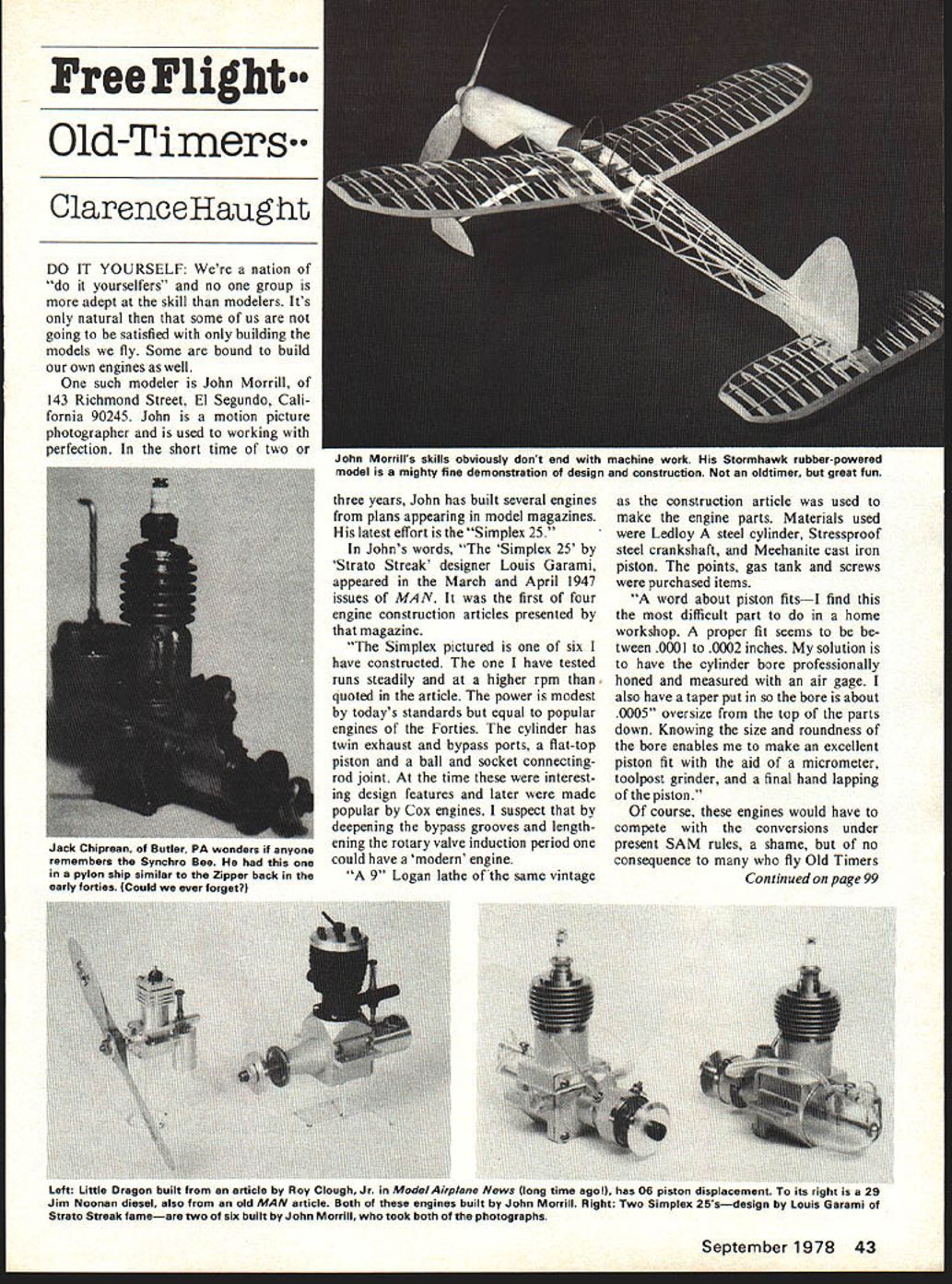
One such modeler is John Morrill, of 143 Richmond Street, El Segundo, California 90245. John is a motion picture photographer and is used to working with perfection. In the short time of two or three years, John has built several engines from plans appearing in model magazines. His latest effort is the "Simplex 25."
In John's words: "The 'Simplex 25' by 'Strato Streak' designer Louis Garami appeared in the March and April 1947 issues of M.A.N. It was the first of four engine construction articles presented by that magazine.
"The Simplex pictured is one of six I have constructed. The one I have tested runs steadily and at a higher rpm than quoted in the article. The power is modest by today's standards but equal to popular engines of the Forties. The cylinder has twin exhaust and bypass ports, a flat-top piston and a ball-and-socket connecting-rod joint. At the time these were interesting design features and later were made popular by Cox engines. I suspect that by deepening the bypass grooves and lengthening the rotary valve induction period one could have a 'modern' engine.
"A 9" Logan lathe of the same vintage as the construction article was used to make the engine parts. Materials used were Ledloy A steel cylinder, 'Stressproof' steel crankshaft, and Meehanite cast-iron piston. The points, gas tank and screws were purchased items.
"A word about piston fits—I find this the most difficult part to do in a home workshop. A proper fit seems to be between .0001" to .0002" inches. My solution is to have the cylinder bore professionally honed and measured with an air gage. I also have a taper put in so the bore is about .0005" oversize from the top of the parts down. Knowing the size and roundness of the bore enables me to make an excellent piston fit with the aid of a micrometer, toolpost grinder, and a final hand lapping of the piston."
Of course, these engines would have to compete with the conversions under present SAM rules—a shame, but of no consequence to many who fly Old Timers.
Blue Ridge Models, in what used to be their "spare" time, has already sold around 500 of its fine Coupe d'Hiver kit. I find that rather amazing considering that the kit is expensive, advertising is largely by word of mouth, and the kit is sold only by direct mail. If I were to estimate the number of competition-oriented Coupe fliers in the country, I'd have to come to the conclusion that each of them already has two Blue Ridge Coupes.
Free flight is apparently much larger than what meets the eye, but it is still not big enough to entice the big boys in the business to market kits for some of the not-all-that-popular competition events. Meanwhile we're fortunate in being able to obtain high-quality kits from cottage-industry outfits such as Blue Ridge and a handful of others we have mentioned from time to time.
Not to be overlooked are Blue Ridge's offerings:
- Coupe props and rib sets (sold separately from the kits)
- Kits for hand-launch gliders, sport models, and P-30 models
- A vast assortment of free-flight goodies
For a catalog, send a S.A.S.E. to Blue Ridge Models, P.O. Box 429, Skyland, NC 28776. Tell them Bob sent you, and receive a DT rubberband absolutely free!
X-Acto Knife Fix
Have trouble unleashing the blade from your pet X-Acto knife after cinching it tight for a tough job? Try a wrap of Teflon tape—apply it around the collet. The stuff is slippery, stretchy, and conforms to anything. It is intended for sealing pipe threads and is available in the plumbing section of most hardware stores.
How To Make Friends and Influence Free-Flighters, People, and Everybody Else
You decide to write to a total stranger to ask him about his model, someone whose name appeared in a magazine or a contest results listing. Since you are not yet on a first-name basis, you start out "Dear Sir", or better, "Dear Mr. Smith." Cautious, formal, restrained. But, feeling uncomfortable with all that formality, you sign the letter simply "Al", being sure to put your full name and address at the top, of course. Chances are, the reply will come back "Dear Al" and you are old buddies instantly. It works!
Of course you could hasten the process by starting out "Dear Fred" in the first place. But if the reply comes back, "Dear Mr. Jones", you are in trouble!
Formality has its place, I guess, but it seems best reserved for use on people you are mad at.
Outstanding Performance
If there were national records for getting the most official AMA National Records (a) ever, (b) as a Senior, (c) in one month, or (d) in one day, all of those record-records would have to go to one C. Keith Martin. Keith's dad, Charlie Martin of Bellevue, Washington, must have picked up a few pointers along the way, as he wound up on the team representing the U.S.A. at the 1977 F.A.I. World Champs.
As a Junior, Keith picked up nine records during 1971. As a Senior, during the period March 1972 through December 1975 he picked up an additional 69 records, for a grand total of 78. During the month of December, 1975 he gathered 24 of the things. On the 27th of that month, he set two records in each of the three Indoor ceiling-height categories, and one in each of the two Outdoor categories, for a record one-day total of eight. The logistics boggle the mind!
Keith's Indoor records were all set in the Autogiro, Ornithopter, and Helicopter events: the easy ones. Easy? ... Ok, kiddo, let's see you do six-minutes-plus with an autogiro! His Outdoor records slice a cross section through all of the Power, Rubber, and Rocket events.
Can you top any of these? Keith established nine records as a Junior, but surely someone must have topped that. Linda Randolph? Marty Thompson? Let's hear about it, eh?
Bob Meuser, 4200 Gregory St., Oakland, CA 94619.
Get It Straight
I'm often asked how to measure wing or stabilizer incidence angles, particularly for undercambered wing sections. Many modelers do not realize that undercambered wings are treated the same as their flat-bottomed cousins. A straightedge placed across the leading and trailing edge becomes the reference line.
The following excerpt from the Flight Plug, monthly newsletter of the Southern California Ignition Flyers, provides a good technique for measuring incidence:
- With wheels on the bench, prop up the tail with books until the stab platform is level. (Use one of those line levels the size of a fat hexagon pencil and about 3 inches long.) OK, stab is zero.
- Lay the level along the wing mount, positioned so its base overhangs the outer edge of the mount just a bit.
- Place a straight piece of cardboard against the base of the level.
- Keeping the front of the level against the wing mount, carefully raise the rear of the level (using the cardboard) until the bubble centers.
- Put a pencil mark on the cardboard to indicate how much it was raised to center the bubble. Draw a straight line from this mark to the point on the cardboard that was under the front of the level.
- Measure this line with a protractor against the base of the cardboard, and that's your wing incidence. Use the same technique for checking the pitch of your motor mounts.
Troubleshooting
There are times the old engine just doesn't want to cooperate. Invariably, this occurs at the most inopportune moment, just before an official flight for example. Most of us grab a screwdriver and begin checking the wiring for shorts, opens, or cold-solder joints with the time-honored arcing test for current. A better way is suggested by Don Jenkins of Indianapolis.
Don writes, "I have found that a 3-volt bulb with wires soldered to the contacts makes a very good and inexpensive test light. It will also give you a pretty good idea of the condition of the batteries, although most modelers now use the sophisticated ohm/volt/amp meters. There are many places that this test light can be used and I keep mine handy. A bulb, a couple lengths of medium-gauge wire, a couple of small alligator clips, and you are in business. Solder one end of each wire to the terminals on the bulb; very quickly, so as not to open a hole and cause the bulb to blow. Attach the clips to the other ends of the wires and that's it. I also soldered a pointed probe to the end of each clip, so as to be able to make contact in places where the clips cannot be attached, like in tight spots."
I think you'll find this little test light very handy. One thing, though: don't use the light in series with the points to check for instant of opening, as the build-up of current in the primary windings of the coil may burn out the lamp upon collapse of the field as the points open.
Oops! Ralph Turner, of Amherst, Ohio, wrote to inform me of an error in the fuselage cross-sectional area formula for Old Rulers. The proper formula is Cf = L^2/100, not 2L as stated. Ralph accuses me of not really being an old timer! He goes on to ask if anyone remembers the "old days" when Air Trails gave away a Class A Buzzard Bombshell kit at one-year subscription! Doubt if we'll see those days again. (Editor's Note: AT gave away 10,000 kits.)
Clarence Haught, Route 5, Box 16, Coeur d'Alene, ID 83814.
Transcribed from original scans by AI. Minor OCR errors may remain.

