
Free Flight Old-Timers
Bill Baker — 1902 Peter Pan, Norman, OK 73072
Thanks to all of the newsletter editors who send me their publications. I could not do this column as I have for more than 10 years without the newsletters that I get from across the country. Several items in this column are from newsletters. However, sometimes it is hard to give proper credit, as the original source may be obscured by the fact that newsletters tend to borrow interesting things from each other.
SAM Champs and Tulsa Glue Dobbers Annual
Gene Wallock will be an assistant Contest Director (CD) at this year's SAM (Society of Antique Modelers) Champs. He wrote a letter describing his impressions of the Muskogee, OK site, and it is being published in newsletters across the country.
- SAM events: October 4–8 (Monday through Friday).
- Tulsa Glue Dobbers Annual: October 2–3 (the weekend before SAM Champs).
Gene wrote the following about the field:
- It is a two-minute Free Flight field.
- There is a 2,800-foot runway running north–south and a 3,400-foot runway running southeast–northwest.
- Bob Hanford, the Free Flight CD, brought a Moffett and put up a four-minute flight. He dethermalized at two minutes and it landed at the other end of the 2,800-foot runway. The field extends about 100 feet past each end of the 2,800-foot runway.
- Prevailing wind direction in Oklahoma: north wind in winter and south wind in summer. Chasing off the north end of the runway is impossible — it's a dense patch of scrub trees, the tallest about 30 feet.
- Wind is normally 6–8 mph.
If you want more information about the SAM Champs or the Glue Dobbers Annual, send an SASE to:
- Bob Hanford, Free Flight CD and editor of the TGD newsletter
- 1608 S. Poplar Ave., Broken Arrow, OK 74012
Removing screw-in cylinders without marks (Cerrobend method)
Bob Beecroft contributed a useful method to El Torbellino, the newsletter of the San Diego Orbiteers (editor Howard Haupt, 3860 Ecochee Ave., San Diego, CA 92117-4622). In the February 1999 issue, Bob described a way to remove screw-in cylinders without plier marks, even if you don't have the correct wrench. This can be a problem on OK Cubs, Cox, or Arden engines.
- Bob's method: place a bar of Cerrobend® type 160 (a metal alloy that melts at 160°) in a container of water and heat it on a stovetop until the Cerrobend melts. Push the cylinder into the molten metal; when it cools and resolidifies, it serves as a handle for the cylinder. The Cerrobend can be removed from the cylinder by reversing the process, leaving no blemish on the part.
- Source: Micro-Mark. Cost is about $15 for an 11.4-ounce bar. Order by calling (800) 225-1066 and ask for a Micro-Mark catalog. Catalog part number: 80962.
Jimmie Allen Postal contest
In the May issue I mentioned the annual Jimmie Allen Postal contest. You can enter this event, but you need to be brought up to date on rules, sources of plans/kits, etc., by sending a large SASE to:
- Jerry Rocha, 3583 Ruston Ln., Napa, CA 94558.
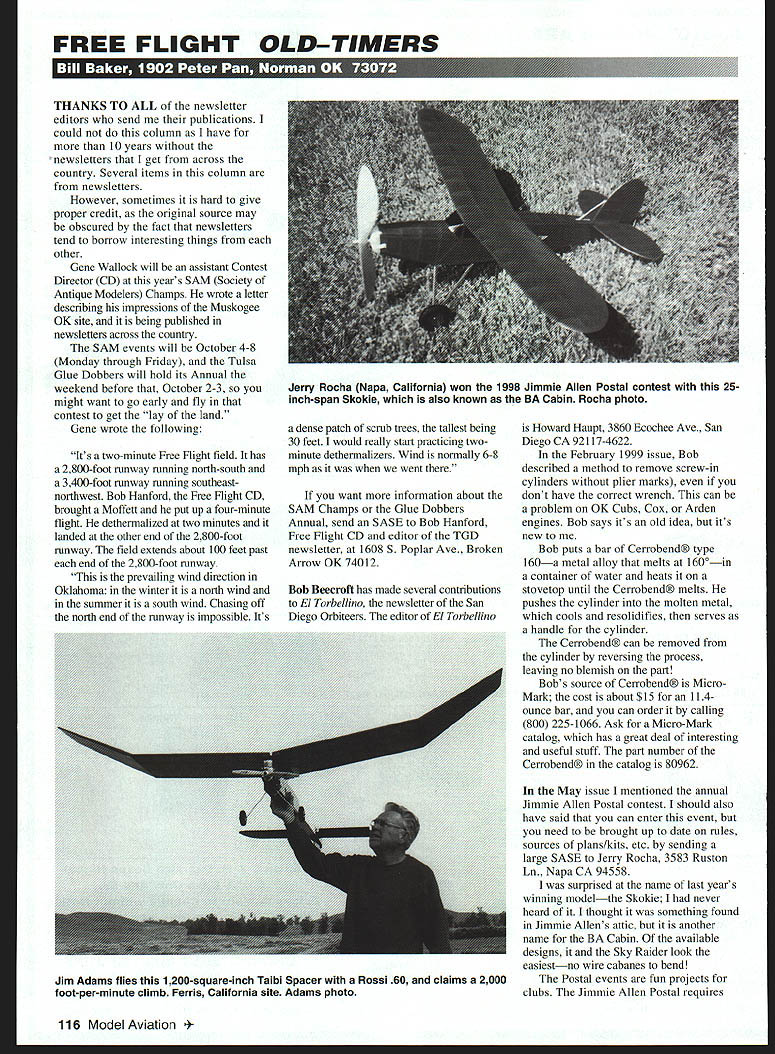
I was surprised at the name of last year's winning model—the Skokie; I had never heard of it. It is another name for the BA Cabin. Of the available designs, the BA Cabin and the Sky Raider look the easiest—no wire cabanes to bend! The Postal events are fun projects for clubs.
Visual perception tip (open field myopia)
I received an interesting and useful bit from the Flightplug — newsletter of the Southern California Ignition Flyers. John McNeil quoted an expert in human visual perception, Greg Irvin:
"It seems that most humans have what is called 'open field myopia.' In layman's terms, it means that when there is nothing to focus on in your field of view, your eyes will drift to a focal point about five feet away!
"This means that if you speck out, lose sight of your model, even as you try to reacquire it, your eyes are losing focus. After 10 or 15 seconds you could be looking straight at the airplane and not see it because it is out of focus.
"If you have lost sight of your airplane, you must focus on some structured object at a distance (such as clouds or the horizon) periodically as you search for it. The time it takes to refocus varies from person to person, but you can actually feel it happen if you pay attention."
I think the ability to focus at infinity is to some extent learned. My late friend Al Bissonette, who was a B-47 and B-52 pilot for many years, had a highly developed ability to focus at a great distance. He used it to help "pick air"; he could see grass move (or distant trees, dust, etc.) upwind from an oncoming thermal. When you fly low in a jet, you learn to look way ahead.
Atwood Shrike — RJL contact
RJL has resumed production of the Atwood Shrike. Contact:
- RJL, Box 5, Sierra Madre, CA 91025
- Tel: (626) 359-0016
- Fax: (626) 301-0298
Transcribed from original scans by AI. Minor OCR errors may remain.

