
FREE FLIGHT OLD-TIMERS
Bill Baker — 1902 Peter Pan, Norman, OK 73072
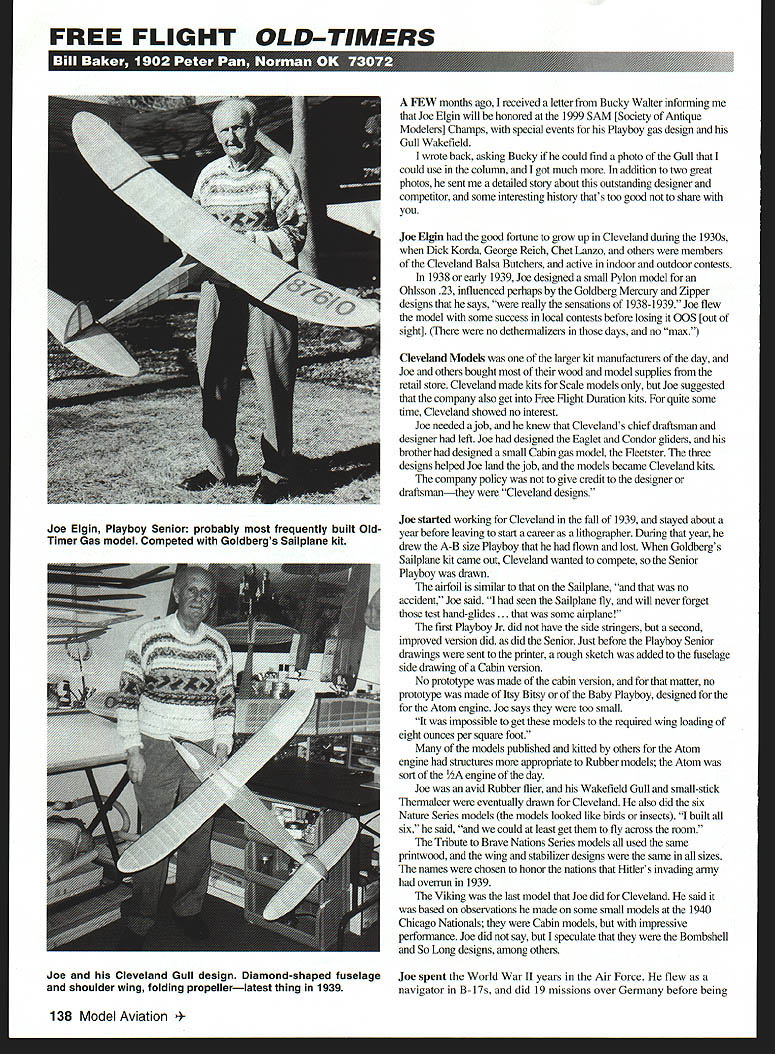
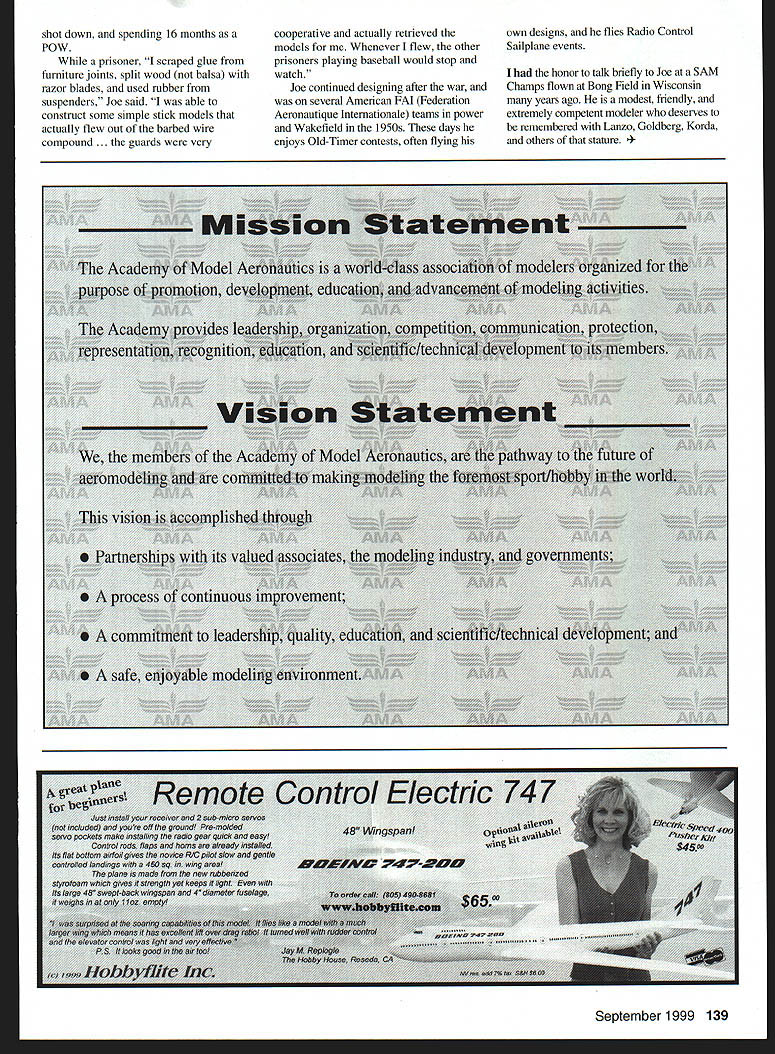
A few months ago I received a letter from Bucky Walter informing me that Joe Elgin will be honored at the 1999 SAM (Society of Antique Modelers) Champs, with special events for his Playboy gas design and his Gull Wakefield. I wrote back asking Bucky if he could find a photo of the Gull that I could use in the column, and he sent much more: two great photos plus a detailed story about this outstanding designer and competitor. That history is too good not to share.
Growing up in Cleveland
Joe Elgin had the good fortune to grow up in Cleveland during the 1930s, when Dick Korda, George Reich, Chet Lanzo, and others were members of the Cleveland Balsa Butchers and active in indoor and outdoor contests.
In 1938 or early 1939 Joe designed a small pylon model for an Ohlsson .23, perhaps influenced by the Goldberg Mercury and Zipper designs. "They were really the sensations of 1938–1939," he said. Joe flew the model with some success in local contests before losing it OOS (out of sight). There were no dethermalizers in those days, and no "max."
Employment at Cleveland Models
Cleveland Models was one of the larger kit manufacturers of the day. Joe and others bought most of their wood and model supplies from the retail store. Cleveland made kits for scale models only, but Joe suggested the company also get into Free Flight Duration kits. For quite some time Cleveland showed no interest.
Needing a job, Joe learned that Cleveland's chief draftsman and designer had left. He had designed the Eaglet and Condor gliders, and his brother had designed a small cabin gas model, the Fleetster. Those three designs helped Joe land the job, and the models became Cleveland kits. Company policy was not to give credit to the designer or draftsman — they were simply "Cleveland designs."
Joe started working for Cleveland in the fall of 1939 and stayed about a year before leaving to start a career as a lithographer. During that year he drew the A–B size Playboy that he had flown and lost. When Goldberg's Sailplane kit came out, Cleveland wanted to compete, so the Senior Playboy was drawn.
"The airfoil is similar to that on the Sailplane, and that was no accident," Joe said. "I had seen the Sailplane fly, and will never forget those test hand-glides... that was some airplane!"
The first Playboy Jr. did not have the side stringers, but a second, improved version did, as did the Senior. Just before the Playboy Senior drawings were sent to the printer, a rough sketch was added to the fuselage side drawing of a cabin version. No prototype was made of that cabin version.
Small models and the Atom engine
No prototype was made of the Itsy Bitsy or the Baby Playboy, designed for the Atom engine; Joe said they were too small. "It was impossible to get these models to the required wing loading of eight ounces per square foot." Many models published and kitted by others for the Atom engine had structures more appropriate to rubber models; the Atom was something like the ½A engine of the day.
Joe was also an avid rubber flier. His Wakefield Gull and small-stick Thermaleer were eventually drawn for Cleveland. He also did the six Nature Series models (the models looked like birds or insects). "I built all six," he said, "and we could at least get them to fly across the room."
The Tribute to Brave Nations Series models all used the same printwood, and the wing and stabilizer designs were the same in all sizes. The names were chosen to honor the nations that Hitler's invading army had overrun in 1939.
The Viking was the last model Joe did for Cleveland. He said it was based on observations he made of some small models at the 1940 Chicago Nationals; they were cabin models with impressive performance.
World War II and afterward
Joe spent the World War II years in the Air Force. He flew as a navigator in B-17s and completed 19 missions over Germany before being shot down and spending 16 months as a POW. He scraped glue from furniture joints, split balsa with razor blades, and used rubber suspenders. Joe said he was able to construct some simple stick models that actually flew out over the barbed-wire compound. Guards were very cooperative and retrieved models; whenever he flew, other prisoners playing baseball would stop and watch.
After the war Joe continued designing. Several American FAI (Federation Aeronautique Internationale) teams, in both power and Wakefield classes in the 1950s, used his designs. He enjoys Old-Timer contests, often flying his own designs, and also flies radio-control sailplane events.
Notable designs
- Eaglet (glider)
- Condor (glider)
- Fleetster (small cabin gas model, by Joe's brother)
- A–B Playboy (small pylon model for Ohlsson .23)
- Playboy Jr. (two versions)
- Playboy Senior (Senior Playboy)
- Itsy Bitsy (designed for Atom engine; prototype not built)
- Baby Playboy (designed for Atom engine; prototype not built)
- Wakefield Gull
- Thermaleer (small-stick)
- Nature Series (six bird/insect-like models)
- Tribute to Brave Nations Series
- Viking
Legacy
Modest, friendly, and an extremely competent modeler, Joe Elgin deserves to be remembered with Lanzo, Goldberg, Korda, and other designers of that stature. I had the honor to speak briefly with him at a SAM Champs flown at Bong Field in Wisconsin many years ago; he left a lasting impression as a talented and generous figure in the free-flight community.
Transcribed from original scans by AI. Minor OCR errors may remain.

