
Free Flight Old-Timers
By
Bill Baker, 1902 Peter Pan, Norman OK 73072
The Column
This will be my last column for Model Aviation. The first column that I wrote was published in the January 1988 issue.
In September 1987, when I was on vacation in Galveston, Texas, I called home to check my answering machine and heard Carl Wheeley’s voice asking if I would like to do the column. I agreed, but I never expected to last very long. Approximately 70 columns later, here I am.
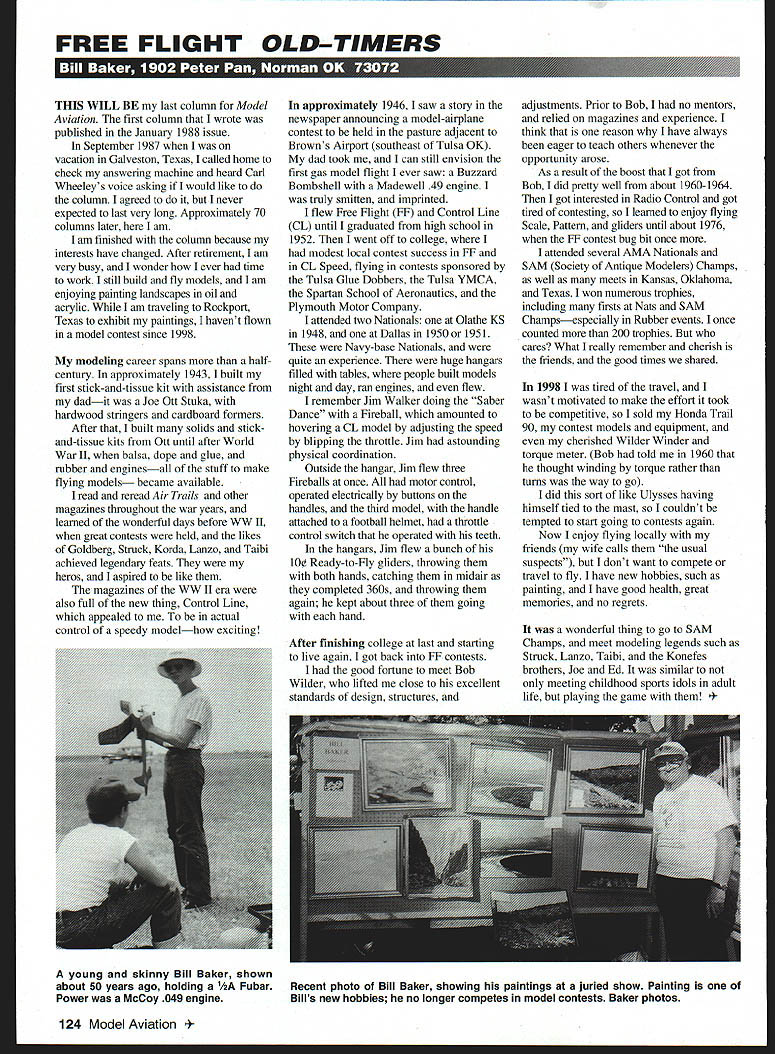
I am finishing the column because my interests have changed. After retirement I am very busy, and I wonder how I ever had time to work. I still build and fly models, and I am enjoying painting landscapes in oil and acrylic. Since I began traveling to Rockport, Texas, to exhibit my paintings, I haven't flown in a model contest since 1998.
Early Modeling Years
My modeling career spans more than a half-century. In approximately 1943 I built my first stick-and-tissue kit with assistance from my dad — a Joe Ott Stuka with hardwood stringers and cardboard formers.
After that I built many solids and stick-and-tissue kits from Ott until after World War II, when balsa, dope and glue, rubber, and engines — all of the stuff to make flying models — became available.
I read and reread Air Trails and other magazines throughout the war years, and learned about the wonderful days before WWII when great contests were held and the likes of Goldberg, Struck, Korda, Lanzo, and Taibi achieved legendary feats. They were my heroes, and I aspired to be like them.
The magazines of the WWII era were also full of the new thing, Control Line, which appealed to me. To be in actual control of a speedy model — how exciting!
In approximately 1946 I saw a newspaper story announcing a model-airplane contest to be held in the pasture adjacent to Brown’s Airport (southeast of Tulsa, OK). My dad took me, and I can still envision the first gas-model flight I ever saw: a Buzzard Bombshell with a Madewell .49 engine. I was truly smitten and imprinted.
High School, College, and Nationals
I flew Free Flight (FF) and Control Line (CL) until I graduated from high school in 1952. Then I went off to college, where I had modest local contest success in FF and CL Speed, flying in contests sponsored by the Tulsa Glue Dobbers, the Tulsa YMCA, the Spartan School of Aeronautics, and the Plymouth Motor Company.
I attended two Nationals: one at Olathe, KS, in 1948, and one at Dallas in 1950 or 1951. These Navy-base Nationals were quite an experience. There were huge hangars filled with tables where people built models night and day, ran engines, and even flew.
I remember Jim Walker doing the "Saber Dance" with a Fireball — essentially hovering a CL model by adjusting the speed with brief throttle blips. Jim had astounding physical coordination.
Outside the hangar, Jim flew three Fireballs at once. He had motor control operated electrically by buttons on the handles, and the third model, with the handle attached to a football helmet, had a throttle-control switch that he operated with his teeth.
In the hangars Jim flew a bunch of his 10-cent Ready-to-Fly gliders, throwing them with both hands, catching them in midair as they completed 360s, and throwing them again; he kept about three going with each hand.
Mentors and Competition
After finishing college and getting back into life, I returned to FF contests. I had the good fortune to meet Bob Wilder, who brought me close to his excellent standards of design, structure, and adjustments. Prior to Bob I had no mentors and relied on magazines and experience. I think that is one reason I have always been eager to teach others whenever the opportunity arose.
As a result of the boost I got from Bob, I did pretty well from about 1960–1964. Then I got interested in Radio Control and grew tired of contesting, so I learned to enjoy flying Scale, Pattern, and gliders until about 1976, when the FF contest bug bit once more.
I attended several AMA Nationals and SAM (Society of Antique Modelers) Champs, as well as many meets in Kansas, Oklahoma, and Texas. I won numerous trophies, including many firsts at Nats and SAM Champs — especially in Rubber events. I once counted more than 200 trophies. But who cares? What I really remember and cherish are the friends and the good times we shared.
Stepping Back and Now
In 1998 I was tired of the travel and not motivated to make the effort it took to be competitive, so I sold my Honda Trail 90, my contest models and equipment, and even my cherished Wilder Winder and torque meter. (Bob had told me in 1960 that winding by torque rather than turns was the way to go.) I did this sort of like Ulysses having himself tied to the mast so I couldn't be tempted to start going to contests again.
Now I enjoy flying locally with my friends (my wife calls them "the usual suspects"), but I don't want to compete or travel to fly. I have new hobbies, such as painting, and I have good health, great memories, and no regrets.
It was wonderful to go to SAM Champs and meet modeling legends such as Struck, Lanzo, Taibi, and the Konefes brothers, Joe and Ed. It was like not only meeting childhood sports idols in adult life, but playing the game with them.
Transcribed from original scans by AI. Minor OCR errors may remain.

