
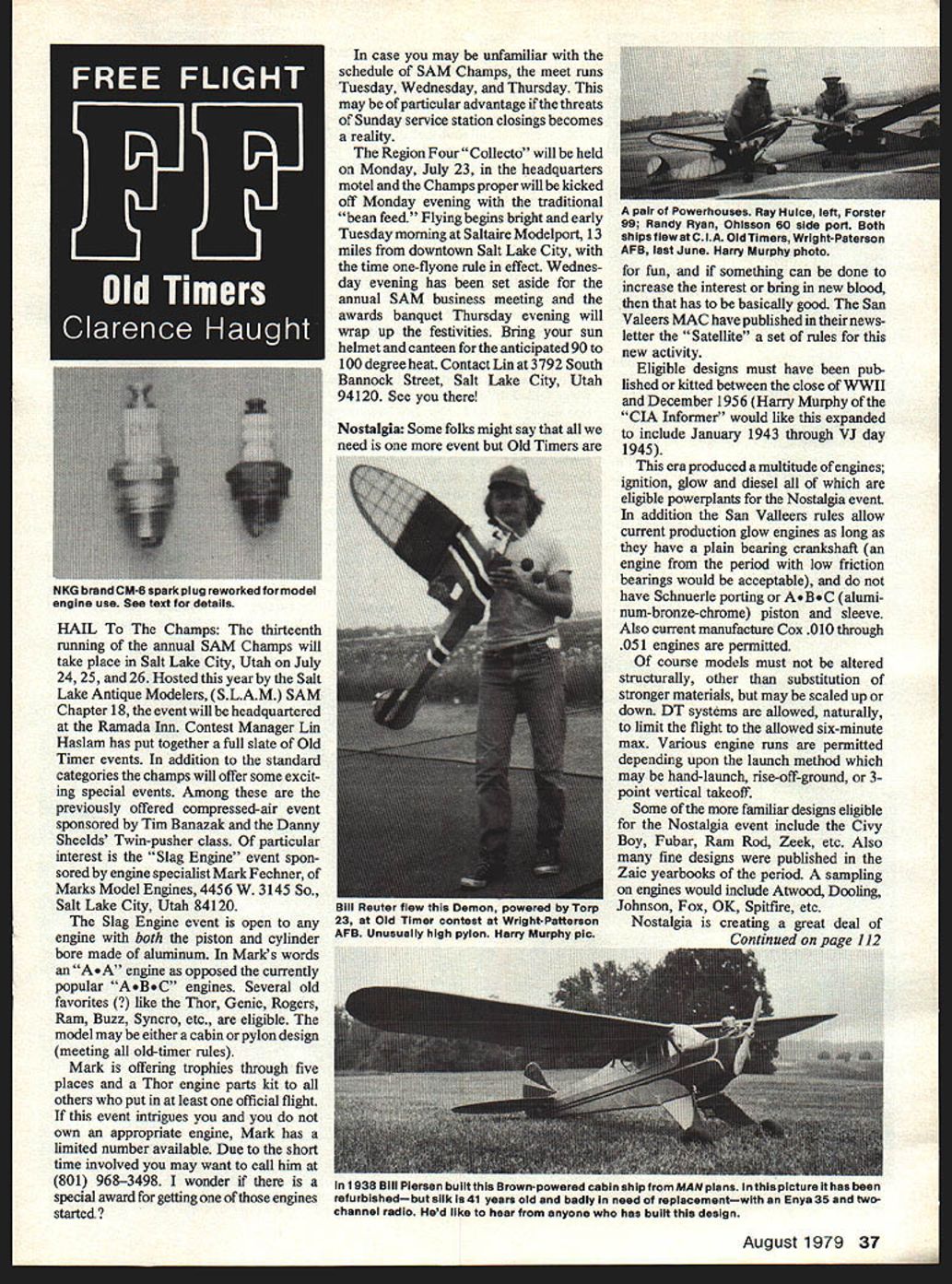
Free Flight: Old Timers
Clarence Haught
Hail to the Champs
HAIL To The Champs: The thirteenth running of the annual SAM Champs will take place in Salt Lake City, Utah on July 24, 25, and 26. Hosted this year by the Salt Lake Antique Modelers (S.L.A.M.), SAM Chapter 18, the event will be headquartered at the Ramada Inn. Contest Manager Lin Haslam has put together a full slate of Old Timer events. In addition to the standard categories, the champs will offer some exciting special events, including the previously offered compressed-air event sponsored by Tim Banazak and Danny Shields' Twin-pusher class.
Slag Engine Event
Of particular interest is the "Slag Engine" event sponsored by engine specialist Mark Fechner of Marks Model Engines, 4456 W. 3145 So., Salt Lake City, Utah 84120.
- Eligibility: any engine with both the piston and cylinder bore made of aluminum — an "AA" engine as opposed to the currently popular A-B-C engines.
- Examples of eligible engines: Thor, Genie, Rogers, Ram, Buzz, Syncro, etc.
- Model types: cabin or pylon designs (meeting all Old Timer rules).
Prizes: Trophies through five places and a Thor engine parts kit to all others who put in at least one official flight. Mark has a limited number of suitable engines available; due to short time, call him at (801) 968-3498.
Schedule
- The SAM Champs runs Tuesday, Wednesday, and Thursday — a schedule that may be advantageous if Sunday service station closings become a reality.
- Region Four "Collecto" will be held Monday, July 23, in the headquarters motel.
- Champs will be kicked off Monday evening with the traditional "bean feed."
- Flying begins Tuesday morning at Saltaire Modelport, 13 miles from downtown Salt Lake City, with the time one-fly-one rule in effect.
- Wednesday evening: annual SAM business meeting.
- Thursday evening: awards banquet.
Bring sun protection for anticipated 90–100°F heat. Contact Lin at 3792 South Bannock Street, Salt Lake City, Utah 84120.
Nostalgia
Nostalgia: Some folks might say that all we need is one more event, but Old Timers are fun, and if something can be done to increase interest or bring in new blood, that is basically good. The San Valleers MAC have published in their newsletter, the "Satellite," a set of rules for this new activity.
- Eligible designs: must have been published or kitted between the close of WWII and December 1956 (Harry Murphy of the "CIA Informer" would like this expanded to include January 1943 through V-J Day 1945).
- Eligible powerplants: ignition, glow, and diesel engines from the era. Current-production glow engines are allowed provided they have a plain-bearing crankshaft (an engine from the period with low-friction bearings would be acceptable), and do not have Schnuerle porting or A-B-C (aluminum-bronze-chrome) piston and sleeve. Current-manufacture Cox .010 through .051 engines are permitted.
- Model restrictions: models must not be structurally altered other than substitution of stronger materials, but may be scaled up or down. DT systems are allowed to limit flight to the allowed six-minute max.
- Launch methods: hand-launch, rise-off-ground (ROG), or 3-point vertical takeoff.
- Examples of eligible designs: Civy Boy, Fubar, Ram Rod, Zeek, and many designs from the Zaic yearbooks of the period.
- Example engines from the era: Atwood, Dooling, Johnson, Fox, OK, Spitfire, etc.
Nostalgia is creating a great deal of interest.
Flight Trim and Adjustment
Offset will help the transition by initiating a left turn as soon as the engine cuts, and will assist the stabilizer tilt for left-glide. If the glide circle was originally set for a right glide, increase stabilizer tilt. However, it may also be necessary to decrease wash-in if the stabilizer still does not make the model turn right. If wash-in is reduced, readjust the climb using right rudder as required to bank right in the climb.
For pylon designs with wash-out on the left main wing panel and stabilizer tilt for left-glide turn, the wash-out becomes effective upwind due to decreased speed. The stabilizer tilt is trying to overpower the wing forces but can't quite make it. Therefore, increase stabilizer tilt for more left-glide turn. Be careful not to use too much tilt, which could cause the model to be unstable in the glide turn. Too much tilt would increase the turn into the washed-out wing which, when upset by a gust, could cause it to dive to the left.
For pylon designs with no wash-in or wash-out that use left vertical fin or rudder offset, and high-thrust-line designs, the stabilizer tilt may not be enough to keep the model turning left or right as required. Also, left rudder tab offset may be affecting the turn as speed increases downwind, causing wandering. Increase the tilt for either more left or right turn as needed.
Problem 7: Glide too fast, inadequate turns
- Symptom: Model grooves the full engine run at a shallower angle than desired; makes about 1/2 to 3/4 right turn during the full 12 seconds, but you want at least 1 to 1-1/4 turns. Transition is good, but the glide is too fast, nose down.
- Axis involved: Lateral.
- Cause and cure (pylon models): overall nose-down tendency caused by insufficient decalage.
- Increase decalage by decreasing the positive angle of incidence of the stabilizer; this will raise the nose in climb and glide and slow the sink rate.
- Note: Increasing decalage also increases tendency to turn right in the climb and conversely decreases turn in the glide. Therefore, decreasing decalage will increase right turn in the climb to the desired 1 to 1-1/4 turns and slow the glide sink rate.
- Adjust glide turn with stabilizer tilt.
Problem 8: Occasional slight stall in glide
- Symptom: Model grooves in a steep right climb; transition and glide turn are perfect, but there is an occasional slight stall.
- Axis involved: Lateral.
- Cure: Add a little nose weight to reduce the stall. Added nose weight helps penetration upwind and improves glide sink rate.
Problem 9: Climb too steep; loops in wind
- Symptom: Model grooves in a steeper climb than desired, transition is good, glide is perfect. In calm air climb is acceptable, but in increased wind the model may loop in the climb.
- Axis involved: Lateral.
- Cure (pylon/high-thrust models):
- Reduce decalage to flatten the climb. This can be done by adding shims under the leading edge of the stabilizer to bring the nose down in the climb.
- Add weight to the tail to adjust the glide. Reduced decalage will speed up the glide; the added tail weight will restore the glide without significantly increasing wing loading.
Do's and Don'ts
- When adding incidence to the wing or stabilizer, don't use balsa wood shims — balsa compresses and will change the adjustment.
- Use 1/64", 1/32", or 1/16" plywood shims.
- If shims less than 1/64" are needed, use brass shims (auto parts stores carry brass shim stock).
- If a vertical fin is used for offset instead of a rudder tab, be sure to re-key the stabilizer when the fin is installed. Use hardwoods for keying.
- If a metal engine mount is used, ensure side thrust can be added without also adding down thrust.
- Example: mounts with only three mounting holes may add down thrust when side thrust is added. Re-drill the mount with four mounting holes and avoid using the original center bottom hole for mounting. Space the four holes so side thrust can be added without adding down thrust.
- Use metal shims for all engine thrust adjustments when using metal mounts. To keep the shim from pressing into the plywood firewall, use a .020" aluminum spacer against the firewall and the metal mount, then insert the metal shim between the aluminum spacer and the mount.
- Check DT line tension. Too much tension can bow the fuselage, changing decalage or vertical fin/rudder offset.
Final Thought
Stand on your own decisions as to what adjustments to make. It's your model and your decision; don't let some bystander con you into changes against your judgment. You've built into your design things the bystander may not know about. Even if you make a mistake, let it be your decision — you'll learn more by making your own decisions. I sincerely hope the information in this series will help you make the right decisions to continuously max in dead air.
Transcribed from original scans by AI. Minor OCR errors may remain.

