
Free Flight: Old Timers
Clarence Haught
I recently had the great fortune to interview the legendary Frank Zaic. If you’ve been in the free-flight game for long, you have undoubtedly come across Frank Zaic’s fabulous Yearbooks. These gold mines of free-flight lore and knowledge occupy a revered spot on my bookshelf and are frequently consulted as authoritative sources of practical and theoretical information. A perusal of these soft-cover manuals reveals that there is really not much that is new in model aviation—only refinements of what has been tried before.
The three hours I spent with Frank were a highlight of my year. He has recently retired from his regular job and is now devoting his full efforts to personal interests, which include:
- model airplanes,
- photography,
- reading science fiction,
- and, most recently, oil painting.
Frank is concerned about maintaining physical and mental health in his retirement years, but his enthusiasm for life and the sparkle in his eyes suggest he is in excellent health and much younger than his years indicate.
Early life and JASCO
Frank was only ten years old when he arrived in New York City from the Swiss Alps. He became interested in airplanes through the usual boyhood curiosity about mechanical things. The need for supplies and communications in modeling led to the establishment of JASCO—the Junior Aeronautical Supply Company—by Frank and his brother. JASCO is still in business today, and Frank has the financial records dating back to 1933 just in case of a tax audit! JASCO had an interesting personnel policy in those days: any boy wanting to quit his job at JASCO had to find his own replacement.
During those early years, the Yearbooks were Frank’s main means of support and were sought after by air-minded youth who considered modeling a progression into the world of aviation. Frank’s first mail-order product was a beam-scale kit accurate to 1/1000 of an ounce—indispensable to indoor modelers.
Innovations and notable designs
Frank is extremely innovative. He told me about producing indoor thrust washers by drilling brass sheet and punching out the washers using dime-store paper punches. He also revealed that he was the originator of the now-common J-bolt—an idea he hit upon while skiing in Vermont.
When asked what he considered his most successful design, Frank gave the nod to the New Yorker, which performed exceptionally well for him and others who built it. Other well-known designs include the Floater (a towline glider) and the classic Miss America cabin gas model.
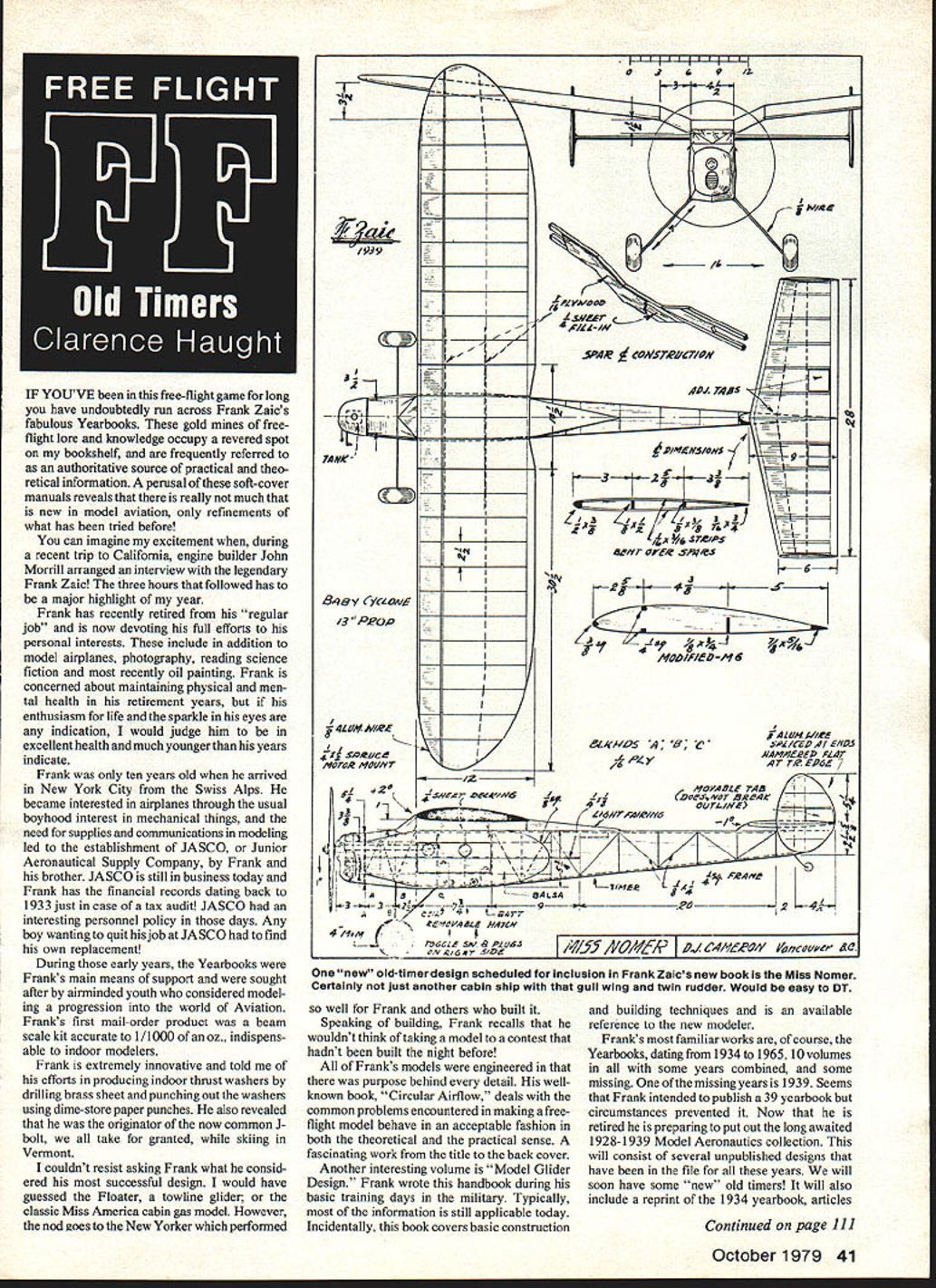
One “new” old-timer design scheduled for inclusion in Frank Zaic’s next book is the Miss Nomer. It’s certainly not just another cabin ship with its gull wing and twin rudder. It would be easy to DT, and it did well for Frank and others who built it.
Speaking of building, Frank recalls that he wouldn’t think of taking a model to a contest that hadn’t been built the night before. All of his models were engineered with purpose behind every detail.
Publications and the Yearbooks
Frank’s well-known book Circular Airflow deals with the common problems encountered in making a free-flight model behave acceptably in both theoretical and practical senses—a fascinating work from the title to the back cover.
Another interesting volume is Model Glider Design, which Frank wrote during his basic training in the military. Much of the information remains applicable today; it covers basic construction and building techniques and is a useful reference for the new modeler.
Frank’s most familiar works are, of course, the Yearbooks, dating from 1934 to 1965—ten volumes in all, with some years combined and some missing. One of the missing years is 1939; Frank intended to publish a 1939 Yearbook but circumstances prevented it. Now that he is retired, he is preparing to put out the long-awaited 1928–1939 Model Aeronautics collection. This will consist of several unpublished designs that have been in the files for all these years—we will soon have some “new” old-timers! It will also include a reprint of the 1934 Yearbook, articles from the American Boy, and other odds and ends from the files.
Frank showed us some of the designs to be included in his new work and this afforded the opportunity to ask about the drafting style employed in all the Yearbooks. The answer was simple: Frank had worked as a patent draftsman in his early years. All at once it clicked—the drawings in the Yearbooks are the same style as those used in early patent-office drawings.
Views on modern free flight
Switching the discussion to modern free flight, Frank expressed concern over “pre-programmed” free flight or the use of auto surfaces controlled by multi-function timers. He feels this technique detracts from the understanding of the forces acting on a model in flight and allows substitution of controlled surfaces in place of the thought-producing work of aerodynamic trimming. Asked about the future of free flight and the scarcity of newcomers, Frank suggested drawing from the ranks of RC fliers who might be looking for a new challenge.
Honors and memorabilia
Frank Zaic has received national and international recognition for his contributions to model aviation. He was elected to the AMA Hall of Fame, and the National Free Flight Society dedicated the 1974 Symposium report to him. In May 1956, the Fédération Aéronautique Internationale (FAI) awarded him the prestigious Diplôme Paul Tissandier for contributions to aero modeling.
In his Northridge, California den is a vast collection of photos, negatives, and other modeling and aviation memorabilia, including Frank’s glider pilot license signed by Orville Wright!
Personal notes
When I asked about dedications in the Yearbooks, Frank replied that his work was often dedicated to his current girlfriend. Happily, there is a dedication to his lovely wife Carmen!
During a time in his life while bemoaning the loss of a girl, Frank wrote one of his best works in my opinion—the poem “Free Flight,” reprinted here with Frank’s permission from the 1955–56 Yearbook.
"Be it so long ago, none of us can forget the wonder of our first Free Flight—Be it only a minute ago, all of us look forward to the next flight.
"How clean the mind, how weary the body after a day of thermal hunting—How much more exciting life can be because of Free Flight.
"Some would have us believe that the price is not worth Free Flight. Could it be that it takes a special kind of man to do all of the things that need to be done before Free Flight can become a reality?
"Yet, who else but those who are willing to pay the price will know in their hearts the glory of the skies; watching their own creation Fly Free."
And that, free flighters, somehow says it all!
Clarence Haught Rt. 5, Box 16, Coeur d'Alene, ID 83814.
Transcribed from original scans by AI. Minor OCR errors may remain.

