
Free Flight: Old-Timers
Clarence Haught
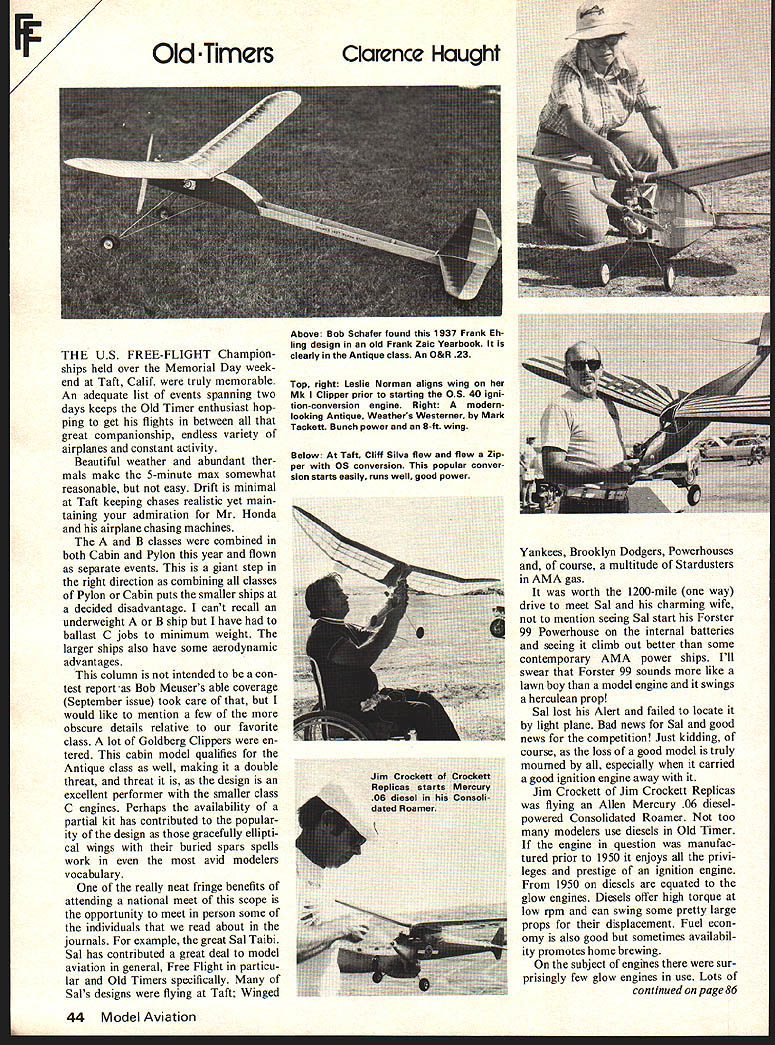
THE U.S. FREE-FLIGHT Championships held over the Memorial Day weekend at Taft, Calif. were truly memorable.
An adequate list of events spanning two days keeps the Old Timer enthusiast hopping to get his flights in between all that great companionship, endless variety of airplanes and constant activity.
Beautiful weather and abundant thermals make the 5-minute max somewhat reasonable, but not easy. Drift is minimal at Taft keeping chases realistic yet maintaining your admiration for Mr. Honda and his airplane chasing machines.
The A and B classes were combined in both Cabin and Pylon this year and flown as separate events. This is a giant step in the right direction as combining all classes of Pylon or Cabin puts the smaller ships at a decided disadvantage. I can't recall an underweight A or B ship but I have had to ballast C jobs to minimum weight. The larger ships also have some aerodynamic advantages.
This column is not intended to be a contest report; as Bob Meuser's able coverage (September issue) took care of that, but I would like to mention a few of the more obscure details relative to our favorite class. A lot of Goldberg Clippers were entered. This cabin model qualifies for the Antique class as well, making it a double threat, and, thread it is, as the design is an excellent performer with the smaller class C engines. Perhaps the availability of a partial kit has contributed to the popularity of the design as those gracefully elliptical wings with their buried spars spells work in even the most avid modeler's vocabulary.
One of the really neat fringe benefits of attending a national meet of this scope is the opportunity to meet in person some of the individuals that we read about in the journals. For example, the great Sal Taibi. Sal has contributed a great deal to model aviation in general, Free Flight in particular and Old Timers specifically. Many of Sal's designs were flying at Taft.
Yankees, Brooklyn Dodgers, Powerhouses and, of course, a multitude of Stardusters in AMA gas.
It was worth the 1200-mile (one way) drive to meet Sal and his charming wife, not to mention seeing Sal start his Forster 99 Powerhouse on the internal batteries and seeing it climb out better than some contemporary AMA power ships. I'll swear that Forster 99 sounds more like a lawn boy than a model engine and it swings a herculean prop! Sal lost his Alert and failed to locate it by light plane. Bad news for Sal and good news for the competition! Just kidding, of course, as the loss of a good model is truly mourned by all, especially when it carried a good ignition engine away with it.
Jim Crockett of Jim Crockett Replicas was flying an Allen Mercury .06 diesel-powered Consolidated Roamer. Not too many modelers use diesels in Old Timer. If the engine in question was manufactured prior to 1950 it enjoys all the privileges and prestige of an ignition engine. From 1950 on diesels are equated to glow engines. Diesels offer high torque for low rpm and can swing some pretty large props for their displacement. Fuel economy is also good but sometimes availability prompts home brewing.
On the subject of engines there were surprisingly few glow engines in use. Lots of Ohlssons and Cyclones. Saw one Delong 30. Quite a few converted glow engines. Chandler Black Knights and several O.S. Max Conversions. The conversions seem to handle well, start easy, and have good power.
As far as airplane designs go, most entries were the familiar old favorites seen at nearly every contest. Did see a couple of Albatrosses, a Marsden, a Weathers' Westerner plus a couple other less common designs. Workmanship was generally very high quality with many colorful paint schemes in evidence. A few plastic film cover jobs were seen, usually well done. I have a little trouble accepting this in Old Timer but I guess I'm just old fashioned.
.020 Replicas were everywhere with a good representation of designs. For example, Mark Tackett of Anaheim produced an .020 Mystery Man! Very cute! The .020 did present one major disappointment of the meet. The pre-contest advertising listed events for .020 Old Timer and .020 Antique. Upon registration my son was told that .020 Antique was a misprint in the literature and he would have to fly his Lanza in the regular .020 class. Most of the Antiques just can't compete with the Strato Streaks, Rangers and Playboys. With very little effort on my part I managed to get hit in the head by an errant Class A Foote Westerner. I happened to be timing at the time and, although aware that the Westerner was "race-horseing" somewhere behind me, my attention was on the model to be timed. The left wing hit me, quartering from behind and knocked off my glasses and sort of stunned me. I had a nice lump and a small scab to show for my efforts. I never did like those Westerners and I guess I've been too vocal about it in the past so now we should be even!
Lots of other memories fill the corners of my mind like the husband and wife team of Leslie and Bruce Norman of Fort Worth, Tex., who flew daylight till dark, testing and officiating, AMA as well as Old Timer, and Cliff Silva starting and launching, from his wheelchair, many different models. Space doesn't permit much more except to say it's a fantastic experience and Taft shared it with a great bunch of people. Go if you ever can!
Event of the Month: Antique
To many Old Timer enthusiasts Antique is where it's really at. This group feels that the Antique class captures the romance of the early gas model more accurately than the Old-Timer categories.
Antique is defined as a model designed prior to December 31, 1938. The Antique Category is further broken down into Fuel Allotment Antique with a specified 6-ft. minimum wingspan and engine runs limited only by their consumption of a fuel ration of 1/2 oz. per lb. of model weight up to a maximum of 7 lbs., and 30-second Antique (no size restrictions).
All Antique models must take off unassisted (R.O.G.) and must be powered by ignition engines.
Many modelers visualize an Antique class model as a large, squarish, lumbering, parasol-wing model and indeed many are. Others, however, can be very sleek and streamlined, for example, some of the designs in the old Zaic Yearbooks. Many attractive cabin models qualify as Antiques and can be flown in Old Timer Cabin as well as the Antique Class, making them attractive to the competition-interested modeler. Typical examples seen at most contests include Flying Quakers, Miss Americas, Clippers and Powerhouses.
All Antiques have one thing in common: a high fun factor!
See you in two months. Keep those cards and letters coming to Route 5, Box 16, Coeur d'Alene, Idaho 83814.
Transcribed from original scans by AI. Minor OCR errors may remain.

