
Free Flight: Old Timers
Clarence Haught
Prop It Up
What size propeller to use is a frequent point of discussion when old-timers gather. I've attempted a little personal survey during the last few contests, but reached no conclusions! The rule seems to be: use the prop that works best. That, of course, involves lots of experimenting. General rules for prop selection on modern glow engines do not necessarily apply to ignition engines.
Ignition engines develop their maximum power at much lower rpm than the newer glow engines (we're talking about original engines here, not conversions), typically at 6,000 to 8,000 rpm. The long-stroke vintage engine is capable of swinging relatively large-diameter and higher-pitch propellers. An O&R .23 will turn a 10-6 prop at its rated rpm of 7,500 — the same prop commonly used on a Fox .35 for CL Stunt. Glow .40s flown in AMA Class C are often equipped with 10-4 props. The legendary Brown Jr. put out its rated power at 6,000 rpm with a 14-8 prop!
My own rule of thumb is to run as large a prop as the engine will swing at its rated rpm. Most ignition engines will only run so fast anyhow, so if the prop is too big, it will bog down the engine. Try for the largest practical diameter for both efficiency and flywheel action.
Propeller performance differs greatly between brands, and experimentation is the best answer. If your ship is trimmed and flying well and you still wish to experiment, always go back to test-flight procedures. Use short engine runs, and work up to full power gradually. Changing props often changes torque, and this affects the power pattern.
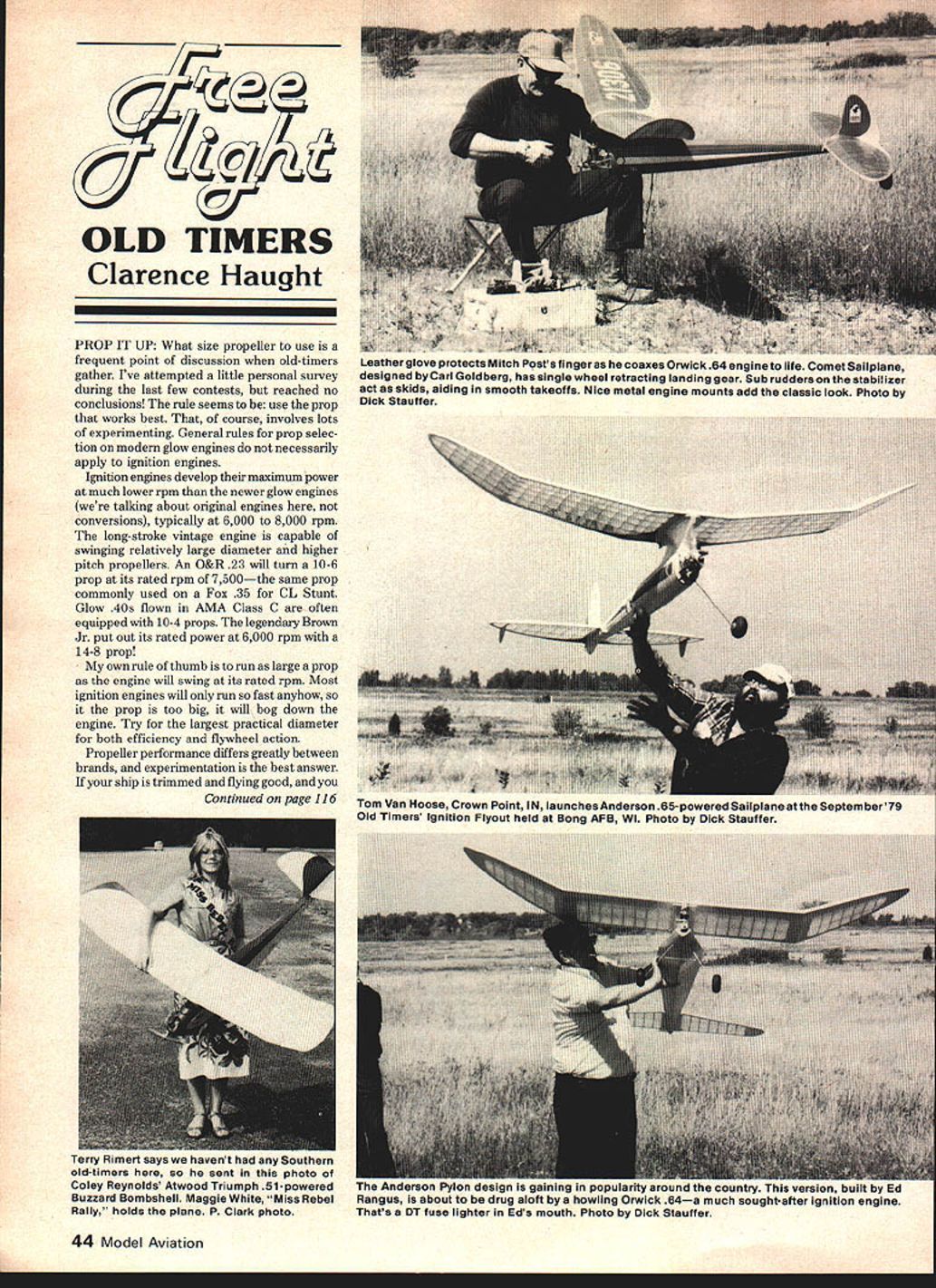
Some fliers, including myself, like nylon props for their added flywheel effect. I must admit that they don't look right on an old-timer, and they sometimes tend to flex and vibrate at the lower speeds of ignition engines. Nylon props seldom break during minor mishaps, but do tend to cause damage to other parts, such as engine lugs or mounts. Wood props usually break before damaging the engine and, of course, run much smoother, provided they are properly balanced. Many old-time designs have "propeller protecting" landing gear, and wood props last many flights.
In the so-called "good old days," you couldn't run down to the local hobby shop and purchase a near-perfect prop. The modeler had to carve his own from whatever material he had available. If you want to be really authentic, you may want to try prop carving. Arthur Suhr, W218 N5866 Maclynn Court, Menomonee Falls, WI 53051, among other offerings, sells the 1935 Brown Jr. instruction book. This includes a separate sheet on prop carving for a 14 in. diameter, 8 in. pitch propeller. Cost is $2.00, postpaid. Also, the book Air Age Gas Models, published by Model Airplane News, has an article on carving "true pitch gas model props."
Gentlemen's OT HLG
Joe Kresnak, writing for the Michigan Antique Modelers Newsletter, is promoting an Old-Timer Hand Launch Glider event for "old-time" modelers. Joe doesn't want to insult anyone by calling them old, so he has devised an alternate title: "Gentlemen." Joe's definition is that to be a gentleman, you must be born before 1943! Sounds fair.
I personally gave up HLG back in 1971 when I saw those Canadian Juniors at the Western Free Flight Championships getting twice the altitude on launch that I could get. A couple of responses to Joe's informal survey were: "I'll give all you old rubber arms a go of it, because I can still throw a ball across the street," and "I can hardly throw a ball from first to third base, but HLG is still as much fun to me as when I was a kid." If this sounds like fun to you, Bob Larsh, 455 Whitcomb Ave., Indianapolis, IN 46224, has plans for 32 OT HLGs. A buck and a stamp will get you two samples and a catalog. There are also many good ones in the Zaic year books.
More cottage industries
4-K's Models, 4202 W. 172nd St., Torrance, CA 90504, has added more old-timers to their kit line. My most recent list includes:
- Buzzard Bombshell
- Baby Bombshell
- Korda Wakefield
- Denny Plane Jr. (72 in. span)
- '41 Lamb Climber
4-K's also handle aniline dye for coloring tissue or tinting clear dope in red, yellow and blue. They also produce several modern free-flight designs as well. I built a 4-K's Korda, and was pleased with the kit. I took it to the USFFC at Taft this year and had it trimmed in six flights. While winding a new motor for my first "official," it burst at 167 actual turns (12 strands of 1/4 in. FAI) and destroyed the fuselage. Oh well, I was there to report, not fly!
Aerodyne, 3154 Falcon, Pomona, CA 91767, is producing a line of prepared fuels, including two special formulas for ignition engines. High Octane Ignition is a special blend, legal for SAM competition, formulated to help eliminate plug fouling. It works quite well in the converted glow engines. Low Octane Ignition is designed primarily for original ignition engines. Aerodyne also offers non-tautening nitrate dope and thinner. Of particular interest is their NGK CM-6 spark plugs rethreaded from 10mm to 3/8-24. These plugs work fine in engines with the 3/8 plug hole. They have heavier electrodes, and are slightly larger than the old Champions, but they are available!
Clarence Haught, R. R. 5, Box 16, Coeur d'Alene, ID 83814.
Transcribed from original scans by AI. Minor OCR errors may remain.

