
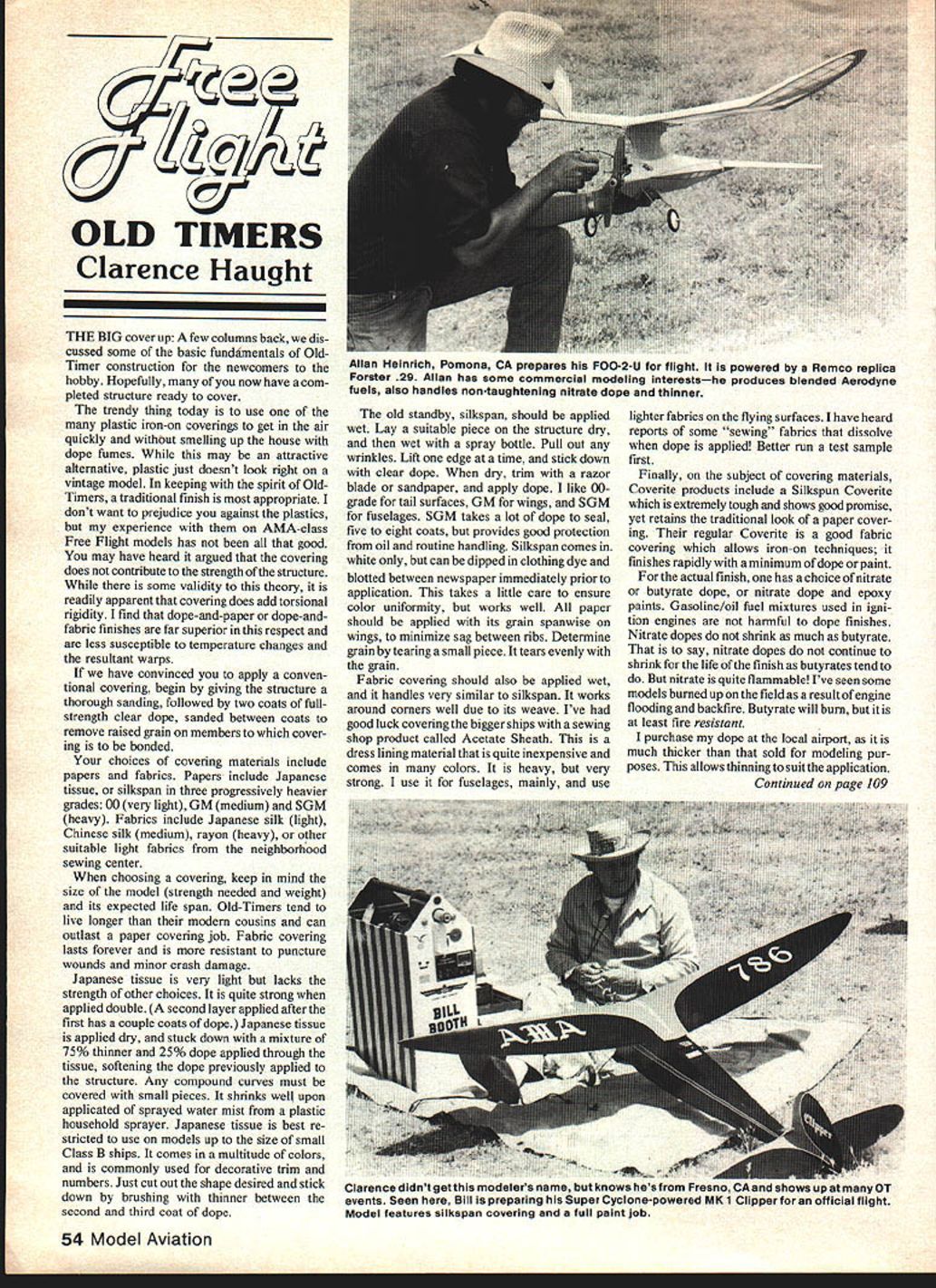
Free Flight: Old Timers
THE BIG cover up: A few columns back we discussed some basic fundamentals of Old-Timer construction for newcomers to the hobby. Hopefully many of you now have a completed structure ready to cover.
The trendy thing today is to use one of the many plastic iron-on coverings to get in the air quickly and without smelling up the house with dope fumes. While this may be an attractive alternative, plastic just doesn't look right on a vintage model. In keeping with the spirit of Old-Timers, a traditional finish is most appropriate. I don't want to prejudice you against the plastics, but my experience with them on AMA-class free flight models has not been all that good. You may have heard it argued that the covering does not contribute to the strength of the structure. While there is some validity to this theory, it is readily apparent that covering does add torsional rigidity. I find that dope-and-paper or dope-and-fabric finishes are far superior in this respect and are less susceptible to temperature changes and the resultant warps.
If you apply a conventional covering, begin by giving the structure a thorough sanding, followed by two coats of full-strength clear dope, sanding between coats to remove raised grain on members to which covering is to be bonded.
Covering materials — choices and considerations
When choosing a covering, keep in mind the size of the model (strength needed and weight) and its expected life span. Old-Timers tend to live longer than their modern cousins and can outlast a paper covering job. Fabric covering lasts longer and is more resistant to punctures and minor crash damage.
Your choices of covering materials include:
- Papers:
- Japanese tissue
- Silkspan in three progressively heavier grades: 00 (very light), GM (medium), SGM (heavy)
- Fabrics:
- Japanese silk (light)
- Chinese silk (medium)
- Rayon (heavy)
- Other suitable light fabrics from the neighborhood sewing center
Papers
Japanese tissue is very light but lacks the strength of other choices. It is quite strong when applied double (a second layer applied after the first has a couple coats of dope). Japanese tissue is applied dry and stuck down with a mixture of 75% thinner and 25% dope applied through the tissue, softening the dope previously applied to the structure. Any compound curves must be covered with small pieces. It shrinks well upon application of a sprayed water mist from a plastic household sprayer. Japanese tissue is best restricted to models up to the size of small Class B ships. It comes in a multitude of colors and is commonly used for decorative trim and numbers — just cut out the shape desired and stick down by brushing with thinner between the second and third coat of dope.
The old standby, silkspan, should be applied wet. Lay a suitable piece on the structure dry, then wet with a spray bottle and pull out any wrinkles. Lift one edge at a time and stick down with clear dope. When dry, trim with a razor blade or sandpaper, then apply dope. Recommended grades:
- 00-grade for tail surfaces
- GM for wings
- SGM for fuselages
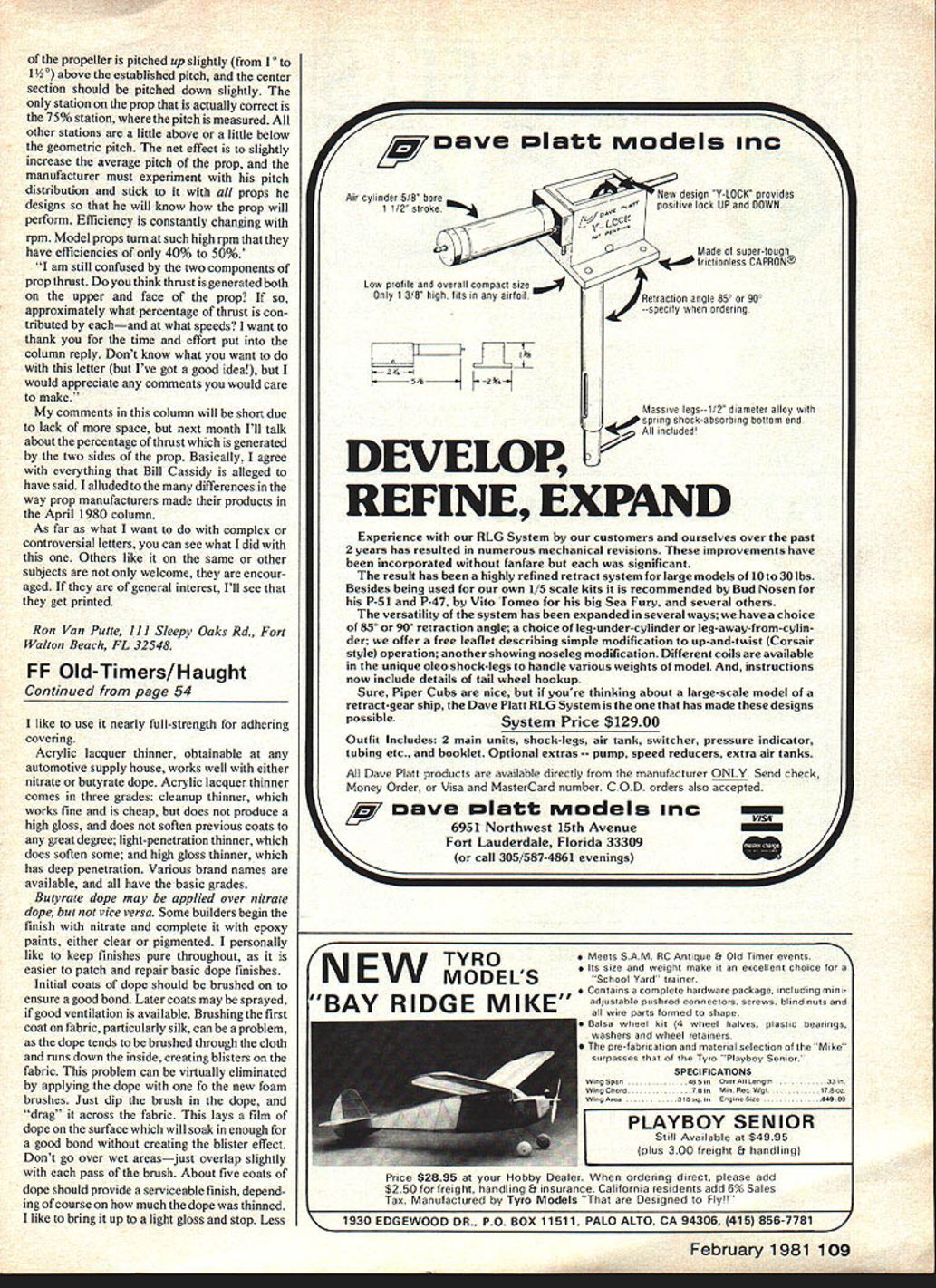
SGM takes a lot of dope to seal (five to eight coats) but provides good protection from oil and routine handling. Silkspan comes in white only but can be dipped in clothing dye and blotted between newspaper immediately prior to application — this takes care to ensure color uniformity but works well.
All paper should be applied with its grain spanwise on the wings to minimize sag between ribs. Determine grain by tearing a small piece — it tears evenly with the grain.
Fabrics
Fabric covering should also be applied wet and handles very similarly to silkspan. Fabric works around corners well due to its weave. One useful material for larger ships is a sewing-shop product called Acetate Sheath — a dress-lining material that is inexpensive, comes in many colors, and is heavy but very strong. I use it mainly for fuselages and lighter fabrics on flying surfaces. Be aware: some sewing fabrics reportedly dissolve when dope is applied; always test a sample first.
Commercial alternatives
Coverite products include a Silkspun Coverite that is extremely tough and retains the traditional look of a paper covering. Their regular Coverite is a good fabric covering which allows iron-on techniques and finishes rapidly with a minimum of dope or paint.
Dope and finishes
For the actual finish, you have a choice of:
- Nitrate dope
- Butyrate dope
- Nitrate dope with epoxy paints
Gasoline/oil fuel mixtures used in ignition engines are not harmful to dope finishes. Nitrate dopes do not shrink as much as butyrate; that is, nitrate dopes do not continue to shrink for the life of the finish as butyrates tend to do. But nitrate is quite flammable — I've seen models burned up in the field as a result of engine flooding and backfire. Butyrate will burn, but is at least more fire resistant.
I purchase dope at the local airport, as it is much thicker than that sold for modeling purposes. This allows thinning to suit the application. I like to use it nearly full-strength for adhering covering.
Acrylic lacquer thinner, obtainable at automotive supply houses, works well with either nitrate or butyrate dope. It comes in three grades:
- Cleanup thinner: cheap, works fine, but does not produce a high gloss and does not soften previous coats much
- Light-penetration thinner: softens some
- High-gloss thinner: has deep penetration
Various brand names are available and all have these basic grades.
Butyrate dope may be applied over nitrate dope, but not vice versa. Some builders begin with nitrate and complete the finish with epoxy paints (either clear or pigmented). I personally prefer to keep finishes pure throughout, as it is easier to patch and repair basic dope finishes.
Application techniques
- Initial coats of dope should be brushed on to ensure a good bond. Later coats may be sprayed if good ventilation is available.
- Brushing the first coat on fabric, particularly silk, can be a problem because the dope tends to be brushed through the cloth and run down the inside, creating blisters on the fabric. This can be virtually eliminated by using a foam brush: dip the foam brush in the dope and "drag" it across the fabric. This lays a film of dope on the surface which will soak in enough for a good bond without creating blisters. Don't go over wet areas — just overlap slightly with each pass of the brush.
- About five coats of dope should provide a serviceable finish, depending on how much the dope was thinned. I like to bring it up to a light gloss and stop. If left too thin, it allows oil soaking; too much dope, however, begins to invite warps.
Sources and final notes
Incidentally, R. J. Mikkelson is producing nitrate dope in red, yellow, blue, orange, black, and white for distribution by Old Timer Models, P.O. Box 913, Westminster, CA 92683.
One last word: don't stink up the house just before company comes — they may not understand your reference to dope!
Clarence Haught Rt. 5, Box 16, Coeur d'Alene, ID 83814.
Transcribed from original scans by AI. Minor OCR errors may remain.

