
Free Flight: Old-Timers
Clarence Haught
Sparky
One must be careful when assigning the word "classic," particularly when the subject is vintage models and classic models are the norm rather than the exception. But, at the risk of incurring the wrath of "gas" modelers, I feel comfortable in designating Sparky as a classic!
Sparky is the brainchild of Ed Lidgard, who designed it while serving in the U.S. Army back in 1939. I understand it first appeared as a kit advertisement in Model Airplane News sometime in 1940, but my magazine collection is too sparse to verify this.
Sparky is currently available as a Comet kit featuring a nice, clearly illustrated plan, printwood parts, sawn stripwood, and a 9-1/2-inch plastic propeller. The plane does show an optional folding wood prop, but no blank layout or carving instructions—just the folding mechanism. While the kit plan follows the basic Sparky layout, the original model included several features not incorporated in the kit. The original model had side cabin windows and a sub-rudder. The small three-view on the plan shows the sub-rudder but not the windows, as does the perspective drawing. The plan features neither.
The original model's stabilizer tips were angled down in an anhedral break about 2 inches from the tips to support the model as it ROGs from a single-stick retracting main gear—much like the old ROG sticks used on Coupe d'Hiver in the early stages of development. The wing and stab of Ed's original model were constructed using sliced ribs rather than conventional sheet ribs, and used a thin under-cambered airfoil.
Sparky was clearly designed as a high-performance model. With a 32-inch span, 115 sq. in. wing, and a 42% lifting stab, it thermals easily at its all-up weight of 3 oz., complete with six strands of 1/4-inch rubber (about 20 grams). The model handles this power quite well when equipped with the sub-rudder, but won't handle high power without it. The kit plan shows the nose block retained with rubber bands, a feature I find desirable on all contest rubber ships. Nothing can be more disturbing than to see the glide ruined by a dangling prop and nose block assembly after a perfect, altitude-grabbing climb.
As presented in the kit, the model has removable tail surfaces but no dethermalizer. If you are not into long chases, even with a free-wheeling prop, better install a dethermalizer!
John Pond, Old-Time Plan Service, P.O. Box 3215, San Jose, CA 95156, has both the original and kit plan available.
Next time you're all stretched out, packing in the turns, and counting under your breath, and someone asks you, "How do I get into OT rubber?" say, "Get a Sparky," and keep on counting!
New engine
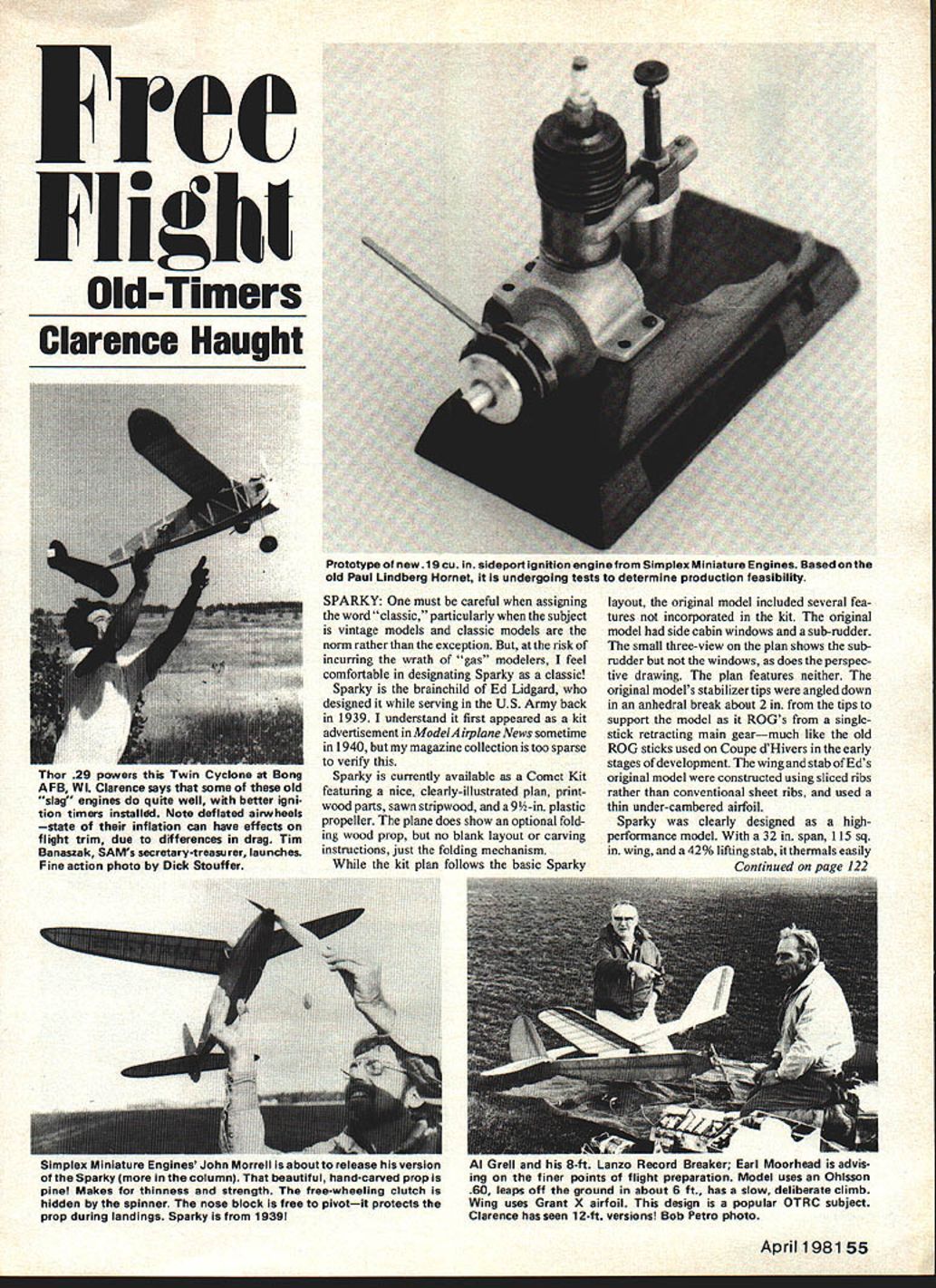
During a recent visit from John Morrell, Simplex Miniature Engines, 143 Richmond, El Segundo, CA 90245, John opened his briefcase and produced the prototype of a proposed new product: a sideport .19 ignition engine.
The engine, based on the old Paul Lindberg "Hornet," would fill a current void in Old-Timer activity created by the scarcity of old Class A engines. John selected a sideport engine rather than the popular rotary valve engine because of its classic appeal.
I quickly dug out my clamp-down engine test stand and my self-contained field ignition test box. A 10-6 prop was bolted on, and the tank filled with 3-to-1 fuel mixture. A few quick flips brought the engine to life, and after carefully establishing needle and spark advance, a solid 6,000 rpm was attained. This is not exactly outstanding for an engine of this size, and John plans to work it up at least another 1,000 rpm — and hopefully more — to make the engine competitive.
The prototype was equipped with the very good Simplex timer built around Super Cyclone–type points, and an NGK spark plug. Some porting and minor induction changes are planned, as well as some construction changes to simplify production. Of course, the final product will be submitted to the SAM engine committee to gain approval as an original type for competition purposes, and thus eliminate engine-run penalties associated with modern glow engine conversions.
By the way, John has produced a second run of Simplex .25s. These are identical to the original production run with all-machined parts. Sooner or later they will have to resort to a cast crankcase due to rising labor costs. This is a good-starting, easily handled engine with good power output!
1981 SAM Champs
Al Hellman, West Coast SAM Vice President, sends us advance information of the SAM Champs for next year.
Taft, CA, the Free Flight capital of the world, has been chosen as the place where the SAM Champs will be held in 1981. The dates selected are June 30, July 1, and July 2. These dates are Tuesday, Wednesday, and Thursday — traditional SAM Champs selections. These dates permit driving to the contest if you start on Friday night from anywhere in the U.S. Al also reminds us that you will have an extra day when returning home because of the 4th of July holiday. The rest of the program will be announced later, but current plans call for making use of the dorms at Taft Junior College; camping in the field will be permissible. A list of available motels will be compiled later.
Hellman has announced that he will be assisted by Larry Clark with the Contest Manager's duties, that Bruce Chandler of the Southern California Ignition Fliers Society (SCIFS) will be Free Flight C.D., and that John Tagors of SAM 49 will be R/C Contest Director.
Flight rules will be current SAM rules, as applicable. Engine runs will be per the SAM rule book, and maxes will be per SAM rules—or as defined in the rule book in the case of R/C events.
Clarence Haught Rt. 5, Box 16, Coeur d'Alene, ID 83814
Transcribed from original scans by AI. Minor OCR errors may remain.

