
Free Flight: Old-Timers
Clarence Haught
Decisions, decisions: Whenever a new model approaches the covering stage I have to agonize over the choice of covering. I tend to lean toward fabrics because of their strength and normally longer life expectancy.
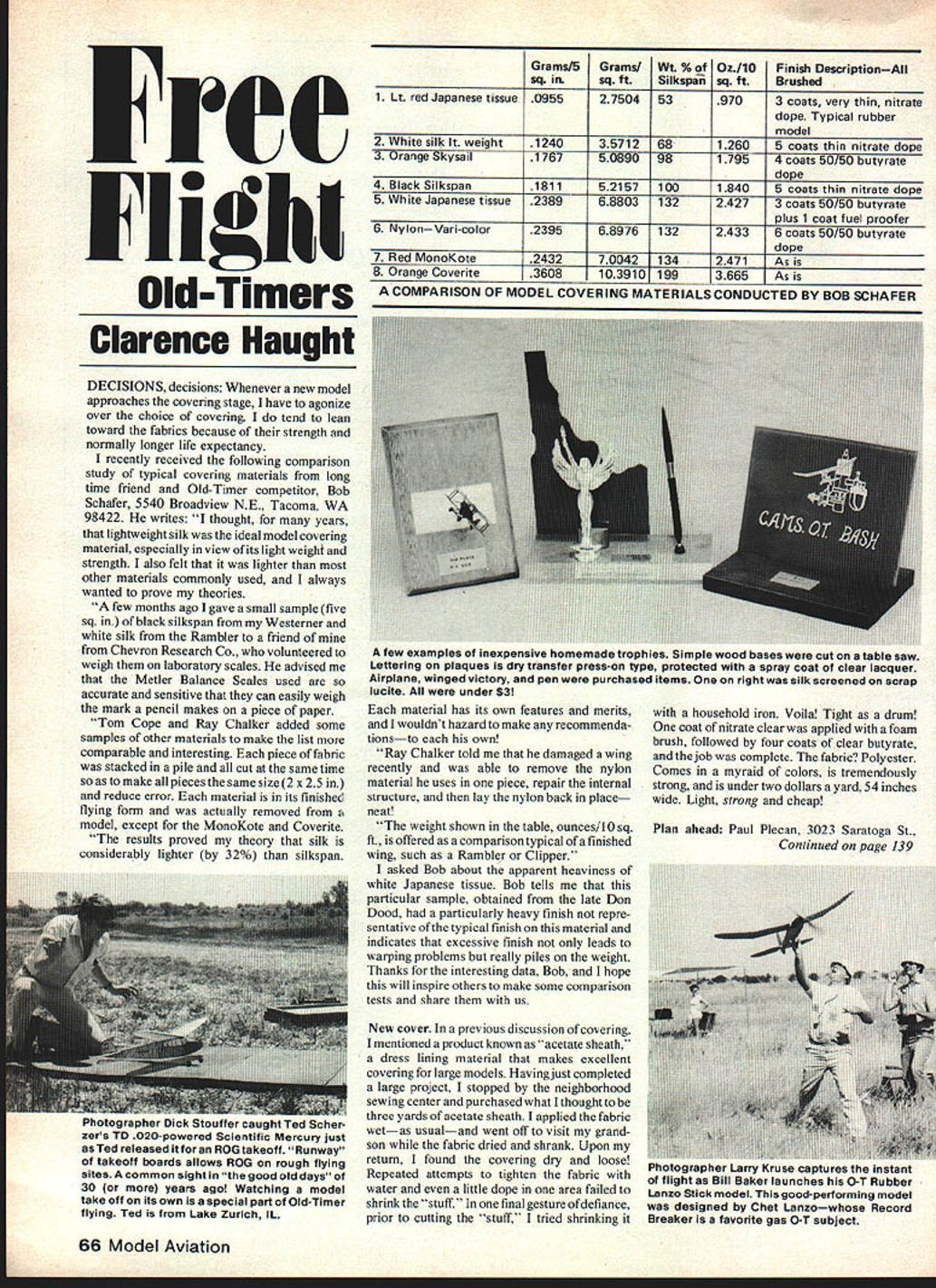
I recently received the following comparison study of typical covering materials from long-time friend and Old-Timer competitor Bob Schafer, 5540 Broadview N.E., Tacoma, WA 98422. He wrote that for many years he thought lightweight silk was the ideal model covering material because of its light weight and strength. He also felt it was lighter than most other commonly used materials and wanted to prove his theory.
A few months ago he gave a small sample (five sq. in.) of black silkspan from his Westerner and white silk from the Rambler to a friend at Chevron Research Co., who volunteered to weigh them on laboratory scales. He advised that the Mettler balance scales used are so accurate and sensitive they can easily weigh the mark a pencil makes on a piece of paper.
Tom Cope and Ray Chalker added samples of other materials to make the list more comparable and interesting. Each piece of fabric was stacked in a pile and all cut at the same time so as to make all pieces the same size (2 x 25 in.) and reduce error. Each material is in its finished flying form and was actually removed from a model, except for the MonoKote and Coverite.
The results proved the theory that silk is considerably lighter (by 32%) than silkspan.
A comparison of model covering materials conducted by Bob Schafer
Columns: Grams / 5 sq. in. · Grams / sq. ft. · Wt. % of Silkspan · Oz. / 10 sq. ft. · Finish description (all brushed)
- Light red Japanese tissue
- 0.0955 g / 5 sq. in.
- 2.7504 g / sq. ft.
- 53% of silkspan
- 0.970 oz. / 10 sq. ft.
- Finish: 3 coats, very thin nitrate dope. Typical rubber-model finish.
- White silk, light weight
- 0.1240 g / 5 sq. in.
- 3.5712 g / sq. ft.
- 68% of silkspan
- 1.260 oz. / 10 sq. ft.
- Finish: 5 coats thin nitrate dope.
- Orange Skysail
- 0.1767 g / 5 sq. in.
- 5.0890 g / sq. ft.
- 98% of silkspan
- 1.795 oz. / 10 sq. ft.
- Finish: 4 coats 50/50 butyrate dope.
- Black silkspan
- 0.1811 g / 5 sq. in.
- 5.2157 g / sq. ft.
- 100% (reference)
- 1.840 oz. / 10 sq. ft.
- Finish: 5 coats thin nitrate dope.
- White Japanese tissue
- 0.2389 g / 5 sq. in.
- 6.8803 g / sq. ft.
- 132% of silkspan
- 2.427 oz. / 10 sq. ft.
- Finish: 3 coats 50/50 butyrate plus 1 coat fuel proofer. Note: this particular sample (from the late Don Dood) had a particularly heavy finish and is not representative of typical white Japanese tissue. Excessive finish increases weight and can lead to warping.
- Nylon — Varicolor
- 0.2395 g / 5 sq. in.
- 6.8976 g / sq. ft.
- 132% of silkspan
- 2.433 oz. / 10 sq. ft.
- Finish: 6 coats 50/50 butyrate dope. Ray Chalker reported he once removed nylon covering in one piece to repair a wing and then laid it back neatly in place.
- Red MonoKote
- 0.2432 g / 5 sq. in.
- 7.0042 g / sq. ft.
- 134% of silkspan
- 2.471 oz. / 10 sq. ft.
- Finish: As is (film covering).
- Orange Coverite
- 0.3608 g / 5 sq. in.
- 10.3910 g / sq. ft.
- 199% of silkspan
- 3.665 oz. / 10 sq. ft.
- Finish: As is (film covering).
Each material has its own features and merits; I wouldn't hazard to make specific recommendations—each to his own. The weight shown in the table (oz./10 sq. ft.) is offered as a comparison typical of a finished wing, such as a Rambler or Clipper.
Thanks to Bob for the interesting data. I hope this will inspire others to run comparison tests and share the results.
New cover
In a previous discussion of covering I mentioned a product known as "acetate sheath," a dress-lining material that makes excellent covering for large models. Having just completed a large project, I stopped by the neighborhood sewing center and purchased what I thought were three yards of acetate sheath. I applied the fabric wet—as usual—and went off to visit my grandson while the fabric dried and shrank. Upon my return I found the covering dry and loose. Repeated attempts to tighten the fabric with water and even a little dope in one area failed to shrink the material.
In one final attempt, prior to cutting the material away, I tried shrinking it with a household iron. Voila—tight as a drum! One coat of nitrate clear was applied with a foam brush, followed by four coats of clear butyrate, and the job was complete. The fabric turned out to be polyester. It comes in many colors, is tremendously strong, and costs under two dollars a yard, 54 inches wide. Light, strong, and cheap!
Plan ahead: Paul Plecan, 3023 Saratoga St., Riverside, CA 92503, well known for his excellent drafting and model design, has come up with a real winner: a Plan Packet Subscription Service. The first issue contains a 1/20-scale Pilatus/Fairchild Turbo Porter rubber model, a well-designed model that should perform well. The plan includes three-view scale documentation, drawings, and photos of the finished model. For convenience, the first issue also contains the Tornado II, designed by Paul for the Cox .049 Baby Bee–type engine (the original ship was powered by a Bantam .14). The model features a parasol-mounted elliptical wing and an open cockpit with headrest.
Plan Packets will be published every 10 to 12 weeks. You may subscribe for as many issues as you want, up to six. Prices are reasonable; write to Paul for his list of "goodies," which includes several other items of interest to Old-Timers.
1934 at last
The legendary Frank Zaic has published the long-awaited 1934 Junior Aeronautics Year Book. Forty-seven years is a long time to wait, but preliminary reading indicates Frank's latest work is a valuable addition to any modeler's library. The book includes a wealth of aeromodeling information—much of it still relevant today. Looking through the included Jasco catalogs is as informative and exciting now as it must have been when they were current. After modeling for a lifetime, it took the '34 yearbook to explain the color code on the end grain of balsa!
Also included are reprints of the AMA publication Model Aviation for June and August 1936 (Volume 1, Numbers 1 and 2), plus Volume 1, Number 1 of Model Aeronautics, edited by Frank.
The book provides information on several previously unpublished Old-Timers in gas, rubber, and hand-launch types. Frank's yearbooks have been a constant reference source for modelers through the years, and it doesn't take long to realize there's not much that is truly new in the world of modeling.
Price: $5.50 direct from Frank Zaic, Box 135, Northridge, CA 91324.
Clarence Haught Rt. 5, Box 16, Coeur d'Alene, ID 83814.
Transcribed from original scans by AI. Minor OCR errors may remain.

