
Free Flight: Old-Timers
Clarence Haught
FAI Old-Timer — sportsmanship and concerns
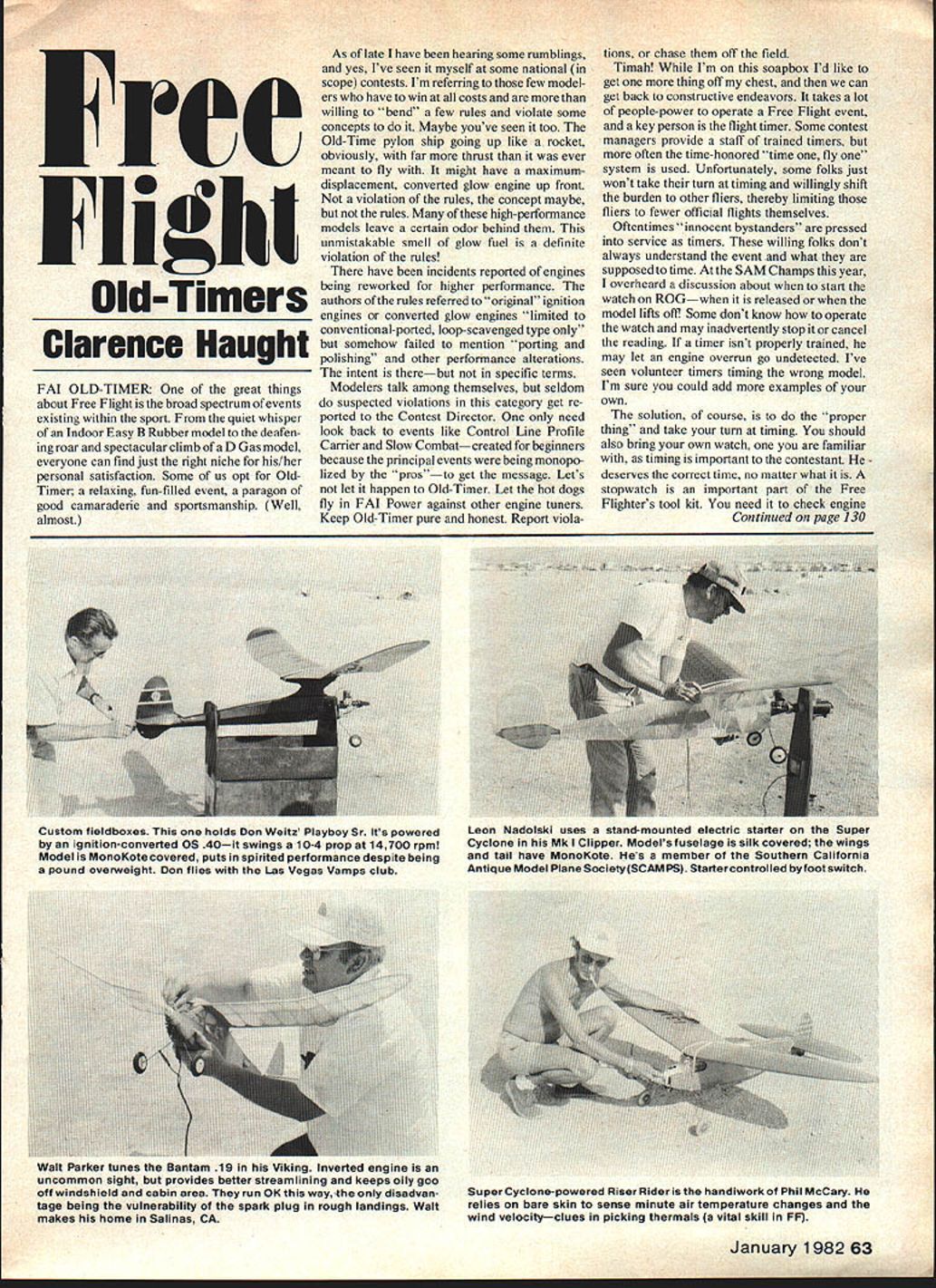
One of the great things about Free Flight is the broad spectrum of events within the sport. From the quiet whisper of an indoor Easy-B rubber model to the deafening roar and spectacular climb of a D/Gas model, everyone can find the right niche for personal satisfaction. Some of us opt for Old-Timer — a relaxing, fun-filled event and a paragon of camaraderie and sportsmanship. Well, almost.
Lately I've heard rumblings and have seen, at some national contests, a few modelers who seem to feel they must win at all costs. Some are willing to bend rules or violate the spirit of the event to do it. Maybe you've seen it: an Old-Timer pylon ship launching like a rocket, obviously fitted with far more thrust than it was designed to have. It might even have a maximum-displacement ignition engine converted to glow up front. Not every modification is a literal rules violation, but some clearly violate the concept of the class. Many high-performance models also leave a certain odor behind — the unmistakable smell of glow fuel — which is a definite rule violation.
There have been reports of engines reworked for higher performance. The rules mention "original" ignition engines or converted glow engines "limited to conventional-ported, loop-scavenged type only," but they don't always mention porting, polishing, or similar performance alterations. The intent is there, but not always in specific terms.
Modelers often talk among themselves, but suspected violations in this category are seldom reported to the Contest Director. Remember how events such as Control Line Profile Carrier and Slow Combat were created for beginners after original events became dominated by the "pros." Let's not let that happen to Old-Timer. Let the hot-dogs compete in FAI Power and against other engine tuners — keep Old-Timer pure and honest. Report violations, or chase them off the field.
Timing: the unsung key to fair competition
It takes a lot of people-power to operate a Free Flight event. A key person is the flight timer. Some contest managers provide a staff of trained timers, but more often the time-honored "time one, fly one" system is used. Unfortunately, some fliers simply won't take their turn at timing and shift the burden to others, thereby limiting those fliers to fewer official flights.
Too often, "innocent bystanders" are pressed into service as timers. These willing folks don't always understand the event or what they are supposed to time. At the SAM Champs this year I overheard a discussion about when to start the watch on ROG — when the model is released or when it actually lifts off. Some people don't know how to operate the watch and may inadvertently stop it or cancel the reading. An untrained timer may let an engine overrun go undetected. I've even seen volunteer timers timing the wrong model. You can probably add more examples from your own experience.
Common timing mistakes:
- Starting the watch at the wrong moment (release vs. liftoff).
- Stopping, pausing, or canceling the watch accidentally.
- Timing the wrong model or failing to detect engine overruns.
- Not knowing how to operate or read the stopwatch.
The solution is simple and practical: take your turn timing, and bring your own watch — one you are familiar with. Timing is important to the contestant; he or she deserves the correct time, whatever it is. A stopwatch is an essential part of the Free Flighter's toolkit. You need it to check engine runs and your own model's performance. Don't leave home without it.
ROG it — wind, alignment, and safety (notes from Don Jenkins)
CIA agent Don Jenkins made relevant observations during the SAM Champs at Wright-Patterson AFB and the Central Indiana Aeromodelers Annual:
- Check wind direction before release. Too many fliers ignore wind direction; models attempting ROG can stall at nearly right angles to the wind, causing ground loops, broken props, and near-misses for bystanders.
- Timers can often see problems before the flier does. A simple demonstration — holding a handkerchief to show wind direction — can help the flier adjust alignment.
- Use Mylar streamers or other wind-direction aids. Several streamers should be available to help a flier line up the model as desired.
- Inspect the takeoff path for obstructions: motorcycles, toolboxes, people, and other hazards. Keep it safe.
From a timer's standpoint: look around before allowing an Old-Timer to launch. Many contemporary AMA models may tolerate less-than-perfect alignment, but Old-Timers of any engine type usually need careful aligning prior to release.
Final reminders
- Keep Old-Timer events honest by reporting suspected rule violations.
- Take your turn timing, train volunteer timers, and bring a familiar stopwatch.
- Use wind-direction aids and check the launch path for obstructions.
- Encourage good sportsmanship so Old-Timer remains a relaxing, friendly event for all.
Time's up — I'm off the soapbox. Now let's get back to constructive endeavors and keep Old-Timer the enjoyable, honest class it should be.
Transcribed from original scans by AI. Minor OCR errors may remain.

