
Old-Timers
Clarence Haught
OFTEN TIMES the choices of A-models to build are somewhat limited by engine availability. Given the fact that ignition engines are a bit more flexible than their glow counterparts and can be operated satisfactorily through a wider rpm range, one still must match engine power to airframe size.
Original ignition engines seem to be more readily available in the larger displacements. Installing a large engine in a medium size model can be a handicap if the 80 ounce per cubic inch displacement rule is enforced. This will bring the wing loading above the required 8 oz. per square foot, and will detract from glide performance. This and the sometimes limited availability of engines has led me to investigate the world of engine conversions.
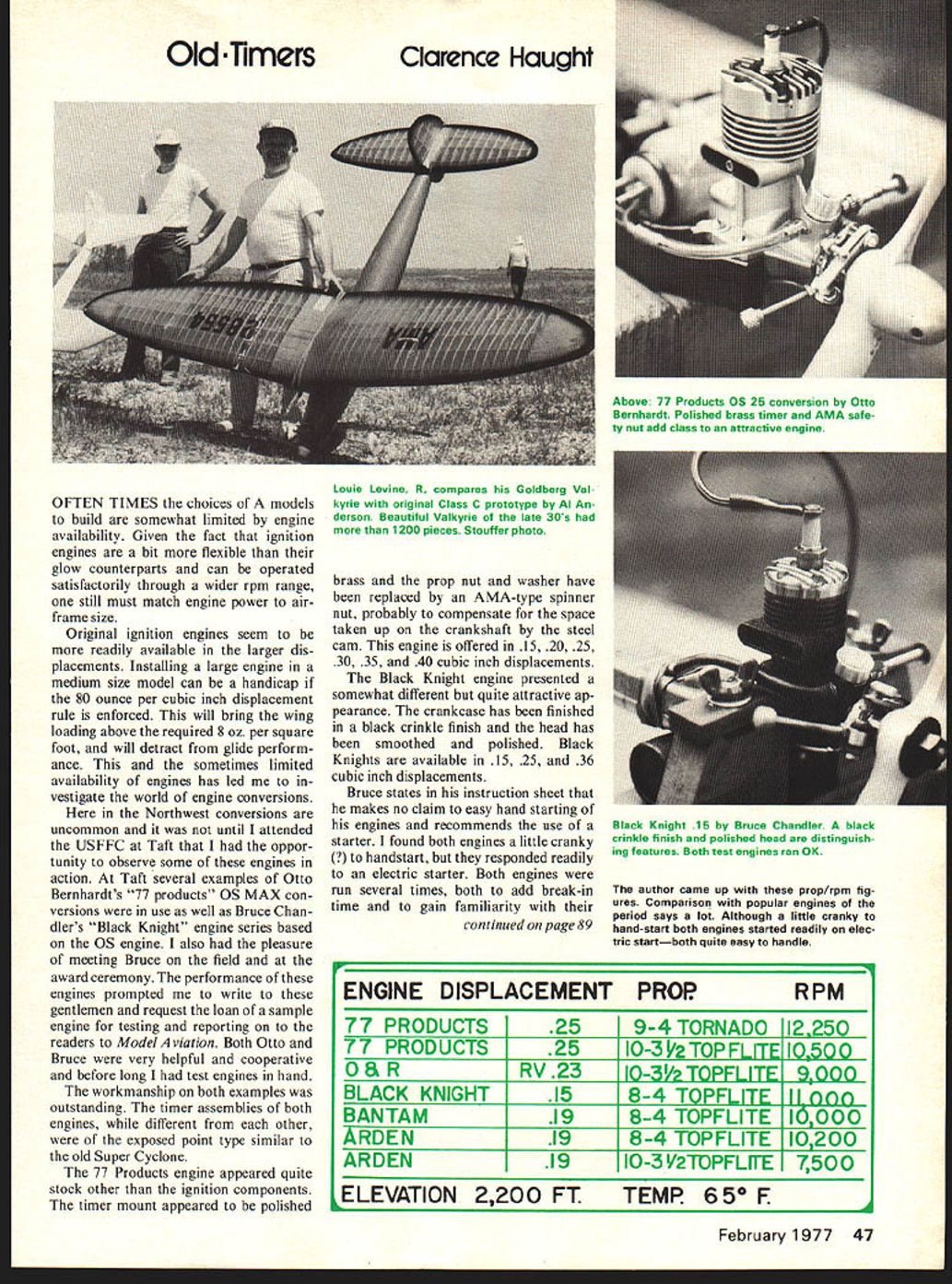
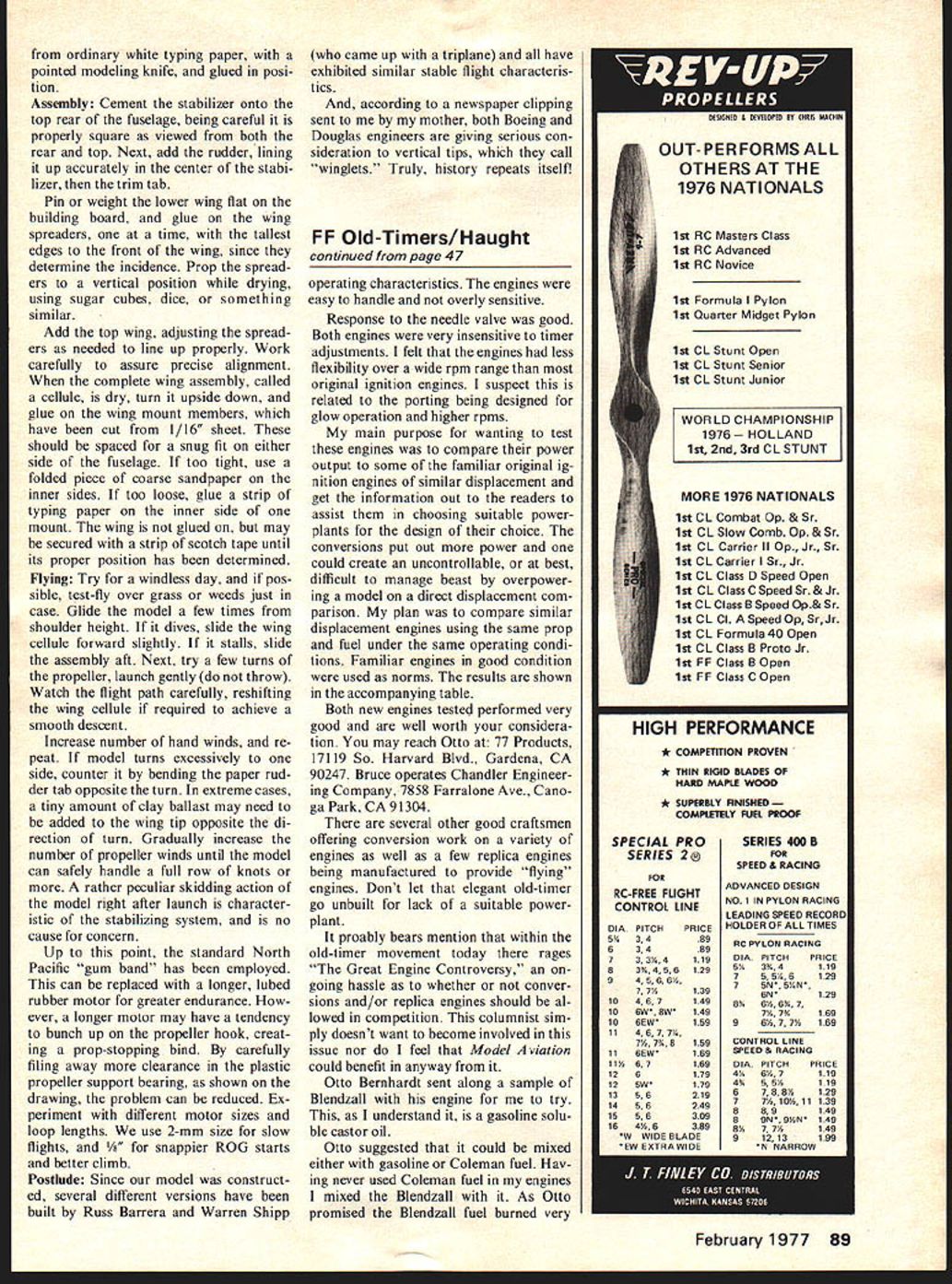
Here in the Northwest conversions are uncommon and it was not until I attended the USFFC at Taft that I had the opportunity to observe some of these engines in action. At Taft several examples of Otto Bernhardt's "77 products" OS MAX conversions were in use as well as Bruce Chandler's "Black Knight" engine series based on the OS engine. I also had the pleasure of meeting Bruce on the field and at the award ceremony. The performance of these engines prompted me to write to the gentlemen and request the loan of a sample engine for testing and reporting on to the readers of Model Aviation. Both Otto and Bruce were very helpful and cooperative and before long I had test engines in hand.
The workmanship on both examples was outstanding. The timer assemblies of both engines, while different from each other, were of the exposed point type similar to the old Super Cyclone.
The 77 Products engine appeared quite stock other than the ignition components. The timer mount appeared to be polished brass and the prop nut and washer have been replaced by an AMA-type spinner nut, probably to compensate for the space taken up on the crankshaft by the steel cam. This engine is offered in .15, .20, .25, .30, .35, and .40 cubic inch displacements.
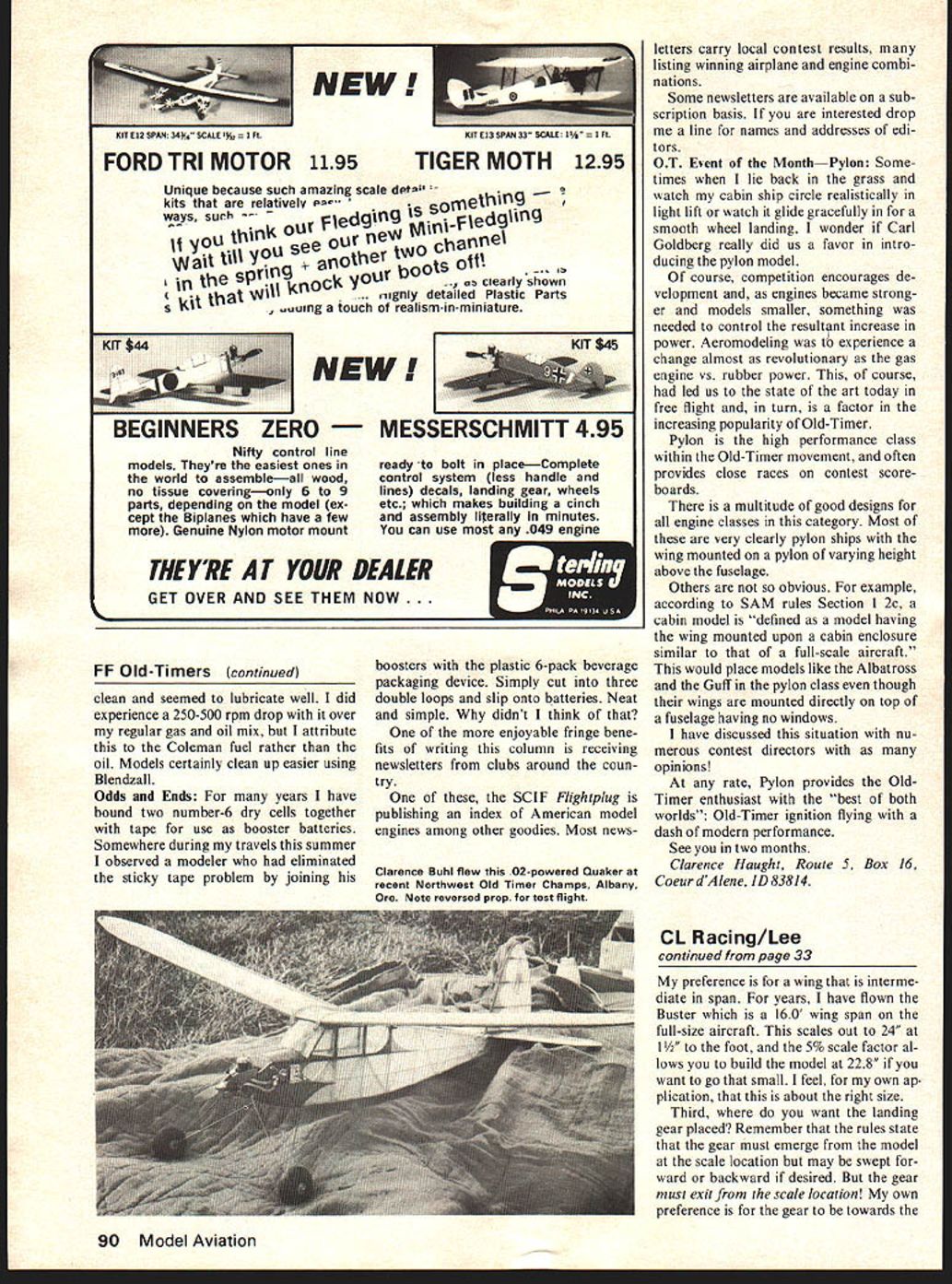
The Black Knight engine presented a somewhat different but quite attractive appearance. The crankcase has been finished in a black crinkle finish and the head has been smoothed and polished. Black Knights are available in .15, .25, and .36 cubic inch displacements.
Bruce states in his instruction sheet that he makes no claim to easy hand starting of his engines and recommends the use of a starter. I found both engines a little cranky to hand-start, but they responded readily to an electric starter. Both engines were run several times, both to add break-in time and to gain familiarity with their prop/rpm figures. Comparison with popular engines of the period says a lot. Although a little cranky to hand-start, both engines started readily on electric start—both quite easy to handle.
ENGINE DISPLACEMENT PROP RPM 77 PRODUCTS .25 9-4 TORNADO 12,250 77 PRODUCTS .25 10-3 1/2 TOPFLITE 10,500 O & R .23 10-3 1/2 TOPFLITE 9,000 BLACK KNIGHT .15 8-4 TOPFLITE 11,000 BANTAM .19 8-4 TOPFLITE 10,000 ARDEN .19 8-4 TOPFLITE 10,200 ARDEN .19 10-3 1/2 TOPFLITE 7,500
ELEVATION 2,200 FT. TEMP. 65° F. from ordinary white typing paper, with a pointed modeling knife, and glued in position.
Assembly: Cement the stabilizer onto the top rear of the fuselage, being careful it is properly square as viewed from both the rear and top. Next, add the rudder, lining it up accurately in the center of the stabilizer, then the trim tab.
Pin or weight the lower wing flat on the building board, and glue on the wing spreaders, one at a time, with the tallest edges to the front of the wing, since they determine the incidence. Prop the spreaders to a vertical position while drying, using sugar cubes, dice, or something similar.
Add the top wing, adjusting the spreaders as needed to line up properly. Work carefully to assure precise alignment. When the complete wing assembly, called a cellule, is dry, turn it upside down, and glue on the wing mount members, which have been cut from 1/16" sheet. These should be spaced for a snug fit on either side of the fuselage. If too tight, use a folded piece of coarse sandpaper on the inner sides. If too loose, glue a strip of typing paper on the inner side of one mount. The wing is not glued on, but may be secured with a strip of scotch tape until its proper position has been determined.
Flying: Try for a windless day, and if possible, test-fly over grass or weeds just in case. Glide the model a few times from shoulder height. If it dives, slide the wing cellule forward slightly. If it stalls, slide the assembly aft. Next, try a few turns of the propeller, launch gently (do not throw). Watch the flight path carefully, refitting the wing cellule if required to achieve a smooth descent.
Increase number of hand winds, and repeat. If model turns excessively to one side, counter it by bending the paper rudder tab opposite the turn. In extreme cases, a tiny amount of clay ballast may need to be added to the wing tip opposite the direction of turn. Gradually increase the number of propeller winds until the model can safely handle a full row of knots or more. A rather peculiar skidding action of the model right after launch is characteristic of the stabilizing system, and is no cause for concern.
Up to this point, the standard North Pacific "gum band" has been employed. This can be replaced with a longer, lubed rubber motor for greater endurance. However, a longer motor may have a tendency to bunch up on the propeller hook, creating a prop-stopping bind. By carefully filing away more clearance in the plastic propeller support bearing, as shown on the drawing, the problem can be reduced. Experiment with different motor sizes and loop lengths. We use 2-mm size for slow flights, and 1/8" for snappier ROG starts and better climb.
Postlude: Since our model was constructed, several different versions have been built by Russ Barrera and Warren Shipp (who came up with a triplane) and all have exhibited similar stable flight characteristics.
And, according to a newspaper clipping sent to me by my mother, both Boeing and Douglas engineers are giving serious consideration to vertical tips, which they call "winglets." Truly, history repeats itself!
operating characteristics. The engines were easy to handle and not overly sensitive.
Response to the needle valve was good. Both engines were very insensitive to timer adjustments. I felt that the engines had less flexibility over a wide rpm range than most original ignition engines. I suspect this is related to the porting being designed for glow operation and higher rpms.
My main purpose for wanting to test these engines was to compare their power output to some of the familiar original ignition engines of similar displacement and get the information out to the readers to assist them in choosing suitable powerplants for the design of their choice. The conversions put out more power and one could create an uncontrollable, or at best, difficult to manage beast by overpowering a model on a direct displacement comparison. My plan was to compare similar displacement engines using the same prop and fuel under the same operating conditions. Familiar engines in good condition were used as norms. The results are shown in the accompanying table.
Both new engines tested performed very good and are well worth your consideration. You may reach Otto at: 77 Products, 17119 So. Harvard Blvd., Gardena, CA 90247. Bruce operates Chandler Engineering Company, 7858 Farralone Ave., Canoga Park, CA 91304.
There are several other good craftsmen offering conversion work on a variety of engines as well as a few replica engines being manufactured to provide "flying" engines. Don't let that elegant old-timer go unbuilt for lack of a suitable powerplant.
It probably bears mention that within the old-timer movement today there rages "The Great Engine Controversy," an ongoing hassle as to whether or not conversions and/or replica engines should be allowed in competition. This columnist simply doesn't want to become involved in this issue nor do I feel that Model Aviation could benefit in anyway from it.
Otto Bernhardt sent along a sample of Blendzall with his engine for me to try. This, as I understand it, is a gasoline soluble castor oil.
Otto suggested that it could be mixed either with gasoline or Coleman fuel. Having never used Coleman fuel in my engines I mixed the Blendzall with it. As Otto promised the Blendzall fuel burned very clean and seemed to lubricate well. I did experience a 250-500 rpm drop with it over my regular gas and oil mix, but I attribute this to the Coleman fuel rather than the oil. Models certainly clean up easier using Blendzall.
Odds and Ends:
For many years I have bound two number-6 dry cells together with tape for use as booster batteries. Somewhere during my travels this summer I observed a modeler who had eliminated the sticky tape problem by joining his boosters with the plastic 6-pack beverage packaging device. Simply cut into three double loops and slip onto batteries. Neat and simple. Why didn't I think of that?
One of the more enjoyable fringe benefits of writing this column is receiving newsletters from clubs around the country. One of these, the SCIF Flightplug, is publishing an index of American model engines among other goodies. Most newsletters carry local contest results, many listing winning airplane and engine combinations.
Some newsletters are available on a subscription basis. If you are interested drop me a line for names and addresses of editors.
O.T. Event of the Month — Pylon:
Sometimes when I lie back in the grass and watch my cabin ship circle realistically in light lift or watch it glide gracefully in for a smooth wheel landing, I wonder if Carl Goldberg really did us a favor in introducing the pylon model.
Of course, competition encourages development and, as engines became stronger and models smaller, something was needed to control the resultant increase in power. Aeromodeling was to experience a change almost as revolutionary as the gas engine vs. rubber power. This, of course, has led us to the state of the art today in free flight and, in turn, is a factor in the increasing popularity of Old-Timer.
Pylon is the high performance class within the Old-Timer movement, and often provides close races on contest scoreboards.
There is a multitude of good designs for all engine classes in this category. Most of these are very clearly pylon ships with the wing mounted on a pylon of varying height above the fuselage.
Others are not so obvious. For example, according to SAM rules Section 12c, a cabin model is "defined as a model having the wing mounted upon a cabin enclosure similar to that of a full-scale aircraft." This would place models like the Albatross and the Gulf in the pylon class even though their wings are mounted directly on top of a fuselage having no windows.
I have discussed this situation with numerous contest directors with as many opinions!
At any rate, Pylon provides the Old-Timer enthusiast with the "best of both worlds": Old-Timer ignition flying with a dash of modern performance.
See you in two months.
Clarence Haught, Route 5, Box 16, Coeur d'Alene, ID 83814.
Transcribed from original scans by AI. Minor OCR errors may remain.

