
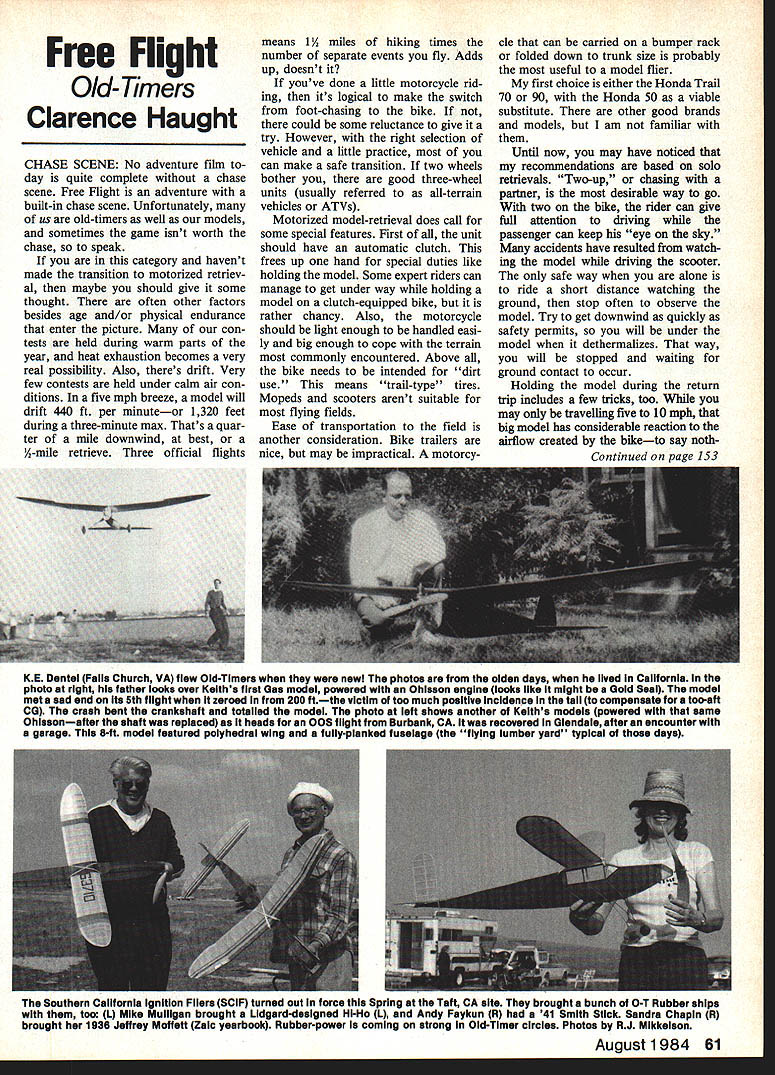
Free Flight: Old-Timers
Clarence Haught
CHASE SCENE: No adventure film today is quite complete without a chase scene. Free Flight is an adventure with a built‑in chase scene. Unfortunately, many of us are old‑timers as well as our models, and sometimes the game isn't worth the chase, so to speak.
If you are in this category and haven't made the transition to motorized retrieval, then maybe you should give it some thought. There are often other factors besides age and physical endurance that enter the picture. Many of our contests are held during warm parts of the year, and heat exhaustion becomes a very real possibility. Also, there's drift. Very few contests are held under calm air conditions. In a five mph breeze, a model will drift 440 ft. per minute—or 1,320 feet during a three‑minute max. That's a quarter‑mile downwind, at best, or a half‑mile retrieve. Three official flights means 1 1/2 miles of hiking times the number of separate events you fly. Adds up, doesn't it?
If you've done a little motorcycle riding, then it's logical to make the switch from foot‑chasing to the bike. If not, there could be some reluctance to give it a try. However, with the right selection of vehicle and a little practice, most of us can make a safe transition. If two wheels bother you, there are good three‑wheel units (usually referred to as all‑terrain vehicles or ATVs).
Motorized model retrieval does call for some special features. Important considerations include:
- An automatic clutch. This frees up one hand for duties like holding the model; trying to get underway while holding a model on a manual‑clutch bike is chancy.
- A unit light enough to be handled easily but big enough to cope with common terrain.
- A bike intended for "dirt use"—that means trail‑type tires. Mopeds and scooters aren't suitable for most flying fields.
- Ease of transportation to the field. Bike trailers are nice but may be impractical; a motorcycle that can be carried on a bumper rack or folded to trunk size is very useful.
My first choice is either the Honda Trail 70 or 90, with the Honda 50 as a viable substitute. There are other good brands and models, but I am not familiar with them.
Until now, you may have noticed that my recommendations are based on solo retrievals. "Two‑up," or chasing with a partner, is the most desirable way to go. With two on the bike, the rider can give full attention to driving while the passenger can keep an "eye on the sky." Many accidents have resulted from watching the model while driving the scooter. The only safe way when you are alone is to ride a short distance watching the ground, then stop often to observe the model. Try to get downwind quickly, and, as safety permits, you will be under the model when it dethermalizes. That way, you will be stopped and waiting for ground contact to occur.
Holding the model during the return trip includes a few tricks, too. While you may only be traveling five to 10 mph, that big model has considerable reaction to the airflow created by the bike, to say nothing of the wind which you will be riding into. I recommend grasping the model by the landing gear at the bottom of the fuselage and holding it above shoulder height and to one side. This is like letting it "fly" back to the launch site. Be sure to return the stab to its flight position rather than allow it to bang around in the dethermalized model! Many modelers tend to go too fast when returning their models, resulting in unnecessary damage.
Some fliers prefer to attach a carrying fixture to the cycle's rear fender luggage rack. Most of these units feature wing‑support brackets on each side of the fuselage, and the model is secured with rubber bands over the wings. Others simply disassemble the model and lash the component parts to a padded luggage carrier. These systems allow the rider to use both hands for control. Either way, keep in mind that adequate clearance must exist between the model and fixed objects such as bushes, trees, and other vehicles.
The cost of a good chase bike will vary considerably, with new ones costing several hundred dollars—and good used ones considerably less. Watch the classified ads in your paper or contact your local cycle dealer.
Whatever method you settle on, you will find yourself adapting to motorized retrieval quickly, and soon the chase will be a good part of the game.
Data and comment
The letter we published from G. R. Nolin on Hal deBolt's design brought some information on other deBolt designs from Fran Ptaszkiewicz, 23 Manlee Dr., Tonawanda, NY 14150. Fran worked in deBolt's kit‑manufacturing plant at various times in his younger years and remembers how fussy Hal was about quality in his kits. Fran has permission to offer some of Hal's old plans including the Airfoiler, a 44‑in. span, 342‑sq.‑in. pylon design intended for Bantam, Forster, Cannon, etc. The stamped, self‑addressed envelope will get you the details. Fran and Hal were both active in the Flying Bisons of Control Line Speed fame in the late Forties and early Fifties. He would like to reach anyone who can furnish information on the deBolt Thunderbolt Free Flight design.
Catalogs
Bill Effinger's Design Service Bulletin No. 3 is out. Bill, as you may recall, was president of Berkeley Models for 28 years. During that time, Berkeley produced over 200 different kits. Many of these kits are produced today by Sig Mfg. Co. of Montezuma, IA. Bill is officially "retired," but that's just an honorary title. He spends a great deal of his time today updating and redesigning what he calls the "all‑time best" of the Berkeley line in the four most popular engine size groups:
- .049 to .12 cu. in.
- .15 to .25 cu. in.
- .40 to .60 cu. in.
- .78 to 2.6 cu. in.
Bill doesn't produce kits any more, but rather supplies plan‑pattern sets. This allows you to produce your own "kit" or to make the parts as you go along. This system eliminates the tiresome transfer of parts outlines from the plan itself and produces true‑size parts sheets you can use with parts from your scrap box. Bill's patterns are blueprints rather than photocopies. So far, the inventory contains seven popular scale models and ten non‑scale Free Flight–RC Assist designs, including three sizes of Buccaneers; two Brigadiers; three Ace/Rulers; a Custom Cavalier; and several others. Prices are reasonable. You can reach Bill Effinger at W. E. Technical Services, Box 76884, Atlanta, GA 30328.
Clarence Haught, 3226 Honeysuckle Dr., Coeur d'Alene, ID 83814.
Transcribed from original scans by AI. Minor OCR errors may remain.

