
Free Flight: Old-Timers
Clarence Haught
Wakefield's Golden
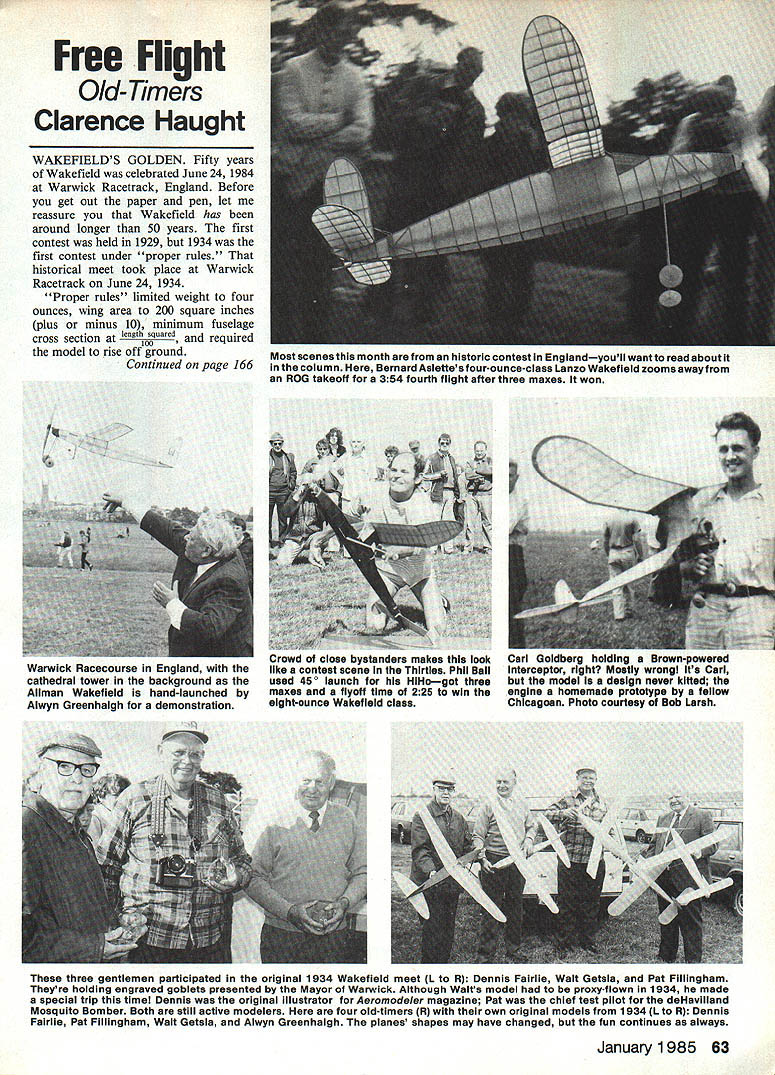
Fifty years of Wakefield was celebrated June 24, 1984 at Warwick Racetrack, England. Before you get out the paper and pen, let me reassure you that Wakefield has been around longer than 50 years. The first contest was held in 1929, but 1934 was the first contest under "proper rules." That historical meet took place at Warwick Racetrack on June 24, 1934.
"Proper rules" limited weight to four ounces, wing area to 200 square inches (plus or minus 10), minimum fuselage cross section at 1/100 of the square of the length, and required the model to rise off the ground.
The decision to hold this historic event at the original venue, even though the surrounding terrain is not overly friendly to model airplanes any more, added considerable nostalgic value. According to three of the original 1934 contestants, Dennis Fairlie, Walt Getsla, and Pat Fillingham, even the weather was similar: a little drizzle and gusting wind. Walt was unable to compete in 1934, his model being proxy-flown, but he made the trip in person in 1984.
Four countries entered the 1934 competition:
- Australia
- Britain
- France
- United States
Unfortunately, the Australian models failed to arrive in time for the contest. The British team of six was selected from 46 entries between noon and 4:00 p.m., when official competition began. Of 15 fliers (six British, three French, and six American), 13 posted scores. The rules called for the average of three flights.
In 1984, two separate events were flown:
- Four-ounce models (per 1936 rules)
- Eight-ounce models (conforming to 1951 rules)
Four-ounce class (1984)
- 22 competitors entered; 3 posted official flights.
- Wind drift necessitated cutting the max score to 90 seconds.
- B. Aslett (flying a Lanz) and V. Dubery (with a Judd) each made the max; Aslett lost his model on the third flight, so a joint win was declared for Aslett and Dubery.
- E. Hapgood posted 259 seconds for third place using a Copeland.
- Of the 22 entries there were: Copelands, three Judges, three Gordon Lights, two Lanzos, and 11 individual entries.
Eight-ounce class (1984)
- 35 entries; 28 got on the scoreboard.
- Scoring models included Copelands, five Kordas, two Flying Minutes, two Clodboppers, two Gopsies, and various others.
- P. Ball won with a Hi Ho.
- P. Brown was second with his Copeland.
- R. Oldridge was third using a Krusader.
An overall fly-off saw B. Aslett make three minutes, 54 seconds with his reserve plane against P. Ball's two minutes, 25 seconds — a thrilling conclusion to an exciting contest!
Awards were presented by the Mayor of Warwick, and retired aviators were among the dignitaries in attendance. Sponsors SAM 35 provided a wonderful souvenir program containing nostalgic articles, a half-dozen plans, vintage Wakefield rules, and the results of the 1934 contest.
Fifty years of progress (experience) has seen many changes in Wakefield models. Rule changes have limited performance as technology improved, but keeping the equation balanced, dedication, perseverance and skill of the competitor have remained high throughout the years. We thank SAM 35 for providing this occasion.
Free Flight: Old-Timers
and a special "Thank you" to R. G. Moulton, Editorial Director of Aeromodeller Magazine for sharing the facts and photos for this report.
I received the following letter of interest from Bob Larsh of the Central Indiana Aeromodelers (CIA):
"Enclosed is an old picture of Carl Goldberg snapped at the 1939 Nationals in Detroit. Note that he holds a model rather suspiciously close to being a large version of his later-kitted A/B Interceptor. This snapshot was recently found in the photo album of a long-deceased, old-time modeler. I had a number of copies made.
"The engine, under magnifying glass, looks like a standard Brown Jr. But I think it is not. I confronted Carl at the '84 Toledo Trade Show with this picture. He was quite amazed to see it, but also recognized the model immediately. He said it was one of his experimental jobs of the period, and that he worked two years trying to develop it into a good competition machine but had nothing but problems and was never able to tame it. Carl said the engine was not a Brown but was a very powerful homebuilt motor made by a fellow in Chicago. Carl lamented that he had to return the engine, as it wasn't for sale. He also commented that he was able to determine the optimum design pylon height with this configuration, and that this particular model resembled the virtues of several modern Wakefield models. It should be noted that Carl was also flying a Class A Interceptor prototype at the '39 Nats which resembled the 1941 kit model very closely."
"I recently attended one of the CIA Old-Timers' meets at Wright Patterson AFB in Dayton, OH. They have access to a small, but adequate, flying site behind the Air Force Museum. The field is mowed for competition and is a fantastic place to fly, if you can get yourself away from the museum long enough to put in a few Old-Timer flights. I also had the pleasure of meeting some of the 'name brand' Old-Timers and visiting with relative Bill Haught. Old-Timers do come in small groups, but the quality is always high."
Clarence Haught 3226 Honeysuckle Coeur d'Alene, ID 83814
Transcribed from original scans by AI. Minor OCR errors may remain.

