
Free Flight: Old-Timers
Clarence Haught
A Classic
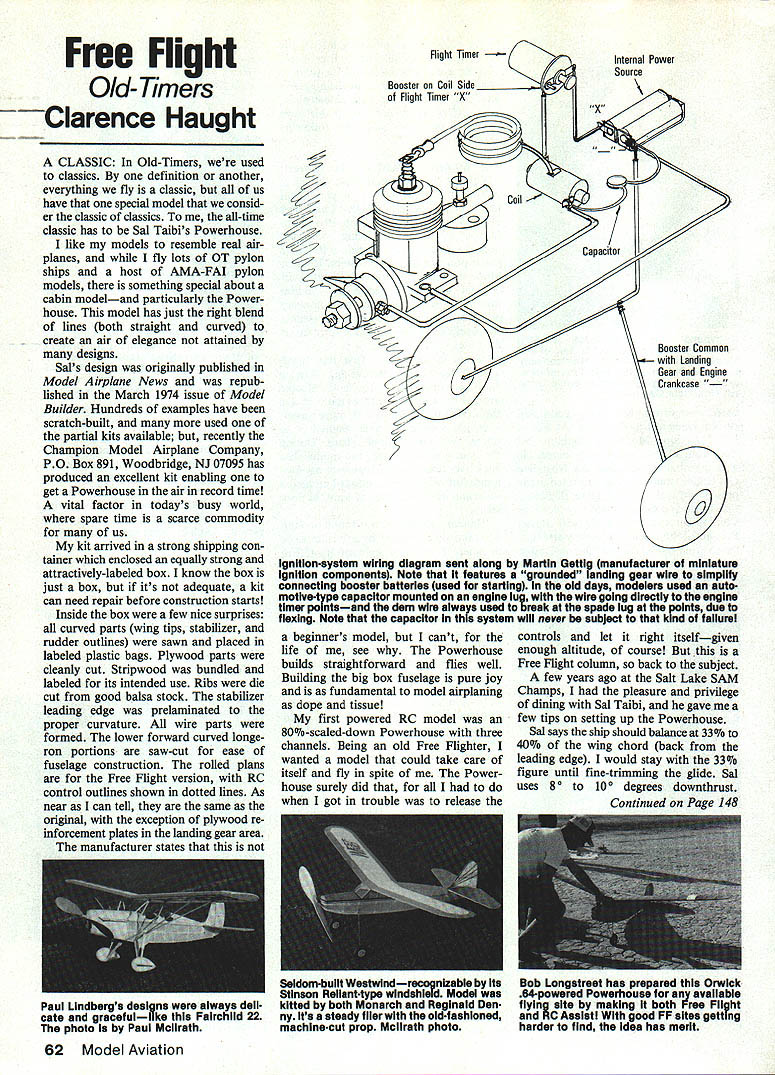
A CLASSIC: In Old-Timers, we're used to classics. By one definition or another, everything we fly is a classic, but all of us have that one special model that we consider the classic of classics. To me, the all-time classic has to be Sal Taibi's Powerhouse.
I like my models to resemble real airplanes, and while I fly lots of OT pylon ships and a host of AMA-FAI pylon models, there is something special about a cabin model—and particularly the Powerhouse. This model has just the right blend of lines (both straight and curved) to create an air of elegance not attained by many designs.
Sal's design was originally published in Model Airplane News and was republished in the March 1974 issue of Model Builder. Hundreds of examples have been scratch-built, and many more used one of the partial kits available, but recently the Champion Model Airplane Company, P.O. Box 891, Woodbridge, NJ 07095, has produced an excellent kit enabling one to get a Powerhouse in the air in record time — a vital factor in today's busy world, where spare time is scarce.
The Kit and Construction
My kit arrived in a strong shipping container which enclosed an equally strong and attractively labeled box. Inside the box were a few nice surprises: all curved parts (wing tips, stabilizer, and rudder outlines) were sawn and placed in labeled plastic bags. Plywood parts were cleanly cut. Stripwood was bundled and labeled for its intended use. Ribs were die-cut from good balsa stock. The stabilizer leading edge was pre-laminated to the proper curvature. All wire parts were formed. The lower forward curved longeron portions are saw-cut for ease of fuselage construction.
The rolled plans are for the Free Flight version, with RC control outlines shown in dotted lines. As near as I can tell, they are the same as the original, with the exception of plywood reinforcement plates in the landing gear area. The manufacturer states that this is not a beginner's model, but the Powerhouse builds straightforward and flies well. Building the big box fuselage is pure joy and is as fundamental to model airplaning as dope and tissue!
Personal Experience and Setup Tips
My first powered RC model was an 80%-scaled-down Powerhouse with three channels. Being an old Free Flighter, I wanted a model that could take care of itself and fly in spite of me. The Powerhouse surely did that: all I had to do when I got in trouble was release the controls and let it right itself—given enough altitude, of course!
A few years ago at the Salt Lake SAM Champs, I had the pleasure and privilege of dining with Sal Taibi, and he gave me a few tips on setting up the Powerhouse. Sal says the ship should balance at 33% to 40% of the wing chord (back from the leading edge). I would stay with the 33% figure until fine-trimming the glide. Sal uses 8° to 10° downthrust.
I know, for a fact, that certain phenomena have led some pilots to the incorrect belief that their ships didn't turn well outside. I know this because I've flown them with my handle setup, and they turned outside just fine.
Letter: Handle Design and Flying Style
Ted Fancher, 158 Flying Cloud Isle, Foster City, CA 94404
More controversial is whether or not a handle can be built with only the grip biased for a "natural" grip in a fashion similar to Bobby Hunt's inflight-adjustable handle of the late Seventies. I would give a qualified "yes," provided the designer is careful to ensure that the line-attach points are not only directly above one another at the "natural" position but also that they are equal distance above and below the median line at neutral.
At the risk of getting myself in trouble again, the only real good patterns I've seen flown with a biased-type handle were flown by Bobby Hunt, and Bobby's flamboyant flying style, with lots of arm and body input, was equally unique. Almost all the other exceptional fliers I've watched over the last 10 years flew with a style typified by a symmetrical handle held vertically between shoulder and eye height in level flight. Most maneuvering inputs were accomplished with hand and wrist inputs to the control handle rather than with flamboyant arm and body gestures.
Even Jimmy Casale, who is probably the most balletic of current fliers, uses his body movements primarily to position himself with the airplane. Almost all his actual control inputs come from the hand and wrist, plus his distinctive thumb-push on the top of his handle at each outside corner.
In summary, it would appear that the ideal handle for a given plane would be one that, at comfortable angles of hand and wrist motion, provides adequate line displacement to achieve full available control deflection. Control feel should be adjusted with overhang to allow control loads that can be overcome comfortably with hand and wrist motion without resorting to large arm gestures, yet forces should not be so light that the pilot has no feel of control inputs. Such a condition would make flight erratic and jumpy.
Lastly, the handle should be designed so that neutral control results in balanced up and down line forces with the airplane in stable level flight, ideally with the handle vertical.
One last piece of advice: if you design your own handle, include U-shaped projections above and below the hand grip and position them so that your index and little fingers contact them when the handle is gripped. In addition to ensuring the handle is always gripped in the same position, these projections allow minor trimming inputs to be made by little nudges from the fingers. I discovered their importance while beach flying: after several flights with a handle similar in every other respect to my Hot Rocky-type, I found myself unable to fly consistent shapes and bottoms. Upon reverting to my old handle, I was able to feel the little nudges and tweaks I was giving that I was unable to do with the other handle. I proceeded to add simple balsa arms to the offending handle (a Martine-built, Baron adjustable-type) and immediately fell in love with it. This is the same handle I have used since 1977.
I hope all this proves useful. Fly Stunt.
Powerplant, Thrust, and Glide Pattern
Remember, Sal uses a Forster .99, and less-powerful engines may struggle. On the subject of powerplants, this aircraft needs a strong .60–.80; .60 sideports have trouble lugging a Powerhouse upstairs. It will fly on smaller engines and can do quite well in Texaco-type fuel-allotment events where a shallow, cruising-type climb and fuel economy are desired.
The recommended 2° of left thrust helps establish the natural left climb of a cabin model. Sal offsets this with a rudder (not tab) offset of 1/8 in. for right turn. Thus, he climbs left and glides right. This is a safe and stable pattern for any OT cabin model.
Many fliers prefer to glide in the same direction as they climb, feeling that this aids in a smooth transition and reduces the possibility of flying out of a thermal (provided the model was launched into one). However, a left-left pattern usually requires wash-in in the left wing to hold that panel up during the climb (that panel is going through the air slower than the right one, thus it needs added incidence to generate more lift at lower airspeed) and to help establish the glide turn through increased drag. You would probably be better off following Sal's specifications and flying left climb, right glide.
Covering and Warps
Avoid warps during the covering phase of construction, particularly in the stabilizer, as this structure does not have built-in warp resistance. A model like the Powerhouse deserves to be covered in silk and, preferably, finished in nitrate dope, which has a little less tendency to pull in and show warps than butyrate.
Scaling and Engine Recommendations
Bill Baker, who writes an informative Old-Timer column in Free Flight (the publication of the National Free Flight Society), wrote briefly about the Powerhouse in the March 1983 issue. His discussion with Sal revealed that four-, five- and six-foot span versions were mentioned in the original MAN article and that various sizes had flown. This allows modelers with smaller engines or smaller cars to enjoy the design. SAM rules allow scaling original designs up or down for Old-Timers.
Recommended sizing and power:
- Six-foot span: about right for a sideport O&R .60 (or similar .60).
- Five-foot span: a good .29 will fly it.
- Four-foot span: could be powered with a .19–.23.
Landing Gear and Balance
One final advantage to the Powerhouse design is its forward-placed, prop-sitting landing gear — an important feature in the day of hand-carved props and larger-diameter propellers. That forward axle location is also handy for using heavier wheels to bring the balance point within limits. The long tail can get heavy!
Clarence Haught, 3226 Honeysuckle Dr., Coeur d'Alene, ID 83814
Transcribed from original scans by AI. Minor OCR errors may remain.

