
Free Flight: Old-Timers
By Clarence Haught
REAL Old-Timers fly twin-pushers! With all the emphasis on what “real” people do nowadays, I just couldn’t help myself. Actually, real Old-Timers did fly twin-pushers long before most other events emerged. Regardless of what events you may currently enjoy, you are missing a lot of nostalgic fun if you don’t try a twin-pusher.
The twin-pusher may not have been the first model airplane configuration, but it certainly played a major role in model airplane competitions. In fact, the type reached a high level of sophistication before it lost out to the more familiar tractor designs we are now accustomed to.
History and early design
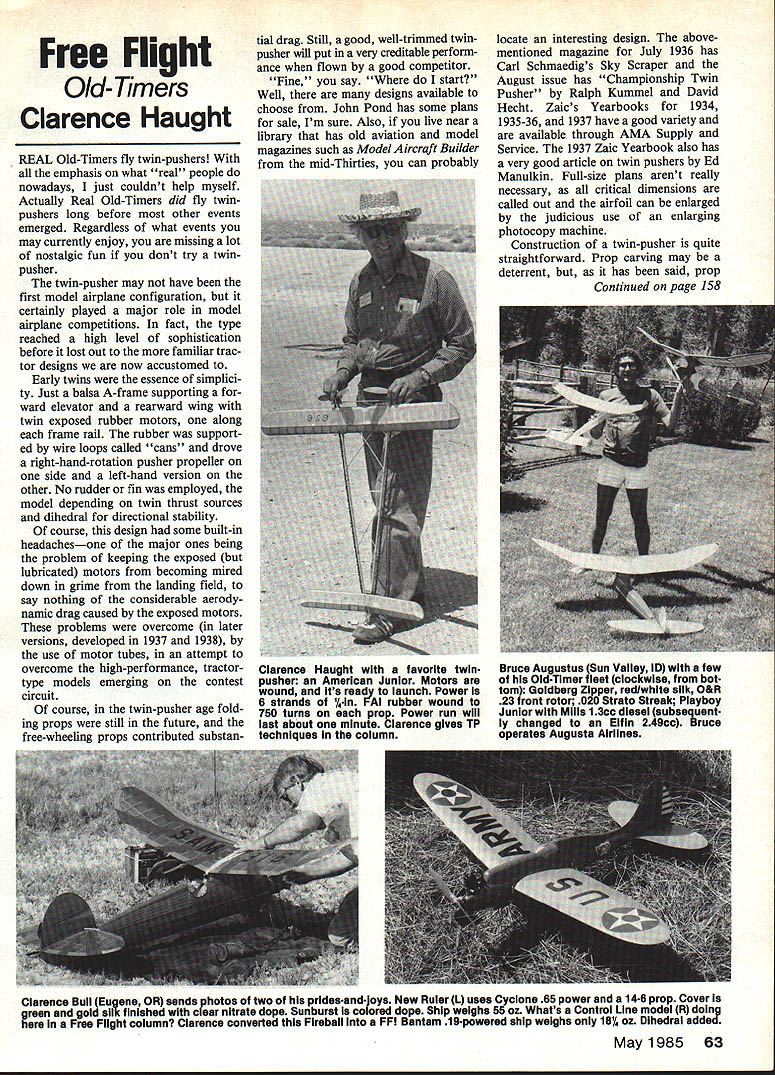
Early twins were the essence of simplicity: a balsa A-frame supporting a forward elevator and a rearward wing with twin exposed rubber motors, one along each frame rail. The rubber was supported by wire loops called “cans” and drove a right-hand-rotation pusher propeller on one side and a left-hand version on the other. No rudder or fin was employed; the model depended on twin thrust sources and dihedral for directional stability.
This design had some built-in headaches—one major one being the difficulty of keeping the exposed (but lubricated) motors from becoming mired in grime from the landing field, to say nothing of the considerable aerodynamic drag caused by the exposed motors. These problems were partly overcome in later versions (developed in 1937 and 1938) by the use of motor tubes, in an attempt to remain competitive with the high-performance tractor-type models emerging on the contest circuit.
Of course, in the twin-pusher age folding props were still in the future, and the free-wheeling props contributed substantial drag. Still, a good, well-trimmed twin-pusher will put in a very creditable performance when flown by a good competitor.
Where to start / Plans and references
There are many designs available to choose from. Sources include:
- Plans for sale from designers such as John Pond.
- Old aviation and modeling magazines (for example, Model Aircraft Builder from the mid-1930s).
- The July 1936 issue has Carl Schmaedig’s “Sky Scraper.”
- The August 1936 issue has “Championship Twin Pusher” by Ralph Kummel and David Hecht.
- Zaic’s Yearbooks for 1934, 1935–36, and 1937 (available through AMA Supply and Service). The 1937 Zaic Yearbook also has a very good article on twin pushers by Ed Manulkin.
Full-size plans aren’t really necessary, as all critical dimensions are usually called out and the airfoil can be enlarged by the judicious use of an enlarging photocopy machine.
Construction
Construction of a twin-pusher is quite straightforward. Prop carving may be a deterrent, but, as it has been said, prop carving builds character (as well as a pile of balsa chips). Most plans give prop blank dimensions; if this layout is followed, a prop of the desired 1½-to-1 pitch/diameter ratio will result. (That simply means the pitch will be 1½ times the diameter, so a 12‑in. prop would have an 18‑in. pitch.)
Be sure to carve one right-hand and one left-hand propeller. Pusher props are just regular propellers driven from the front. Proper rotation is determined when viewed from the rear of the model (looking forward): the vertical prop blades should rotate away from each other.
Propeller and free-wheeling tips
- Ensure the free-wheeling device is simple and reliable. The system used on light-sheet balsa “skeeter”-type flying models sold in variety stores is a good one and easy to duplicate.
- A common method is to use a piece of brass tube with a notch for a pawl; secure it to the back of the prop hub. This arrangement takes some practice to make and tune.
- Support the prop shaft at two points to eliminate wobble.
Motors and winding
Power was usually specified as ten strands of 1/8‑in. brown rubber. Brown rubber is no longer available, but modern rubber of similar size is a good place to start. I often substitute six strands (three loops) of 1/8‑in. rubber with good results.
- Rubber motors on twin-pushers are rigged with no slack. Some slack is needed for the free-wheeling system to work, but stretch from the first winding will usually provide this.
- The motor should fit with no droop between the cans.
- Motors are wound in opposite directions (easily determined by checking prop rotation).
- Early-day modelers often modified egg beaters to drive both motors simultaneously and evenly, but they can be wound separately with a single winder; you will need a helper if winding one at a time.
- Be sure to wind both motors equally.
Preflight, trimming and glide
Before flight, check the flying surfaces for alignment, warps, and incidence. Incidence is usually:
- Wing: 1° negative
- Elevator (stabilizer): 3° positive
Hand-glide the model without motors and props and adjust the glide:
- Shift the wing forward to correct for diving.
- Move the elevator aft to correct for stalling.
A fast, flat glide is desired.
Flying and launch procedure
The first flight should be at low power (200–300 turns). To launch:
- Hold the model by the wound props at the hub.
- Give it a gentle push away from you at a low (but positive) angle of attack while releasing the props.
The model should climb in a spiral. Either turn direction is fine; trim for the model’s natural turn direction. To increase the turn, wash in the elevator on the side away from the desired turn direction. If all is well, gradually increase power in successive flights. With six strands of 1/8‑in. rubber I usually quit at about 600 to 750 turns.
Glides are relatively fast due to all the drag, but if stalling in the glide is evident, experiment with the basic incidences given above. If the model refuses to turn, it probably has too much dihedral. An old rule of thumb is:
- One inch of dihedral per foot of wingspan (per side).
- One and one-third inches per foot of elevator span (per side).
Competitions
Competitions for twin-pushers are not widespread. However, informal competitions are available wherever two or more such models meet. Today’s competitions are duration events, but at one time speed and distance events were held. The type can be trimmed for straightaway flight, so speed and distance are measurable and comparable.
The annual Society of Antique Models (SAM) Championships include an event for twin-pushers. This is typically a one-flight duration contest and is often flown as a mass launch. Last one down wins, although this can sometimes be difficult to determine unless individual timers are assigned to each model. The practice of using a panel of visual judges is sometimes ineffective, due to various flight patterns flown.
Welcome to the world of twins!
Clarence Haught 3226 Honeysuckle Dr. Coeur d'Alene, ID 83814
Transcribed from original scans by AI. Minor OCR errors may remain.

