
Free Flight: Old-Timers
Clarence Haught
Field Boxes
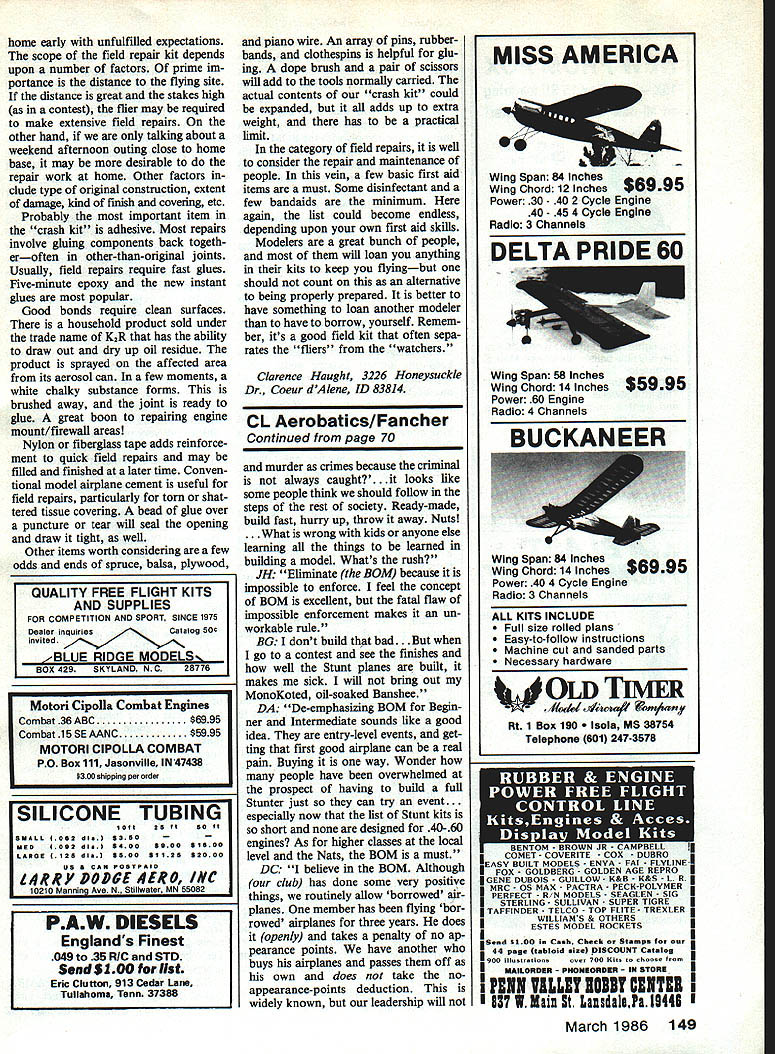
Field boxes come in all sizes and descriptions: shoe boxes, cigar boxes, cardboard boxes, kitchen baskets, modified or adapted fishing tackle boxes, tool boxes, styrofoam coolers — the list is endless. They range from the ultra-simple to the ultimate "field shops." I've seen field boxes so large they had wheels. One such box seen at the U.S. Free Flight Championships at Taft had a bicycle wheel and two handles just like a wheelbarrow! Card tables, picnic tables, and folding camp stools are even pressed into service as field kits.
The industry has responded with a good selection of specialty field boxes both assembled and in kit form which span the spectrum from simple tote-tray-type boxes to elaborate "field houses" with parts drawers, work tables, and model holders built in.
Field Kit Functions
Three main functions
- Flight support
- Field maintenance
- Field repair
Flight Support
Flight support includes all items necessary for getting into the air. This not only includes "fire and fuel" for power models or launching equipment for gliders or rubber models, but simple field assembly items like rubber bands, DT fuses, and the required tools to get the model airworthy.
Many modelers employ electric starters. These starters require an adequate battery; most people use a motorcycle battery. Fuel, a necessary evil, must also be included in the flight support system. Fuel in metal containers is bad news around any electrical spark hazard. Recent reports of a fuel-can fire ignited by a starting battery graphically illustrate the need for an electrically nonconducting fuel can. Plastic fuel bottles are the answer. Fuel pumps, both powered and hand-operated, are popular accessories. Fuel pumps are awkward for priming engines, hence a priming bottle or hand fuel-bulb is required.
Electric starters and fuel pumps bring about a need for a power-distribution system within the field kit. Several commercial units also provide 1½ to 2 volts for glow plug operation. Not only do these power panels eliminate clutter and provide efficiency, they also create an air of professionalism. Of course, many modelers use the time-honored 1½‑volt dry cells in either the round or square configuration. Carrying a spare set of battery leads (complete with terminals) is good insurance against the day the battery leads break from excessive flexing or fuel contamination.
No flight support system is complete without one or two of the protective engine-starting aids commonly referred to as "chicken sticks." A flooded engine can backfire viciously, inflicting serious injury to anything in the prop's arc.
Field Maintenance
The field maintenance portion of the field box should include any anticipated spare parts. High on this list are propellers. Take several of the size commonly used plus a couple more of sizes on either side of the usual for experimental purposes. Flight performance is often enhanced by changing to a different-size propeller.
Next in popularity is a supply of extra spark or glow plugs held in a handy plug holder or a clean plastic box. Did you know that fuel system and needle-setting problems can be isolated from ignition problems by running the ignition engine on a glow plug? Gas-and-oil fuel mixtures will run on glow as long as the battery is hooked up to the glow plug.
Fuel line and filters may become unserviceable, so it is wise to have some extra on hand — again in a clean container isolating the new parts from the dust and grit of the flight line. An assortment of machine screws, nuts, washers, metal screws, lock washers, etc., should be included. Many is the time an elusive nut or screw has disappeared forever to the detriment of the airworthiness of the model. Don't let this happen to you or your friends! Spare wheels and collars, while not common in many field kits, are well worth carrying. A lost wheel ends the day's flying. Of course, spare flight batteries are a must.
Suggested spare parts:
- Propellers (several of the common size plus adjacent sizes)
- Extra spark or glow plugs (in a holder or clean box)
- Fuel line and filters
- Assorted machine screws, nuts, washers, lock washers
- Spare wheels and collars
- Spare flight batteries
Tools
Obviously, before the aforementioned parts can be of any value on the field, the kit must also include the appropriate tools to facilitate their use.
Essentials:
- Prop and glow plug wrenches
- Assortment of standard screwdrivers and Phillips screwdrivers
- Long-nose pliers and wire cutters
- Modeling knife
- Correct-size Allen wrench(es) if using Allen-head bolts
Nice-to-have:
- Tweezers
- Hemostats (surgical locking "pliers" available from medical supply houses)
- Scissors
Field Repair
Field repair is a subject most of us would rather not think about. It is a reality that must be faced or we will return home early with unfulfilled expectations. The scope of the field repair kit depends upon a number of factors. Of prime importance is the distance to the flying site. If the distance is great and the stakes high (as in a contest), the flier may be required to make extensive field repairs. On the other hand, if we are only talking about a weekend afternoon or a site close to home base, it may be more desirable to do the repair work at home. Other factors include type of original construction, extent of damage, kind of finish and covering, etc.
Probably the most important item in the "crash kit" is adhesive. Most repairs involve gluing components back together — often in other-than-original joints. Usually, field repairs require fast glues. Five-minute epoxy and the new instant glues are most popular.
Good bonds require clean surfaces. There is a household product sold under the trade name K & R that has the ability to draw out and dry up oil residue. The product is sprayed on the affected area from its aerosol can. In a few moments a white chalky substance forms; this is brushed away, and the joint is ready to glue. A great boon to repairing engine mount/firewall areas!
Nylon or fiberglass tape adds reinforcement to quick field repairs and may be filled and finished at a later time. Conventional model airplane cement is useful for field repairs, particularly for torn or shattered tissue covering. A bead of glue over a puncture or tear will seal the opening and draw it tight.
Other useful crash-kit items:
- Small stock of spruce, balsa, and plywood
- Piano wire
- Pins, rubber bands, and clothespins (for gluing)
- Dope brush
- Scissors
Keep in mind that the contents of a crash kit can be expanded indefinitely, but every added item increases weight and there must be a practical limit.
First Aid (Repair and Maintenance of People)
It is well to consider the repair and maintenance of people. A few basic first aid items are a must. Some disinfectant and a few Band-Aids are the minimum. Here again, the list could become endless depending upon your own first aid skills.
Modelers are a great bunch of people, and most of them will loan you anything in their kits to keep you flying — but one should not count on this as an alternative to being properly prepared. It is better to have something to borrow from another modeler than to have to borrow yourself. Remember, it's a good field kit that often separates the "fliers" from the "watchers."
Clarence Haught 3226 Honeysuckle Dr. Coeur d'Alene, ID 83814
Transcribed from original scans by AI. Minor OCR errors may remain.

