
Free Flight: Old-Timers
Clarence Haught
THE WINNING SYNDROME: When the Old-Timer movement began, its major thrust was nostalgia, low pressure, comradeship and, most of all, fun. To a great extent these factors are still present. However, people being what they are competitive by nature. Competition to some degree is basic to living, be it children at play, shopping for bargains, or performance on the job. Competition flying dominates the AMA free-flight events. Sport flying is rare and usually boils down to competition preparation and training or trimming sessions in anticipation of an upcoming contest.
Be it good or bad this competitive urge is infiltrating the Old-Timer movement. Modelers who once chose, as their next project, a model which appealed to their personal tastes are now looking at consistent winners. I receive numerous newsletters from across the country and many publish contest results showing the winning airplane-engine combinations.
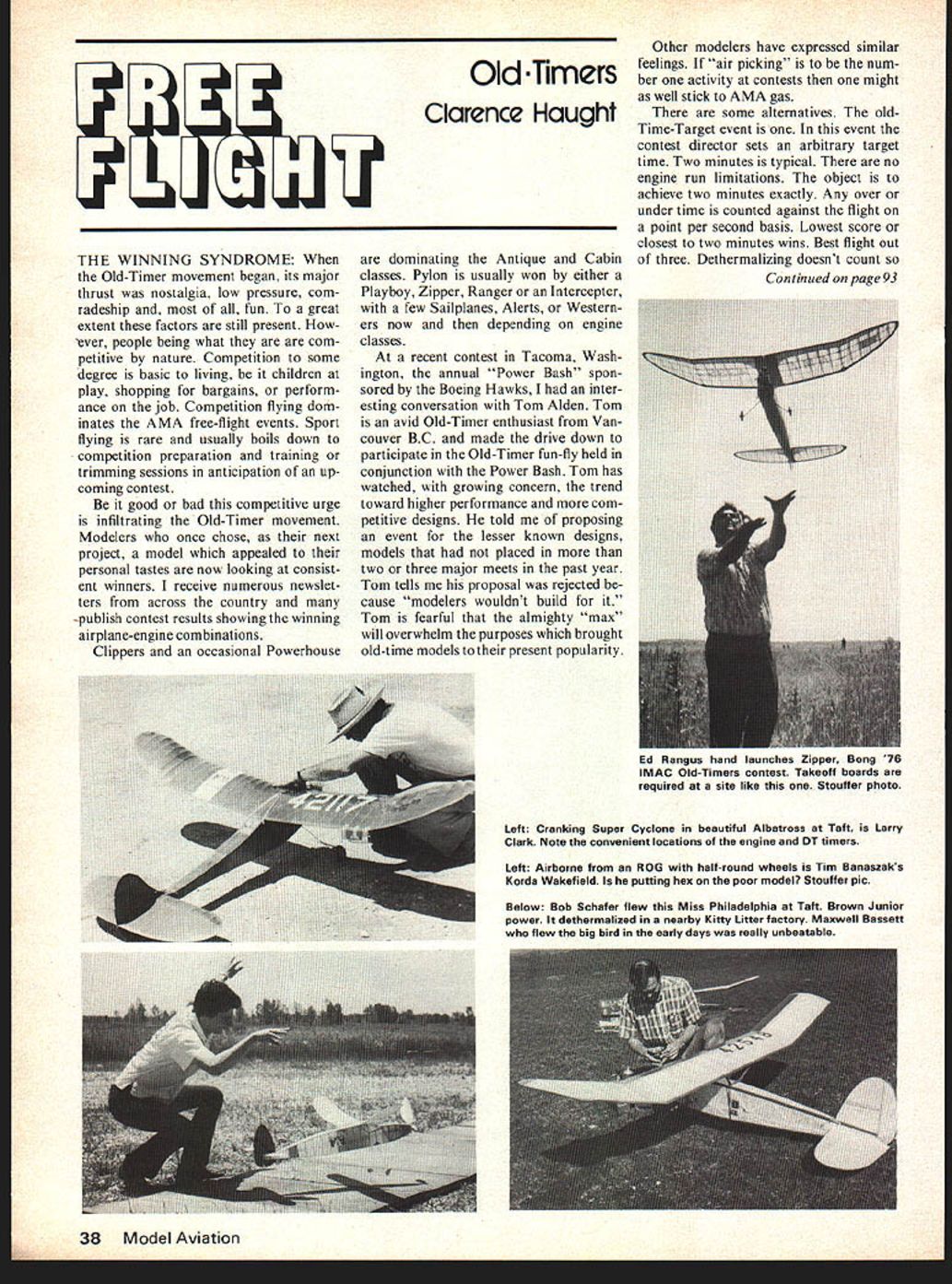
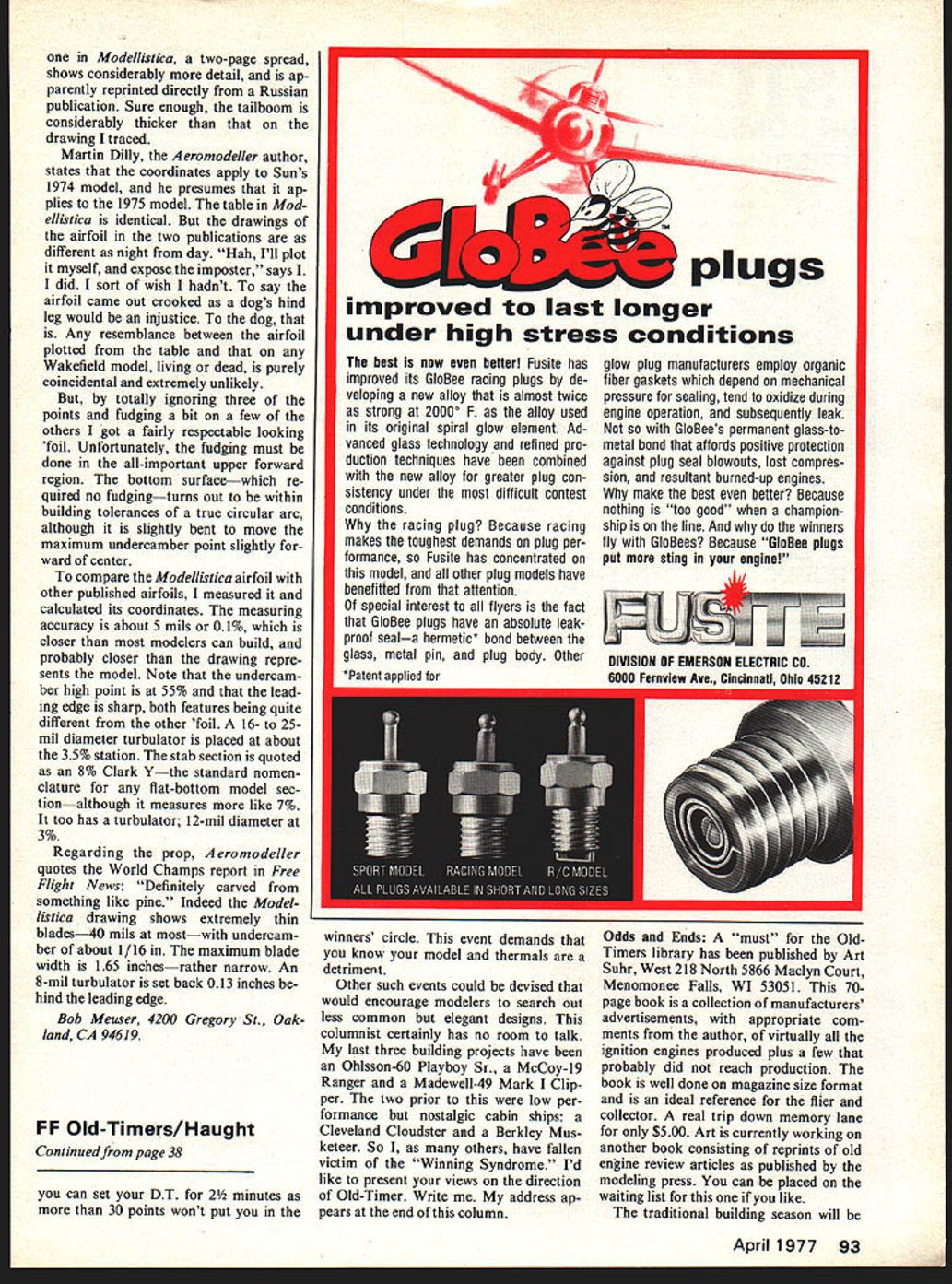
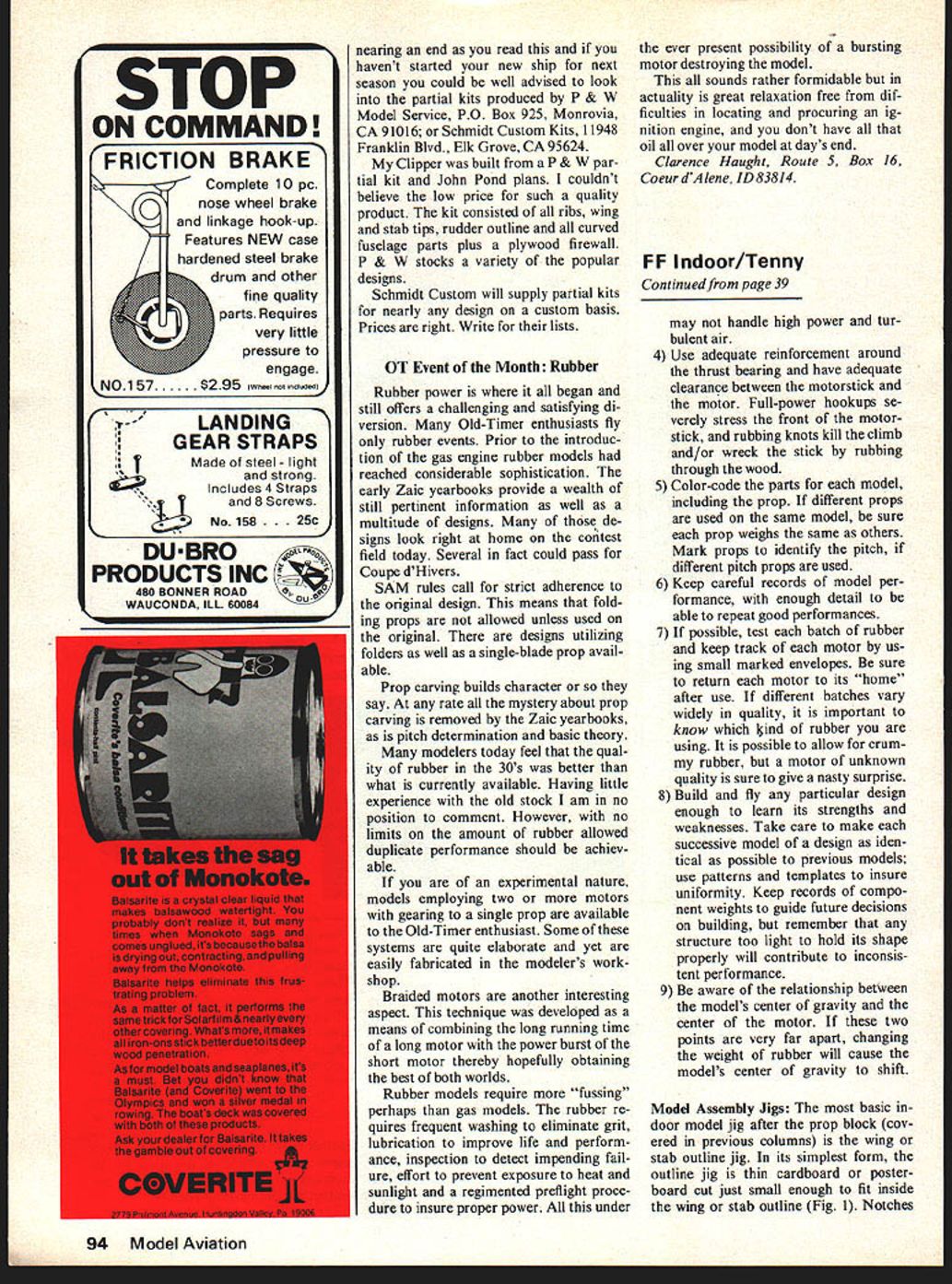
Clippers and an occasional Powerhouse are dominating the Antique and Cabin classes. Pylon is usually won by either a Playboy, Zipper, Ranger or an Intercepter, with a few Sailplanes, Alerts, or Westerners now and then depending on engine classes.
At a recent contest in Tacoma, Washington, the annual "Power Bash" sponsored by the Boeing Hawks, I had an interesting conversation with Tom Alden. Tom is an avid Old-Timer enthusiast from Vancouver, B.C., and made the drive down to participate in the Old-Timer fun-fly held in conjunction with the Power Bash. Tom has watched, with growing concern, the trend toward higher performance and more competitive designs. He told me of proposing an event for the lesser known designs, models that had not placed in more than two or three major meets in the past year. Tom tells me his proposal was rejected because "modelers wouldn't build for it." Tom is fearful that the almighty "max" will overwhelm the purposes which brought old-time models to their present popularity.
Other modelers have expressed similar feelings. If "air picking" is to be the number one activity at contests then one might as well stick to AMA gas.
There are some alternatives. The Old-Time-Target event is one. In this event the contest director sets an arbitrary target time. Two minutes is typical. There are no engine run limitations. The object is to achieve two minutes exactly. Any over or under time is counted against the flight on a point per second basis. Lowest score or closest to two minutes wins. Best flight out of three. Dethermalizing doesn't count. you can set your D.T. for 2½ minutes as more than 30 points won't put you in the winners' circle. This event demands that you know your model and thermals are a detriment.
Other such events could be devised that would encourage modelers to search out less common but elegant designs. This columnist certainly has no room to talk. My last three building projects have been an Ohlsson-60 Playboy Sr., a McCoy-19 Ranger and a Madewell-49 Mark I Clipper. The two prior to this were low performance but nostalgic cabin ships: a Cleveland Cloudster and a Berkley Musketeer. So I, as many others, have fallen victim of the "Winning Syndrome." I'd like to present your views on the direction of Old-Timer. Write me. My address appears at the end of this column.
Odds and Ends:
A "must" for the Old-Timers library has been published by Art Suhr, West 218 North 5866 Maclyn Court, Menomonee Falls, WI 53051. This 70-page book is a collection of manufacturers' advertisements, with appropriate comments from the author, of virtually all the ignition engines produced plus a few that probably did not reach production. The book is well done on magazine size format and is an ideal reference for the flier and collector. A real trip down memory lane for only $5.00. Art is currently working on another book consisting of reprints of old engine review articles as published by the modeling press. You can be placed on the waiting list for this one if you like.
The traditional building season will be nearing an end as you read this and if you haven't started your new ship for next season you could be well advised to look into the partial kits produced by P & W Model Service, P.O. Box 925, Monrovia, CA 91016; or Schmidt Custom Kits, 11948 Franklin Blvd., Elk Grove, CA 95624.
My Clipper was built from a P & W partial kit and John Pond plans. I couldn't believe the low price for such a quality product. The kit consisted of all ribs, wing and stab tips, rudder outline and all curved fuselage parts plus a plywood firewall. P & W stocks a variety of the popular designs.
Schmidt Custom will supply partial kits for nearly any design on a custom basis. Prices are right. Write for their lists.
OT Event of the Month: Rubber
Rubber power is where it all began and still offers a challenging and satisfying diversion. Many Old-Timer enthusiasts fly only rubber events. Prior to the introduction of the gas engine rubber models had reached considerable sophistication. The early Zaic yearbooks provide a wealth of still pertinent information as well as a multitude of designs. Many of those designs look right at home on the contest field today. Several in fact could pass for Coupe d'Hivers.
SAM rules call for strict adherence to the original design. This means that folding props are not allowed unless used on the original. There are designs utilizing folders as well as a single-blade prop available.
Prop carving builds character or so they say. At any rate all the mystery about prop carving is removed by the Zaic yearbooks, as is pitch determination and basic theory.
Many modelers today feel that the quality of rubber in the 30's was better than what is currently available. Having little experience with the old stock I am in no position to comment. However, with no limits on the amount of rubber allowed duplicate performance should be achievable.
If you are of an experimental nature, models employing two or more motors with gearing to a single prop are available to the Old-Timer enthusiast. Some of these systems are quite elaborate and yet are easily fabricated in the modeler's workshop.
Braided motors are another interesting aspect. This technique was developed as a means of combining the long running time of a long motor with the power burst of the short motor thereby hopefully obtaining the best of both worlds.
Rubber models require more "fussing" perhaps than gas models. The rubber requires frequent washing to eliminate grit, lubrication to improve life and performance, inspection to detect impending failure, effort to prevent exposure to heat and sunlight and a regimented preflight procedure to insure proper power. All this under the ever present possibility of a bursting motor destroying the model.
This all sounds rather formidable but in actuality is great relaxation free from difficulties in locating and procuring an ignition engine, and you don't have all that oil all over your model at day's end.
Clarence Haught, Route 5, Box 16, Coeur d'Alene, ID 83814.
Transcribed from original scans by AI. Minor OCR errors may remain.

