
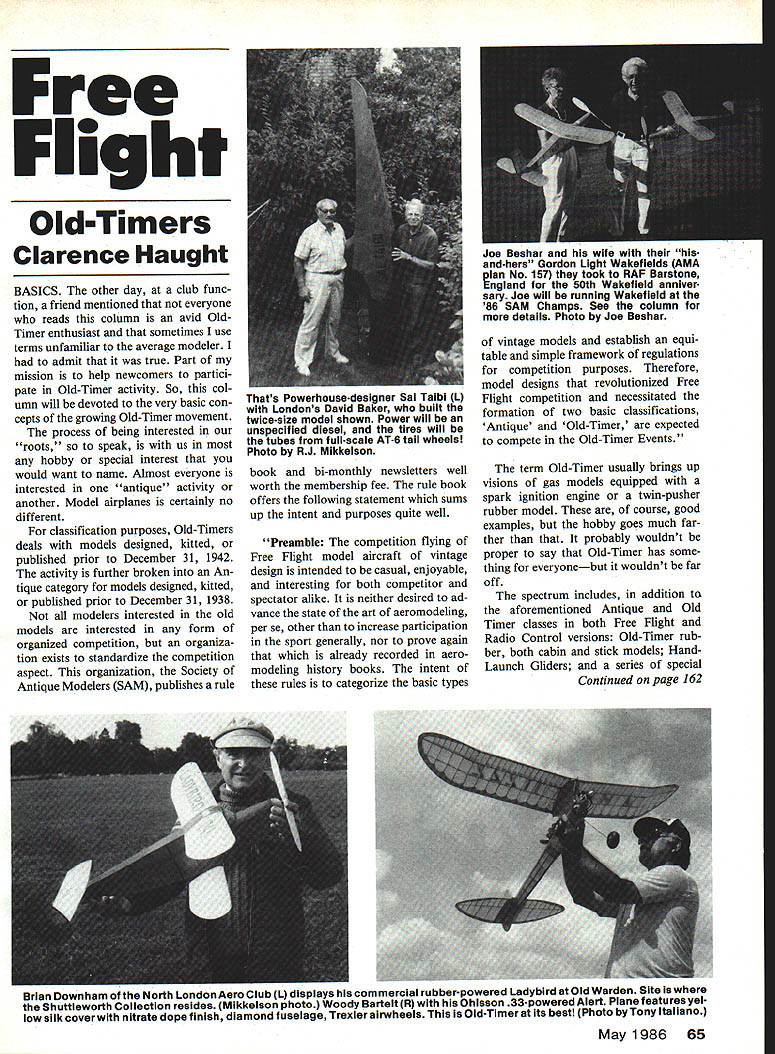
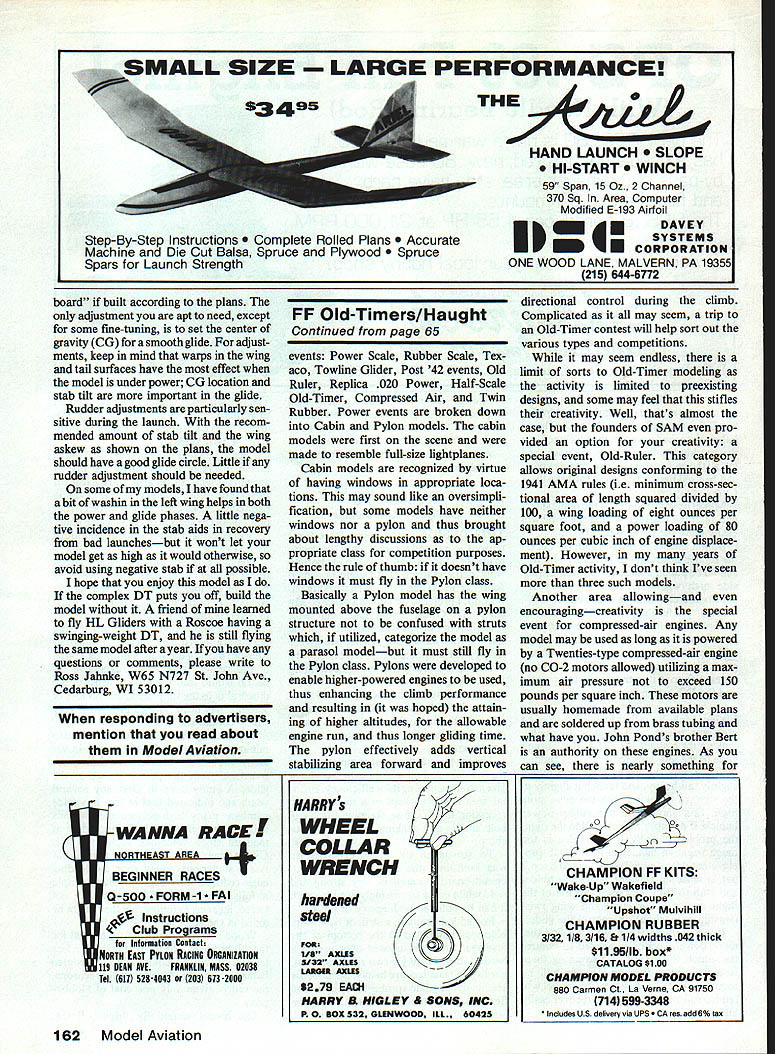
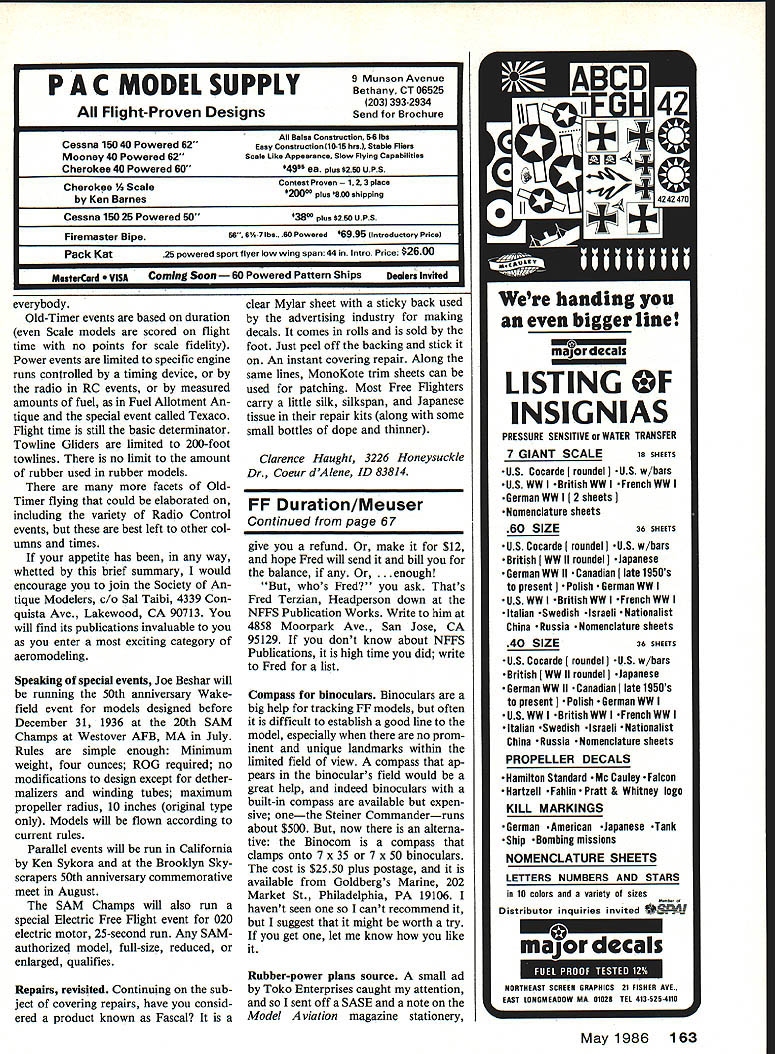
Free Flight: Old-Timers
Clarence Haught
Basics
The other day, at a club function, a friend mentioned that not everyone who reads this column is an avid Old-Timer enthusiast and that sometimes I use terms unfamiliar to the average modeler. I had to admit that it was true. Part of my mission is to help newcomers participate in Old-Timer activity. This column will be devoted to the very basic concepts of the growing Old-Timer movement.
Interest in our "roots," so to speak, exists in most hobbies and special interests. Almost everyone is interested in one "antique" activity or another. Model airplanes are no different.
For classification purposes, Old-Timers covers models designed, kitted, or published prior to December 31, 1942. The activity is further broken into an Antique category for models designed, kitted, or published prior to December 31, 1938.
Not all modelers interested in the old designs pursue organized competition, but an organization exists to standardize the competitive aspect. The Society of Antique Modelers (SAM) publishes a rule book and bi-monthly newsletters well worth the membership fee. The rule book offers the following statement which sums up the intent and purposes quite well:
"Preamble: The competition flying of Free Flight model aircraft of vintage design is intended to be casual, enjoyable, and interesting for both competitor and spectator alike. It is neither desired to advance the state of the art of aeromodeling, per se, nor to increase participation in the sport generally, nor to prove again that which is already recorded in aeromodeling history books. The intent of these rules is to categorize the basic types of vintage models and establish an equitable and simple framework of regulations for competition purposes."
Therefore, model designs that revolutionized Free Flight competition and necessitated the formation of the two basic classifications, Antique and Old-Timer, are expected to compete in Old-Timer events.
The term Old-Timer usually brings up visions of gas models equipped with spark ignition engines or twin-pusher rubber models. These are good examples, but the hobby goes much farther. It probably wouldn't be proper to say Old-Timers has something for everyone — but it wouldn't be far off.
Classes and events
The spectrum of Old-Timer activity includes, in addition to Antique and Old-Timer classes in both Free Flight and Radio Control versions:
- Old-Timer rubber (cabin and stick models)
- Hand-launch gliders
- Power Scale and Rubber Scale
- Texaco
- Towline glider
- Post-'42 events
- Old-Ruler (special event)
- Replica .020 Power
- Half-Scale Old-Timer
- Compressed air
- Twin rubber
Power events are broken down into Cabin and Pylon models. Cabin models were first on the scene and were made to resemble full-size lightplanes. Cabin models are recognized by having windows in appropriate locations. This may sound like an oversimplification, but some models have neither windows nor a pylon, which has led to lengthy discussions about the appropriate competition class. Hence the rule of thumb: if it doesn't have windows it must fly in the Pylon class.
A Pylon model has the wing mounted above the fuselage on a pylon structure (not to be confused with struts, which, if used, categorize the model as a parasol model — but it must still fly in the Pylon class). Pylons were developed to enable higher-powered engines to be used, thus enhancing climb performance and (it was hoped) attaining higher altitudes during the allowable engine run and therefore longer gliding time. The pylon also adds vertical stabilizing area forward and improves directional control during the climb.
While it may seem endless, Old-Timer modeling has limits because the activity is restricted to preexisting designs. Some may feel this stifles creativity. The founders of SAM provided an option: the Old-Ruler special event. This category allows original designs conforming to the 1941 AMA rules (minimum cross-sectional area of 10 square inches, wing loading of 8 ounces per square foot, and power loading of 80 ounces per cubic inch of engine displacement). In my many years of Old-Timer activity, I haven't seen more than three such models.
Another area encouraging creativity is the compressed-air special event. Any model may be used as long as it is powered by a Twenties-type compressed-air engine (no CO2 motors allowed), using a maximum air pressure not to exceed 150 pounds per square inch. These motors are usually homemade from available plans and soldered from brass tubing and similar materials. John Pond's brother Bert is an authority on these engines.
Old-Timer events are based on duration (even Scale models are scored on flight time with no points for scale fidelity). Power events are limited to specific engine runs controlled by a timing device, or by the radio in RC events, or by measured amounts of fuel, as in Fuel Allotment Antique and the Texaco special event. Flight time is still the basic determinant.
Additional rules and limits:
- Towline gliders are limited to 200-foot towlines.
- There is no limit to the amount of rubber used in rubber models.
- Power events may specify engine-run times or fuel allotments.
- Scale events are scored on flight time, not scale fidelity.
There are many more facets to Old-Timer flying, including a variety of Radio Control events, but those are best left to other columns and times.
Special events and upcoming meets
If your appetite has been whetted by this summary, consider joining the Society of Antique Modelers. Contact: Sal Taibi, 4339 Conquista Ave., Lakewood, CA 90713. SAM publications are invaluable as you enter this exciting category of aeromodeling.
Speaking of special events, Joe Beshar will run the 50th-anniversary Wakefield event for models designed before December 31, 1936, at the 20th SAM Champs at Westover AFB, MA in July. Rules are simple:
- Minimum weight: 4 ounces
- ROG (rise off ground) required
- No modifications to the design except for dethermalizers and winding tubes
- Maximum propeller radius: 10 inches (original type only)
- Models will be flown according to current rules
Parallel events will be run in California by Ken Sykora and at the Brooklyn Skyscrapers 50th-anniversary commemorative meet in August.
The SAM Champs will also run a special Electric Free Flight event for .020 electric motors, 25-second run. Any SAM-authorized model, full-size, reduced or enlarged, qualifies.
Repairs, revisited
Continuing on the subject of covering repairs: have you considered a product known as Fascal? It is a clear Mylar sheet with a sticky back used by the advertising industry for making decals. It comes in rolls and is sold by the foot. Just peel off the backing and stick it on—an instant covering repair.
Along the same lines, Monokote trim sheets can be used for patching. Most Free Fighters carry a little silk, silkspan, and Japanese tissue in their repair kits, along with small bottles of dope and thinner.
Clarence Haught 3226 Honeysuckle Dr. Coeur d'Alene, ID 83814
Transcribed from original scans by AI. Minor OCR errors may remain.

