
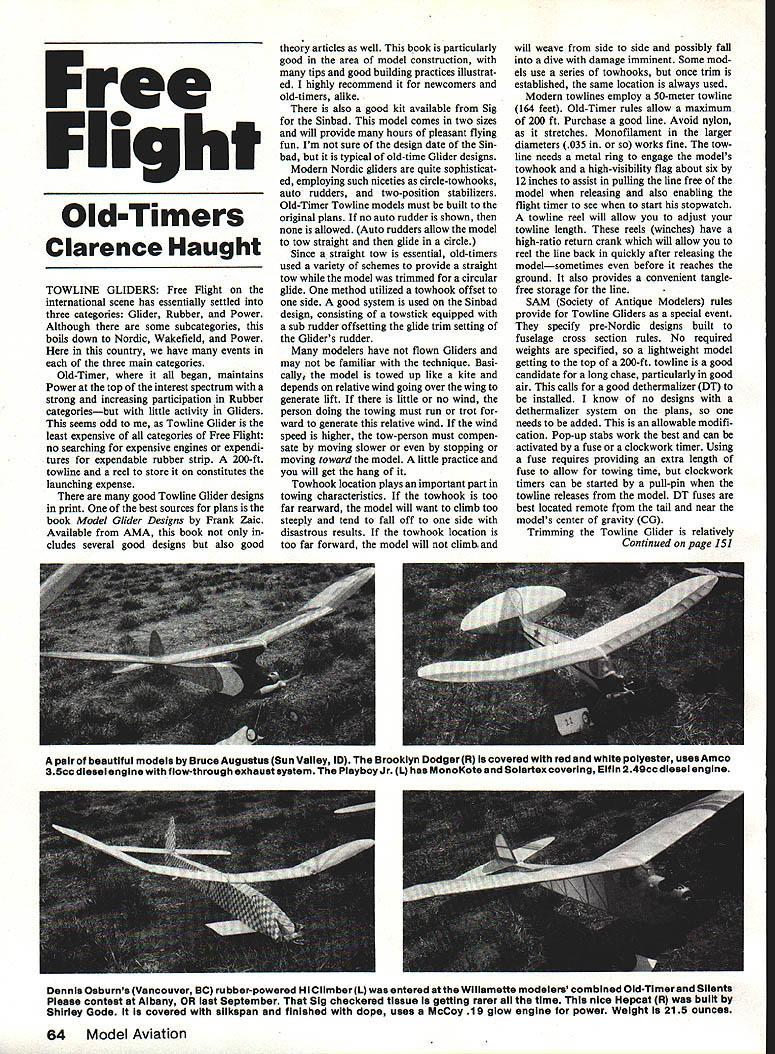
Free Flight: Old-Timers
Clarence Haught
Towline Gliders
Free Flight on the international scene has essentially settled into three categories: glider, rubber, and power. Although there are some subcategories, this boils down to Nordic (gliders), Wakefield (rubber), and power. Here in this country we have many events in each of the three main categories.
Old-Timer, where it all began, maintains power at the top of the interest spectrum with strong and increasing participation in rubber categories — but with little activity in gliders. This seems odd to me, as towline glider is the least expensive of all Free Flight categories: no searching for expensive engines or expenditures for expendable rubber strip. A 200-ft towline and a reel to store it on constitute the launching expense.
Sources and designs
There are many good towline glider designs in print. One of the best sources for plans is the book Model Glider Designs by Frank Zaic, available from AMA. This book not only includes several good designs but also useful theory articles. It is particularly strong in the area of model construction, with many tips and good building practices illustrated. I highly recommend it for newcomers and old-timers alike.
There is also a good kit available from Sig for the Sinbad. This model comes in two sizes and will provide many hours of pleasant flying fun. I’m not sure of the design date of the Sinbad, but it is typical of old-time glider designs.
Modern Nordic gliders are quite sophisticated, employing niceties such as circle tow hooks, auto-rudders, and two-position stabilizers. Old-Timer towline models must be built to the original plans. If no auto-rudder is shown, then none is allowed. (Auto-rudders allow the model to tow straight and then glide in a circle.)
Tow-hook and trim considerations
Since a straight tow is essential, old-timers used a variety of schemes to provide a straight tow while the model was trimmed for a circular glide. One method used an offset tow hook. A good system is used on the Sinbad design, consisting of a towstick equipped with a sub-rudder offsetting the glide-trim setting of the glider’s rudder.
Many modelers have not flown gliders and may not be familiar with the technique. Basically, the model is towed up like a kite and depends on relative wind over the wing to generate lift. If there is little or no wind, the person doing the towing must run or trot forward to generate this relative wind. If the wind speed is higher, the tow person must compensate by moving slower or even by stopping or by moving toward the model. A little practice and you will get the hang of it.
Tow-hook location plays an important part in towing characteristics:
- If the tow hook is too far rearward, the model will want to climb too steeply and tend to fall off to one side.
- If the tow hook is too far forward, the model will not climb and will weave from side to side and possibly fall into a dive.
- Some models use a series of tow hooks, but once trim is established the same location is always used.
A wide glide circle is ideal because the model must compensate for glide-turn trim.
Towline and equipment
Modern towlines employ a 50-meter towline (about 164 ft). Old-Timer rules allow a maximum of 200 ft. Purchase a good line and avoid nylon — it stretches. Monofilament in the larger diameters (about .035 in.) works fine.
Essential items:
- A metal ring to engage the model’s tow hook.
- A high-visibility flag about 6 to 12 inches long to assist in pulling the line free of the model when releasing and to enable the flight timer to see the start.
- A towline reel (winch) with a high-ratio return crank to reel line back quickly after releasing the model and to provide convenient, tangle-free storage.
SAM rules and dethermalizers
SAM (Society of Antique Modelers) rules provide for towline gliders as a special event. They specify pre-Nordic designs built to full-scale plans. No required weights are specified — lightweight models tend to do best. A 200-ft towline is a good candidate for a long chase, particularly in good air.
This calls for a good dethermalizer (DT) to be installed. I know of no designs with a dethermalizer system on the plans, so one needs to be added. This is an allowable modification. Pop-up stabs work best and can be activated by a fuse or a clockwork timer. Using a fuse requires providing an extra length of fuse to allow for towing time, but clockwork timers can be started by a pull-pin when releasing the towline. DT fuses are best located away from the tail near the model’s center of gravity (CG).
Trimming
Trimming the towline glider is relatively easy. Check for proper CG location and proceed with hand gliding. Trim for a gentle glider with no stall and with a built-in 200-ft glide circle. Remember your tow-hook offset or tow start. The model will have to compensate for glide-turn trim, so a wide circle is ideal.
Flying and launching
Flying a towline glider requires two people — one to launch and one to tow.
Launcher duties:
- Hold the model over your head with the nose up slightly (about 15°).
- Allow the tow person to pull the model from your hand over the tow start — do not throw the model.
Tow person duties:
- Move forward into the wind while watching the model over your shoulder and regulate your speed to control the climb.
- Watch carefully for any signs of erratic climb or veering sideways.
- Releasing tension on the line will usually release the model; don’t be afraid to release the towline if things aren’t going well.
A good tow should have the model climbing at an angle of around 40° and tracking straight. As the model climbs overhead, stop towing and ease off line tension. The model should float off the line and glide on its own.
Local interest helps. Give towline a try — it’s a fun event. Happy chasing!
Transcribed from original scans by AI. Minor OCR errors may remain.

