
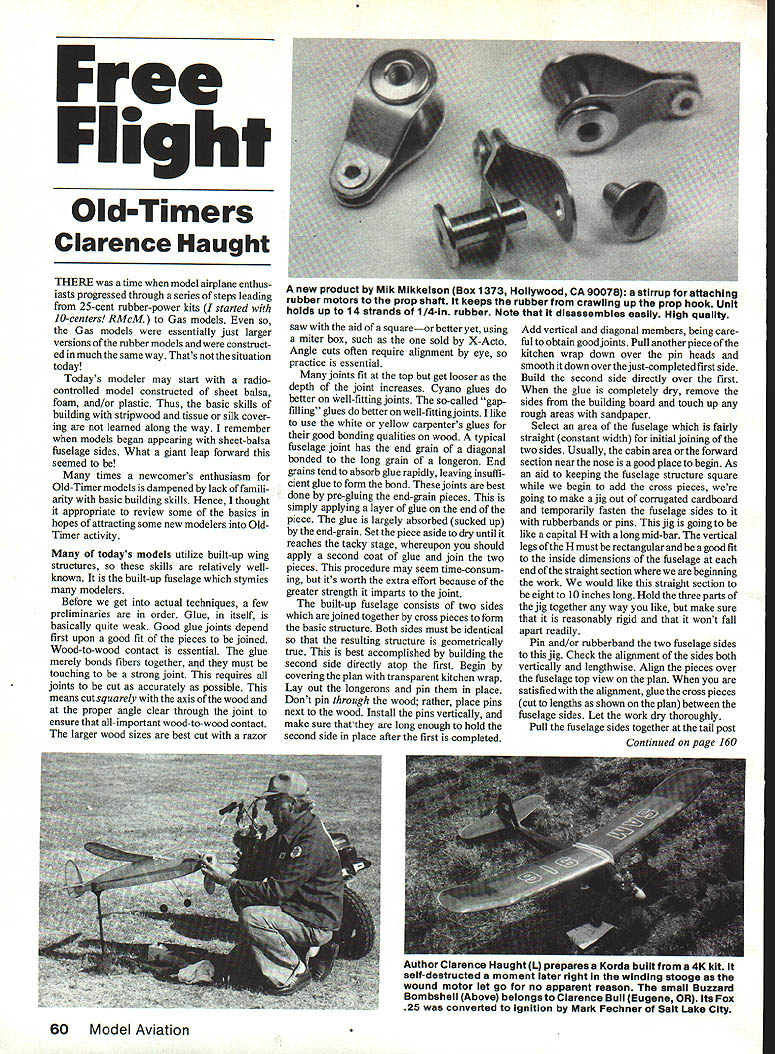
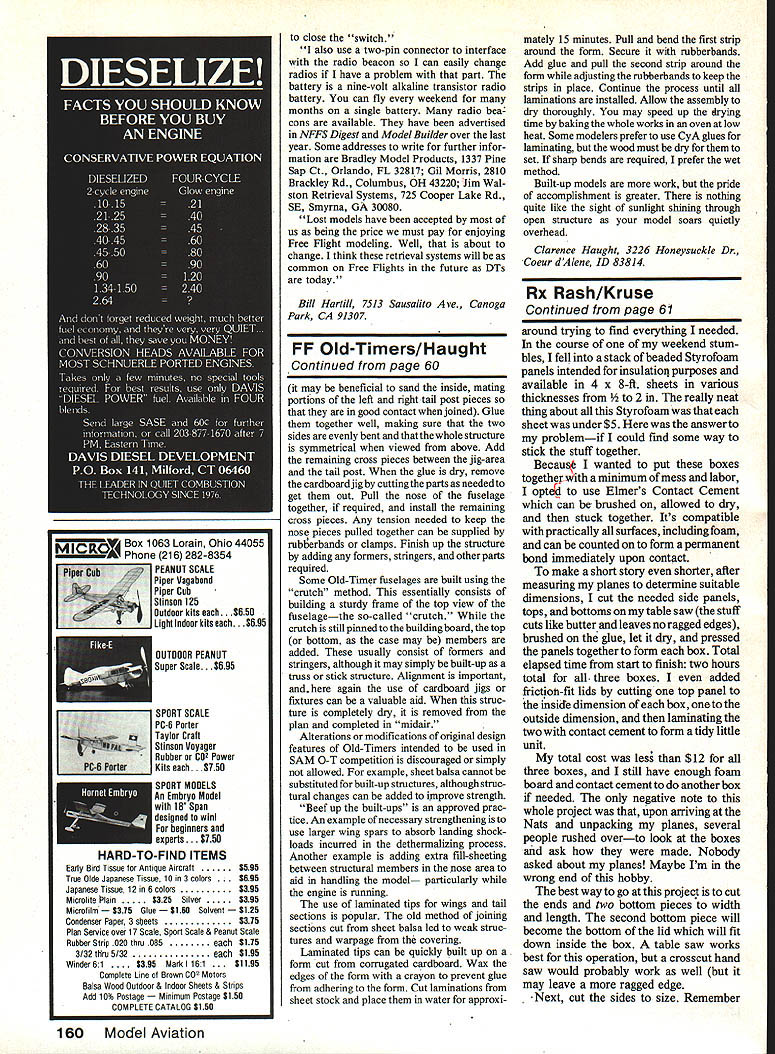
Free Flight: Old-Timers
Clarence Haught
Introduction
There was a time when model airplane enthusiasts progressed through a series of steps leading from 25-cent rubber-power kits (it started with 10-cent kits: RMcM) to gas models. Even so, the gas models were essentially just larger versions of the rubber models and were constructed in much the same way. That's not the situation today.
Today's modeler may start with a radio-controlled model constructed of sheet balsa, foam, and/or plastic. Thus, the basic skills of building with stripwood and tissue or silk covering are not learned along the way. I remember when models began appearing with sheet-balsa fuselage sides. What a giant leap forward that seemed to be!
Many times a newcomer's enthusiasm for Old-Timer models is dampened by lack of familiarity with basic building skills. Hence, I thought it appropriate to review some of the basics in hopes of attracting some new modelers into Old-Timer activity.
Many of today's models utilize built-up wing structures, so those skills are relatively well known. It is the built-up fuselage which stymies many modelers.
Glue and Joints
Before we get into actual techniques, a few preliminaries are in order. Glue, in itself, is basically quite weak. Good glue joints depend first upon a good fit of the pieces joined. Wood-to-wood contact is essential. The glue merely bonds the fibers together; without touching, a strong joint requires the joints to be cut as accurately as possible. This means cut squarely with the axis of the wood and at the proper angle clear through the joint to ensure that all-important wood-to-wood contact.
The larger wood sizes are best cut with a razor saw with the aid of a square—or better yet, using a miter box, such as the one sold by X-Acto. Angle cuts often require alignment by eye, so practice is essential.
Many joints fit at the top but get looser as the depth of the joint increases. Cyano glues do better on well-fitting joints. The so-called "gap-filling" glues do better on joints that have some gap. I like to use white or yellow carpenter's glues for good bonding qualities on wood.
A typical fuselage joint has the end grain of a diagonal bonded to the long grain of a longeron. End grains tend to absorb glue rapidly, leaving insufficient glue to form the bond. These joints are best done by pre-gluing the end-grain pieces. This is simply applying a layer of glue on the end of the piece. The glue is largely absorbed (sucked up) by the end grain. Set the piece aside to dry until it reaches the tacky stage, whereupon you should apply a second coat of glue and join the two pieces. This procedure may seem time-consuming, but it's worth the extra effort because of the greater strength it imparts to the joint.
Building the Fuselage
The built-up fuselage consists of two sides which are joined together by cross pieces to form the basic structure. Both sides must be identical so that the resulting structure is geometrically true. This is best accomplished by building the second side directly atop the first.
- Begin by covering the plan with transparent kitchen wrap.
- Lay out the longerons and pin in place. Don't pin through the wood; rather, place pins next to the wood.
- Install the pins vertically, and make sure that they are long enough to hold the second side in place after the first is completed.
- Pull another piece of kitchen wrap down over the pin heads and smooth down over the just-completed first side. Build the second side directly over the first.
- When the glue is completely dry, remove the sides from the building board and touch up any rough areas with sandpaper.
Select an area of the fuselage that is fairly straight (constant width) for initial joining of the two sides. Usually the cabin area or the forward section near the nose is a good place to begin.
As an aid to keeping the fuselage structure square while you begin to add the cross pieces, make a jig out of corrugated cardboard and temporarily fasten the fuselage sides to it with rubber bands and pins. This jig is going to be like a capital H with a long mid-bar. The vertical legs of the H must be rectangular and be a good fit to the inside dimensions of the fuselage at each end of the straight section where you are beginning your work. We would like this straight section to be eight to ten inches long. Hold the three parts of the jig together any way you like, but make sure that it is reasonably rigid and that it won't fall apart readily.
Pin and/or rubber-band the two fuselage sides to this jig. Check the alignment of the sides both vertically and lengthwise. Align the pieces over the fuselage top view on the plan. When you are satisfied with the alignment, glue the cross pieces (cut to lengths as shown on the plan) between the two fuselage sides. Let the work dry thoroughly.
Pull the fuselage sides together at the tail post. It may be beneficial to sand the inside, mating portions of the left and right tail-post pieces so that they are in good contact when joined. Glue them together well, making sure that the two sides are evenly bent and that the whole structure is symmetrical when viewed from above. Add the remaining cross pieces between the jig-area and the tail post. When the glue is dry, remove the cardboard jig by cutting the parts as needed to get it out. Pull the nose of the fuselage together, if required, and install the remaining cross pieces. Any tension needed to keep the nose pieces pulled together can be supplied by rubber bands or clamps. Finish up the structure by adding any formers, stringers, and other parts required.
The "Crutch" Method
Some Old-Timer fuselages are built using the "crutch" method. This essentially consists of building a sturdy frame of the top view of the fuselage—the so-called "crutch." While the crutch is still pinned to the building board, the top (or bottom, as the case may be) members are added. These usually consist of formers and stringers, although they may simply be built-up as a truss or stick structure. Alignment is important, and small temporary jigs or fixtures can be a valuable aid. When this structure is completely dry, it is removed from the plan and completed "midair."
Modifications and Strengthening
Alterations or modifications of original design features of Old-Timers intended to be used in SAM O/T competition are discouraged or simply not allowed. For example, sheet balsa is often substituted for built-up structures, although structural changes can be made to improve strength. "Beefing up" the built-ups is an approved practice.
- An example of necessary strengthening is to use larger wing spars to absorb landing shocks encountered during the dethermalizing process.
- Another example is adding extra fill-sheets between structural members in the nose area—particularly while the engine is being run.
Laminated Tips
The use of laminated tips for wings and tail sections is popular. The old method of joining sections aft of the main spar is to make stubs or slides rather than glue a long tapered sheet across the spar. Laminated tips can be built up on the wing by gluing narrow strips of stock and placing them in water for approximately 15 minutes.
Laminating steps:
- Pull and bend the first strip around the form. Secure it with rubber bands.
- Add glue and pull the second strip around the form while adjusting the rubber bands to keep the strips in place.
- Continue the process until all laminations are installed.
- Allow the assembly to dry thoroughly.
You may speed up the drying time by baking the whole unit in an oven at low heat. Some modelers prefer to use cyanoacrylate glues for laminating, but the wood must be dry for them to set. If sharp bends are required, I prefer the wet method.
Conclusion
Built-up models are more work, but the pride of accomplishment is greater. There is nothing quite like the sight of sunlight shining through open structure after your model soars quietly overhead.
Clarence Haught 3226 Honeysuckle Dr., Coeur d'Alene, ID 83814.
Transcribed from original scans by AI. Minor OCR errors may remain.

